- 296 pages
- English
- ePUB (mobile friendly)
- Available on iOS & Android
eBook - ePub
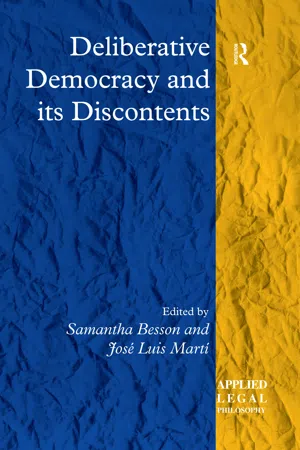
Deliberative Democracy and its Discontents
About this book
Drawing on political, legal, national, post-national, as well as American and European perspectives, this collection of essays offers a diverse and balanced discussion of the current arguments concerning deliberative democracy. Its contributions' focus on discontent, provide a critical assessment of the benefits of deliberation and also respond to the strongest criticisms of the idea of democratic deliberation. The essays consider the three basic questions of why, how and where to deliberate democratically. This book will be of value not only to political and democratic theorists, but also to legal philosophers and constitutional theorists, and all those interested in the legitimacy of decision-making in national and post-national pluralistic polities.
Trusted by 375,005 students
Access to over 1.5 million titles for a fair monthly price.
Study more efficiently using our study tools.
Information
PART I
Why Deliberate
Chapter 1
Is the Ideal of a Deliberative Democracy Coherent?
Introduction
In what follows, I would like to contribute to a defense of deliberative democracy by giving an affirmative answer to the question in the title. The goal is admittedly humble. For the coherence of an ideal says nothing about its desirability, feasibility or overall appropriateness.1 And, indeed, I will not address these further issues here. But, though humble, the goal of assessing the coherence of an ideal seems to take precedence over any of the other issues. For addressing such issues with regard to an incoherent ideal would be pretty pointless. Of course, all of this assumes that the coherence of the ideal is not self-evident. It is not hard to show why this is so. According to the ideal of a deliberative democracy, political decisions should be made on the basis of a process of public deliberation among citizens. Thus, political decision-making procedures should be both democratic and deliberative. But given that not all procedures that are deliberative are also democratic and vice versa, the possibility of a clash between the deliberative and the democratic components of the ideal cannot be ruled out a priori. That is, depending on how each component is interpreted and justified, it could turn out that the best decision-making procedures from a purely deliberative point of view are not particularly democratic or that the best decision-making procedures from a democratic point of view are not particularly deliberative. If that were the case, increasing the deliberative quality of political decisions would require sacrificing their democratic quality and vice versa.2 This indicates that, under some interpretations, the deliberative ideal will be clearly incoherent. Moreover, its coherence seems very much to depend on a happy coincidence, namely, that the reasons why political decisions must be deliberative and the reasons why they must be democratic turn out to be mutually compatible. But taking into account that plausible answers to each of these questions can pull in opposite directions, it seems clear that not just any defense of the deliberative ideal will do. Only a defense for the right reasons can actually lend support to the claim that public democratic deliberation can simultaneously meet our deliberative and our democratic demands. In what follows, I will argue that such a defense is possible precisely by trying to provide a mutually consistent answer to the aforementioned questions, namely, why democracy must be deliberative and why deliberation must be democratic.
As already hinted at, these questions point to an internal tension in the very ideal of a deliberative democracy. Given that “deliberative” and “democratic” do not seem in any obvious way to be coextensive, let alone identical properties, there is no a priori guarantee that a commitment to one would always be compatible with a commitment to the other. Thus, it cannot be ruled out that, if worse comes to worse, one may have to choose which commitment trumps the other. However, the mere prospect of facing such a choice weakens considerably any attraction that the ideal may have. For, paradoxical as it may sound, it seems that by developing a full conception of deliberative democracy one may end up either not being a strongly committed democrat or a strong defender of deliberation in politics. Seen in this light, the conceptual challenge for any attempt to develop the ideal of deliberative democracy into a fleshed out conception is to answer the aforementioned questions in a way that is internally consistent and does not lead to a weakening either of the commitment to democracy or to deliberation. In other words, taking at face value the dual commitment entailed in the ideal of deliberative democracy, the task would be to explain the source of each of those commitments and to show how democratic deliberation in particular can contribute to the satisfaction of both of them at once.3
Perhaps a hint for how to approach the first task can be taken from the general ideal of democracy as a government “for the people and by the people,” as this ideal seems to express a dual commitment as well. Although the specifically “democratic” element lies in the second property, it seems obvious that a system of government could hardly be justified if it did not (at least) claim to satisfy the first property as well. Thus, a democratic system of government is one that is not only for the benefit of all those governed by it, but one in which the governed are at the same time those who get to decide what is and what is not in their benefit. In more familiar terms, the governed are not only subject to the law but authors of the law. According to this ideal of self-rule, the validity of legislative decisions depends not only on whether they are “for the people,” that is, just (efficient, good, etc.) from a substantive point of view, but also on whether they are decided “by the people,” that is, by a procedure that secures the voluntary consent of those who must comply with them. This already provides us with a schematic answer to our first question. At a minimum, the ideal of democracy entails a commitment to a political decision-making procedure that should secure the voluntary assent of its members (1) to substantively just outcomes (2).
However, the democratic ideal suggests a stronger connection between both commitments. It suggests that satisfying the former condition intrinsically contributes to the satisfaction of the latter.4 For the procedure of making legislative decisions dependent on the voluntary assent of those who must comply with them requires taking the interests of all of them into consideration and thus it contributes at the same time to reaching substantively just decisions, that is, decisions equally in everyone’s interest. A government “by the people” intrinsically contributes to the achievement of a government “for the people.”
It is with the interpretation of this connection, however, that the difficulties I mentioned at the beginning originate. For the attempt to give an account of the internal relationship between these two dimensions of validity invites all kinds of reductive strategies of explanation, from strongly reductive strategies that try to define one dimension in terms of the other (e.g., to be a just outcome is to be a democratically decided outcome) to weaker strategies that consider either one dimension of instrumental value for the other (e.g., the value of democratic procedures reside in their instrumental value for reaching substantively just outcomes) or both of value for yet a third dimension (e.g., justice requires substantively correct outcomes and democratic procedures, but for mutually independent reasons).5 Of course, the reductive character of these strategies by no means prevents them from being plausible or even correct. The problem concerns specifically the model of deliberative democracy. For, as already hinted at, a defense of the deliberative model on the basis of a reductive strategy threatens to end up being either a strong defense of deliberation at the expense of democracy or a strong defense of democracy at the expense of deliberation. However plausible any of these strategies may be, it is just hard to see how they could count as defenses of the model of deliberative democracy in particular, rather than of something else.
It seems thus that a defense of the model of deliberative democracy can be successful only if it can give a consistent justification to the following claims: that democratic deliberation, by its very nature, contributes to securing the best possible outcomes from a substantive point of view, as well as the reasoned acceptance of those who must comply with them and that, to that extent, it can explain the internal relationship in the satisfaction of both conditions as suggested by the democratic ideal. Moreover, to the extent that it is possible to show the intrinsic contribution that democratic deliberation can make to satisfy each of these requirements (or, more cautiously, to the extent that there is nothing about democratic deliberation that would make it impossible to satisfy both of them at the same time), the deliberative model can be considered a plausible ideal and thus serve as a practical guide for designing democratic institutions.
Now, to claim that the deliberative model requires a non-reductive strategy of political justification implies recognizing the logical independence of the aforementioned constraints or requirements. In other words, it implies recognizing that, according to the deliberative model, securing the voluntary consent to political decisions by all those who must comply with them is of intrinsic value, regardless of the likelihood that, by so doing, the outcomes of these decisions may be better or worse from a substantive point of view; and vice versa, securing substantively just decisions is of intrinsic value regardless of the likelihood that, by so doing, the voluntary consent of citizens may be easier or harder to secure.6 Different conceptions of deliberative democracy offer different explanations for the nature and justification of each of these constraints and I will not try to defend any particular version of these justifications here.7 Assuming that at least some of them are plausible,8 what matters in our context is whether their logical independence can be defended as well. If both conditions of political justification impose independent constraints for the design of democratic institutions, a clash between them may seem unavoidable, unless a specific way of making them compatible can be shown.
Within the deliberative model this is done by introducing a further condition that can plausibly be said to satisfy both constraints at once, namely, a condition of mutual justifiability.9 On the one hand, such a condition is internally connected to the epistemic goal of reaching substantively correct outcomes (i.e., just, efficient, good, etc.).10 For it seems plausible to claim that a deliberative procedure suitably designed to track “the force of the better argument,” to use Habermas’s term, contributes to increasing the epistemic quality of the decisions. On the other hand, a condition of mutual justifiability is internally connected to the democratic goal of reaching legitimate decisions by securing the free and reasoned assent of those who must comply with them. For it seems equally plausible that a deliberative procedure designed to track the force of the better argument can contribute to distinguishing those decisions that can meet with the participants’ free and reasoned assent and those that do not. Moreover, precisely in virtue of its two-dimensional origin, a condition of mutual justifiability indicates the appropriate limits of both our epistemic and our democratic goals. With regard to the epistemic virtues of a political decision procedure, the constraint of mutual justifiability implies that it is not enough that its outcomes be in fact correct, they must be manifestly so to their members (Cohen, 1997, p. 73). Consequently, our goal is to select the decision procedure able to secure not just the epistemically best outcomes, but the best outcomes among those that can attain the free and reasoned assent of their members. With regard to the democratic virtues of a political decision procedure, the constraint of mutual justifiability implies that it is not enough that political decisions be in fact agreed upon. In addition to this, the justifiability of the reasons that support them must be manifest to their members. Consequently, our goal is to select the decision procedure most suited to securing not just agreement, but publicly justified agreement. If this is indeed an appropriate understanding of both our epistemic and our democratic goals, the core claim of the deliberative model, namely, that public deliberation can contribute to reaching both of them, seems very plausible. Thus we need to analyze the details of the deliberative interpretation of each of these goals. For this task we can take as a guide our initial questions, namely, why democracy must be deliberative and why deliberation must be democratic, respectively.
1 Epistemic Virtues of the Deliberative Model
To some, the question of why democracy must be deliberative may sound like another way...
Table of contents
- Cover Page
- Title Page
- Copyright Page
- Table of Contents
- Contributors
- Acknowledgements
- Book Preface
- Introduction
- PART I Why Deliberate
- PART II How to Deliberate
- PART III Where to Deliberate
- Index
Frequently asked questions
Yes, you can cancel anytime from the Subscription tab in your account settings on the Perlego website. Your subscription will stay active until the end of your current billing period. Learn how to cancel your subscription
No, books cannot be downloaded as external files, such as PDFs, for use outside of Perlego. However, you can download books within the Perlego app for offline reading on mobile or tablet. Learn how to download books offline
Perlego offers two plans: Essential and Complete
- Essential is ideal for learners and professionals who enjoy exploring a wide range of subjects. Access the Essential Library with 800,000+ trusted titles and best-sellers across business, personal growth, and the humanities. Includes unlimited reading time and Standard Read Aloud voice.
- Complete: Perfect for advanced learners and researchers needing full, unrestricted access. Unlock 1.5M+ books across hundreds of subjects, including academic and specialized titles. The Complete Plan also includes advanced features like Premium Read Aloud and Research Assistant.
We are an online textbook subscription service, where you can get access to an entire online library for less than the price of a single book per month. With over 1.5 million books across 990+ topics, we’ve got you covered! Learn about our mission
Look out for the read-aloud symbol on your next book to see if you can listen to it. The read-aloud tool reads text aloud for you, highlighting the text as it is being read. You can pause it, speed it up and slow it down. Learn more about Read Aloud
Yes! You can use the Perlego app on both iOS and Android devices to read anytime, anywhere — even offline. Perfect for commutes or when you’re on the go.
Please note we cannot support devices running on iOS 13 and Android 7 or earlier. Learn more about using the app
Please note we cannot support devices running on iOS 13 and Android 7 or earlier. Learn more about using the app
Yes, you can access Deliberative Democracy and its Discontents by Jose Luis Marti,Samantha Besson in PDF and/or ePUB format, as well as other popular books in Politics & International Relations & Law Theory & Practice. We have over 1.5 million books available in our catalogue for you to explore.