eBook - ePub
Contraception, Colonialism and Commerce
Birth Control in South India, 1920–1940
- 182 pages
- English
- ePUB (mobile friendly)
- Available on iOS & Android
eBook - ePub
About this book
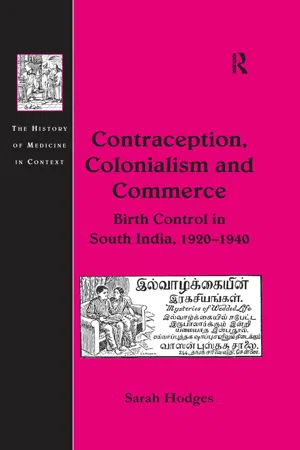
Birth control holds an unusual place in the history of medicine. Largely devoid of doctors or hospitals, only relatively recently have birth control histories included tales of laboratory-based therapeutic innovation. Instead, these histories elucidate the peculiar slippages between individual bodies and a body politic occasioned by the promotion of techniques to manipulate human reproduction. The history of birth control in India brings these as well as additional complications to the field. Contrary to popular belief, India has one of the most long-lasting, institutionalized, far-reaching, state sponsored family planning programs in the world. During the inter-war period the country witnessed the formation of groups dedicated to promoting the cause of birth control. This book outlines the early history of birth control in India, particularly the Tamil south. In so doing, it illuminates India's role in a global network of birth control advocacy. The book also argues how Indians' contraceptive advocacy and associationalism became an increasingly significant realm of action in which they staked claims not just about the utility of contraception but simultaneously over their ability and right to self-rule.
Trusted by 375,005 students
Access to over 1.5 million titles for a fair monthly price.
Study more efficiently using our study tools.
Information
Chapter 1
Anxiety without Action: Contraception and the Late Colonial State
Contraception occupied an awkward place in the governance of health in late colonial India. Maternal and child welfare took on an increased urgency during the period and the political language of the day routinely connected individual health to national progress. Although the late colonial state did not promote contraception as part of its maternal and infant welfare policy, colonial officials regularly voiced anxieties over health—particularly the alarming levels of maternal and infant mortality. There were also occasional dark murmurings about population growth and impending Malthusian catastrophe. Yet despite these regular invocations, there was a distinct lack of official action in terms of building a substantial health infrastructure that could begin to address these anxieties.1
This chapter argues that the characteristics of official engagement with contraception in late colonial Madras Presidency—that is, regular eruptions of anxiety without corresponding ameliorative action—need to be understood with reference both to the peculiar dispositions of the late colonial state as well as those of the elected Indian representatives who presided over the province’s public health. The series of hesitations and deferrals that constituted the relative inactivity of the colonial state in relation to contraception was commensurate with the pallid legacy of colonial investment in a public health infrastructure in India. Yet crucially, this official inactivity was also due to the political priorities and preoccupations of Indian governance over local concerns during the interwar period—in particular the agenda of the non-Brahmin Justice Party whose members occupied pride of place in the Madras Legislative Council during the 1920s and 1930s.
Madras Presidency’s non-Brahmin political leadership (in the form of the Justice Party) distinguished itself from other political formations in late colonial India. Unlike mainline nationalists in India’s Congress Party who largely boycotted the interwar legislative exercises, the Justice Party seized upon “dyarchy”—the moment after the first world war when Indians were given a formal, but limited, electoral role in the late colonial governance of maternal and child welfare. Further, in stark contrast with other caste-based political and social movements elsewhere across India during the period, the Justice Party sought neither to rule over a subject population in order to make model citizens, nor to use their position of power in order to produce a population fit to govern. The Justice Party dyarchy ministries did not administer official health policy primarily as part of a project of reforming poor Indians’ social and hygienic practices. They had their eyes on a different prize.
Instead of governing “down,” the first dyarchy ministries in the Madras Presidency sought to govern “up”: they attempted to re-engineer the entire political and social landscape of the region by displacing Brahminism—the historic structure of bureaucratic, religious and social power in the region. As a result, as we shall see in the next chapter, alarmist health rhetoric in the interwar period found fulsome voice not in the non-Brahmin political leadership of the province, but in an alliance between south Indian Brahminical social reformers and international feminist philanthropists. During this period, contraception was not administered through a system of state-financed clinics and trained health personnel, but fell instead to the commercial sector: private shopkeepers and erotic entrepreneurs.
In order to understand these bundles of anxiety without corresponding ameliorative action that produced the terrain on which contraception was debated as part of official statecraft in the late colonial Tamil south, this chapter has two main aims. The first is to situate the history of contraception within a larger tableau of public health measures provided by the colonial state. The second aim is to understand the particular politics of health that informed the Justice Party’s broader non-Brahmin agenda. Because contraception was never included as part of official colonial health policy in Madras, an investigation into its fraught and episodic career allows us to understand how the administration of public health bounded only some areas of life as governable. The official career of contraception was part of a mode of colonial health policy-making that deemed the health of the public as unduly unruly; as an ungovernable entity. As a result, the colonial government was, in the main, only moved to act on health policy as a part of a tactics of crisis management. Yet it was not only through a high colonial neglect of quotidian public health matters that contraception remained beyond the pale of governability. When Indians had the opportunity to include contraception as part of their policy-making, they chose not to. For the Justice Party, fertility was neither governable nor was contraception an attractive tool of governance. This is because contraception was seen to lie outside their first-order remit of making the political terrain hospitable for non-Brahminical governance.
Health, and debates over contraception and maternal and infant welfare in particular, brought into stark relief the possibilities and limitations for crafting policy within the Justice Party’s impulse to govern “up” rather than “down.” Unlike the largely eugenics-inspired birth control policies that swept across the globe during the interwar period, the official governance of Madras Presidency steered away from cultivating a popular politics of health citizenship. Although health articulated the constitutive parts of late colonial governmentality, contraception remained firmly in the world of individual self-governance rather than becoming part of a project of governing the social.
Episodes of attempted contraception in Madras’s legislative chambers
It was not that contraception was completely absent from the debates in the local government of Madras. On the contrary, throughout the 1930s, and particularly after the publication of the 1931 all-India census in 1933, elected Indians raised the possibility of using the neo-Malthusian strategy of contraception to combat India’s grinding poverty. For example, as part of the Madras Legislative Council’s budget debate in 1930, one councilor, moved that the Public Health Department fund birth control clinics as part of their overall preventative health work.2 In response to this request (seconded by another councilor) the Minister for Public Health countered that contraception was a controversial topic and that self-restraint was the best method of controlling births.3 In the same year, the Madras city Corporation refused the request of the Superintendent of the Child Welfare Scheme for permission to give birth control information upon request.4
In 1932, the councilor again raised the issue of the state provision of contraception as part of the debate of the 1932–1933 public health budget. In so doing he emphasized the importance of the provision of public health in underpinning the overall strength of the province. He called for birth control to be incorporated into the more established Public Health Department remit of ensuring a better water supply, more hygienic milk supply, a more efficient system of drainage and better housing, the prevention of the adulteration of foodstuffs and the control of population. He continued that vital statistic registration should be improved and that the current high maternal and infant mortality rates needed to be brought down and that in connection with this more maternity and child welfare centers needed to be established. He called on the Public Health Department to carry out propaganda for birth control and cited the example of the government birth control clinics recently established in the neighboring Mysore state.5
Other Members of the Legislative Council took a more cautious approach. Whilst they echoed the call for an expansion of the number and scale of maternal, infant and child welfare provision—indeed one called the high rate of infant mortality a “disgrace to the Province”—another argued that the relationship between infant mortality and birth control was a complicated one. While the latter was confident that there was a relationship between the high levels of infant mortality and the overall levels of poverty, he declared that he was personally against birth control. Instead, he, along with the sentiments of a number of fellow councilors, wanted to focus the debate away from establishing a birth control infrastructure as part of the activities of the Public Health Department, and instead onto what could be done to bring down the high levels of infant mortality in the province. Drawing a line under the debate, the province’s Chief Minister replied that public opinion was “not adequately in favour” of birth control and therefore it was “not yet time for government to take up the initiative.”6
In December 1933, in response to the Surgeon General’s recommendation earlier that year that government medical officers should be permitted to offer advice and instruction in birth control in government clinics and hospitals,7 the Madras Legislative Council again witnessed a debate on birth control, this time at the suggestion of this colonial official.8 The modest proposal would have allowed for the possibility of making birth control advice available at Victoria Memorial Caste and Gosha Hospital and the Women and Children’s Hospital in Madras city as well as at the main district headquarter hospitals in Madurai, Coimbatore, Calicut, Tanjore, Guntur and Vizag. The proposal would also have provided for the inclusion of instruction in birth control methods as part of the education of medical students, nurse pupils and health visitors.
The Minister for Local Self Government, the Raja of Bobbili, fielded questions about resolutions against the introduction of birth control clinics which had been received from Catholic organizations across the Presidency. Although one letter of support had been received from the Self Respect Association of Tanjore, a number of letters of protest had been sent to Government throughout 1933, not only from the Presidency’s Catholic associations, but also from Hindu organizations such as the Dharma Samrakshana Sangam of Rajamundry and the residents of Pallavaram who, under the direction of S. Thiruvenkatachariar (sub-editor of the journal Health) held a public meeting to condemn the possibility that government might open birth control clinics.9 The measure was ultimately unsuccessful.
Other birth control initiatives were debated across India in the period. In 1929 the Bombay city Corporation had debated and rejected the proposal to give birth control advice at municipal hospitals and dispensaries.10 In 1932 the United Provinces Legislative Council debated and rejected a proposal similar to what had come before the Madras Legislative Council.11 In Karachi in 1933 the municipality had attempted to establish a birth control clinic, but the city’s Catholics mobilized against it and in response the municipality dropped the proposal.12 The 1934 resolution in the Ahmedabad municipality to provide for contraceptive appliances in municipal hospitals and to supply birth control literature to libraries free of cost was rejected on the grounds that self-restraint offered a more acceptable mode of family limitation, alongside claims about the potential dangers that these “still experimental” methods presented to their potential users.13 Also in 1934 the Governor of French India promulgated a ministerial order from the French Republic prohibiting the practice of birth control and varied methods of preventing conception. The transport of literature on the subject into French territory in India was made illegal. The ban for offences against this order ranged from a F100 to F5,000 fine and from one to six months’ imprisonment.14 In 1935 the Delhi municipal government rejected a proposal to start a birth control clinic for instruction in and supply of contraceptives.15 In July 1937 the Trivandrum municipality (in the princely state of Travancore) passed a resolution requesting the Government to build birth control clinics but the resolution was turned down.16 The Dewan of Travancore, C.P. Ramaswami I...
Table of contents
- Cover Page
- Title Page
- Copyright Page
- Contents
- Acknowledgements
- Note on Transliteration of Tamil Words
- 1 Anxiety without Action: Contraception and the Late Colonial State
- 2 The Madras Neo-Malthusian League and Global Networks of Contraceptive Evangelism
- 3 An Apocalyptic Body Politics of Modernity: Contraception and the Self Respect Movement
- 4 Contraceptive Commercialism
- Epilogue: The State of the Population: History and Fertility in Twentieth-Century Tamil Nadu
- Bibliography
- Index
Frequently asked questions
Yes, you can cancel anytime from the Subscription tab in your account settings on the Perlego website. Your subscription will stay active until the end of your current billing period. Learn how to cancel your subscription
No, books cannot be downloaded as external files, such as PDFs, for use outside of Perlego. However, you can download books within the Perlego app for offline reading on mobile or tablet. Learn how to download books offline
Perlego offers two plans: Essential and Complete
- Essential is ideal for learners and professionals who enjoy exploring a wide range of subjects. Access the Essential Library with 800,000+ trusted titles and best-sellers across business, personal growth, and the humanities. Includes unlimited reading time and Standard Read Aloud voice.
- Complete: Perfect for advanced learners and researchers needing full, unrestricted access. Unlock 1.5M+ books across hundreds of subjects, including academic and specialized titles. The Complete Plan also includes advanced features like Premium Read Aloud and Research Assistant.
We are an online textbook subscription service, where you can get access to an entire online library for less than the price of a single book per month. With over 1.5 million books across 990+ topics, we’ve got you covered! Learn about our mission
Look out for the read-aloud symbol on your next book to see if you can listen to it. The read-aloud tool reads text aloud for you, highlighting the text as it is being read. You can pause it, speed it up and slow it down. Learn more about Read Aloud
Yes! You can use the Perlego app on both iOS and Android devices to read anytime, anywhere — even offline. Perfect for commutes or when you’re on the go.
Please note we cannot support devices running on iOS 13 and Android 7 or earlier. Learn more about using the app
Please note we cannot support devices running on iOS 13 and Android 7 or earlier. Learn more about using the app
Yes, you can access Contraception, Colonialism and Commerce by Sarah Hodges in PDF and/or ePUB format, as well as other popular books in History & World History. We have over 1.5 million books available in our catalogue for you to explore.