eBook - ePub
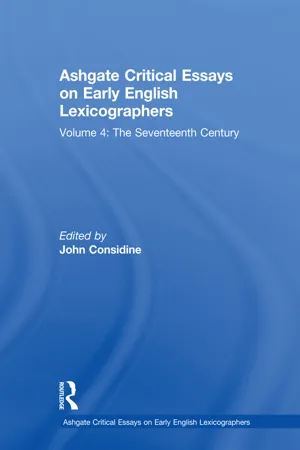
Ashgate Critical Essays on Early English Lexicographers
Volume 4: The Seventeenth Century
- 578 pages
- English
- ePUB (mobile friendly)
- Available on iOS & Android
eBook - ePub
Ashgate Critical Essays on Early English Lexicographers
Volume 4: The Seventeenth Century
About this book
Three major developments in English lexicography took place during the seventeenth century: the emergence of the first free standing monolingual English dictionaries; the making of new kinds of English lexicons that investigated dialect or etymology or that keyed English to invented 'philosophical' languages; and the massive expansion of bilingual lexicography, which not only placed English alongside the European vernaculars but also handled the languages of the new world. The essays in this volume discuss not only the internal history of lexicography but also its wider relationships with culture and society.
Trusted by 375,005 students
Access to over 1.5 million titles for a fair monthly price.
Study more efficiently using our study tools.
Information
Part I
Background
1
Lexicography in the Early Modern English Period: The Manuscript Record
James A. H. Murray, the General Editor of the Oxford English Dictionary, a century ago said that “no one appears before the end of the sixteenth century to have felt that Englishmen could want a dictionary to help them to the knowledge and correct use of their own language” (26). He added that, by 1700, the “notion that an English Dictionary ought to contain all English words had apparently as yet occurred to no one; at least no one had proposed to carry the idea into practice” (34). Yet the early Tudor period produced the first monolingual English lexicon as well as two great dictionaries, both regarded as reference books for English. The printer and dramatist John Rastell brought out Exposiciones terminorum legum anglorum …. The exposicions of ye termys of ye law of england in 1523 (ETLA), a pioneering encyclopedic lexicon of about 170 entries in parallel columns, French and English. John Palsgrave, tutor to Henry VIII’s sister Mary and his son the duke of Richmond, published a much larger English-French lexicon in 1530. It had English headwords and served to document English words as much as French. By 1550, rhetorician Richard Sherry said that the English did indeed have a fine dictionary of their own tongue: he commended Sir Thomas Elyot’s Latin-English Dictionary of 1538, completed at Henry VIII’s instance, for “searchinge oute the copye of oure language in all kynde of wordes and phrases” (TST, A3r; my italics). From the 1540s, the Crown had also legally required grammar schools to teach the Latinate Introduction to Grammar by William Lily and John Colet. Dictionaries and correct Early Modern English (EME) usage were respectable intellectual goals in the early Tudor period, partly enforced by statute. Henry VIII gave his patronage to men who documented contemporary English as a language second to none.
We know the printed lexicons of the period fairly well, but so little is said about the manuscript record that we might be pardoned for doubting one exists. In December 1962 R. C. Alston prepared a typed handlist of 173 manuscripts “relevant to the history of the English language 1480–1800.” It can be consulted in the British Library Manuscripts Room. Yet Alston’s multi-volume bibliography of language works of every conceivable type from the advent of printing to 1800 does not cover manuscripts. Were they unimportant for some reason? Jürgen Schäfer (EMEL) also surveyed only early printed glossaries in 1989.
My work-in-progress, The Lexicons of Early Modern English (LEME), is a searchable Web-based corpus whose goal is 600,000 word entries from several hundred lexical texts between 1475 and 1700. It may encourage academics to undertake a period dictionary and will give researchers convenient access to what individuals living in the Early Modern English period thought of their language. Like the Early Modern English Dictionaries Database (EMEDD) on which it is based, LEME includes bilingual dictionaries, English glossaries, professional vocabularies, prose treatises and grammars, and excerpted encyclopedic works. One hundred sources are now in preparation out of over 800 known primary sources. EMEDD, a publicly-accessible Web site, holding about 200,000 word-entries, has sixteen works: six monolingual English hard-word lexicons by Edmund Coote (1596), Robert Cawdrey (1604 and 1617), John Bullokar (1616), Henry Cockeram (1623), and Thomas Blount (1656); six bilingual dictionaries serving French, Latin, Italian, and Spanish by John Palsgrave (1530), William Thomas (1550), Thomas Thomas (1587), John Florio (1598), John Minsheu (1599), and Randle Cotgrave (1611), respectively; Richard Mulcaster’s English word-list (1582); and three glossaries of hard words in medicine (Bartholomew Traheron, 1543), botany (William Turner, 1548), and general science (John Garfield, 1657). Unlike EMEDD, LEME incorporates manuscript materials. Over 25% of LEME primary sources, some 210 items between 1475 and 1660, are manuscripts.
This preliminary report into manuscript lexical texts surveys research undertaken at the British, Bodleian, Cambridge, Huntington, Newberry, and Toronto libraries over the past two years. Ten types of manuscript lexicon merit close attention: bilingual dictionaries, glossaries and topical vocabularies (especially herbals, medical works, naval lexicons, and legal dictionaries), prose treatises and grammars, books annotated by contemporaries, reference works on proper and place names, and monolingual English glossaries. My coverage is far from exhaustive.
Some of the more than thirty different bilingual lexicons in manuscript serve individual languages better than contemporary printed books do: for example, Algonquin (by William Strachey), Cornish, Irish, Old English, Slavic (by Mark Ridley and Richard James), and Turkish. Even for languages served by print dictionaries, manuscript lexicons are valuable for documenting how individuals understood, rightly or wrongly, their own tongue. They help tell us when terms became popular and how their significations altered, decade by decade. By mapping English to other languages and registers, they belong to the primary sources of Early Modern English. Little is known about many of them because, unlike printed books, they lack title, publisher, and date; and ignorance is always a powerful disincentive to use.
Early in the sixteenth century, the printing press popularized early Latin-English or English-Latin bilingual dictionaries, but many manuscripts in monastic libraries had disappeared following their appropriation by the Crown in 1538. Medieval Latin-English lexicons must have been among them. Promptorium Parvulorum was last printed in 1528, and the Ortus Vocabulorum four years later. Henry VIII may have urged Sir Thomas Elyot to finish his lexicon to fill this anticipated gap. By 1539–40, when Miles Coverdale had Englished the Great Bible, a small bull market in lexicons that served English had developed. It was expected that English-born lexicographers would replace medieval authorities, either with new compilations (as with William Turner’s polyglot lexicons of herbs) or with vernacular glossaries to newly translated texts (as with Bartholomew Traheron’s hard-word glossary to Vigo in 1543). In any event, bilingual lexicons in manuscript during the Henrician period are not numerous. They might have recalled, for those in a position to publish and use them in teaching, a discredited and increasingly dangerous Roman Catholic world. Contemporaries alert to Henrician politics would have valued printed dictionaries because they had the prima facie appearance of being up-to-date and publicly approved. Later, people found more uses for manuscript lexicons. For example, Latin-English manuscript lexicons compiled in the later sixteenth and early seventeenth centuries appear intended to serve private studies rather than to supply a public demand.1
Elizabeth (1558–1603) retained her father’s nationalist language policies and at the same time stimulated a new manuscript culture for lexicons. Henry VIII had destroyed manuscripts on political grounds; Elizabeth’s ministers and servants used them to advance learning about native English. In a backlash against what Thomas Wilson the logician and rhetorician called inkhorn terms, that is, against foreign borrowings introduced in such quantity as to overwhelm English words, Elizabeth gave her patronage to an unverbalized language policy that resisted the wholesale latinization of English. In this period, many foreign words were Englished, but compounding of native words also was practised (witness the emergence of English-only lexical preferences by such as Ralph Lever the logician and George Puttenham the rhetorician). The third mechanism for vocabulary enhancement, revival of archaic terms, however, turned the English to studying their heritage. Those who researched the languages of the British isles preserved early manuscripts and formed an academic subculture that circulated in manuscript its findings on Old English, Middle English, and Welsh.
Old English scholarship, in particular, left behind a trove of manuscript materials (Giese 1991–94; Hetherington 1982). The monarchy’s trusted partners in negotiating the Elizabethan compromise in religious dogma, Sir William Cecil (the queen’s chief minister) and Matthew Parker (Archbishop of Canterbury) stimulated interest in word-revivals by lending their patronage to two men who founded Old English scholarship in the 1560s and 1570s. Laurence Nowell devised his bilingual Old English lexicon in a manuscript dating 1567 or earlier, Bodleian Ms Seiden supra 63, while living at Cecil’s own house (Marckwardt 1952). At his death, Nowell’s lexicon may have been passed by William Lambarde, Nowell’s friend, to John Joscelyn, who worked with Parker’s own son to produce the “Dictionarium Saxonico-Latinum,” now British Library Cotton Titus Mss A.15–16.2 Nowell and Joscelyn inspired later Old English scholars to create manuscript glossaries for their personal use. The Bodleian Library holds many of these. Their authors include Richard James (who left Bodleian Ms James 41, ca. 1620, Ms James 42, ca. 1600, and Ms Seiden supra 62), Sir Symonds D’Ewes (BL Harley Ms 6841), and Francis Junius, who transcribed Nowell in Bodleian Ms Junius 26 (ca. 1650), preparing for his “Etymologicon Linguae Anglicanae” (Mss Junius 4–5), published only in the eighteenth century.3 The first to reach print, almost a century after the first of these manuscripts was written, was William Somner, whose Dictionarium Saxonico-Latino-Anglicum was published in 1659.4 If we trust the print record only, we will be out by decades in recognizing how Old English was understood in England.
There was also curiosity about Middle English and Scots, sparked by print editions of Chaucer’s poetry. This interest emerges first in print with E. K.’s glossary to Spenser’s Shepherd’s Calendar (1579), Paul Greaves’ Chaucerian vocabulary (1594), and Speght’s glossary to an edition of Chaucer’s works (1602). Antiquarians then advance research in forms that did not reach print. Joseph Holland, in Cambridge University Library Ms Gg.4.27, edited Speght’s glossary and added much to it. Later, about 1650, Francis Junius left behind a glossary of Old Scots and Greek in Bodleian Ms Junius 74, a glossary of words in Gavin Douglas’ transcription of the Aeneid, in Ms Junius 114, and a lexicon of Chaucer’s vocabulary in Ms Junius 5. William Dugdale produced a glossary of Old Scots words from John Bellenden and Gavin Douglas in Bodleian Ashmole Ms 846.
The English were curiou...
Table of contents
- Cover
- Half Title
- Title Page
- Copyright Page
- Table of Contents
- Acknowledgements
- Series Preface
- Introduction
- Part I Background
- Part II Overview
- Part III Individual Dictionaries
- Part IV Encyclopedic Historical and Specialized Dictionaries of English
- Part V Bilingual and Polyglot Dictionaries
- Index
Frequently asked questions
Yes, you can cancel anytime from the Subscription tab in your account settings on the Perlego website. Your subscription will stay active until the end of your current billing period. Learn how to cancel your subscription
No, books cannot be downloaded as external files, such as PDFs, for use outside of Perlego. However, you can download books within the Perlego app for offline reading on mobile or tablet. Learn how to download books offline
Perlego offers two plans: Essential and Complete
- Essential is ideal for learners and professionals who enjoy exploring a wide range of subjects. Access the Essential Library with 800,000+ trusted titles and best-sellers across business, personal growth, and the humanities. Includes unlimited reading time and Standard Read Aloud voice.
- Complete: Perfect for advanced learners and researchers needing full, unrestricted access. Unlock 1.5M+ books across hundreds of subjects, including academic and specialized titles. The Complete Plan also includes advanced features like Premium Read Aloud and Research Assistant.
We are an online textbook subscription service, where you can get access to an entire online library for less than the price of a single book per month. With over 1.5 million books across 990+ topics, we’ve got you covered! Learn about our mission
Look out for the read-aloud symbol on your next book to see if you can listen to it. The read-aloud tool reads text aloud for you, highlighting the text as it is being read. You can pause it, speed it up and slow it down. Learn more about Read Aloud
Yes! You can use the Perlego app on both iOS and Android devices to read anytime, anywhere — even offline. Perfect for commutes or when you’re on the go.
Please note we cannot support devices running on iOS 13 and Android 7 or earlier. Learn more about using the app
Please note we cannot support devices running on iOS 13 and Android 7 or earlier. Learn more about using the app
Yes, you can access Ashgate Critical Essays on Early English Lexicographers by John Considine in PDF and/or ePUB format, as well as other popular books in Personal Development & Historical & Comparative Linguistics. We have over 1.5 million books available in our catalogue for you to explore.