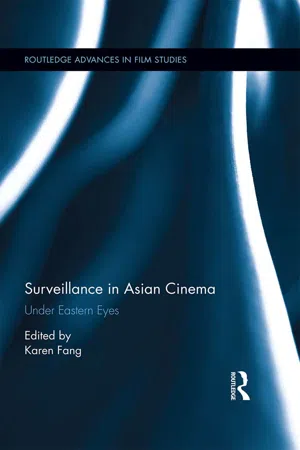
Critical theory and popular wisdom are rife with images of surveillance as an intrusive, repressive practice often suggestively attributed to eastern powers and opposed to western liberalism. Hollywood-dominated global media has long promulgated a geopoliticized east-west axis of freedom vs. control. This book focuses on Asian and Asia-based films and cinematic traditions obscured by lopsided western hegemonic discourse and—more specifically—probes these films' treatments of a phenomenon that western film often portrays with neo-orientalist hysteria. Exploring recent and historical movies made in post-social and anti-Communist societies such as China, Hong Kong, Taiwan, Vietnam and South Korea, the book picks up on the political and economic concerns implicitly underlying Sinophobic and anti-Communist Asian images in Hollywood films while also considering how these societies and states depict the issues of centralization, militarization and technological innovation so often figured as distinctive of the difference between eastern despotism and western liberalism.
- 284 pages
- English
- ePUB (mobile friendly)
- Available on iOS & Android
eBook - ePub
About this book
Information
Part I
Cold War
1 The Might of the People
Counter-Espionage Films and Participatory Surveillance in the Early PRC
The increasing penetration of surveillance technology in everyday life as well as the widespread concern for national security in the face of global terrorism in the past decade has not only boosted surveillance studies in general but also fostered critical attention on surveillance cinema. Aside from film narratives and the new realist aesthetics informed by pervasive surveillance in contemporary societies, issues pertaining to the mutual implication of cinema and surveillance are of particular interest to film and media scholars. For instance, Sébastien Léfait in his study of contemporary film and television programs suggests that cinema engages surveillance structurally through its fictional creation of surveillance microcosms. In the meantime, by being a reality-capturing device, the cinematic apparatus “translates the problem of the ambiguity of the visible into terms of mediated watching,” which is also a matter at the heart of surveillance (ix). Similarly, Catherine Zimmer states that surveillance cinema is not simply one of the recurring tropes or iconographies of surveillance, but also concerns “the multiple mediations that occur through the cinematic narration of surveillance, through which practices of surveillance become representational and representational practices become surveillant” (2).
Rather than pursuing epistemological affinities between surveillance and cinema, however, this chapter returns to those questions of cinema’s political role in the actual surveillance culture that contributes to the production of subjectivity desired in a particular socio-historical context. Specifically, it will take as its case study the Chinese counter-espionage films (fante pian), a burgeoning film genre in the newly established People’s Republic of China (PRC) during the heyday of the Cold War.
Through an examination of cinematic narratives and formal strategies in relation to the prevalent geopolitical discourses and the two political campaigns to suppress counterrevolutionaries in 1950s China, this chapter aims to shed light on how this particular genre was configured into a surveillance culture predicated upon the political mobilization of the masses. This, in turn, modeled participatory surveillance—a mode of surveillance in which the masses act as surveillance agents instead of surveillance subjects in order to safeguard national security. Although participatory surveillance promoted and practiced in the early PRC shaped the vigilant and responsible socialist subjectivity and thus became an essential dimension of socialist modernity, it has long been neglected due to the popularization of and obsession with the Orwellian totalitarian panopticism in the West. It is hoped that this study of historically situated social and cultural practices of surveillance in the early PRC will not only demystify the Western imagination of surveillance in socialist states as homogenous, repressive practices but also help offset the discursive asymmetry in the current field of surveillance studies which has hitherto been dominated by Western models or metaphors of surveillance and their underlying social values of liberal individualism.
The Counter-Espionage Film and the Political Campaigns
The years between the founding of the PRC in 1949 and the onset of the Cultural Revolution in 1966 saw an increasing integration of cinema into the Chinese Communist Party’s (CCP’s) mammoth project of nation building and socialist construction. Being well aware of cinema’s unique capacity to influence hearts and minds, the Communist government developed an annual production quota system and started to allocate specific subject matters to state-owned film studios in 1950 (Xiao and Zhang, 23). By 1953, the nationalization of the Chinese film industry had been completed. Guided by the Party’s overarching cultural policy that “literature and arts should serve the people,” film studios in major production centers such as Changchun, Beijing, and Shanghai, as well as the People’s Liberation Army’s (PLA’s) August First film studio, produced a large number of feature films with the aims of propagating socialist ideology and the Party’s political priorities and satisfying the needs of the workers, the peasants, and the soldiers. Alongside feature films dealing with such topics as revolutionary history, ethnic minorities, agriculture and industry, a steady stream of counter-espionage-themed movies (fante pian) were produced throughout the early years of the PRC.1
Unlike spy films produced in commercially oriented film industries, Chinese counter-espionage films demonstrate no consistent narrative patterns. They display differing degrees of narrative sophistication and stylistic maturity and vary greatly in length.2 Some films such as Shenmi de lüban (Mysterious Travelling Companions, dir. Lin Nong and Zhu Wenshun, 1954) and Bingshan shang de laike (Visitor on Ice Mountain, dir. Zhao Xinshui, 1963) are set in remote frontier regions inhabited by ethnic minorities. The depiction of PLA soldiers’ heroic efforts in the frontier to thwart international intrigue, combined with the cinematic representation of local customs and ethnic landscapes, made these films immensely popular among Chinese audiences.3 Other counter-espionage films are set in urban centers where a diverse mixture of social classes and the constant influx of visitors from abroad render the city vulnerable to subversion and infiltration. The port city Guangzhou, as it is adjacent to Hong Kong, proved to be a favorite location for filmmakers and serves as the backdrop for quite a few films, including Yangcheng anshao (Secret Guards in Canton, dir. Lu Jue, 1957), Xu Qiuying anjian (The Case of Xu Qiuying, dir. Yu Yanfu, 1958), and Genzong zhuiji (On the Trail, dir. Lu Jue, 1963). Still other counter-espionage films, such as Huxue zhuizong (Track the Tiger into Its Lair, dir. Huang Can, 1956), Yingxiong hudan (Intrepid Hero, dir. Yan Jizhou and Hao Guang, 1958), and Qianshao (Outpost, dir. Daoerji Guangbu, 1959), employ the narrative devices of double infiltration and double identity. In addition to the plotline of overseas spies sneaking into mainland China and lurking in the cities, these films provide another plotline where the resourceful and brave protagonist infiltrates the enemy’s camp—a place full of temptation and danger—in order to search for espionage plans. The films in these two sub-categories, though small in quantity, adeptly employ montage and narrative twists in creating a suspenseful atmosphere and building high tension in the audience. They invited some interesting discussions of genre-related issues at the time of their release and have since been regarded as the harbinger of a self-conscious thriller genre in the PRC.4 There exists yet another type of counter-espionage film which obviously crosses over into children’s films. Films such as Pibao (The Briefcase, dir. Wang Lan, 1956) and Yudao zhi zi (The Son of A Fishing Island, dir. Xu Yan, 1959) construct social imaginaries around the ideal revolutionary successor through concentrated depictions of children’s active participation in ferreting out spies and safeguarding public security.5
Despite its heterogeneous features, the counter-espionage film with its narrative focus on tracking down hidden spies constitutes a particular cultural discourse of surveillance framed by Cold War geopolitics in general and by the CCP’s two political campaigns against counterrevolutionaries in the 1950s in particular. As is well known, the CCP’s state-building project is imbricated in the unfolding of Cold War geopolitical order. Despite Mao Zedong’s proclamation of the founding of the PRC in October 1949, the civil war between the Soviet-backed CCP and the US-backed Kuomingtang (KMT, the Chinese Nationalist party) was hardly over. In fact, the young PRC soon found itself stranded in a grim geopolitical situation. The remnants of the Nationalist army still occupied much of South China, as well as many of the provinces and outlying dependencies in the West and Northwest. After the nationalist government led by Chiang Kai-shek retreated to the island of Taiwan in December 1949, it continued to implement its national policy “opposing Communism and resisting the Soviet” (fangong kang’e) and prepared to “counterattack the Mainland” (fangong dalu). As the Cold War was turning hot in 1950, Mao sent millions of Chinese People’s Volunteers Army soldiers to the Korean battle front to fight against US imperialists. In the late 1950s, border crises in both the Taiwan Strait and Sino-Indian border erupted. The social anxiety about national security and stability aroused by the ongoing Cold War found its obvious expression in the counter-espionage film, as evidenced by its depiction of porous borders, literal and metaphorical. Whereas films including Jiaoyin (Footprints, dir. Yan Jizhou, 1955), Tianluo diwang (An Inescapable Net, dir. Gu Eryi, 1955), and Track the Tiger to Its Lair use either geographical landmarks or the character of overseas returnees to indicate the existence of geopolitical “Other,” films such as Jijing de shanlin (Quiet Forest, dir. Zhu Wenshun, 1957) and On the Trail present realistic depiction of border crossings—for instance, ordinary folks walking across the border of Hong Kong and the Chinese mainland and even the military dropping KMT spies into the PRC’s territory.
What deserves attention is that the CCP also skillfully utilized the binary logic and oppositional rhetoric of the Cold War to justify the tramping down of social conflicts and the cleansing of the body politic. It is no accident that the production of counter-espionage films picked up speed from 1949 to 1959 when the Party’s two political campaigns against counterrevolutionaries unfolded.6 The first campaign, known as zhenfan yundong (Campaign to Suppress Counterrevolutionaries), was waged from July 1950 to the summer of 1953 against the backdrop of land reform and China’s entrance into the Korean War. As the CCP’s first political campaign to consolidate the new communist regime, zhenfan focused on identifying and eliminating counterrevolutionaries who commit criminal offences “with the purpose of overthrowing the people’s democratic regime and destroy[ing] the people’s democratic cause” (Anon.). The designated targets of this campaign included secret agents, spies, and various actual or “intended” active counterrevolutionaries, including bandits and robbers, local bullies and tyrants, and leaders of religious sects, although in reality it was hard to differentiate and classify actual counterrevolutionaries and “intended” active counterrevolutionaries. The second campaign, sufan yundong (Campaign to Eradicate Hidden Counterrevolutionaries), started as an expansion of the previous campaign against intellectuals who opposed the Party in June 1955 and ended around October 1957.7 As another regime-consolidation endeavor, this campaign aimed to eliminate suspected reactionaries within the party at all levels of state bureaucratic organs and people’s organizations in order to strengthen the Party’s centralized leadership over economic, legal and security organizations. Despite being primarily an extensive bureaucratic purge, the necessity of the sufan campaign was justified by Mao’s famous 1956 speech “On the Correct Handling of Contradictions among the People” for the sake of deterring foreign invasion and subversion. Using Cold War rhetoric, Mao alerted his audience to the persistent, antagonistic contradiction between the Chinese people and their enemies: “The U.S. imperialists and the Chiang Kai-shek clique are constantly sending in secret agents to carry on disruptive activities. Even after all the existing counterrevolutionaries have been combed out, new ones are likely to emerge. If we drop our guard, we shall be badly fooled and shall suffer severely.”
When it comes to the cleansing and purification of the body politic, surveillance has long been deployed at a variety of different historical moments and locations. Anxieties and fears invoked or inflicted upon individuals in the implementation of surveillance by police officers, security staff, and prison guards have been identified as essential for institutionalized surveillance to maximize its efficiency and disciplinary power. In her study of the CCP’s political campaign against counterrevolutionaries, political scientist Julia Strauss also takes note of the affective state of the individual elicited in the specific context of mass campaign. She argues that the efficacy of the campaign resides in the party-state’s deployment of terror in tandem with paternalism: the state bestowed paternalist care, in the forms of normative incentives and material benefits, on “those whom it deemed to be within the realm of revolutionary society,” unleashed terror against “those beyond the pale of revolutionary society,” and deployed “the coercive power to make both stick” (81). Placing an emphasis on coercive statecraft, Strauss’ concept of “paternalistic terror” not only implies a vertical, hierarchical structure of state power but also directs attention to the restrained subjectivity interpellated by the Party via the use of terror. As a consequence, it plausibly reinforces popular imagination of an authoritarian China that struggles for total domination of its population through centralized forms of surveillance.
It is necessary to stress that the aforementioned political campaigns were driven forward not only by the CCP’s exercise of coercive power but also by the Party’s masterful creation of consent and skillful mobilization of mass support through its long-tested mass line work method (qunzhong luxian).8 During the two campaigns against counterrevolutionaries, public exhibitions were held in various cities to instruct people as to the severity of counterrevolutionary activity;9 anti-counterrevolutionary cartoons and popular songs were created by both professional and amateur artists;10 counter-espionage films11 and fictions12 were widely disseminated to enhance awareness of the struggle against counterrevolutionaries. In towns, villages, and major cities across the nation, the masses were mobilized to inform against suspected counterrevolutionaries and to attend mass accusation meetings where public denunciation of counterrevolutionaries was staged and fear was struck into the hearts of their sympathizers.13 In his report on the campaigns to suppress counterrevolutionaries made in 1956, the Minister of Public Security, Luo Ruiqing, stressed that carrying out the...
Table of contents
- Cover Page
- Title Page
- Copyright Page
- Table of Contents
- Acknowledgments
- Introduction: Asian Cinema and the Surveillance Archipelago
- Part I Cold War
- Part II Market Reform
- Part III Global Capital
- List of Contributors
- Index
Trusted by 375,005 students
Access to over 1.5 million titles for a fair monthly price.
Study more efficiently using our study tools.
Frequently asked questions
Yes, you can cancel anytime from the Subscription tab in your account settings on the Perlego website. Your subscription will stay active until the end of your current billing period. Learn how to cancel your subscription
No, books cannot be downloaded as external files, such as PDFs, for use outside of Perlego. However, you can download books within the Perlego app for offline reading on mobile or tablet. Learn how to download books offline
Perlego offers two plans: Essential and Complete
- Essential is ideal for learners and professionals who enjoy exploring a wide range of subjects. Access the Essential Library with 800,000+ trusted titles and best-sellers across business, personal growth, and the humanities. Includes unlimited reading time and Standard Read Aloud voice.
- Complete: Perfect for advanced learners and researchers needing full, unrestricted access. Unlock 1.5M+ books across hundreds of subjects, including academic and specialized titles. The Complete Plan also includes advanced features like Premium Read Aloud and Research Assistant.
We are an online textbook subscription service, where you can get access to an entire online library for less than the price of a single book per month. With over 1.5 million books across 990+ topics, we’ve got you covered! Learn about our mission
Look out for the read-aloud symbol on your next book to see if you can listen to it. The read-aloud tool reads text aloud for you, highlighting the text as it is being read. You can pause it, speed it up and slow it down. Learn more about Read Aloud
Yes! You can use the Perlego app on both iOS and Android devices to read anytime, anywhere — even offline. Perfect for commutes or when you’re on the go.
Please note we cannot support devices running on iOS 13 and Android 7 or earlier. Learn more about using the app
Please note we cannot support devices running on iOS 13 and Android 7 or earlier. Learn more about using the app
Yes, you can access Surveillance in Asian Cinema by Karen Fang in PDF and/or ePUB format, as well as other popular books in Media & Performing Arts & Film History & Criticism. We have over 1.5 million books available in our catalogue for you to explore.