eBook - ePub
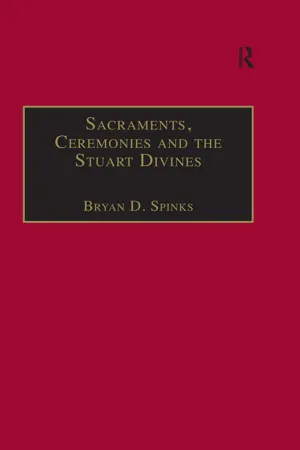
Sacraments, Ceremonies and the Stuart Divines
Sacramental Theology and Liturgy in England and Scotland 1603-1662
- 256 pages
- English
- ePUB (mobile friendly)
- Available on iOS & Android
eBook - ePub
Sacraments, Ceremonies and the Stuart Divines
Sacramental Theology and Liturgy in England and Scotland 1603-1662
About this book
This book surveys developments in sacramental and liturgical discourse and discord, exploring the writings of English and Scottish divines, and focusing on baptism and the Lord's Supper. The reigns of James I and Charles I coincided with divergence and development in teaching on the sacraments in England and Scotland and with growing discord on liturgical texts and the ceremonial. Uniquely focusing on both nations in a single study, Bryan Spinks draws on theological treatises, sermons, catechisms, liturgical texts and writings by Scottish theologians hitherto neglected. Exploring the European roots of the churches of England and Scotland and how they became entwined in developments culminating in the Solemn League and Covenant and Westminster Directory, this book presents an authoritative study of sacramental and liturgical debate, developments, and experiments during the Stuart period.
Trusted by 375,005 students
Access to over 1.5 million titles for a fair monthly price.
Study more efficiently using our study tools.
Information
Topic
Theology & ReligionSubtopic
ReligionChapter 1
The Sacramental Legacy of the Sixteenth-Century Reformation
Continental Reformers: Divergent Sacramental Theologies and Nuanced Terminologies
In urging William Bedell, Bishop of Kilmore, to accept the view that in the sacraments God ‘doth offer and exhibit the grace it signifieth’, Dr Samuel Ward, the Master of Sidney Sussex College, Cambridge, buttressed his argument thus:
For as Mr.Beza saith in Col.Mompel. ‘Obsignari non potest quod non habetur’. Ursin. Cat.Edit.Cant. ‘Sacramentum est opus Dei erga nos, in quo dat aliquid scilicet signa et res signatas, et in quo testatur et se nobis offerre ac dare sua beneficia’, et mox ‘Baptismus ac coena Domini sunt sacramenta, quia sunt opus Dei qui aliquid ni iis nobis dat et se dare testatur’. – Vid. etiam Calvin.Instit.1
Ward, writing in the late 1620s, felt it necessary to anchor his views in the teaching of sixteenth-century Reformed authorities, and cited three authorities whose views he believed confirmed his own. Ward’s appeal is a reminder that the seventeenth-century divines of both the English and Scottish churches were heirs to the sixteenth-century Reformation, and received and built upon that heritage. However, this heritage included divergent views on sacramental theology. The differences between Reformers who were otherwise thought to be in agreement – differences which included different understandings and uses of the same terminology – were reproduced by the sixteenth-century English and Scottish divines, and their seventeenth century successors.
The Lutheran/Reformed Divide
In The Babylonian Captivity of the Church (1520), Luther had attacked the status of seven church rites as sacraments, and insisted that there were in fact only three rites which qualified for this status – baptism, the mass and confession. For something to be called a sacrament, it needed divine warrant, institution or mandate. It was a word with a promise attached. In this work, and subsequent writings, he attacked the ex opere operato concept of sacraments, and the Aristotelian conceptual framework within which the doctrine of transubstantiation was expounded. However, against the fanatics such as Carlstadt, he insisted on an objectivity in the sacraments. Baptism gave remission of sin – original sin, which included original guilt – and although faith was important, faith was ultimately a gift of God, and the efficacy of baptism rested solely on the promise of God.2 The mass was not a sacrifice offered to God, but a gift which God offers the church, and which the church receives. Nevertheless, even though rejecting transubstantiation, Luther insisted that the bread and wine, by virtue of God’s promise – and God does not lie – become the body and blood of Christ. The Risen Christ’s body, by virtue of the divinity, is not restricted in one place, and thus can be present where God so chooses. Christ is therefore present bodily in the bread and wine. ‘This is my Body’ is to be taken at face value.
The Wittenberg reformer found himself battling on two sacramental fronts: against the Roman view of ex opere operato grace, and transubstantiation on the one hand; and against the ‘spiritualising’ of those he called the ‘Schwärmer’ on the other. Amongst the latter was the Zurich reformer, Ulrich Zwingli, who gradually articulated a very different sacramental theology to Luther. The word sacramentum, so Zwingli argued in 1523, is derived from the Latin word for an oath, and he was reluctant to use the word.3 A sacrament is a sure sign or seal. Sacraments, according to Zwingli, were best understood as badges, or tokens of Christian profession, rather like the livery worn by a soldier. Furthermore, if the word is to be applied to ecclesiastical rites, there are but two: baptism and the Lord’s Supper. He thus wrote: ‘a sacrament is nothing else than an initiatory ceremony or a pledging. For just as those who were about to enter upon litigation deposited a certain amount of money, which could not be taken away except by the winner, so those who are initiated by sacraments bind and pledge themselves, and, as it were, seal a contract not to draw back.’4
Zwingli was heavily indebted to Neoplatonism, and drove a sharp dualism between sign and that which is signified (res) in the sacraments. For Zwingli, original sin was to be understood as a disease or condition by which humans are prone to sin, but they do not inherit original guilt. Baptism was less about removing sin than entering the church. After wavering on the question of infant baptism, he launched an attack on the Anabaptists of Zurich, and defended infant baptism on analogy with circumcision in the Old Testament. Baptism was into the covenant, and infants were baptised because their parents were already in the covenant. But salvation came not through baptism, but through faith and the Holy Spirit. On the question of the Lord’s Supper, Zwingli had been influenced by the Dutchman, Cornelius Hoen, who argued that in the statement ‘This is my Body’, the force of the Latin est should be taken as ‘signifies’ or ‘stands for’. Zwingli was adamant that earthly elements – be it the water used in baptism, or the bread and wine of the Lord’s Supper – cannot carry the spiritual or divine. The bread and wine of the Lord’s Supper contained no divine presence, but were to provoke faith. The Supper was a ‘memorial’, as well as an occasion ‘so that we may testify to all men that we are one body and one brotherhood’.5 Thus a clear rift opened up between the Wittenbergers, for whom sacraments, be they three or two, conveyed and gave something by virtue of the promise attached; and the Zurichers (and Oecolampadius at Basel) for whom sacraments, even though mandated, were the church’s obedient response to God to inspire faith and to testify that we pledge ourselves to Christ. For Zwingli, sacraments are not channels of the Spirit to give grace, for the Spirit needs no channel. At very best, sacraments are only signs of grace already given.
These two sharply differing approaches to sacraments – rooted in concepts of God and Christology – were brought together in dialogue at the Colloquy of Marburg in 1529, where it was hoped that Luther and Zwingli in face-to-face discussion might work out some compromise. In the event, the differences on baptism were not explored, and the focal point was whether and in what manner Christ was present in the elements of bread and wine at the Lord’s Supper. Zwingli argued from John 6 that a figurative interpretation was to be given to the words ‘This is my Body’, whereas Luther held firm that these words were to be taken at face value, and were non-negotiable. Thus there emerged one of what would become many differences between the Wittenbergers, or Lutherans, and the Swiss, or Reformed.
Whether Zwingli’s Neoplatonist doctrine, usefully termed ‘symbolic memorialism’ by Brian Gerrish, might have developed to overcome the sharp dualism he created was rendered an unanswerable question by his death at Cappel in 1531.6 However, others whose theology was either unconsciously or consciously Reformed rather than Lutheran, found Zwingli’s sacramental theology (shared by Oecolampadius at Basel and Guillaume Farel of Bern, Neuchâtel and Geneva), an inadequate one. Some of these sought to develop a mediating position between Zwingli and Luther. As they did so, we find a number of terms and descriptions pressed into use, though different Reformers seem to have meant different things by them. In this development, as well as nuanced differences between Reformers, there emerged a distinct difference between the Genevan approach, represented by John Calvin, and the Zurich approach, represented by Zwingli’s successor, Heinrich Bullinger. These have been usefully characterised by Gerrish by the terms ‘symbolic instrumentalism’ and ‘symbolic parallelism’ respectively.7 Gerrish himself noted that these were not exclusive categories, and some divines and documents combine them with different degrees of success and emphasis. Nevertheless, though not water-tight definitions, his categories serve as useful benchmarks.
Martin Bucer: Developing Theologies and Mediation
The Strasbourg reformer Martin Bucer was a Dominican priest, and initially aligned himself with Wittenberg, for which he was excommunicated by the Bishop of Speyer. He came to Strasbourg in 1524, and remained there until the Interim of 1548. Bucer accepted the invitation of Archbishop Thomas Cranmer to come to England, and from 1549 until his death in 1551, he was Regius Professor of Divinity at Cambridge. Through his reputation, even in this short time, he exerted considerable theological influence upon many English adherents of Reformation doctrine.
Although initially ‘Lutheran’, by 1524 Bucer had adopted the sacramental dualism of Zwingli and Oecolampadius. However, he was an ardent ecumenist, and his experience as an observer at Marburg seems to have inspired him to find a compromise position between Luther and Zwingli. Thus both Peter Stephens and René Bornert posit two periods of sacramental thinking for Bucer: the period 1523–30, characterised by a dualism in which the interior working of the Spirit is sharply divided from the exterior sacramental rite; and 1530–51, when the inward and outward are brought closer together and integrated.8 Thus in his Commentary on Matthew in 1527, Bucer argued that it is the Lord who accomplishes inwardly by the Spirit what is signified by the sign. In his Commentary on Ephesians he stated that it is not the sacraments which are the seal of Christians, but the Holy Spirit. In his Grund und Ursach (1524), Bucer denied that God binds grace to water in baptism, and in the Commentary on Matthew rejected the idea that ‘the word of the person baptizing is a vehicle of the Holy Spirit, by which he is conveyed into the water, which is then not water, but is really the Holy Spirit, which at once purges the baptized infant of all sin, giving faith and everything.’9 In Grund und Ursach he said of the Supper: ‘The Lord commanded the bread to be eaten and the cup to be drunk, and directed and commanded [to go] at once from the bodily to the spirit, to remember him … The Lord has given nothing bodily in holy communion except eating and drinking, and that for the sake of the spiritual, that is, his remembrance.’10 And in th...
Table of contents
- Cover
- Dedication
- Title
- Copyright
- Contents
- List of Figures
- Acknowledgements
- Introduction
- Chapter 1 The Sacramental Legacy of the Sixteenth-Century Reformation
- Chapter 2 Lex Ritualis, Lex Credendi? From Hampton Court to the Five Articles of Perth
- Chapter 3 The Development of Conformist Calvinist and Patristic Reformed 'Sacramentalism', and the Sacramental Rites of the 1637 Scottish Book of Common Prayer
- Chapter 4 From the Long Parliament to the Death of Cromwell
- Chapter 5 Kingdoms and Churches Apart: The Restoration
- Chapter 6 After-Thoughts
- Appendices
- Bibliography
- Index
Frequently asked questions
Yes, you can cancel anytime from the Subscription tab in your account settings on the Perlego website. Your subscription will stay active until the end of your current billing period. Learn how to cancel your subscription
No, books cannot be downloaded as external files, such as PDFs, for use outside of Perlego. However, you can download books within the Perlego app for offline reading on mobile or tablet. Learn how to download books offline
Perlego offers two plans: Essential and Complete
- Essential is ideal for learners and professionals who enjoy exploring a wide range of subjects. Access the Essential Library with 800,000+ trusted titles and best-sellers across business, personal growth, and the humanities. Includes unlimited reading time and Standard Read Aloud voice.
- Complete: Perfect for advanced learners and researchers needing full, unrestricted access. Unlock 1.5M+ books across hundreds of subjects, including academic and specialized titles. The Complete Plan also includes advanced features like Premium Read Aloud and Research Assistant.
We are an online textbook subscription service, where you can get access to an entire online library for less than the price of a single book per month. With over 1.5 million books across 990+ topics, we’ve got you covered! Learn about our mission
Look out for the read-aloud symbol on your next book to see if you can listen to it. The read-aloud tool reads text aloud for you, highlighting the text as it is being read. You can pause it, speed it up and slow it down. Learn more about Read Aloud
Yes! You can use the Perlego app on both iOS and Android devices to read anytime, anywhere — even offline. Perfect for commutes or when you’re on the go.
Please note we cannot support devices running on iOS 13 and Android 7 or earlier. Learn more about using the app
Please note we cannot support devices running on iOS 13 and Android 7 or earlier. Learn more about using the app
Yes, you can access Sacraments, Ceremonies and the Stuart Divines by Bryan D. Spinks in PDF and/or ePUB format, as well as other popular books in Theology & Religion & Religion. We have over 1.5 million books available in our catalogue for you to explore.