- 224 pages
- English
- ePUB (mobile friendly)
- Available on iOS & Android
eBook - ePub
About this book
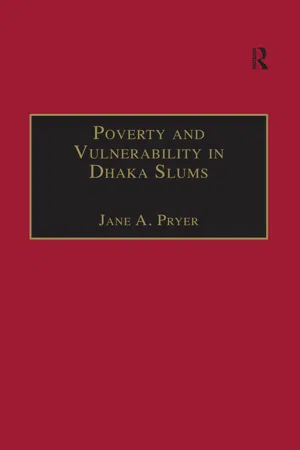
Bangladesh has low levels of urbanization but a high urban population in absolute terms, being one of the most densely populated countries in the world. Rapid urbanization in developing countries brings numerous problems and challenges; urban poverty is one important issue. This important volume presents the findings of a complex and revealing multidisciplinary cohort study conducted in the slums of Dhaka, Bangladesh. Detailed information was assembled on material, social and economic conditions, livelihoods, health and nutritional status. Together with associated qualitative work, the data forms the basis for understanding groups who are vulnerable to economic and environmental shocks and stresses, and for differentiating strategies which might be adaptive in situations of hardship and scarcity. The author examines many aspects of poverty and vulnerability including livelihoods, work disabling illness and coping strategies, the female workforce, women's negotiation and well being, marital instability, child labour, and investments in health and nutrition, and utilizes the assembled material to debate on policy options.
Trusted by 375,005 students
Access to over 1.5 million titles for a fair monthly price.
Study more efficiently using our study tools.
Information
Subtopic
SociologyIndex
Social SciencesChapter 1
Poverty and Vulnerability
In this chapter we explain the measurement of poverty using income and expenditure, and the advantages and disadvantages of this approach. We then move on to entitlement and capability theory as an alternative to poverty measurement.
Measurement of poverty using income and consumption
Income poverty has a long history. “Absolute poverty” is now prevalent as a means of conceptulising poverty in most countries around the world, and is usually traced back to the work of Seebohm Rowntree. Rowntree’s method was to conduct a survey covering nearly every working-class family in York in 1901, to collect information on earnings and expenditure. He then defined poverty as a level of total earnings insufficient to obtain the minimum necessities for maintenance of “merely physical efficiency” including food, rent and other items. He calculated that for a family of five (father, mother and three children) the minimum weekly expenditure to maintain physical efficiency was 21 shillings and 8 pence; he proposed different amounts for families of different size or composition. Comparing these poverty lines with family earnings, he arrived at the poverty estimate (Rowntree, 1901).
The same principles underpin the current World Bank approach. A key building block in developing income or consumption measures of poverty is the poverty line. In principle, this tests for the ability to purchase a basket of commodities that are roughly similar across the world. In Bangladesh for instance, in 1995-6, 36 percent of people nationally, 40 percent of rural people and 14 percent of urban people were below the National Poverty Line, while 29 percent survived on less than $1.00 a day and 78 percent on less than $2.00 a day (World Bank, 2000-2001). But such a universal line is not suitable for analysis of poverty within a country. For that purpose, a country-specific poverty line needs to be constructed, reflecting the country’s economic and social circumstances. Similarly, the poverty line needs to be adjusted for different areas (for example, urban and rural areas) within the country if prices of goods and services differ. The country-specific poverty line is now common practice. In Bangladesh, for instance, 29 percent had less than a $1.00 per day, and 78 percent had less than $2.00 a day. In 1991-2, 42 percent of people nationally, 46 percent of rural people and 23 percent of urban people were below the National Poverty Line. In 1995-6, 36 percent of people nationally, 40 percent of rural people and 14 percent of urban people were below the National Poverty Line (World Bank, 2000-2001).
The most straightforward way to measure poverty is to calculate the percentage of the population below the poverty line. But this has disadvantages; it fails to reflect the fact that among the poor people there may be wide differences in income levels, with some people located just below the poverty line and others experiencing far greater shortfalls. Other poverty measures include the poverty gap, which takes account of the distance of poor people from the poverty line, and the squared poverty gap, which measures the degree of income inequality among poor people (World Bank, 2000-2001). The strengths of the poverty line approach are that it enables governments or the international community to set targets for judging policy options. But there are also a number of limitations. The approach fails to reflect the fact that among the poor people there may be wider differences in income levels, with some people located just below the poverty line and others experiencing far greater shortfalls. Other poverty measures attempt to address this including the poverty gap, which takes account of the distance of poor people from the poverty line and the squared poverty gap, which also measures the degree of income inequality between poor people (World Bank, 2000-2001).
There are also difficulties associated with data collection. Household surveys measure income or consumption, but the design varies between countries, and over time, making comparisons difficult. One month recall data tends to result in higher poverty estimates compared to a one week recall. Then we must decide how to allow for household size and composition into measures for individuals, as well as measurement error. Moreover, income or consumption at the household level has a basic shortcoming in that neither can reveal inequality within the household, so they can underestimate overall inequality and poverty. Haddad and Kanbur (1990) desegregated household consumption by individual members and found that relying on household information could lead to an underestimate of inequality and poverty by 25 percent. In particular, the conventional household survey approach does not allow direct measurement of income or consumption of poverty among women.
Poverty measurement and the within-household distribution
People, not households, experience poverty. Yet it is standard practice to measure poverty at the household level. Household members are assumed to receive equal shares of their household income. The equal sharing concept has long been questioned (Chippori, 1997). The World Bank approach does not account for the fact that some parents make sacrifices to maintain their children’s living standards, and some neglect their children.
The discussion of risk management has viewed the household as the unit of impact and decision making. Yet risk sharing within the household may not be equal, and the burden of the household’s response may fall dispropriationately on the weakest members – children and women. A shock affecting a household as a whole may have different effects on different household members (Udry, 1999). Because poor households have many children, children are more exposed to poverty and vulnerability than other groups. Children in poor households are especially vulnerable to fluctuations in household income and consumption. They are more likely to be underweight, and further declines in food consumption can cause irreversible harm. In Bangladesh, children’s growth suffered during major floods (Foster, 1995). Studies in Bangladesh show that girls’ nutritional status is worse than boys’ in poor households (Pryer, 1992). Price changes also affect girls’ consumption more than it affects boys’ consumption (Behrman and Deolalikar, 1990).
Women suffer more than men from adverse shocks. Rising food prices led to larger reductions in nutrient intake for women than for men in India (Dercon and Krishman, 2000). Divorced and widowed women in South Asia often face higher health risks and are more likely than married women to be poor, because they lose access to their husband’s property (Lanjouw and Stern, 1999). A study in Pakistan found evidence that gender bias in health expenditure decreases with rising income (Alderman and Gertler, 1997). In south Asia, lower value is assigned to women and girls, which translates into excess mortality – 4 percent of girls under five years old are missing (Klasen, 1994).
Gender inequality has strong repercussions for human capital in the next generation, because the burden of bearing and rearing children falls largely upon women. Women deprived of education and decision making power face serious constraints in rearing healthy and productive children. Studies from India find that even controlling for education, household income and other socio-economic characteristics, low domestic autonomy is associated with higher infant and child mortality rates (Das Gupta, 1995), while giving income generating loans to women improves the nutritional status of their children.
In conclusion, it is obvious that incorporating within-household aspects in poverty measurement raises difficult issues of allocation and valuation. Theoretical work can play a role. It may be, for example, that a range of indicators better capture the experience of individuals within-household than estimates of income do. We need more research on how to summarise experience and formulate poverty lines using multi-dimensional measures. There is a burgeoning economic literature on household decision making which is theoretical, as well as proving useful models which have been used (Hoddinott, Alderman, Haddad, 1997; Haddad, Hoddinott, Alderman, 1997).
Entitlement and capability theory as an alternative to poverty measurement
Both entitlement and capability theories were developed as part of Sen’s long-term project of moving the analysis of poverty and hunger away from a focus on commodities and food availability, and towards the idea of the individual as an economic factor. “Commodity fetishism” according to Sen, attempts to define well-being in terms of commodities owned or needed. In capability theory the focus is on what human bei...
Table of contents
- Cover Page
- Title Page
- Copyright Page
- Contents
- Acknowledgements
- List of Figures
- List of Tables
- Preface
- 101 Introduction
- 1 Poverty and Vulnerability
- 2 Study Design and Methods
- 3 Livelihood Clusters
- 4 Marital Instability
- 5 Child Labour
- 6 Female Workforce and the Family
- 7 Investing in Health
- 8 Work Disabling Morbidity
- 9 Strategies for Coping with Costs of Work Disabling 111 Health among Household Heads
- 10 Women’s Negotiation Control and Well-being within the Households
- 11 Factors Affecting Adult Body Mass Index
- 12 Investing in Children’s Nutritional Status
- 13 Intra-household Distribution of Nutritional Vulnerability
- 14 Managing Financial Shocks and Stresses
- 15 Policy Implications
- Bibliography
- Index
Frequently asked questions
Yes, you can cancel anytime from the Subscription tab in your account settings on the Perlego website. Your subscription will stay active until the end of your current billing period. Learn how to cancel your subscription
No, books cannot be downloaded as external files, such as PDFs, for use outside of Perlego. However, you can download books within the Perlego app for offline reading on mobile or tablet. Learn how to download books offline
Perlego offers two plans: Essential and Complete
- Essential is ideal for learners and professionals who enjoy exploring a wide range of subjects. Access the Essential Library with 800,000+ trusted titles and best-sellers across business, personal growth, and the humanities. Includes unlimited reading time and Standard Read Aloud voice.
- Complete: Perfect for advanced learners and researchers needing full, unrestricted access. Unlock 1.5M+ books across hundreds of subjects, including academic and specialized titles. The Complete Plan also includes advanced features like Premium Read Aloud and Research Assistant.
We are an online textbook subscription service, where you can get access to an entire online library for less than the price of a single book per month. With over 1.5 million books across 990+ topics, we’ve got you covered! Learn about our mission
Look out for the read-aloud symbol on your next book to see if you can listen to it. The read-aloud tool reads text aloud for you, highlighting the text as it is being read. You can pause it, speed it up and slow it down. Learn more about Read Aloud
Yes! You can use the Perlego app on both iOS and Android devices to read anytime, anywhere — even offline. Perfect for commutes or when you’re on the go.
Please note we cannot support devices running on iOS 13 and Android 7 or earlier. Learn more about using the app
Please note we cannot support devices running on iOS 13 and Android 7 or earlier. Learn more about using the app
Yes, you can access Poverty and Vulnerability in Dhaka Slums by Jane A. Pryer in PDF and/or ePUB format, as well as other popular books in Social Sciences & Sociology. We have over 1.5 million books available in our catalogue for you to explore.