- 160 pages
- English
- ePUB (mobile friendly)
- Available on iOS & Android
eBook - ePub
About this book
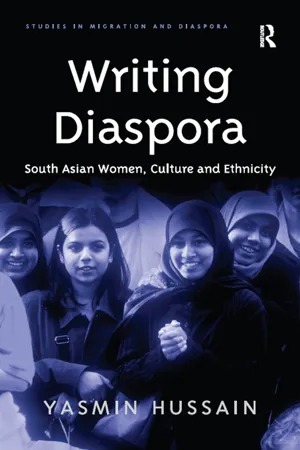
Issues of cultural hybridity, diaspora and identity are central to debates on ethnicity and race and, over the past decade, have framed many theoretical debates in sociology, cultural studies and literary studies. However, these ideas are all too often considered at a purely theoretical level. In this book Yasmin Hussain uses these ideas to explore cultural production by British South Asian women including Monica Ali, Meera Syal and Gurinder Chadha. Hussain provides a sociological analysis of the contexts and experiences of the British South Asian community, discussing key concerns that emerge within the work of this new generation of women writers and which express more widespread debates within the community. In particular these authors address issues of individual and group identity and the ways in which these are affected by ethnicity and gender. Hussain argues that in exploring the different dimensions of their cultural heritage, the authors she surveys have created changes within the meaning of the diasporic identity, articulating a challenge to the notion of 'Asianness' as a homogenous and simple category. In her examination of the process through which a hybridized diasporic culture has come into being, she offers an important contribution to some of the key questions in recent sociological and cultural theory.
Trusted by 375,005 students
Access to over 1.5 million titles for a fair monthly price.
Study more efficiently using our study tools.
Information
Subtopic
Ethnic StudiesIndex
Social SciencesChapter 1
Introduction
Britain’s South Asian ethnic minorities are largely the product of an influx of immigrants, which began in the 1950s as a movement of intending sojourners who instead became settlers, creating a new life for themselves in a different social context (Anwar, 1979). Since their arrival, they have raised new generations whose personal lives and self-images have been conditioned by circumstances very different from those familiar to their parents. The first immigrant generation transplanted into Britain’s ways of being, seeing and living that were determined partly by the experience of imperialist domination and partly by resistance to it. Those who settled in Britain, and more especially their British-born descendants, have participated in the evolution of a new self-image and identity – the British South Asian way of being. This self-concept is influenced by the British social and political environment and includes responses to the rejection and oppression experienced by non-White minorities (Grewal, 1988).
These pressures and resistances have brought about considerable changes in the identity of South Asian women in Britain. The majority culture harboured notions about South Asian communities and the place of women within them which were frequently distorted by stereotypical images and ethnocentric perceptions of women in the context of western values of independence and individuality, which South Asian cultures were seen as denying. However, from within the minority groups themselves, inherited ideas of South Asian identity and women’s roles were also being questioned, not only by the men who were supposedly the privileged guardians of imposed identities but also by the women themselves who rejected the identities prescribed for them. Consequently South Asian women have redefined the very idea of South Asianness and South Asian womanhood within both the minority and majority cultures as they give voice to their resistance to oppression. The creative output from these women documents this struggle.
Changes in South Asian communities’ understandings of themselves affects their culture in a number of ways, including cultural formation, reproduction and dissemination (Gilroy, 1993). The negotiation of identities is fundamental to South Asian women’s writing in cross-cultural contexts. It is the convergence of multiple places and cultures that re-negotiates the terms of South Asian women’s experiences, a process which in turn negotiates and re-negotiates their identities (Davies, 1994). It is against this background of change and expansion that this book aims to decipher questions of identity, by examining certain types of emotional reaction among women as they appear in creative works by the South Asian women who form the British diasporic community. The works deconstructed within this book have been produced by women living in Britain whose subjects and methods are shaped by the specifics of the British South Asian experience and context (Macauley, 1996).
The notion of a ‘South Asian identity’ promotes a unity and solidarity among the ‘imagined community’ of the South Asian diaspora. People from the various South Asian cultures have been treated typically as one monolithic people by the West. For instance, all South Asians were defined in Britain as ‘Indian’ before 1945, and subsequently re-defined as Pakistani and Indian. Bangladeshis were only categorised as such from the 1970s onwards when West and East Pakistan were divided so that Bangladesh emerged as an independent nation. The term ‘South Asian’ also functions as an umbrella term, often abbreviated to ‘Asian’, to unify diverse peoples against common obstacles, in the name of empowerment and coalition-building (Iyer, 1997). Yet the differences ethnically, culturally, religiously within the term ‘South Asian’ are vast. The majority of Britain’s current South Asian population can be placed within four broad categories, Gujaratis and Punjabis from India, Punjabis from Pakistan and Bangladeshi (Ballard, 2002). Those who form the Gujarati population are drawn from the coastal districts in Saurashtra and the Gulf of Cambay, with 80 per cent Hindu and the remainder Muslim. The Punjabis from India, are from the Jullundur Doab, with the majority being Sikh and the remainder either Hindu or Christian. The other substantial body of Punjabis are from areas in Pakistan such as Mirpur, Jhelum, Rawalpindi and Gujrat Districts as well as smaller numbers from Faisalabad and Lahore. The overwhelming majority of Bangladeshis are from the district of Sylhet (Ballard, 2002).
There are a number of differences within these ethnic groups, for instance lifestyles, dress, diet and language. Furthermore, their responses to new social and economic environments are also different, with diverse employment patterns and marriage practises for example (Ballard, 2002). However, irrespective of this diversity there are similarities; for all those categorised as South Asian, the multiplicity of languages has always been a part of their history, and this often entails an acceptance of difference, and an open-ness to different cultural influences. This does not take place at the expense of established cultural ties, nor does it challenge self-identity (Iyer, 1997). This book illuminates the basic patterns and principles that are characteristic of women’s lives in the diasporic communities of Pakistanis, Indians and Bangladeshis in Britain. These run across the whole panethnic category of South Asian, thus allowing them to be treated as an amalgamated identity. The differences between the ethnic categories are highlighted when they emerge as important.
The South Asian identities expressed in the work examined in the following chapters are not religious or national identities, but the collective concerns of women who have roots in South Asia and are living in the diaspora. These issues, including migration and settlement, self-identity, the role of the family and marriage, feature in all of the works to varying degrees regardless of whether the author is Bangladeshi, Indian or Pakistani; Hindu, Muslim or Sikh. The details may be specific to religion or nation, but as will become apparent in what follows the broad themes are shared by South Asian women in the diaspora.
Works of fiction, cinematic screenplays and poetry are essentially products of unique individual imaginations and as such might be challenged as admissible evidence in a sociological study, especially if the works were considered in isolation from each other and outside a theoretical framework. They are, however, entirely relevant to the sociology of culture. The creative works featured in this study are in a real sense eyewitness accounts: not literal autobiographies, but representations of aspects of the lived experience and preoccupations of each author which she recognised as relevant to lives other than her own. They deal with authentic concerns about individual and group identity, framed largely by social relations which position people in terms of ethnicity and gender. By identifying these common themes and the different ways they are addressed in these creative works, we can uncover some of the major issues in the real lives of British South Asian women. The works considered within this book are all by women whose parents originated from India, Pakistan and Bangladesh, and almost all have been either born or brought up in Britain.
This book examines the identities of South Asian women in Britain and the extent to which these permeate through the products of their creativity in the form of literature and film. These works are informed by a historical perspective and are concerned with putting forward an interpretation of the world as experienced by British South Asian women themselves. Similarities in the treatment of issues of identity are highlighted with respect to the thematic concerns and the stylistic techniques used. These women are concerned with the relationships between image, identity, culture, power, politics and representation and the differences between images and reality, policy and practice are made apparent.
The propriety or the motives in associating the personal lives of authors with their writings is problematic. Are imaginative writings attempts to find satisfaction by releasing pre-occupied thoughts? This study accepts the fact that individuals reveal themselves in whatever they read and write. Its purpose is to relate the quantity and temper of imaginative writing to the assumption that what has been written and read for pleasure is a fair index of the interests and attitudes widely shared among contemporary British South Asian women. Diasporic writing as a creative genre encapsulates the shared social and psychological preoccupations of whole dispersed generations and their offspring. The creative product, whether in the form of visual or text media, have opened up new ways of thinking in both peoples’ lives and scholarly work. It is within this literature that diaspora is used as a social and political tool for expressing immediate grievances, those of which are intimately concerned with identity and the quest for individuality.
It is significant that the emergence of this creative endeavour has reworked the language of representation. Women authors ‘pen’ themselves into their own history: they articulate differences in a narrative which is also expressed in their own terms of reference and which highlights ignorance from within the majority and minority communities (Parmar, 1990). Among the themes they address are the different ways that aspects of the ‘host’ or ‘majority’ culture are perceived by women brought up and educated within that culture, compared to the perceptions and valued judgements of their elders. Culture is not genetically inherited but is instilled by upbringing within a given cultural context or a given set of parallel contexts, within which the individual has to learn about such ideas as race and gender. White society’s ignorance related to both their gender and race becomes a core issue within the writing of British South Asian women and an underlying feature of their everyday lives. However, it is the way in which they deal with these issues of contention that is the essence of the writing, as it shows a battling of self-worth alongside preconceived notions of identity which are interwoven within stereotypical notions of South Asian womanhood found in wider British society. Thus the identity which is explored is not only specific and individual but embraces a collective identity of South Asian women in Britain.
What is interesting to note is that the dynamics within the South Asian women’s diaspora develop according to the historical circumstances and alternating environments in which it is situated. The creative works become sites within which active identification appears through their creative works; these women engage in constant practical ideological work – of marking boundaries, creating transnational networks, articulating dissenting voices – at the same time that they re-inscribe collective memories and utopian visions in their public ceremonials or cultural works (Werbner, 1990). Women’s identities are shaped by rejection or acceptance on the basis of identity. The positioning of women when they first arrived in the UK where they were subjected to ethnocentric pathologisation forced them to assert their identity within their creativity. The quest for identity is therefore played out as a means of expressing self-identity, and this identity is not a product of economic determinants, but one arrived at through the multi-axial configurations of power which permeate their lives.
British South Asian women writers are creating new ways of representing their individual and collective identities. In the exploration of identity, gender is of course at the very centre of their preoccupations. They write from a particular time and place, from a particular combination of experiences and influences, and from the rich variety of their creative works it is possible to identify their concerns and their feelings as to what constitutes their identity as young British South Asian women.
The creative works considered in the subsequent chapters serve as evidence of the shared preoccupations of whole generations of South Asian women, within South Asian and the diasporic communities. Whilst social and political grievances are expressed in the writings, the women also succeed in expressing intimately personal concerns, many of which are centred on questions of identity. For all the differences between the works to be surveyed here, the theme of searching for identity is pervasive and brings the many different protagonists into a questioning confrontation with her own heritage as well as the cultural mores of the society in which she finds herself. The quest for individuality, the theme of the journey through space and time, the acceptance or rejection of categorisation, confrontation with patriarchal constraints and the tendency to seek self-definition in terms of comparison with the behaviour or identities of others, are recurring themes in the creativity of British South Asian women. Here is a body of literature which is striking not only in terms of its growth as a creative genre, but in its value as a compelling body of sociological evidence about the South Asian diaspora.
Diaspora
The concept of diaspora is central to this book, so it is appropriate at this point to reflect on its meaning and on what this work has established about its usefulness to the understanding of South Asian women’s identity. The impact of globalisation on the world’s economies means that there have been profound changes in the composition of local, regional and national cultural practices. The break-up of metanarratives and the arrival of new genealogies for spatial fixity, new diasporic communities and the corresponding emergence of new subjectivities; indicates that diaspora has taken on a new dimension (Brah, 1996). Diaspora has becomes a breeding ground for new sociological concepts within scholarly work. The rise of migration, nomadism, religious movements, urbanisation and pilgrimages have all helped precipitate the arrival of new sociological constructs of culture. In recent times diaspora has penetrated the discipline of sociology and provides new ways of thinking about race and ethnicity. The advent of hyphenated identities and multinational attachments reveal not so much loopholes in the traditional ways of analysing culture, but previously uncharted territory within the discipline itself (Werbner, 1997). Consequently, earlier anthropological conceptualisations of culture are rendered inadequate and inappropriate models for analysing the heterogeneous composition of group collectivities in contemporary society.
A growing scholarly literature has responded to the evident expansion of the concept and discourse of diaspora and attempts to probe its salient features and limits (Safran, 1991; Tololyan, 1991 and 1996; Hall, 1990; Gilroy, 1993; Clifford, 1994; Brah, 1996; Werbner, 1990). Vertovec (1996) suggests four ways of approaching the idea of diaspora within this literature. The first, and most literal, is that of a social category: for example, referring exclusively to the experience of the Jews, who dispersed throughout the world over the centuries. This concept of diaspora often focused on a forced displacement and therefore was centred on negative experiences in terms of alienation, loss and victimisation. Whilst their ancestral dispossession is an overwhelmingly negative concept, the idea of the Jewish diaspora describes a community whose socio-economic, cultural, familial and political networks cross boundaries of states, and preserve a common shared identity. Although transformed by the influences of surrounding cultures; for many the dream of return to the ‘homeland’ provided a fundamental principle of identity.
The same model has been applied to other groups often seen as forcibly dispersed, such as the African-American or Armenian diasporas. As a social category, diaspora has created a theoretical framework within which categories including immigrants, ethnic minorities, refugees or migrant labourers cannot be wholly included because the circumstances of their displacement do not necessarily reach back through generations to define collective identities.
It is possible to emigrate, whether temporarily or permanently, without acquiring a diasporic identity. For example, North African day-labourers who regularly cross the Mediterranean to harvest crops in Southern Spain, move to a seasonal workplace and then return to a home, which they have not really left in cultural terms. Another example is an Irish person who migrates to England or the USA and successfully melts into the surrounding culture, not seeking out the company of her compatriots and deliberately losing her accent. By contrast, in Vertovec’s second way of thinking about diaspora, membership of a diasporic community implies a self-conscious attachment to the place of origin as well as a sense of being somewhere else; a sense that one can share with others whose roots are left behind in the same country. To that extent, a first generation immigrant may have a choice as to whether or not to become part of a diaspora. There is less of a choice for daughters or sons when the parents have clung to their cultural and linguistic roots; these people, and their offspring, if they retain that sense of identity, constitute a diaspora, but the term diaspora is sometimes applied rather loosely to cover all individuals who share a ‘foreign’ heritage within the host culture (Vertovec, 1996).
The third sense in which the word is used is that of diaspora as a mode of cultural production. Cultural identity is fluid, produced and reproduced so that it often results in ‘hybrid’ forms of expression. In the British South Asian example, this might include bhangra music or curry houses, neither of which could have come into existence without the interaction of different cultures; each marks the presence of the diasporic community within the majority culture and the way that each has influenced the shape of the other (Hall, 1990; Vertovec, 1996).
For instance, bhangra music has signalled the development of a self-conscious and distinctively British South Asian youth culture. This originates in the Punjab and celebrates the rhythms of the dhol and dholki drums, and is associated with major social occasions, including the harvest festivals. However, in the context of Britain, bhangra music has been reinvented, with bands bringing in sound sampling, drum machines and synthesisers to produce new forms of the bhangra beat, different from the raw dholi sounds found in the bhangra music in its pure form in the Punjab. Again this has developed so that other influences from hip-hop and house music have been incorporated, producing northern rock bhangra and house bhangra (Bennett, 2000).
This cultural approach sees the diaspora(s) as part(s) of the ‘host’ culture(s) and vice-versa. These musical forms are important for the South Asian youth culture, as they cut across nationalities, religion, caste or class and the way they subvert such intra-community divisions is essential when discussing the relevance to British South Asians of the notion of diaspora as a mode of cultural production. This is comparable to the articulation of black diasporic culture in Britain as being about finding alternative ways of defining British identity (Clifford, 1997).
Finally, Vertovec (1996) suggests a fourth approach, diaspora as a ‘problem’. Transnational communities may be, and often are seen, as problems or threats to state security and to the social order when seen from right-wing perspectives within the ‘host’ countries (Vertovec, 1996, p. 54). Here, the individual’s connection with the country of origin calls into question their loyalty to the host country. The existence of hybrid cultural forms and multiple identities are viewed as diluting or undermining the traditional norms of the indigenous population. This has taken its most recent expression in official concerns about South Asian communities in Britain since the 2001 ‘riots’ (Hussain and Bagguley, 2005).
Each of these four approaches to the understanding of diaspora is valid in its own way, and indicative of diaspora as a transnational network of dispersed individuals. These individuals are connected by ties of co-responsibility across the boundaries of empires, political communities or nations (Werbner, 1990). Yet despite their dispersal, they share a collective past and common destiny, and hence also a simultaneity in time. The novels, stories and films examined elsewhere in this book include characters and situations defined in terms of a resentful yearning for the ancestral homeland, or a sense of belonging to more than one home, or the cross-fertilisation of two cultures, or the experience of coming into conflict with the majority culture.
Diaspora as a sociological concept takes account of a ‘homing’ desire – that is, a need for belonging to an identity rooted in a geographical origin – as opposed to simply a desire for a ‘homeland’ in the sense of returning to, possessing or reconquering a physical territory (Brah, 1996). The dream of returning to the homeland provides a fundamental principle of the diasporic identity. This way of thinking about diaspora puts the ideas of ‘home’ and ‘dispersion’ in a creative tension with each other, ‘inscribing a homing desire while simultaneously critiquing discourses of fixed origins’ (Brah, 1996, p. 193). Diasporas emerge out of migrations of collectivities and are places of long-term, if not permanent, community formation. The traumas of dislocation and separation, coupled with instances of hope and new begin...
Table of contents
- Cover
- Half Title
- Title Page
- Copyright Page
- Dedication
- Table of Contents
- Preface
- Acknowledgements
- 1 Introduction
- 2 Identity and Gender Across Generations of British South Asians
- 3 Black British Feminism and the Birth of South Asian Women’s Writing
- 4 The New Woman in South Asian and Diasporic Literature
- 5 Bhaji on the Beach and Bend it like Beckham: Gurinder Chadha and the ‘Desification’ of British Cinema
- 6 Brick Lane: Gender and Migration
- 7 Childhood in Anita and Me
- 8 Conclusion
- Bibliography
- Index
Frequently asked questions
Yes, you can cancel anytime from the Subscription tab in your account settings on the Perlego website. Your subscription will stay active until the end of your current billing period. Learn how to cancel your subscription
No, books cannot be downloaded as external files, such as PDFs, for use outside of Perlego. However, you can download books within the Perlego app for offline reading on mobile or tablet. Learn how to download books offline
Perlego offers two plans: Essential and Complete
- Essential is ideal for learners and professionals who enjoy exploring a wide range of subjects. Access the Essential Library with 800,000+ trusted titles and best-sellers across business, personal growth, and the humanities. Includes unlimited reading time and Standard Read Aloud voice.
- Complete: Perfect for advanced learners and researchers needing full, unrestricted access. Unlock 1.5M+ books across hundreds of subjects, including academic and specialized titles. The Complete Plan also includes advanced features like Premium Read Aloud and Research Assistant.
We are an online textbook subscription service, where you can get access to an entire online library for less than the price of a single book per month. With over 1.5 million books across 990+ topics, we’ve got you covered! Learn about our mission
Look out for the read-aloud symbol on your next book to see if you can listen to it. The read-aloud tool reads text aloud for you, highlighting the text as it is being read. You can pause it, speed it up and slow it down. Learn more about Read Aloud
Yes! You can use the Perlego app on both iOS and Android devices to read anytime, anywhere — even offline. Perfect for commutes or when you’re on the go.
Please note we cannot support devices running on iOS 13 and Android 7 or earlier. Learn more about using the app
Please note we cannot support devices running on iOS 13 and Android 7 or earlier. Learn more about using the app
Yes, you can access Writing Diaspora by Yasmin Hussain in PDF and/or ePUB format, as well as other popular books in Social Sciences & Ethnic Studies. We have over 1.5 million books available in our catalogue for you to explore.