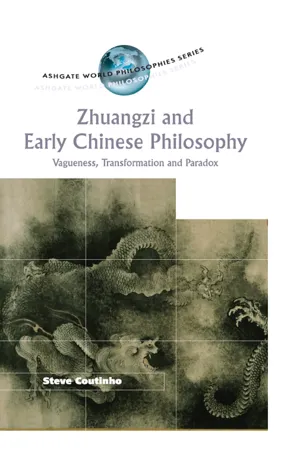
The Daoist philosopher Zhuangzi (also known as Chuang Tzu), along with Confucius, Lao Tzu, and the Buddha, ranks among the most influential thinkers in the development of East Asian thought. His literary style is humorous and entertaining, yet the philosophical content is extraordinarily subtle and profound. This book introduces key topics in early Daoist philosophy. Drawing on several issues and methods in Western philosophy, from analytical philosophy to semiotics and hermeneutics, the author throws new light on the ancient Zhuangzi text. Engaging Daoism and contemporary Western philosophical logic, and drawing on new developments in our understanding of early Chinese culture, Coutinho challenges the interpretation of Zhuangzi as either a skeptic or a relativist, and instead seeks to explore his philosophy as emphasizing the ineradicable vagueness of language, thought and reality. This new interpretation of the Zhuangzi offers an important development in the understanding of Daoist philosophy, describing a world in flux in which things themselves are vague and inconsistent, and tries to show us a Way (a Dao) to negotiate through the shadows of a "chaotic" world.
Trusted by 375,005 students
Access to over 1.5 million titles for a fair monthly price.
The Zhuangzi is without doubt one of the richest and most intriguing among the world’s philosophical texts, and so one would expect the field of Zhuangzi studies to be immense. Yet Laozi and Confucius, Augustine and Aquinas, Wittgenstein and Heidegger attract far greater attention than this mad man of Chu, leaving him in the shadows to wallow in the mud. Perhaps this is because he is such a madman, perhaps because he is too playful: his games take us far beyond the familiar into realms that verge on the grotesque. Perhaps it is also because his writing is extraordinarily difficult to decipher, in part because of its historical and cultural difference, but also because his text is ‘self-consciously’ semeiotic, playing with the very conditions of meaningfulness that it discusses. For these reasons, it is not obvious what reading strategies may appropriately be brought to the text. Was Zhuangzi writing an analytic text, or a deconstructive one? A religious text, or a philosophical one? A political text or a spiritual one? He tells stories, paints vivid pictures: but are these to be understood literally, figuratively, allegorically, metaphorically? If figuratively and metaphorically, how reliable are twentyfirst century western readings of these ancient images and metaphors? The obstacles to understanding may thus appear insurmountable: in the next two chapters I pursue a more detailed exploration of the problems and methods of interpretation. Yet, with even a superficial reading one senses that this text is deep with human significance. Even if we do not fully understand, we can see that important issues are being addressed with great sophistication and extraordinary skill. Our immediate impression is that this work will repay a profounder contemplation, and that an effort to unravel its complexities will be richly rewarded.
The Zhuangzi is an extraordinarily complex text. Interwoven amongst its many strands, there are to be found elements that remind us of a sceptical attitude, other elements that hint of relativism, others still that seem inconsistent with both of these. There is much that is highly reminiscent of Mahayana Buddhist idealism; other aspects resonate deeply with the sunyavada of Nagaijuna, or seem to anticipate the development of Zen. Now, when we first come across any strange and perplexing phenomenon, our natural tendency is to want to make it less strange by magnifying what seems most familiar. It thus becomes tempting to read the Zhuangzi by assimilating it to familiar philosophical doctrines. But a hasty application, or imposition, of such philosophical categories may not necessarily be of the greatest help. Indeed, the practice of looking for what is familiar may well have the unintended consequence of covering over the deeper import of ideas that are difficult to follow precisely because they are unfamiliar. The second chapter, for example, entitled Qi Wu Lun,
. ‘Discussion on Smoothing Things Out,’ reflects at length on issues concerning knowledge and language, but it bears little resemblance to a western treatise on epistemology or philosophy of language. For this reason it would be wise to refrain from a too hasty classification of the text as ‘epistemology’ or ‘philosophy of language.’ Moreover, in this same chapter we find, juxtaposed with paradoxes about language and knowledge, a definite existential mood: tired musings on the contingency and apparent futility of living and dying. Is this ‘existentialism’ or ‘philosophy of language’? Or is it some bizarre hybrid: linguistic existentialism? At some point it becomes clear that forcing our familiar categories in an attempt to clarify the unfamiliar only results in making the text more confusing. It is without doubt instructive, and indeed indispensable, on our first approach to identify similarities with familiar schools and concepts, if we are to find a way in to an appreciation of the text. But as a next step, we must then be sure to notice where the similarities end, and to pay great attention to where and why the incompatibilities arise: this should curtail any tendencies we have to impose our preconceptions on what may turn out to offer something unexpected.
Recently, in the west, there has been some growth of interest in passages of the Zhuangzi that are concerned with human knowledge and understanding. What have drawn the greatest attention are aspects of the text that display a tendency toward some kind of relativism on the one hand, and those that display a contrary tendency toward some kind of scepticism on the other. A. C. Graham, following the traditional interpretation of the Jin dynasty commentator Guo Xiang, presents Zhuangzi as emphasizing the radical equality, and equal acceptability, of all things, all differences, and all perspectives.1 This has been expressed in western interpretations through the language of radical relativism. Indeed, one might say that the received interpretation of Zhuangzi is that he is a radical relativist. Paul Kjellberg and Lisa Raphals,2 perhaps out of a sense of dissatisfaction with this interpretation, seek to re-read the text from another standpoint. Beginning with a thorough appreciation of the philosophies of the ancient Sceptics, such as Sextus Empiricus, they engage in the painstaking process of finding, collating, and interpreting parallels from the Qi Wu Lun, and other chapters. In this way, much light is thrown on aspects of the text that resonate with the epistemic attitudes of these western philosophers.
I propose to explore another possibility; one that I sincerely hope does not attempt to force the philosophy of the Zhuangzi into a preformed ‘ism,’ or into an ad hoc combination of such ‘isms.’ This does not mean that I attempt to approach the text from its own cultural point of view: this, alas, is clearly impossible. I have not been inculturated into that context and so cannot presume to read from it. Indeed, the philosophical and interpretive devices I use are utterly western, and I make no apology for this. Since I am a product of western culture attempting to understand a culture that is ‘Other’ to me, there is no possible alternative. Nor, on the other hand, do I claim to ‘reconstruct the original meaning.’ This, alas, is also impossible! For a genuine reconstruction of the original context of meaning would require that I perform the impossible task of erasing my own context of interpretation: my own historical, cultural, linguistic and philosophical context, and also that of my readers.
Between these two extremes—that of forcing the text to conform to my own preformed conceptual constructions, and that of attempting to uncover the original thought behind the text—there lies another possibility. I must start from my de facto starting position. I cannot but start from my cultural, philosophical background, but I can take care not to hastily impose my cultural categories and methodologies, not to insist that if I cannot force a text or a tradition of thought into my preconceived moulds then it could not possibly make sense. Of course, my starting position itself is not necessarily self-contained or well defined. Indeed, the starting position of some people is already multi-cultural, fragmented, inconsistent, and in process of construction! I suspect that this is true of all of us to a greater or lesser degree. Instead, I start from my inevitable starting point, however complex and unfinished it is: but then I must be willing to shift my position, I must be open to unexpected changes. I must be especially open to the possibility that there may be deep differences even in modes of thinking: presuppositions, basic concepts, cardinal associations, and fundamental metaphors, perhaps even structural relations between ideas. But the deepest differences are the hardest to see: so, I must be on the lookout for signs of difference, and I must welcome them. I must not allow my belief in a common human bond to blind me to whatever differences there may be, no matter at what level.
There is a growing tendency to express impatience with the postmodern call to reclaim the voice of the Other, or rather, to allow Others to reclaim their own voices, to allow those voices to be heard on their own terms. ‘Otherness’ has become a catchword, a standard tool for critique of the ‘tradition.’ There is, however, a danger of exoticizing the Other: objectifying and distancing ‘it’ as a fascinating object of curiosity. There is also a danger of Othering the Other, of excluding the Other precisely by categorizing it as ‘Other’ (with a capital ‘O’)! While these are important cautionary reminders, it does not follow that we should universalize without any sensitivity to difference whatsoever. Besides, I think it is far too early to be yielding to any expressions of reactionary impatience. We have not even begun to understand humanity in all its difference, and already we are getting tired of it. Being open to difference is painful and difficult, and indeed sometimes dangerous—but it is a necessary task, and an ethical responsibility, even with something so apparently trivial as interpreting a text.
Now, the reading that I explore emphasizes a number of intriguing passages that are not usually taken as central to the philosophy espoused by the Zhuangzi ‘A discourser has a discourse, but what is said is exceptionally indeterminate.’ ‘Using a horse to show that a horse is not a horse, is not as good as using a non-horse to show that a horse is not a horse.’ ‘If we wish to affirm what we deny and deny what we affirm, nothing is as good as illuminating it on the grindstone of nature.’ These passages are usually understood by subordinating them to the parts of the text that have a more relativist, conventionalist, or fallibilist feel. My reading shifts these passages from the periphery to the center, and thereby produces a very different understanding, one that displaces the hints of relativism and scepticism with a very different sensibility. These passages suggest a very sophisticated attitude toward language, one that has strong resonances with the most recent of twentieth century linguistic theories. It is these resonances that I wish to exploit, not, I hope, by imposing the western ideas on the text, but by sounding the textual material simultaneously and listening for the overtones. Thus, my aim is not to unmask the real Zhuangzi as a deconstructionist, or has having discovered concepts of vagueness, open texture, and family resemblance. Unfortunately, for purposes of stylistic convenience, I find that I must often resort to this sort of direct attribution. Thus, I talk quite freely about Zhuangzi’s aims, thoughts, and intentions! But the ‘imputations’ implied by such language go quite against my explicit intentions, and I urge the reader to make appropriate emendations: to read my apparent attributions not as direct attributions, but as hermeneutic explorations. Dichotomies and indeterminacies, clearings and penumbrae, as they appear from the standpoint of transformation: these will be both the tools and the materials with which I shall attempt to fashion my alternative interpretation. But, while sounding these traces through the text, I urge the reader to listen carefully for the clashes and the dissonances, and to struggle to understand what kinds of deep differences might be responsible. If vagueness and open texture somehow resonate deeply in these ancient Chinese texts, and yet at the same time seem somehow artificially imposed and jarring, I suggest the following hypothesis: this paradoxical state might be a sign of differences at the deepest levels of significance, structural differences at the very heart of the webs of understanding.
A prerequisite to interpreting any text is to place it in its historical, cultural, and philosophical context. The particular elements of context that one emphasizes will shape the possibilities of interpretation. If one emphasizes the Confucian context of early Daoist texts, for example, this leads to the familiar reading of Daoism as essentially a critical response to Confucianism. I choose instead to place greater emphasis on the philosophy of the Mohists, in particular the concurrently developing philosophy of the ‘later’ Mohists. Zhuangzi makes quite explicit reference to their concepts, especially when expressing his most complex and enigmatic ideas about language. The later Mohists articulate some very clear conditions of linguistic evaluation. Their attitude, I shall argue, is one that asserts a dichotomy of values, variously characterized as acceptability, ke
, and unacceptability, buke
or affirmation, shi
and rejection, fei
. One might, as we shall see, characterize it as an attitude of ‘bivalence.’ The word ‘bivalence’ is a term of art from logic: it refers to the existence of two and only two mutually exclusive values, Truth and Falsehood. What I am calling an attitude of bivalence is one that sees in the world, or imposes on it, such mutually exclusive dichotomies. Dualistic worldviews, then, are typical products of an attitude of bivalence. The later Mohists, I argue in chapter five, quite explicitly claim that any assertion must be either affirmed or rejected, it must either be acceptable or unacceptable; it must be one or the other, and it certainly cannot be both. It can thus easily be seen to be an expression of an attitude of bivalence. The Mohist discourse of shifei, affirmation and rejection, acceptability and unacceptability, plays a pivotal role in the philosophical discussions of the second chapter of the Zhuangzi. For this reason, a deeper understanding of the more complex passages devoted to Zhuangzi’s reflections on shifei thinking requires a closer and more sustained investigation of the significance of affirmation and rejection in the later Mohist Canon. Moreover, the reflections on linguistic evaluation of the later Mohists also take place within their own context: the philosophical thinking of Mozi and the early Mohists. We will thus acquire a deeper understanding still by tracing the roots of such dichotomous thinking back to the political theorizing of the early Mohists. When placed in this context, new aspects of Zhuangzi’s concern with language begin to surface, and their significance can in turn throw light on other aspects of Zhuangzi’s philosophy.
The Mohists were the first among the Chinese thinkers to value simplicity and clarity in expressing doctrines and values. They took simplicity and clarity to new levels in the iterative structure of their arguments, and in their insistence on the importance of clearly determined dichotomies. Zhuangzi, in contrast, sees language as extremely open and unsettled—although words do say something, what they say is extremely vague, profoundly unsettled. We find a further indication of this when Zhuangzi suggests that we should affirm what we reject and reject what we affirm. Indeed, he gives us this advice as a direct response to the dichotomous thinking espoused by the Mohists. He also gives us a very cryptic piece of advice with regard to affirming what we reject: ‘Using a horse to show that a horse is n...
Table of contents
Cover
Half Title
Title Page
Copyright Page
Dedication
Table of Contents
Preface
Acknowledgments
1 Vagueness: ‘East’ and West’
2 Zhuangzi: Text, Author, Context
3 Interpretation: Problems and Methods
4 Xiao Yao You: Wandering Beyond the Boundaries
5 Mohism: Clarity and Dichotomous Evaluation
6 Vagueness and the Laozi
7 Vastness, Imagination and Penumbral Cases
8 Qi Wu Lun: Anomalies and the Grindstone
9 Conclusion
Bibliography
Index
Frequently asked questions
Yes, you can cancel anytime from the Subscription tab in your account settings on the Perlego website. Your subscription will stay active until the end of your current billing period. Learn how to cancel your subscription
No, books cannot be downloaded as external files, such as PDFs, for use outside of Perlego. However, you can download books within the Perlego app for offline reading on mobile or tablet. Learn how to download books offline
Perlego offers two plans: Essential and Complete
Essential is ideal for learners and professionals who enjoy exploring a wide range of subjects. Access the Essential Library with 800,000+ trusted titles and best-sellers across business, personal growth, and the humanities. Includes unlimited reading time and Standard Read Aloud voice.
Complete: Perfect for advanced learners and researchers needing full, unrestricted access. Unlock 1.5M+ books across hundreds of subjects, including academic and specialized titles. The Complete Plan also includes advanced features like Premium Read Aloud and Research Assistant.
Both plans are available with monthly, semester, or annual billing cycles.
We are an online textbook subscription service, where you can get access to an entire online library for less than the price of a single book per month. With over 1.5 million books across 990+ topics, we’ve got you covered! Learn about our mission
Look out for the read-aloud symbol on your next book to see if you can listen to it. The read-aloud tool reads text aloud for you, highlighting the text as it is being read. You can pause it, speed it up and slow it down. Learn more about Read Aloud
Yes! You can use the Perlego app on both iOS and Android devices to read anytime, anywhere — even offline. Perfect for commutes or when you’re on the go. Please note we cannot support devices running on iOS 13 and Android 7 or earlier. Learn more about using the app
Yes, you can access Zhuangzi and Early Chinese Philosophy by Steve Coutinho in PDF and/or ePUB format, as well as other popular books in Theologie & Religion & Religion. We have over 1.5 million books available in our catalogue for you to explore.