- 164 pages
- English
- ePUB (mobile friendly)
- Available on iOS & Android
eBook - ePub
About this book
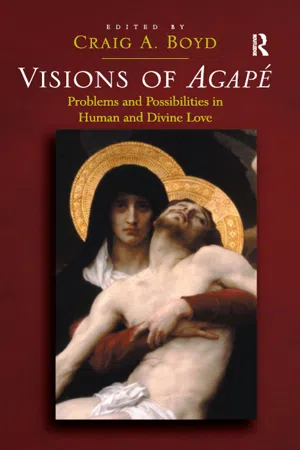
This book brings together philosophical and theological perspectives on agapistic love. The aim of the text is to illuminate the nature of unlimited love by distinct and integrative approaches to the intersection of the divine and the human. Various scientific approaches to human forms of love seem to shed light on our nature as social beings. But to what extent are the natural desires for affection, sexual love and friendship augmented, revised, perfected or replaced by the gift of grace? In other words, we can ask how is it that agapé modifies or shapes the natural loves? Diverse theological and moral traditions address the question in quite startling contrast. Thomists follow the dictum that 'Grace does not destroy nature but perfects it'. Lutherans draw a sharp contrast between law and Gospel while Wesleyans see charity as the sanctifying power of the Holy Spirit. Some feminist theorists see the idea of self-giving love as contrary to genuine self-fulfilment while the neo-Kantians see love as a duty to others, and some Kierkegaardians see the command to love as an unusual manifestation of divine command ethics. These diverse approaches, in light of contemporary research in the natural and social sciences, can provide fertile ground for the exploration of the intersection of human and divine love. To date, there is no text available that brings scholars from various theological and philosophical backgrounds together to engage in interdisciplinary dialogue on this important and much neglected aspect of research into the human and divine loves. This book offers a significant attempt to remedy the situation.
Trusted by 375,005 students
Access to over 1.5 million titles for a fair monthly price.
Study more efficiently using our study tools.
Information
Topic
Teologia e religioneSubtopic
ReligioneChapter 1
The Perichoretic Nature of Love: Beyond the Perfection Model
Introduction
One of the unfortunate realities of modern theology, and slightly less so with post-modern theology, has been the separation of Christian theology from Christian ethics. Too often Christian ideas on the incarnation and the Trinity have had little bearing on Christian ethics with the result that ethics often assumes an autonomy as a separate and distinct discipline from Christian theology.1 In fact Karl Barth went so far as to suggest that there is no such thing as ethics as severed from theology. He says, “When we speak of ethics, the term cannot include anything more than this confirmation of the truth of the grace of God as it is addressed to man. If dogmatics, if the doctrine of God, is ethics, this means necessarily and decisively that it is the attestation of that divine ethics, the attestation of the good of the command issued to Jesus Christ and fulfilled by Him. There can be no question of any other good in addition to this.”2 For Barth the attempt “to do ethics,” apart from theology shaping and informing it, was a species of hubris. Although Barth’s rhetoric often verges on the hyperbolic I must agree that a distinctively Christian ethic cannot proceed as if Christian commitment and doctrine are irrelevant.
This essay is a modest attempt at one way of bridging the gap between the two disciplines. As I see it, Christian ethics should intentionally borrow from theology not only the teachings of Christ Himself on love of God and neighbor, but should intentionally use Christian doctrine to shape and inform Christian views on ethics with respect to how we conceptualize the relationship between human and divine love. But to make the assumption that there are human and divine loves as distinct and discrete categories already seems to beg the question. It may be more appropriate to say that love qua love is always good and life-affirming in all its various manifestations but that we often confuse love with mere desire, which may or may not be appropriate. Some thinkers have maintained that we should distinguish between “genuine” and “false” notions of love and that these categories cut across the traditional designations of “human” and “divine.” But I believe that this also betrays a question-begging method in the sense that love can be good or evil inasmuch as the loves are identified with their sources as divine and human. To some extent, an example of these kinds of distinctions can be found in C.S. Lewis’s The Four Loves.3
In this work Lewis considers the three natural loves (storgé, eros and philia) as fundamentally incomplete without divine love (agapé). Lewis’s work is provocative and thoughtful in its consideration of how the human loves operate in every day life. The human loves are good since each one is part of our created nature and serves a specific purpose. Eros attracts the sexes to one another while storgé provides the affection necessary for human infants to thrive. Philia not only enables human cooperation but further gives humans living in community a sense of authentic friendship that transcends the merely cooperative.
Lewis’s famous proclamation that “Each of the human loves, when left to themselves, can become demonic,” represents his view that charity is a necessary complement to the natural loves. Charity, as all-sufficient, seems to have no need of the other loves but each of the natural loves requires the presence of charity. This seems to echo the Thomistic notion that “Grace does not destroy nature but perfects it.”4 Charity, on Lewis’s view, completes and perfects the human loves. It penetrates and imbues them with a new vision of life. Although Lewis’s work is significant and provocative it still suffers from two basic weaknesses. First, it too readily divides the loves into discrete domains which seems counter to much of human experience. Second, agapé is construed in such a way that it has the power to affect the other loves, but the other loves have no appreciable effect on agapé. The cumulative effect of these two weaknesses is that it results in a denigration of the human loves and the created order such that his views come much closer to Anders Nygren’s more pessimistic theory than he would probably be comfortable with. I contend that the divisions between the loves are blurred by the fact that each of the loves has the capacity to inform each of the other loves by means of a perichoresis—an idea intentionally borrowed from theology to describe the mutual interpenetration of the persons of the Trinity. A perichoretic theory of love can reaffirm the goodness of the created loves without the danger of hubris. Since each of the loves needs the other, we see a reflection in our lives of the love that the persons of the Trinity have for one another. In short, I see each of the loves as necessarily interpenetrating the others. I begin by considering two examples of the “perfection model”: the work of Thomas Aquinas and that of C.S. Lewis. Aquinas is the first to develop a coherent account of the perfection model, which seems to anticipate a good deal of what Lewis addresses in the “Four Loves.” I briefly consider the Christian understanding of perichoresis and how it might serve as a model for thinking about human and divine loves and their relationships to one another. In my discussion of Aquinas and Lewis, I do not intend simply to reject their views outright, but I consider carefully their positive contributions to my analysis of love and incorporate these ideas into my own reconstruction of the relationship of the various loves.
Aquinas on the Nature of Love
For Thomas Aquinas, human nature was endowed in the creation with various desires and goods appropriate to their nature as rational animals. On Aquinas’s hylomorphic understanding of the human soul, the human (or more properly, the “rational”) powers of the soul unify the organic and animal powers of the soul. Humans share with all living creatures the natural drive to preserve their own being. With other animals they share the desire to eat, drink, procreate, and nurture the young. But humans are unique in that they also desire the good qua good and not merely the good in reference to the satisfaction of one of the animal appetites or inclinations.
The love that animals have for the objects of their desire moves them to action. In this way, an appropriate object of love elicits animal love and is not merely an innate desire. Desire is contingent upon the sensory apprehension of the object in question which moves the animal from potency to act. Desire, in this respect, always signifies a completion of a natural inclination to the good that is not already present to the agent. All animals, including humans, have this “love” for an object and this arises from specific desires for food, drink, sex, and nurturing the young. But humans also have the capacity to judge among competing loves or desires that other animals do not seem to possess.
Human love transcends and integrates the other loves inasmuch as the human agent can adjudicate among various goods. Indeed, the term dilectio implies that there is a prior choice (electio) in amor (IaIIae.26,3). Like the animal loves the desire is elicited by an appropriate object, but unlike the animal loves the choice a human makes regarding the relative value of the good in question compared to the good itself should always play an important role.
For Aquinas, the will (voluntas) has as its natural object the good qua good and not any particular good. The will is a “rational appetite” and as such is subject to the intellect’s apprehension of the good that should be pursued. While other animals pursue particular goods based upon elicited appetites, humans desire the good as presented to the will by the intellect. As such, love, or desire, is the proper activity of the will.
The generic term for love Aquinas gives the name amor. His famous comment that “All charity and desire are love but not the converse” illustrates the point that “love” is a multivalent term and that each use of the term requires special attention to its appropriate context. For Aquinas, there are many forms of amor, and it is worth noting briefly their special meanings. As we have seen above, dilectio is that love that includes the idea of choice. Affectio carries with it the idea of “being moved” to love, much as the Latin passio does. Amicitia is the special form of love we know as friendship. And caritas is a specific form of amicitia in that it is the love, and friendship, God lavishes upon us and we in turn have for God. An important feature of all the manifestations of love is the tendency towards union with the object of its desire. Michael Sherwin says that all the loves require a kind of union between lover and beloved. He observes, “Love both presupposes union and likeness between lover and beloved, and causes deeper union. It causes mutual indwelling between lover and beloved, and even an ecstasy that draws the lover out of himself and toward the beloved.”5 Sherwin lists five characteristics of love:
1. Entails mutual benevolence
2. Benevolence that is mutually recognized
3. Mutual love entails mutual beneficence
4. Friendship has the nature of a habitus
5. Based on a certain communicatio in bono.6
Obviously love must be mutual for it to be love, otherwise it is mere admiration—an affirmative gazing upon the other. But it also requires benevolence—that is, literally “willing the good” for the other, and once again there is a kind of mutuality that pervades the relationship.
But “willing the good” (i.e., benevolence) is not the same as “doing the good” (i.e., beneficence). I must not only will the good for the other but I must also act on the basis of my will for the good. This willing and doing the good for the other is not a singular event but a pattern that forms and informs my life. It is a habitus that enables me to practice love with relative ease. Finally, love requires a communicatio in bono, that is, a participation in the good. For Aquinas, this participation is an ontological reality that enables friends, blood-relatives, spouses, and others to participate together in one another’s good.
The various loves can be distinguished according to their objects which determine the kinds and manners of love. With regard to our love for our blood-relatives (amicitia consanguineorum), Aquinas believes that this is a love based upon our nature which tends to place a greater obligation upon us because the bond with our kindred is based upon natural origin which is something more enduring than other kinds of friendships. He says, “friendship among blood-relatives is more stable as it is based upon nature and prevails in matters concerning nature. Thus, there is a greater obligation to provide them with the necessities of life” (IIaIIae.26.8,ad1). Since our parents brought us into the world, we owe them an obligation of reverence similar to that which we owe God. Our relationship to our own offspring is a bit different: since we brought our children into the world we undertake a voluntary obligation to provide for them. The natural love we have for both parents and children is based upon our nature as social beings and this can be seen in the animal kingdom as well.
Another kind of love that seems to have its origin in our sensitive powers is the desire for sexual union. Clearly all mammals have a desire for sexual reproduction. The human creature has this appetite as well, but this kind of love for the other is also dilectio, a love that assumes a prior choice. Non-rational animals do not possess choice and therefore cannot experience this sort of love. Aquinas sees this sort of love between a man and a woman as a kind of intimate union such that the intimacy is greater than our love for our parents but not based upon kinship. The desire for union with the other is of ultimate concern here.7 The imagery of sexual union and the partners’ mutual participation in the life of the other demonstrates not only the intimacy and unification of selves but also serves to show that love is reproductive. Sexual union leads to new life. It is fitting that the act of sexual love results in a new life that is the incarnation of that love. Yet, the original lovers are not jealous of the new life but welcome it and nurture it. There is always room for one more person to participate in the life of love.
Two interesting features of Aquinas’s treatment of the natural loves need comment here. First, the natural loves appear in the treatise on charity. He briefly discusses love in the treatise on the emotions in an earlier passage of the Summa, but his most extended treatment of it occurs within a specifically theological context. That is, we come to know more fully what love is when we consider it from the perspective of faith. Second, his tendency to speak of these loves in terms of dilectio and amicitia signifies that human love always includes two important components: choice and friendship. In all genuine human love—as distinguished from purely animal loves—we may be prompted by our appetites to pursue an object of love but we always retain choice. Further, the choice is a choice to “befriend” another.
For Aquinas the love we have for God is a kind of friendship with God. But friendship is a kind of communion or participation in the life of the other. Charity itself is a special kind of participation in God since the created order is such that all creatures “live and move and have their being” in God. For Aquinas, there is an important ontological sense that all human creatures participate in God to the extent that their noetic and affective capacities are parasitic upon the God of creation as expressed in the verbum Dei.8
An important point Aquinas makes regarding the love of God is that we have a two-fold love for God: one based on our natural desire for God (as found articulated in the precepts of the natural law) and another love for God based upon the charity that God lavishes upon us. He says,
We can say that there are two kinds of goods that we are able to receive from God: the good of nature and the good of grace. But the good of nature which God has given to us, serves as the foundation for the natural love by which humans, when they are in the integral state of nature, love God above all things including themselves. (IIaIIae.26.4)
The telos of nature directs us to the good of grace even though we cannot achieve the good of grace without divine assistance. One of the primary precepts of the natural law indicates humans have a natural desire to pursue the truth about God (IaIIae.94.2). The desire to pursue the truth about God may lead one to the point of coming to know and love God through divine grace—the second and more perfect kind of love we can have for God.
The love of God—as infused in us by divine charity—is such that it transforms and orients our lives towards God in a new way: a way that perfects but does not destroy our natural affections or loves. Stephen Pope says that “Thomas’s interpretation of charity followed from the ...
Table of contents
- Cover
- Half Title
- Title Page
- Copyright Page
- Dedication
- Table of Contents
- List of Contributors
- Acknowledgements
- Introduction: Perspectives on Love and Agapé
- 1 The Perichoretic Nature of Love: Beyond the Perfection Model
- 2 Nature, Grace, and Measuring Agapé: Science, Religion, and the “Flame of Love”
- 3 The Love of God the Father: Agapé and Masculinity Ruth Groenhout
- 4 Agapé and Nonviolence
- 5 Can Love Be Commanded? Kierkegaard’s View of Neighbor Love
- 6 Agapé, Brokenness and Theological Realism in L’Arche
- 7 God’s Love Encountering Human Love: Psychological Perspectives Informing (and Informed by) Theology
- 8 That Than Which Nothing More Lovely Can be Conceived
- 9 A Relational God and Unlimited Love
- Index
Frequently asked questions
Yes, you can cancel anytime from the Subscription tab in your account settings on the Perlego website. Your subscription will stay active until the end of your current billing period. Learn how to cancel your subscription
No, books cannot be downloaded as external files, such as PDFs, for use outside of Perlego. However, you can download books within the Perlego app for offline reading on mobile or tablet. Learn how to download books offline
Perlego offers two plans: Essential and Complete
- Essential is ideal for learners and professionals who enjoy exploring a wide range of subjects. Access the Essential Library with 800,000+ trusted titles and best-sellers across business, personal growth, and the humanities. Includes unlimited reading time and Standard Read Aloud voice.
- Complete: Perfect for advanced learners and researchers needing full, unrestricted access. Unlock 1.5M+ books across hundreds of subjects, including academic and specialized titles. The Complete Plan also includes advanced features like Premium Read Aloud and Research Assistant.
We are an online textbook subscription service, where you can get access to an entire online library for less than the price of a single book per month. With over 1.5 million books across 990+ topics, we’ve got you covered! Learn about our mission
Look out for the read-aloud symbol on your next book to see if you can listen to it. The read-aloud tool reads text aloud for you, highlighting the text as it is being read. You can pause it, speed it up and slow it down. Learn more about Read Aloud
Yes! You can use the Perlego app on both iOS and Android devices to read anytime, anywhere — even offline. Perfect for commutes or when you’re on the go.
Please note we cannot support devices running on iOS 13 and Android 7 or earlier. Learn more about using the app
Please note we cannot support devices running on iOS 13 and Android 7 or earlier. Learn more about using the app
Yes, you can access Visions of Agapé by Craig A. Boyd in PDF and/or ePUB format, as well as other popular books in Teologia e religione & Religione. We have over 1.5 million books available in our catalogue for you to explore.