- 240 pages
- English
- ePUB (mobile friendly)
- Available on iOS & Android
eBook - ePub
About this book
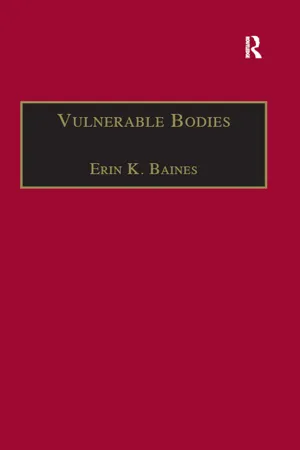
Examining the response of the United Nations to forced displacement in three cases, this insightful work lays bare the breach between advances in global policy on gender equality and humanitarianism and the implementation of these policies. In this book Erin Baines uses the examples of Bosnia, Rwanda and Guatemala to explore the interplay between the global, the national and the local level. By providing critical empirical data, feminist propositions can be tested against experience. Vulnerable Bodies will form an excellent resource for courses in international relations, gender studies, development studies, comparative politics, and for UN policymakers and government practitioners.
Trusted by 375,005 students
Access to over 1.5 million titles for a fair monthly price.
Study more efficiently using our study tools.
Information
Subtopic
PoliticsIndex
Social SciencesChapter 1
Transnational Advocacy on Refugee Women, 1979–1989
‘I did not see any women’. UN High Commissioner for Refugees, Jean-Pierre Hocke on a visit to Afghan refugee camps (quoted in Camus-Jacques 1989, 141).
In the late-1980s, Anders Johnsson, a senior legal advisor in UNHCR, candidly remarked that ‘Women make up half, if not more, of the world’s refugees, yet since the UNHCR was established in 1950, little has been done…to deal with them as women in a particular situation and with particular needs’ (Johnsson 1989, 222). Johnsson attributed this lack of attention to the ‘exclusively male-oriented’ exercise of treaty making that both figuratively and literally made refugee women “invisible”. Even the then High Commissioner Jean-Pierre Hocke had to admit it. In a visit to an Afghan refugee camp where women were the majority, he did not see women. The UN Decade for Women presented a critical opportunity for refugee advocates to lobby UNHCR to end this institutional legacy.
The rape of Indo-Chinese refugees and reports of sexual violence in refugee camps across the world challenged the legitimacy of UNHCR’s claim that “gender neutral” assistance mechanisms protected both men and women equally. Advocates argued that when refugee women were excluded from camp management structures, or denied access to identity documents or to asylum procedures, their vulnerability to exploitation increased. Through information campaigns and rallies, workshops and conferences, publications and the creation of databases, advocates ensured that the experiences of refugee women were no longer confined to some domestic space, but became a public issue that UNHCR could no longer ignore. These arguments were imbued with liberal sensibilities about universal equality and compassionate humanitarianism. By 1990, UNHCR relented, introducing a series of corrective measures.
Refugee women not only became visible on the global humanitarian agenda, they became a universal example of the limitations and fallacies inherent in humanitarian work. After a decade of seemingly intractable population displacement in the 1980s, transnational advocates for refugee women and Western donors became unlikely partners in their criticisms of UNHCR operational approaches. While advocates and donors may have diverged on the question of extending legal asylum in the 1980s, both sets of critics demanded UNHCR take a more proactive and preventative approach to the refugee problem, as well as called on the UN agency to adopt inclusive and participatory refugee management practices. Both preventative and participatory initiatives were pursued by the refugee agency in separate veins, with frequently contradictory and sometimes even pernicious results. I address this issue further in chapter 2. The puzzle before us in this chapter is how UNHCR arrived at this remarkable set of policy and operational changes after 30 years of relatively immutable management practices regarding men and women.
In particular, I examine the process in which refugee women gained global visibility by analyzing the campaigns of transnational advocates against the historical backdrop of global refugee work in the 1980s. I ask the following types of questions: How and why were transnational networks of refugee advocates able to successfully realize policy-related change within a decade?; If refugee women were so totally excluded from UNHCR definitions of asylum and camp management that they literally were not seen, what historical circumstances led to their visibility?; Who were these advocates, and what were their objectives?; How did the discursive framing of the issue represent refugee women in particular ways that made policy change possible?
As Keck and Sikkink (1998) have argued, any global campaign that converges around a single issue in turn constructs a universal set of problems, representations, articulations and discourses. Issues are presented as simple and singular in transnational campaigns in order to make policy change thinkable, or doable. By mobilizing new information on refugee women’s experiences and using the power of persuasion and the politics of “shame”, a transnational network helps to ‘create new issues and categories to persuade, pressure, and gain leverage over much more powerful organizations and governments…to influence policy outcomes [and] to transform the terms and nature of debate’ (Keck and Sikkink 1998, 2). Given that the global refugee regime was undergoing a crisis in international protection and legitimacy, advocates keenly appealed to the liberal sensibilities of policy makers and notions of equality and economic efficiency current in this debate. As a result of this strategic representational campaign, refugee women were simultaneously located in the private realm (equated with the domestic, private sphere) and removed from this realm to the universal, global realm (the public). The implications of all this are explored in the case studies.
The Crisis of Asylum and UNHCR Legitimacy, 1980–1990
One of the most pressing issues facing UNHCR in the early 1980s was the flight of hundreds of thousands of refugees in South East Asia. The tragic, risk-everything plight of refugees across dangerous waters in congested boats captured the attention of the world. In 1979, members of the Association of South East Asian Nations (ASEAN) announced that they would pushback the hundreds of refugee-laden boats landing on their shores. They argued that refugee camps were already overcrowded and that their resources were nearly exhausted. Recognizing that hundreds of thousands of lives were in jeopardy, UNHCR convened an international conference in July 1979, bringing together ASEAN and Western states to commonly address the issue. The conference marked an era of global commitment to burden sharing, where Western states pledged dollars to refugees in camps, and vastly increased resettlement numbers from 125,000 to 250,000. In return, ASEAN state leaders promised to cease push-backs. The Vietnamese government pledged to halt the departure of illegal boats trafficking refugees and to establish orderly departures.
Media visuals of Indo-Chinese boat-persons were particularly compelling to Western publics and governments. The US government accepted increased numbers of refugees, largely as a statement to communist governments. However, the US also counted on the public’s sympathy, repeatedly referring to the brutal pirate attacks on persons who had seemingly next to nothing left. Within this narrative, refugee women were represented as the “most” vulnerable.
This is what usually happens when a refugee boat is attacked by pirates. The pirates board the boat and search all the passengers for valuables…they also conduct body searches on men as well as women and children. Then the women are forced to move to the pirate boat while the men stay behind. The women are raped repeatedly by the crew of the fishing boats and are often only returned to the refugee boat after two or three days…(Simandjuntak in Kelley 1989, 234).
Among Vietnamese boat people there have also been massive instances of rape. The pirates who attacked the refugees in the boats…no longer killed them…but forced the boat people to take active part in the rape of their own girls and women or to look on, in this way they were made accomplices in their own humiliation. This led to a loss of self respect for the entire group, not only for the victims of rape (Dutch Refugee Association 1985, 31).
…Fewer than half the women abducted since 1982 have been recovered (UNHCR 1985a).
The numbers of attacks were staggering. In a 1981 study of 452 boats overloaded with 15,479 refugees, UNHCR found that 349 boats had been attacked an average of three times each; 578 women and girls were confirmed to have been raped; 228 women had been abducted; and 881 people were missing or dead (UNHCR 2000b, 87).
As the media focused its attention on the “Asian Holocaust”, sexual violence against Vietnamese women during flight increasingly occupied the agendas of UN agencies, governments and NGO bodies. Up until this point, international humanitarian law did not consider rape a crime of war that required a political response. Rather, it was understood as an unfortunate, inevitable side effect of conflict. While the rape of refugee women on the high seas was not a subject of discussion at the Geneva Conference on Indo-China, it was raised at a UNHCR workshop on Indo-Chinese refugees in 1981, and UNHCR did report on this situation in the second UN World Conference on Women in Copenhagen (1980).
The Indo-Chinese crises at the start of the decade had arguably strengthened the international protection regime, and opened spaces for the discussion of gender-related protection issues. But by the end of the decade, the protection regime was swinging into full crisis again, and the global consensus on burden-sharing that had been reached in 1979 had virtually collapsed. As new waves of Indo-Chinese refugees fled to the West during the latter half of the decade, Western suspicions of their reasons for seeking asylum grew. Many were regarded as economic migrants rather than refugees, and it was feared that overly generous asylum policies opened the door to “bogus” refugees. In June 1989, then High Commissioner Jean-Pierre Hocke called for a second international refugee conference. Seventy government attendants adopted a more rigorous, new regional approach – the Comprehensive Plan of Action – that would enforce higher standards for resettlement.
Compounding the South East Asian crisis of asylum, were similar crises in Central America, Latin America and Africa. As the Cold War heated up, the superpowers resumed proxy wars in “third world” states to contain the geo-political reach of the other. In conflicts that might otherwise have been short-lived, the superpowers intervened, prolonging conflicts that in turn produced new and large numbers of displaced persons. Communities of “refugee warriors” sprang up, often with the material and strategic support of vying superpowers. This in turn led to the generation of regional insecurities and crises in Central America, the Horn of Africa, Southern Africa and Afghanistan. UNHCR was struggling to handle multiple refugee crises at the same time, while walking the tightrope of superpower interests. The refugee organization depended on funding from the West, and so was reluctant to openly criticize American or European policies. But Western asylum practices were dubious, as the case of US reluctance to accept asylum seekers from Central America illustrated in the 1980s.
In contrast to the Indo-Chinese refugee situation, most refugees produced by Cold War proxy conflicts were less interested in resettlement, than they were in the prospect of returning home. As resettlement grew less and less of an option, and as many proxy wars reached a seemingly endless stand-off, neither return nor resettlement appeared feasible options. For UNHCR, the 1980s stretched into a decade of long-term care and maintenance programmes in sizeable refugee camps.
Within camps, it had become progressively more difficult to ignore the disproportionate number of women present. In a sense, refugee women became “visible” through their sheer numbers. Already at the beginning of the decade, UNHCR and refugee-assisting organizations admitted that, in fact, refugee women and their children constituted of the majority of refugee populations globally. While UNHCR maintained that its protection and assistance practices were gender neutral and therefore equally accessible to both refugee men and women (UNHCR 1985b, 10), in some camps the specific needs of women were becoming harder to ignore. For instance, in Pakistan, UNHCR distributed assistance to Afghan refugees based on the “head of household” model. Assistance went almost exclusively to men, assuming a “trickle down” effect; that women and children would automatically receive resources distributed by male leadership. However, large numbers of female-headed households in camps – not uncommon where men were killed or engaged in combat – were excluded in this model. Even if men were present in households, the model increased women’s dependence on men, lacking their own refugee documents necessary to obtain assistance. In either case, the head of household model increased instances of sexual exploitation and violence.
Against the background of these protracted refugee settings, donors and activists alike began to criticize UNHCR assistance practices, arguing it created dependency and as a result, mitigated refugee return. The delivery of relief supplies was also criticized for failing to address the root causes of displacement. The reactive and exile-oriented refugee practices of the past failed to challenge sending states, or create an environment in which refugees could find solutions to their own problems. At the same time, a number of widely read academic studies (Chambers 1984; Harrell-Bond 1986; De Waal 1997) were critical of UNHCR camp management practices. Harrell-Bond’s Imposing Aid: Emergency Assistance to Refugees made a convincing case that UNHCR aid distribution was based on an outmoded, archaic model of delivering assistance. Based on a study of aid distribution in Sudan, Harrell-Bond found that top-down delivery mechanisms failed to take into consideration the realities, experiences and resources of refugees themselves and, in doing so, undermined their potential to become self-sufficient. Her influential study was joined by a growing number of critiques of development and humanitarian practices in the 1980s. All argued for a revolution in such practices, advocating for “empowerment” approaches and participatory practices. Importantly, these critics recognized that ‘refugees [were] not the passive recipients of relief…but active and dynamic in the outcome of all interventions’.
Responding to the growing crisis of asylum and UNHCR legitimacy, High Commissioner Hocke tried to shift the focus of the agency away from protection and towards assistance (UNHCR 2001a, 249–51). Hocke attempted to make the organization more “operational”, dismissing protection-oriented activities as Eurocentric and overly legalistic. At the same time, Hocke recognized that care and maintenance programmes were costly and unsustainable. Hocke introduced the idea of promoting “repatriation” as the preferred durable solution. He claimed that UNHCR could be a central player in the mediation and facilitation of repatriation. To lead by example, High Commissioner Hocke eagerly accepted an invitation by Central American leaders to participate in a conference on durable solutions to the problems of refugees, the internally displaced and returnees. The International Conference on Central American Refugees was held in Guatemala City, resulting in an action plan for refugee repatriation.
Hocke’s emphasis on “root causes” and repatriation foreshadowed the direction of the organization in the 1990s. However, his ‘…ideas were clearly too far ahead of the times’ (Loescher 2001b, 42). Cold War geo-politics continued to contain refugee movements (and the UN) throughout most of the decade, and most of the ‘refugees were destined to remain trapped in camps’. By the start of Hocke’s second term in 1988, the Cold War unexpectedly gave signs of ending. Recognizing an opportunity to engage the Soviet giant, Hocke visited Moscow to discuss the situation in Afghanistan, causing a stir in Washington. Hocke’s often maverick leadership style and inability to reign in the unwieldy UN budget led to further donor scrutiny of UNHCR. As a new series of refugee crises were unleashed after the fall of the Berlin Wall in 1989, UNHCR experienced a gaping deficit leading to a complete breakdown of trust between UNHCR and Western donors. High Commissioner Hocke resigned in late fall of that year, leaving the organization in disarray (Loescher 2001a, 264). It was within this historical moment that a transnational network of advocates for refugee women finally won the attention of senior UNHCR managers.
The UN Decade for Women, 1975–1985
The UN Decade for Women was perhaps one of the single most significant series of events for the advancement of refugee women’s visibility in the refugee regime (Spencer-Nimmons 1994a). Declared after the first World Conference on Women in Mexico City (1975), the Decade would convene two more world conferences and one follow-up conference, drawing together interested state and non-state actors. Under the themes of Equality, Development and Peace, the world conferences were marred by some of the very same turbulent geo-political dynamics that shaped the refugee agenda (see Winslow 1995), but these monumental events were also a catalyst to the emergence of a transnational advocacy network for refugee women, later allied under the banner, the International Working Group for Refugee Women (IWGRW).
While the 1975 World Conference in Mexico made no mention of refugees, the mid-decade World Conference in Copenhagen (1980) provided key meeting points for activists, government representatives and staff of refugee-related organizations concerned about women’s issues. As refugee camps grew in number and size in the 1980s, UNHCR increasingly “partnered” with non-governmental organizations (NGOs) that implemented humanitarian assistance programmes. More than at any previous time in history, there was a greater number of women working in refugee-assisting NGOs (Spencer-Nimmons 1994b, 13). Witnessing the negative impact of assistance delivered to refugee populations without regard to sex, some staff began to voice concerns to senior managers of the international NGOs they worked for. They took advantage of connections in the West to lobby Western donor decision-makers. Mindful of the plight of Vietnamese women, some feminist-minded donor state decision-makers found themselves in agreement with advocates that the issue needed further study. In December 1979, the General Assembly called upon UNHCR to prepare a report on the situation of refugee women the world over, and to make recommendations for action (UN General Assembly 1979).
The UNHCR report presented in Copenhagen was thin, but raised substantive awareness of the challenges that refugee women faced in exile, including sexual violence. UNHCR reported that 80 percent of all populations were women and children, and declared that they were among the most vulnerable groups. Yet state delegates at Copenhagen were tumultuously divided over global geo-political issues. Specifically, Western state delegates wanted to focus the agenda on sexual discrimination against women. Delegates from Latin America, Africa, the Soviet Union and Asia rejected the term “sexism” itself on the grounds that it did not translate easily into other languages. Some delegates suggested that the term reflected a preoccupation with sex. More poignantly, delegates were divided over root causes of women’s subordination. Many third world delegates firmly stood behind the movement towards a New International Economic Order (NIEO), and were vocally opposed to the West’s disproportionate share of global wealth at the expense and exploitation of the rest of the world. Global inequalities, along with foreign aggression and exploitation were key issues debated by delegates. Palestinian and Arab delegates insisted on the inclusion of clauses that equated Zionism with racism, alienating Israel and its Western allies (see Jacquette 1995). Despite long and tedious negotiations, walk-outs and the rejection of the ultimate declaration by key players, the conference ended with the adoption of a global declaration.
In her assessment of the conference, Jane Jacquette argues that in the face of all this acrimony, one of the key successes was the addition of the issue of refugee women to the final declaration (Jacquette 1995, 56). Yet this success was realized by avoiding larger political debates on root causes and global inequalities. Rather, the Copenhagen Declaration included a number of symbolic statements recognizing the specificity of refugee women’s protection needs within the context of existing refugee definitions, and urging UNHCR to take corrective steps to extend protection in areas where UNHCR was “gender blind” (Bonnerjea 1985, 15). Despite these efforts, UNHCR took few actions to comply with the suggestions outlined in the Copenhagen Declaration. In the years following the conference, few staff members inside the organization were sufficiently impressed that gender mattered, maintaining the gender neutrality of the international convention for refugees (Camus-Jacques 1989). At a symbolic level, the Declaration provided fuel to activists, inspired to collect more data on the issue.
To this end, conferences and workshops became key forums for information-sharing. Gender-related issues such as rape, sexual violence, female genital cutting, forced abortion, and lack of access to services were brought into the public domain and debated. In 1983, the Intergovernmental Committee for Migration (ICM) met to discuss protection-related...
Table of contents
- Cover
- Half Title
- Title Page
- Copyright Page
- Dedication
- Table of Contents
- Foreword
- Preface
- Series Editors’ Preface
- List of Abbreviations
- Introduction: On Vulnerable Bodies
- 1 Transnational Advocacy on Refugee Women, 1979-1989
- 2 Promoting Gender Equality in the UN Refugee Agency, 1990-2002
- 3 In Ruby Splendor: Guatemala
- 4 The Fragile World: Bosnia-Herzegovina
- 5 Stones, Skulls, Bones: Rwanda
- 6 Lessons Learned for the Next Generation
- Bibliography
- Index
Frequently asked questions
Yes, you can cancel anytime from the Subscription tab in your account settings on the Perlego website. Your subscription will stay active until the end of your current billing period. Learn how to cancel your subscription
No, books cannot be downloaded as external files, such as PDFs, for use outside of Perlego. However, you can download books within the Perlego app for offline reading on mobile or tablet. Learn how to download books offline
Perlego offers two plans: Essential and Complete
- Essential is ideal for learners and professionals who enjoy exploring a wide range of subjects. Access the Essential Library with 800,000+ trusted titles and best-sellers across business, personal growth, and the humanities. Includes unlimited reading time and Standard Read Aloud voice.
- Complete: Perfect for advanced learners and researchers needing full, unrestricted access. Unlock 1.5M+ books across hundreds of subjects, including academic and specialized titles. The Complete Plan also includes advanced features like Premium Read Aloud and Research Assistant.
We are an online textbook subscription service, where you can get access to an entire online library for less than the price of a single book per month. With over 1.5 million books across 990+ topics, we’ve got you covered! Learn about our mission
Look out for the read-aloud symbol on your next book to see if you can listen to it. The read-aloud tool reads text aloud for you, highlighting the text as it is being read. You can pause it, speed it up and slow it down. Learn more about Read Aloud
Yes! You can use the Perlego app on both iOS and Android devices to read anytime, anywhere — even offline. Perfect for commutes or when you’re on the go.
Please note we cannot support devices running on iOS 13 and Android 7 or earlier. Learn more about using the app
Please note we cannot support devices running on iOS 13 and Android 7 or earlier. Learn more about using the app
Yes, you can access Vulnerable Bodies by Erin K. Baines in PDF and/or ePUB format, as well as other popular books in Social Sciences & Politics. We have over 1.5 million books available in our catalogue for you to explore.