- 232 pages
- English
- ePUB (mobile friendly)
- Available on iOS & Android
eBook - ePub
Women in Early Modern Polish Society, Against the European Background
About this book
While far fewer studies on women and gender have been published in Poland than in the West, the last decade has seen growing interest in gender history among Polish scholars. The first general history of Polish women in the early modern times was published by Dr. Bogucka in Polish in 1998; the present study constitutes an expansion, as well as a translation into English, of that seminal work. Women in Early Modern Polish Society, against the European Background makes widely available to historians and women's studies scholars in the West a mass of information about women in Poland from the 16th to the 18th century, previously inaccessible in Polish archives. In the preface, Bogucka points to the need for theoretical reflection within Polish studies of women's history, and the need to develop standard concepts and terms for the study of gender, to allow this research to develop further. She emphasizes that scholars of women's history must rely on all documents of a given epoch if they want to examine women's lives. Urban and rural records (especially law court records), church archives, private archives, diaries, noblemen's records, collections of sermons, last wills, inventories, belles letters, correspondence, are all sources which always contain scattered direct or indirect information on women and gender relations. Bogucka examines the stages of the typical woman's life-girl, married woman, widow-discussing their position in the family and society, as well as the societal changes that occurred in this sphere from the sixteenth to the eighteenth century. She also looks, among other things, at the role of women's work in the countryside and in towns according to social status and education; religious life, which offered possibilities to women to appear and to act outside the home; the impact of Reformation on the situation of women; the participation of women in the creation and consumption of culture; and women's roles in political life. Finally, she places her discussion of Polish women in comparative context, exploring the legal status and general situation of women in Poland against those in Western countries - Germany, France and England - as well as Central and Eastern Europe-Hungary, Bohemia, and Russia.
Trusted by 375,005 students
Access to over 1.5 million titles for a fair monthly price.
Study more efficiently using our study tools.
Information
Chapter 1
Phases of Women’s Lives
During the sixteenth to eighteenth centuries a woman’s whole existence and her status were determined by two basic factors: gender and belonging to a given social group. The combination of those two determinants was of crucial importance, but a discussion on which of them was the more significant is futile, particularly as the outcome of their ‘mixture’ also depended on a number of smaller factors, including the personality of the woman herself and people from her immediate circle (especially her father and her husband), as well as on the vicissitudes of life and many accidental circumstances.
On the other hand, the phases of a woman’s existence were determined by her gender and her place in the family, regardless of her social position. Hence women were perceived as maidens, wives, mothers and widows. The transition from one phase to another followed a certain ritual (the so-called rites of passage). Each phase had its own features, granted different rights and duties, the awareness of which was deeply rooted not only in legal regulations but, above all, in Old Polish mentality and custom.1 The most important rite of passage for a woman was marriage.
The inequality of the sexes manifested itself at the very moment of childbirth: everybody impatiently expected a male descendant.2 Not only in royal and aristocratic families, but also among the common gentry and burghers, a son ensured the continuity of the family line; he was also, by the law of nature, the main heir of a family’s fortune and, in royal families, of the throne. Moreover, among the wealthy peasants a son guaranteed the family’s stability and the continuation of the farm. By contrast, the birth of a daughter was a kind of disappointment, although this does not mean that girls were not loved, and even loved very deeply, by their parents. A father’s despair after the loss of his little daughter in the second half of the sixteenth century gave rise to the masterpiece of Old Polish literature, Jan Kochanowski’s Treny (Threnodies). More than a hundred years later Stanisław Morsztyn, a nobleman of Raciborsko, similarly bemoaned the loss of his beloved daughter in his Smutne Żale (Sad Laments, 1698). The deep emotional ties connecting fathers with their daughters are also evidenced in correspondence, of which, unfortunately, only fragments are preserved (for example, Halszka Tęczyńska’s née Radziwiłł letters to her father, from the turn of the sixteenth century).3 The presence of portraits of little girls on gravestones and epitaphs commissioned by parents of the nobility and rich burghers class, also testifies that they were surrounded by the same degree of affectionate love as boys. In the sixteenth century the following inscription was engraved on a tombstone in Warsaw: ‘To the worthiest, the most modest virgins Bona and Barbara Baryczkas, who as soon as they received lives, lost them, and were entombed straight from their cradles and diapers. O, cruel Death! Thou who pierces their parents’ hearts and sweepest them both with your scythe.’4 The epitaph of little Adelgunda Zappio, who died at the age of ten in Danzig in the seventeenth century, expresses the hope of her bereft, grief-stricken parents that they will meet their daughter again on the Last Judgement Day.
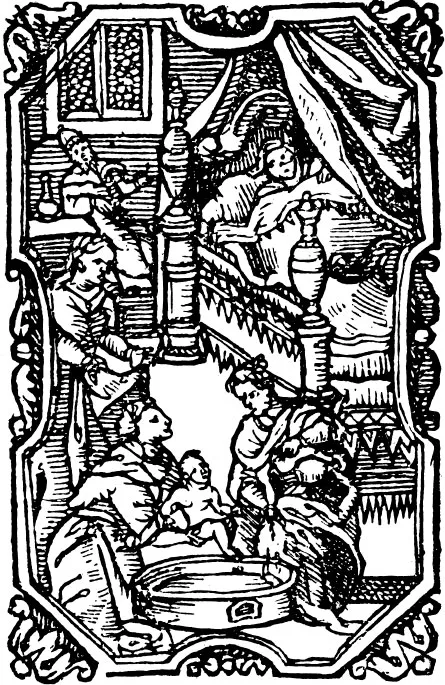
Figure 1. Birth of a child. Woodcut from J.K. Haur
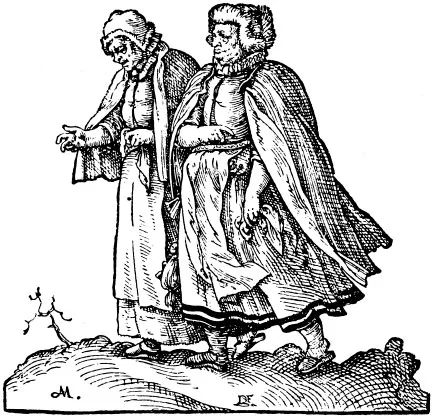
Figure 2. Women inviting guests to attend family celebrations. Woodcut by A. Möller
On reaching the age of about 14–18, each young girl faced a serious choice: marriage or convent. For the poorest groups only, a third alternative existed: she could take up a position as a servant and remain unmarried until old age and even to her very death. This choice, of course, was made not by the girl herself but by her parents and relatives;5 however, it was the parents and relatives too who decided on marriage or a religious career for a young man. Especially in the sixteenth and the beginning of the seventeenth centuries the wishes and feelings of young people of both sexes counted for little: the choice was determined by the family’s financial interests – the prospects of entering into advantageous relationships through marriage, establishing family alliances and merging landed property (among the gentry) or developing a commercial enterprise or a workshop (among the burghers). A certain F. Schulz from Livland, visiting Poland in the eighteenth century, observed: ‘Marriages without political and economic calculation are here rather an exception.’6 There was no shame attached to openly admitting such calculations: ‘Wanting to gain more power, I decided to get married’, noted Marcin Matuszewicz in his Diary.7 Among the peasants the choice of a spouse was determined mostly by practical considerations and requirements of the work on the farm. Therefore many people had an interest in each matrimonial union: family members and relatives, neighbours and friends, the whole social community to which the nupturienti belonged.
Matches were preferred among partners of equal social status and property (following M. Rey’s recommendations in the sixteenth century),8 and similar age. However, dowry-hunting and marriages of old men to young girls or wealthy old widows to youngsters were not ruled out. A certain J.J. Kausch, who visited Poland at the end of the eighteenth century, observed every rich widow was always surrounded by a crowd of young gentlemen determined to marry her.9 Writers often made fun of such unions, probably because they gave no hope for progeny: ‘80 years of age and white hair are not a good match for a young girl,’ wrote Wespazjan Kochowski.10 Wacław Potocki mocked: ‘Husband 17 years old, the spouse about 50, her teeth are all gone; the devil himself creates such unions.’11
Despite jokes and words of condemnation, differences in spouses’ age were not a rare occurrence. In 1659 38-year-old nobleman Stanislaw Druszkiewicz married 14-year-old Elżbieta Poradowska. And the reason for this match? His health problems: ‘Before my wedding I suffered great ailments for several years … and this trouble inspired me to marry, so that I should know who would bury me,’ he admitted frankly.12 Aleksander Franciszek Sapieha, who in 1675 died tragically at the age of 21, had a wife, Joanna née Chodkiewicz, who was 13 years older.13 Well-known writer and historian Bartosz Paprocki was married to a much older but rich woman, Jadwiga Kossobudzka lured into wedlock at the age of 20 by the elderly widow’s wealth. This union turned out total hell, till Jadwiga’s death in 1572 released them from their unhappy bonds. Because of this unfortunate experience Paprocki remained a fierce misogynist until the end of his life.14 Unions between old men and young girls sometimes seemed to have better outcomes: thus a magnate, Lew Sapieha who in 1599 at the age of 42 married 16-year-old Halszka née Radziwiłł, enjoyed total conjugal bliss with her, as their correspondence shows.15 Such alliances, however, could sometimes have tragic consequences – for example the sudden death in 1646 of old Hetman Stanisław Koniecpolski as a result of an overdose of aphrodisiacs after his wedding to the young Zofia Opalińska.16
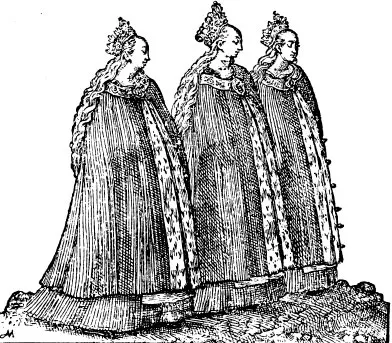
Figure 3. Bride and her maidens. Woodcut by A. Möller
Much criticized were matches between members of different social groups. The Polish nobility was well aware of the fact that marriage constituted an easy way for burghers, or even rich peasants, to obtain noble status and therefore strongly condemned such unions. ‘Nobility attracts nobility; an eagle should not associate with an owl,’ wrote Jan Chryzostom Pasek in his Diary.17 Walerian Nekanda Trepka thundered against burghers who married women from nobility and poor nobles who married rich burghers’ or even peasants’ daughters.18 Wacław Potocki, in his poem ‘On Mongrels’, suggested that the ‘half-breeds’ should be drowned.19 Research conducted on this problem (for example, by I. Gieysztorowa and W. Dworzaczek) show, however, that social boundaries were often disregarded and mixed marriages constituted an important element of social mobility.
The choice made by parents generally was not questioned by the girl who was trained in the virtues of obedience and submissiveness from her childhood. Besides, these choices were usually reasonable and acceptable. Of course, there were outright tragic cases, as is testified in the sixteenth century by the life story of Halszka of Ostróg who, as an only child and rich heiress, fell victim to the dowry hunters.20 She ended her life as a prisoner of her husband. In the mid-seventeenth century the whole country was electrified by the scandal connected by the amorous adventures of Katarzyna Sobieska, the sister of Jan Sobieski who later became King John III. Despite the girl’s affection for the young Prince Dymitr Wiśniowiecki, her despotic mother gave her in marriage to the Duke Władysław Dominik Zasławski-Ostrogski, a widower 20 years older than her. Katarzyna gave birth to a son, the fruit of an illegitimate love, barely a fortnight after her wedding ceremony! Fortunately, her elderly husband turned out to be tolerant; and after his rapid death Katarzyna was free to marry a man of her own choice – Michał Kazimierz Radziwiłł.21
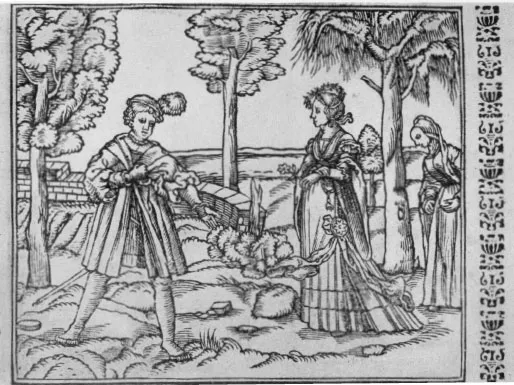
Figure 4. Proposal. Woodcut from M. Rey’s Zwierciadło [The Mirror], Kraków, 1568
Among the most renowned forced and unsuccessful unions of the second half of the seventeenth century was the first marriage of Anna Stanisławska. A 15-year-old heiress to an enormous fortune, she was given by her family in marriage to the degenerate and feeble-minded Kazimierz Warszycki. Anna’s fate, however, turned out to be much better than that of the above-mentioned Halszka: times had changed so much she could have her marriage annulled and she went on to choose, for herself, two subsequent husbands and enjoyed a short but happy span of conjugal life with each.22
Widows had considerable freedom in their choice of husband. As early as 1535, Andrzej Glaber of Kobylin, in his Tales About the Harmony of the Human Limbs mentioned as a great oddity ‘a widow who was not choosy about her candidates for marriage’ – that is, not fussy and independent in her choice.23 In the middle of the seventeenth century, young girls also started to gain more freedom in the choice of their prospective husbands.24 In the 1640s Zofia Opalińska, a young female from a magnate family was found by her suitors to be extremely difficult to please and was the despair of her brothers who wanted to give her away in marriage. Krzysztof Opaliński lamented that ‘our sister is getting on in years’ and was indignant at Zofia’s refusal to marry the magnate Ludwik Wejher, an excellent match in his opinion. She could allow herself to be squeamish, he complained, ‘if she could choose as among mushrooms, but altogether we deterred many men with so much protraction.’25 Energetic Miss Katarzyna Ottenauz was similarly choosy about her suitors and rejected those suggested to her – among others, the elderly but rich widower Mr Gabriel Kiersnowski. She finally married, according to her choice, a certain Mr Rajski. Her guardian Mr Krzysztof Zwiartowski, excused her case, writing ‘supposedly in this matter a girl cannot be forced, she is old enough and has her own understanding’.26 This opinion, acknowledging a girl’s right of choice, testifies to the changes in customs...
Table of contents
- Cover
- Half Title
- Title Page
- Copyright Page
- Table of Contents
- List of Illustrations
- Introduction
- 1 Phases of Women’s Lives
- 2 Women and Economic Life
- 3 Women and Religion
- 4 Great Debates about Women
- 5 Patterns of Female Behaviour
- 6 Women and Culture
- 7 Women and Politics
- 8 Polish Women in Comparative Context
- Index
Frequently asked questions
Yes, you can cancel anytime from the Subscription tab in your account settings on the Perlego website. Your subscription will stay active until the end of your current billing period. Learn how to cancel your subscription
No, books cannot be downloaded as external files, such as PDFs, for use outside of Perlego. However, you can download books within the Perlego app for offline reading on mobile or tablet. Learn how to download books offline
Perlego offers two plans: Essential and Complete
- Essential is ideal for learners and professionals who enjoy exploring a wide range of subjects. Access the Essential Library with 800,000+ trusted titles and best-sellers across business, personal growth, and the humanities. Includes unlimited reading time and Standard Read Aloud voice.
- Complete: Perfect for advanced learners and researchers needing full, unrestricted access. Unlock 1.5M+ books across hundreds of subjects, including academic and specialized titles. The Complete Plan also includes advanced features like Premium Read Aloud and Research Assistant.
We are an online textbook subscription service, where you can get access to an entire online library for less than the price of a single book per month. With over 1.5 million books across 990+ topics, we’ve got you covered! Learn about our mission
Look out for the read-aloud symbol on your next book to see if you can listen to it. The read-aloud tool reads text aloud for you, highlighting the text as it is being read. You can pause it, speed it up and slow it down. Learn more about Read Aloud
Yes! You can use the Perlego app on both iOS and Android devices to read anytime, anywhere — even offline. Perfect for commutes or when you’re on the go.
Please note we cannot support devices running on iOS 13 and Android 7 or earlier. Learn more about using the app
Please note we cannot support devices running on iOS 13 and Android 7 or earlier. Learn more about using the app
Yes, you can access Women in Early Modern Polish Society, Against the European Background by Maria Bogucka in PDF and/or ePUB format, as well as other popular books in History & World History. We have over 1.5 million books available in our catalogue for you to explore.