- 288 pages
- English
- ePUB (mobile friendly)
- Available on iOS & Android
eBook - ePub
Witchcraft, Magic and Superstition in England, 1640–70
About this book
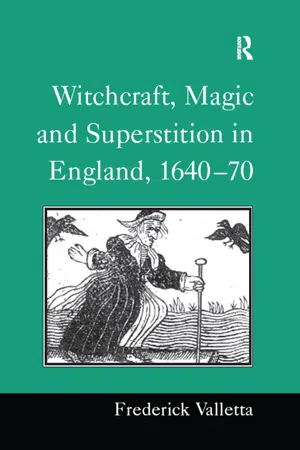
This study examines the relationship between élite and popular beliefs in witchcraft, magic and superstition in England, analyzing such beliefs against the background of political, religious and social upheaval characteristic of the Civil War, Interregnum and Restoration periods. Belief in witchcraft received new impulses because of the general ferment of religious ideas and the tendency of participants in the Civil Wars to resort to imagery drawn from beliefs about the devil and witches; or to use portents to argue for the wrongs of their opponents. Throughout the work, the author stresses that deeply held superstitions were fundamental to belief in witches, the devil, ghosts, apparitions and supernatural healing. Despite the fact that popular superstitions were often condemned, it was recognized that their propaganda value was too useful to ignore. A host of pamphlets and treatises were published during this period which unashamedly incorporated such beliefs. Valletta here explores the manner in which political and religious authorities somewhat cynically used demonic imagery and language to discredit their opponents and to manipulate popular opinion.
Trusted by 375,005 students
Access to over 1.5 million titles for a fair monthly price.
Study more efficiently using our study tools.
Information
Subtopic
World HistoryIndex
HistoryCHAPTER 1
Introduction
Immediately prior to the Civil War, and certainly during the war itself, existing social, political, judicial and religious structures either changed radically or broke down. The 1640s saw the widespread collapse of long-established institutions on an unprecedented scale. Star Chamber, the Court of High Commission, the Councils of Wales and the North were all abolished before the end of 1641. Episcopacy and church courts followed in 1646, the House of Lords three years later. The Earl of Strafford (1641) and the Archbishop of Canterbury (1645) were executed; and then, in 1649, the King was tried and suffered the same fate.1
The collapse of the personal rule of Charles I, and the failure of Crown and Parliament to reach a settlement, provided an opportunity for many people to settle their grievances with landlords. Enclosure riots took place in 26 English counties between 1640–44. The Fens experienced rioting against enclosure and drainage works as fenlanders tried to reclaim lost common lands.2 Apprentices, affected by the dislocation of the cloth trade, rioted in many towns. Moreover, there was widespread opposition to the payment of tithes, with tithe barns and manorial records being burned.3 In addition the Civil War transformed the practice of local government. Many men, who before the war would have been barred from positions of local power because of their social background, now found themselves occupying senior posts within county committees previously held by pre-war élites.4 These new county committees were empowered to summon wayward ministers and politically suspect landlords and then deprive them respectively of their parishes and their lands. Ordinary parishioners often found they were required to testify before such committees against their former superiors. In Suffolk only seven out of 400 deponents summoned to give evidence to the county committee had their occupations described as ‘gentlemen’. In Essex only two out of 250 and in Norfolk only two out of 90 were so described.5 In addition the social upheaval caused by the war together with the collapse of censorship provided ample opportunity for the emergence of various religious sects and cults.6 Towards the end of the 1640s and especially during the Interregnum, groups such as the Brownists, Diggers, Levellers, Muggletonians and Ranters were well established and many supported their causes in print.7 The growth of radical new religious sects together with the social upheaval prevalent during the 1640s also provided the impetus for the emergence of the Quaker movement during the Interregnum. Many of its members had in the 1640s been in conflict with landlords over their opposition to excessive rents and manorial services; others had been refusing to pay tithes.8 According to one estimate, by the end of the 1650s there were 35,000 to 40,000 Quakers, perhaps as many as 60,000. They were as numerous as the Catholics, more numerous than the Fifth Monarchists and Baptists.9 Running parallel with this social and religious upheaval was an increased belief in the potency, power and influence of the devil and witchcraft.
Perhaps of greater importance, the Civil War allowed English men and women to make up their minds which side they were to fight for and the leaders of both sides had to win their support.10 This was increasingly achieved through the publication of pamphlets, tracts and news-sheets. Following the removal of censorship in 1640 – which had hitherto prevented the publication of all but the most harmless of tracts – the country became inundated with news from a wide variety of sources. Between 1641 and 1642 there was an astonishing increase in the volume of news and propaganda: the first English newspapers, the publication of speeches by leading political figures, whether licensed or not, and the concoction of didactic pamphlets appealing to particular interest groups such as the London artisans or the provincial gentry. Over 20,000 titles were collected by the bookseller George Thomason, of which 5,000 appeared in 1642 alone.11 Many of these accounts attacked or defended existing popular beliefs in witchcraft, ghosts, monstrous births and apparitions, by interpreting them in relation to the troubles of the period. All shades of opinion represented themselves as occupying the middle ground, and emphasised their own moderation in contrast to the ‘schematics and atheists’ or ‘papists and malignants’ who opposed them.12
Women too were more involved in vocal discord. Although it may have been true that the Puritans with their denunciation of wife beating and churching had helped to raise the status of women, if the wife was a partner she was still an inferior one. According to Keith Thomas, many believed that to question the natural order of the family was to question the will of God, and in this sense the patriarchal system was reinforced under Puritanism. Despite this in the separatist sects women as well as men had to give proof of their individual regeneration.13 Often women would predominate in such congregations. At a Norwich meeting in 1645, there were 31 men and 83 women in the congregation.14 Many women joined the Quaker movement and were able to preach and participate in church government. According to the findings of Barry Reay, of the 300 Quakers in trouble for disrupting ministers during the period 1654 to 1659, 34 per cent were women; of the 59 Quaker ministers who arrived in America during the period 1656 to 1663, 45 per cent were women.15
At the same time the collapse of censorship allowed women to write and publish tracts often of a political nature. As has been pointed out by John Walter this could involve mobilising support for the Levellers. By 1649, The Humble Petition of Divers Well-Affected Women justified women’s new role: ‘We are assured of our creation in the image of God, and of an interest in Christ, equal unto men, as also of a proportianable share in the Freedoms of this Commonwealth’.16 Women were also concerned to express their anxieties concerning the social effects of the Civil War. In 1643 a group of London Witchcraft, Magic and Superstition in England, 1640–70 midwives petitioned Parliament to end the war because of the decrease in childbirth caused by men being away fighting.17
The anxieties that many people felt during the Civil War together with the unpredictability of events in a time of revolution increased the demand for printed auguries about the future or of the condition of loved ones fighting far away. The astrologer William Lilly’s casebooks contain many examples of wives seeking to know whether their husbands were dead or alive. Long after the fighting had stopped the enquiries continued to pour in. In July 1649 a baker’s wife asked after her husband, who had left to be a soldier in 1643, and was informed he had died five years previously.18 In addition astrologers were inundated with questions concerning the most propitious side to support – King or Parliament.19 Lilly was consulted by Mr Whitely who wanted to know if it was safe for his son to go to war; Captain Willoughby wondered if he should stay in the service or seek civilian employment.20
As well as the widespread dissemination of political and religious tracts during this period, there were also an unprecedented number of learned treatises published on the subject of witchcraft. Such publications were consistent with a widespread debate amongst the intellectual élite on the potency of magic, astrology, sympathetic cures, and a host of other ancillary topics.21 These treatises often utilised such beliefs in order to popularise particular religious or political ideologies. Many of the pamphlets that had attacked the notion of female preachers had associated their actions with imagery that deliberately pandered to the superstitions of the time – some writers even connected such schisms with delusions of Satan.22 Other sects were directly compared with witchcraft, especially Baptists and Quakers.23 As a result the superstitious tensions in rural communities, which had always existed, could now be legitimised and be channelled in the persecution of witches. One manifestation of this was the helplessness the legal authorities often felt in the face of popular hostility to a particular person.24 This does not mean witches were prosecuted and found guilty because of popular opinion, just that such a process often brought them before the courts in the first place. English law was still very much based on the common law accusatorial system, and mob retribution could often be justified on these grounds. As early as the twelfth century, anyone convicted of murder by maleficium could be handed over to the victim’s family for punishment.25 Thus while it is evident that élite attitudes helped to encourage witchcraft accusation at the popular level, it would be erroneous to attribute the rise in witchcraft persecution during the English revolutionary period solely to such a change.
However, at the outset a number of limitations need to be identified in addressing the question of witchcraft between 1640 and 1670. Firstly, it is difficult to find evidence of direct government involvement in such accusations during this time. This is not to say that central government ignored such cases, but it became increasingly impotent in the face of the revival of such beliefs. In 1646 a tentative attempt was made to impose some sort of restriction on the witch-hunting methods of Mathew Hopkins. A special Commission of Oyer and Terminer was granted in London for the trial of witches following the sensational discovery of the Suffolk witch, John Lowes.26 The Commission stressed that care was needed in the gathering of evidence and that confessions should be voluntary. One of the first things done by the court was to put an end to swimming (the method used by Hopkins to detect John Lowes). However, the appointment to the special court of Samuel Fairclough and Edmund Calamy (the elder), both of them nonconformist Suffolk clergy and strict Puritans, along with Sergeant Godbolt and the two JPs Sir Harbottle Grimston and Sir Thomas Bowes, meant that it was of a staunchly godly character. Perhaps the Commission was genuinely concerned about the methods employed by Mathew Hopkins, but it seems more likely that they wished to impose some sort of centralised control over his activities. Thus, although Parliament recognised that special care was needed in obtaining the evidence, it by no means condemned the practice of witch-hunting. In fact R. Trevor Davies has noted that the appointment of the divines, Samuel Fairclough and Edmund Calamy, to assist the JPs shows that they were perfectly willing to support further witch hunts, as both men were noted for the strength of their convictions about witchcraft.27 In addition the attitude of the Long Parliament towards witchcraft could hardly be more explicitly expressed than in the General Act of Pardon and Oblivion (24 February 1651/52). It specifically exempted from pardon ‘all offences of Invocations, Conjurations, Witchcrafts, Sorceries, Inchantments and Charms; and all offences of procuring, abetting or comforting the same; and all persons now Attainted or Convicted of the said offences’.28 However, it would be disingenuous to conclude that central government was the moving force behind witchcraft persecutions, simply from these two examples. Usually the initiative seems to have come from the popular level. Whether it progressed any further often depended on the scepticism of the presiding JP or judge.
Secondly, many of the pamphlets analysed in this work contain accounts of supernatural phenomena and stories, which are at best of doubtful authenticity and at worst blatant lies. Therefore it is necessary to exercise caution when analysing some of the more popular pamphlet accounts. As has been pointed out by Joad Raymond, often the authors of such works were not particularly learned men. In addition, the process of editing meant that accounts purporting to be contemporaneous copies were often in practice shortened and sometimes wholly rewritten. Indeed contemporaries often criticised the reliability of the content and the lack of eloquence of the writing style of such pamphlets.29 It is hardly surprising therefore that the objective interpretation of the numerous tracts published during this period must have proved...
Table of contents
- Cover
- Half Title
- Title Page
- Copyright Page
- Dedication
- Table of Contents
- List of Figures
- List of Tables
- Preface
- Glossary
- Abbreviations
- 1 Introduction
- 2 The Background to Witchcraft, Magic and Superstition
- 3 The Devil, Demonology and its Relation to Witchcraft
- 4 Ghosts, Apparitions and Prodigies: Superstition or Signs from God?
- 5 Healing, Cunning Folk and Witchcraft
- 6 Witchcraft, Law and Popular Belief
- 7 The Practice of Witchcraft
- 8 Psychological Aspects to Witchcraft and Popular Belief, 1640–70
- 9 Conclusion
- Appendix 1 Alphabetical List of Witches by County
- Appendix 2 Sympathetic Magic
- Appendix 3 The Humoral System of Medicine
- Bibliography
- Index
Frequently asked questions
Yes, you can cancel anytime from the Subscription tab in your account settings on the Perlego website. Your subscription will stay active until the end of your current billing period. Learn how to cancel your subscription
No, books cannot be downloaded as external files, such as PDFs, for use outside of Perlego. However, you can download books within the Perlego app for offline reading on mobile or tablet. Learn how to download books offline
Perlego offers two plans: Essential and Complete
- Essential is ideal for learners and professionals who enjoy exploring a wide range of subjects. Access the Essential Library with 800,000+ trusted titles and best-sellers across business, personal growth, and the humanities. Includes unlimited reading time and Standard Read Aloud voice.
- Complete: Perfect for advanced learners and researchers needing full, unrestricted access. Unlock 1.5M+ books across hundreds of subjects, including academic and specialized titles. The Complete Plan also includes advanced features like Premium Read Aloud and Research Assistant.
We are an online textbook subscription service, where you can get access to an entire online library for less than the price of a single book per month. With over 1.5 million books across 990+ topics, we’ve got you covered! Learn about our mission
Look out for the read-aloud symbol on your next book to see if you can listen to it. The read-aloud tool reads text aloud for you, highlighting the text as it is being read. You can pause it, speed it up and slow it down. Learn more about Read Aloud
Yes! You can use the Perlego app on both iOS and Android devices to read anytime, anywhere — even offline. Perfect for commutes or when you’re on the go.
Please note we cannot support devices running on iOS 13 and Android 7 or earlier. Learn more about using the app
Please note we cannot support devices running on iOS 13 and Android 7 or earlier. Learn more about using the app
Yes, you can access Witchcraft, Magic and Superstition in England, 1640–70 by Frederick Valletta in PDF and/or ePUB format, as well as other popular books in History & World History. We have over 1.5 million books available in our catalogue for you to explore.