- 232 pages
- English
- ePUB (mobile friendly)
- Available on iOS & Android
eBook - ePub
About this book
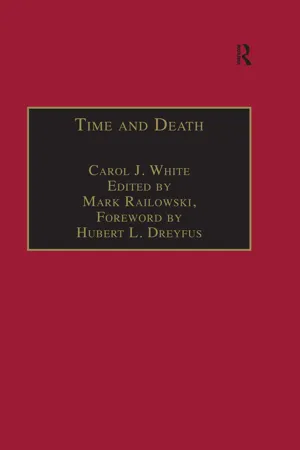
In Time and Death Carol White articulates a vision of Martin Heidegger's work which grows out of a new understanding of what he was trying to address in his discussion of death. Acknowledging that the discussion of this issue in Heidegger's major work Being and Time is often far from clear, White presents a new interpretation of Heidegger which short-circuits many of the traditional criticisms. White claims that we are all in a better position to understand Heidegger's insights after fifty years because they have now become a part of the conventional wisdom of common opinion. His view shows up in accounts of knowledge in the physical sciences, in the assumptions of the social sciences, in art and film, even in popular culture in general, but does so in ways ignorant of their origins. Now that these insights have filtered down into the culture at large, we can make Heidegger intelligible in a way that perhaps he himself could not. White presents the best possible case for Heidegger, making him more intelligible to those people with a long acquaintance with his work, those with a long aversion to it and in particular to those just starting to pursue an interest in it. White places the problems with which Heidegger is dealing in the context of issues in contemporary Anglo-American philosophy, in order to better locate him for the more mainstream audience. The language and approach of the book is able to accommodate the novice but also offers much food for thought for the Heidegger scholar.
Trusted by 375,005 students
Access to over 1.5 million titles for a fair monthly price.
Study more efficiently using our study tools.
Information
Topic
PhilosophySubtopic
Philosophy History & TheoryChapter 1
The Existential Analysis
Before we can analyze the finitude of Dasein we must get clearer about the nature of this entity. For the purposes of my discussion of time and death, I do not need to go into all the details of the first division of Part One of Being and Time, the early work that provided an 'existential analytic' of Dasein's being and set up Heidegger's lifelong task in philosophy. But we do need an account of the general project and structure of the published work, which I provide in Section 1.1. Sections 1.2 and 1.3 examine Dasein's selfhood and the difference between authenticity and inauthenticity. The fourth section examines the issue of the 'turn' or 'reversal' in Heidegger's thought and the relevance of his later work for understanding what is at issue in Being and Time.
1.1 The Project of Being and Time
In Being and Time Heidegger suggests that we should start a discussion of the nature of what it is 'to be' by examining the entity that is asking the question about the meaning of being. If we ourselves ask the question, we must have some idea, however vague, of what can count as an answer. And it is we who understand what things 'are' and constantly speak of them using conjugations of the verb "to be.' Indeed, according to Heidegger's definition of Dasein, our very way of being consists of having this 'pre-ontological' understanding of what it is 'to be.' An understanding of being 'constitutes' our being (12); our way of being is 'existence' as a 'standing toward' being. In this early work Heidegger does not argue that we would fail to discover the meaning of being if we started by examining the being of things which we encounter, and he does use this approach in later works when, for example, he investigates the nature of the work of art and what it is to be 'a thing." But in Being and Time he concentrates on the being of Dasein, since we ourselves are the ones asking the question and hence must have some vague, 'pre-ontological' understanding of what would count as an answer.
Heidegger calls his investigation of Dasein 'fundamental ontology (13). He later admits that the term is misleading since it suggests that he still is engaging in a traditional kind of ontology, one which will find some hidden presupposition or secure ground that earlier ontologies failed to discover (Way 276f./380). He does not, however, seek some rock-bottom, rock-solid 'foundation' from which all ways of being will be derived once and for all, as if there is ultimately one right answer to the question of what it is to be. Indeed, his claim that Temporality is the meaning of being implies that there is no such foundation - or no such right answer.1
The phrase 'fundamental ontology' as applied to the analysis of Dasein is also misleading in so far as it suggests that Dasein's invention of ontologies for the other realms of what-is makes things what they are. Disputants in the current controversy over Heidegger's involvement with the Nazis frequently make this implied subjectivist, voluntaristic view the link between Heidegger's philosophy and Hitler's effort to re-make Germany. Indeed, this view is so common that Luc Ferry and Alain Renault call it the 'orthodox position.' They suggest its advocates can excuse Heidegger's involvement with the Nazis on the grounds that in the early 1930s he was still beguiled by the metaphysical quest of Western culture. According to this view, in the latter part of the decade he would begin to cleanse himself from this contamination in his lectures on Nietzsche and Hölderlin in which he refers to the Nazi ideology as the ultimate expression of the last metaphysical epoch, the epoch of the Nieztschean 'will to power' and the technological drive to organize all things to serve self-chosen ends.2
However, in this chapter I will tacitly argue that this assumption about the 'subjective' and 'voluntaristic' nature of Being and Time is mistaken. The first stage of this argument is to clarify the level of analysis on which it operates. Drawing on his characterization of Dasein's being as 'existence,' he sets out to look for the 'existential structures' manifest in this being.
A simple way to comprehend the analysis of Dasein presented in Division One of Being and Time is to see it as going through a series of layers or excavations prompted by the question, what makes this aspect of Dasein's being possible?3 In the Introduction Heidegger posits what could be taken, depending on one's sympathies, as either a fundamental fact or a definition, perhaps an arbitrary one. He declares that Dasein is the entity that makes an issue of being (11f.).
If this is to be taken as an indisputable fact, one would appreciate being told more about how the phenomenological analysis uncovers it. Heidegger notes that science, a particular creation of Dasein, has undergone revolutions when it has questioned the being of the things it investigates, but he argues that Dasein in its 'everydayness,' not just its revolutionary periods, exhibits at least a tacit questioning of being. But this is not at all obvious. On the other hand, if the declaration is offered as a definition of what human beings are, or what they have been in Western culture, one would appreciate some justification of its adequacy and accuracy. How does it differ from defining humans as the rational animal or the self-conscious one?
Since the whole of Heidegger's philosophy depends on the truth of this initial, foundational claim, some readers might want to block the building of Heidegger's "house of being' right here. But, once this premise is accepted, Heidegger's version of a transcendental argument can get off the ground. In the following chapters, he proceeds to ask, how is Dasein's way of being possible?
The 'existential analysis' of Part One of Being and Time examines the 'ontological structures' of Dasein's way of being, that is, of 'existence' in Heidegger's technical sense. Such a structure is referred to as an 'existentiale,' the adjective turned into a noun. Existential understanding of Dasein's being at this level is contrasted with the 'existentiell' understanding of any particular Dasein in its quest to answer the question of being (12). An existentiell understanding takes a particular stance toward what it is to be, including what it is to be us.' We all share an understanding of ourselves and what-is: 'Every Dasein moves in such an interpretation, which for the most part coincides with the way the generation of a particular time has been interpreted and which changes with the time' (HCT 270/372).
As we read through the six chapters of Division One, Heidegger uncovers successive "layers' of Dasein's being. Given the peculiar being of its object, Heidegger's phenomenology cannot just describe the facts of experience; it must interpret something whose very being is constituted by an understanding of being. Heidegger claims that the phenomenology of Dasein is 'hermeneutical.' Hermeneutics is the study of the principles of interpreting texts, and discovering the meaning of Dasein's being is analogous to discovering the meaning of a text.
Although the 'meaning' of Dasein's being and the 'meaning' of being in general are not equivalent to the 'meaning' or 'significance' of the verb 'to be,' or the meaning of any words in any language, understanding them involves a similar process. The meaning of a word must be determined in the context of a sentence; the meaning of a sentence in the context of a paragraph; the meaning of a paragraph in the context of a passage; and so on. Hermeneutics neither begins nor ends with what is self-evident. The data for interpretation can only be understood against the background of a context which can itself only be interpreted against a broader context, that is, against its own 'horizon.'
What is the condition for the possibility of Dasein asking the question of being? The first regressive argument is that, to make an issue of being, Dasein is 'being-in-the-world.' This being-in-the-world depends on 'being-at-home-with'5 things around us, 'being-with' others, and 'being-itself' as Dasein. Next Heidegger argues that the condition for this three-faceted being-in-the-world is Dasein's understanding, situatedness, and discourse.6 Understanding, as I suggested in the Introduction, refers to the way that Dasein 'projects' its dealings with things and people on the basis of its comprehension of what-is; situatedness refers to this understanding's personal and cultural embeddedness in ways of responding and acting; and discourse refers to the way the significance of the world is articulated, both literally in language and practically in the involved activity on which it is based.7
In Chapter 6, completing the excavation of the layers presented in Division One, Heidegger argues that these aspects of Dasein are made possible by its being as care. Dasein's being is a caring for things, other people, and its own being. Things matter to it, and this sets up the context of concern in which we move every day. 'Care' is a technical term: things and people can matter to us in hate and indifference as well as the liking or affection we ordinarily call 'care.'
Chapter 6 introduces the phenomenon of anxiety in which Dasein's understanding of being is brought into question and its being as a 'standing toward being,' as simply caring, revealed most starkly. The other important feature of the last chapter of Division One is its re-description of understanding, situatedness, and discourse as aspects of care having an orientation toward the past, present, and future dimensions of time. This makes his task in Division Two much easier; in fact, he may seem to stack the deck so that its cards will fall easily into place without much argument.
When Heidegger wants to show us that the meaning of Dasein's being is timeliness, he can draw directly on his earlier analysis. Understanding has been correlated with care as being 'ahead-of-itself,' that is, being ready to deal with whatever is yet to come. Situatedness refers us to Dasein's past in that care is being-already-in a context of mattering; we always find ourselves already possessing a certain understanding of being and 'attuned' to things in certain ways. In Heidegger's famous way of putting it, we are 'thrown' into our world; we appropriate the complex significance of social practices as we are trained to be human according to our culture as we grow up. Discourse is the articulation of the significance of this present world.
This anticipation of Division Two's discussion of timeliness serves as a reminder that the transcendental layers of Dasein's being do not come to an end when we discover that behind understanding, situatedness, and discourse stands care. The second division of Part One begins by noting that, so far, the analysis has only considered Dasein in its everydayness and inauthenticity (332—33). The existential generality of Division One's discussion, with its focus on everyday activities, has neglccted Dasein's authentic being-itself; the 'layers' unearthed so far are necessary aspects of any Dasein's being. What further conditions make possible the being of authentic Dasein? We now know what it means to have an understanding of being, but how is it possible for Dasein to make an issue of being or change its understanding of being? These questions refer us to Dasein's finitude and timeliness, which in turn lead to a discussion of its historicality. These subjects occupy Division Two of the text.
Before turning to a more detailed analysis of the level of Heidegger's analysis, though, we should pause to consider its initial assumption. By analyzing Dasein in its 'everydayness,' Heidegger hopes to bring out structures common to every Dasein and avoid any bias introduced by a particular existentiell understanding of what it is to be human. Certainly it seems harmless to think that any Dasein, no matter what its time, place, or culture deals with tools, relates to other humans, understands itself in a particular way, and so forth.
However, Heidegger seems to have no a priori guarantee that his own philosophy is not another episode in the history of being, one which clearly finds its roots in the history-conscious culture of his age. John Caputo argues that the conclusion of Heidegger's analysis of culture should be the discovery that no epoch is privileged.8 So why assume that his own account of the structure of Dasein, for example, is not biased by his own particular, historical understanding of being? This is not a problem to which Heidegger is oblivious. It is the problem of justifying an interpretation, the problem of the 'hermeneutic circle,' which he says we cannot get out of but rather must 'come into' in the right sort of way (153). Any interpretation picks out the evidence it considers relevant according to the conclusion it is advancing. Heidegger's hermeneutic of Dasein seems to aim for a level of abstraction where differences in Dasein's self-interpretation are irrelevant. Hence he avoids analyzing either authentic or inauthentic Dasein, Dasein that questions being, or Dasein that takes an understanding of being for granted, and chooses instead to focus on everyday activities common to both and necessary in any culture.9
Yet such an analysis performed from within the understanding of being of the Middle Ages would surely not have considered historicality as a structure of our existence, even though the people of that time lived within a tradition to an extent unsurpassed by any...
Table of contents
- Cover
- Half Title
- Title
- Copyright
- Contents
- Acknowledgements
- Foreword
- Editor's Preface
- Heidegger's Texts and 'Translations
- Author's Preface
- Introduction
- 1 The Existential Analysis
- 2 The Death of Dasein
- 3 The Timeliness of Dasein
- 4 The Derivation of Time
- 5 The Time of Being
- Bibliography
- Index
Frequently asked questions
Yes, you can cancel anytime from the Subscription tab in your account settings on the Perlego website. Your subscription will stay active until the end of your current billing period. Learn how to cancel your subscription
No, books cannot be downloaded as external files, such as PDFs, for use outside of Perlego. However, you can download books within the Perlego app for offline reading on mobile or tablet. Learn how to download books offline
Perlego offers two plans: Essential and Complete
- Essential is ideal for learners and professionals who enjoy exploring a wide range of subjects. Access the Essential Library with 800,000+ trusted titles and best-sellers across business, personal growth, and the humanities. Includes unlimited reading time and Standard Read Aloud voice.
- Complete: Perfect for advanced learners and researchers needing full, unrestricted access. Unlock 1.5M+ books across hundreds of subjects, including academic and specialized titles. The Complete Plan also includes advanced features like Premium Read Aloud and Research Assistant.
We are an online textbook subscription service, where you can get access to an entire online library for less than the price of a single book per month. With over 1.5 million books across 990+ topics, we’ve got you covered! Learn about our mission
Look out for the read-aloud symbol on your next book to see if you can listen to it. The read-aloud tool reads text aloud for you, highlighting the text as it is being read. You can pause it, speed it up and slow it down. Learn more about Read Aloud
Yes! You can use the Perlego app on both iOS and Android devices to read anytime, anywhere — even offline. Perfect for commutes or when you’re on the go.
Please note we cannot support devices running on iOS 13 and Android 7 or earlier. Learn more about using the app
Please note we cannot support devices running on iOS 13 and Android 7 or earlier. Learn more about using the app
Yes, you can access Time and Death by Carol J. White,edited by Mark Ralkowski in PDF and/or ePUB format, as well as other popular books in Philosophy & Philosophy History & Theory. We have over 1.5 million books available in our catalogue for you to explore.