eBook - ePub
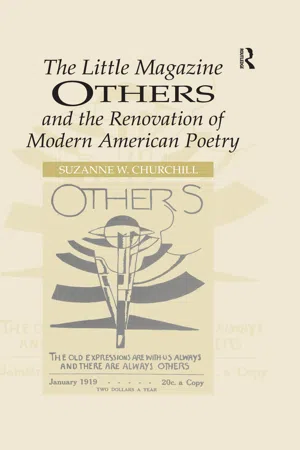
The Little Magazine Others and the Renovation of Modern American Poetry
- 304 pages
- English
- ePUB (mobile friendly)
- Available on iOS & Android
eBook - ePub
The Little Magazine Others and the Renovation of Modern American Poetry
About this book
Suzanne Churchill's well-researched and superbly crafted study is the first book-length treatment of Others, an important and neglected little magazine that served as a laboratory for modernist poetic experimentation. In discussions of influential poets such as Mina Loy, Marianne Moore, and William Carlos Williams, whose careers Others helped launch, Churchill counters the notion of Modernism as aesthetically self-isolating and socially disengaged. Rather, she traces a correspondence between formal innovation and social change in American modernist poetry and argues that this dimension of modernist formalism is lost when poems are studied in isolation. Others provides a framework for reassessing the scope and significance of modernist formalism. The little magazine not only anchors modernist poetry in a social context but also leads to new insight into major modernist texts. Churchill's commitment to her subject's broad cultural contexts makes her book important for students and teachers of Modernism as well as for those working in the fields of American poetry and poetics, gender studies, queer theory, periodical studies, and cultural studies.
Trusted by 375,005 students
Access to over 1.5 million titles for a fair monthly price.
Study more efficiently using our study tools.
Information
Subtopic
Literary CriticismIndex
LiteratureChapter One
Housing Modernism: Little Magazines and the American Free Verse Movement
The free verse movement in America … crystallized in Alfred Kreymborg’s group of Others. That was a magic moment. No one who was touched by the kindling breath will ever forget the joy of it nor cease to regret that a great fiery wind devoured it. It will be worth while someday to review that frail but vital page in American literary history.
Robert Alden Sanborn
It is with this magazine [Others] and the group that grew up around it that modernism in American poetry really begins. William Carlos Williams, Marianne Moore, Mina Loy, T. S. Eliot, Conrad Aiken, Marsden Hartley, Wallace Gould, Alfred Kreymborg himself, Maxwell Bodenheim, and the socialist poets Lola Ridge and James Oppenheim, the anarchist Arturo Giovannitte, dozens of others—Kreymborg produced them all suddenly on the literary stage in America, like a conjurer pulling rabbits from a hat.
Kenneth Rexroth1
Others: A Magazine of the New Verse ran only from 1915 to 1919, its subscription base peaking at 300, yet the little magazine helped launch the careers of many of the most innovative and influential modernist American poets.2 Providing an open forum for unknown writers, this low-budget salon des refuses helped instigate modern poetry in America, providing a stage for the seemingly harmonic convergence of artistic genius known as modernism. Others championed formal innovation and artistic autonomy, dedicating its pages to free verse experiments. These aesthetic interests have been viewed as a sign of modernist poetry’s self-absorption—its disengagement from social problems, political issues, and historical exigencies. In contrast, I argue that modernist poetry was socially embedded and engaged precisely because of its emphasis on form, but that the social dimensions of modernist formalism are lost when poems are studied in isolation. Little magazines—non-commercial, small-circulation, low-budget periodicals—anchor modernist poetry in a social context, situating individual poems in relation to other texts and discourses. These periodicals enable us to see modernist poetry as a product of its time, rather than as an art that transcends or evades time.
Until recently, modernism was promulgated as an irrevocable break from the past—a sudden, spontaneous revolution of thought and representation. In the effort to escape the shackles of the past, modernist artists claimed artistic autonomy, positioning themselves outside the bounds of social conventions, moral codes, and political causes. Poetry already enjoyed an elevated status as a transcendent art of universal feelings and timeless values.3 The special status granted poetry, combined with modernism’s vehement rejection of an outmoded past, claims for autonomy, and, above all, emphasis on form, conspired to cloister modernist poetry as a separate artistic sphere, allowing the genre to be mystified, mythologized, and misunderstood as a closed, hermetic activity.
Virginia Woolf fosters this poetic mythology in her 1931 “Letter to a Young Poet.” She asserts that the modern poet’s range is “restricted,” his poetry is “concentrated and intensified,” and he seems to be “looking within and not without,” as if describing “a self that sits alone in the room at night with the blinds drawn.”4 Woolf claims to select three poems randomly from an unnamed volume to demonstrate her thesis, quoting lines such as “To penetrate that room is my desire / The extreme attic of the mind” and “There is a dark room, / The locked and shuttered womb.”5
Whether real or parodied, Woolf’s selections could have come out of Others, where a generous sampling reveals an almost morbid fixation on interior spaces:
It is a dangerous place in which to walk—a heart.
Especially one’s own.
Mary Carolyn Davies, “Songs of a Girl” (July 1915)
And thus it is that what I feel,
Here in this room, desiring you
Wallace Stevens, “Peter Quince at the Clavier” (August 1915)
And four wax candles in a darkened room
Four rings of light upon the ceiling overhead
An atmosphere of Juliet’s tomb
T. S. Eliot, “Portrait of a Lady” (September 1915)
if I in my north room
dance naked, grotesquely,
before my mirror,
waving my shirt around my head,
and singing softly to myself
William Carlos Williams, “Danse Russe” (December 1916)
I steal into the play-room
Of my mind
And take out the paint box
David Rosenthal, “The Paint Box” (December 1917)
In my heart, the love-lanterns I hung for you are dark.
Harriet Dean, untitled (December 1918)
Shall I too press—how much of my essence?— in a cube of space—
Lola Ridge, “Easter Dawn” (July 1919)
These excerpts provide compelling evidence for Woolf’s judgment that the modern poet has fixed his gaze on his own interior consciousness and isolated himself from the world. Yet each of these poems seeks to make public the private regions of consciousness, and the act of self-exposure is represented as a daring and even “dangerous” act. Moreover, in many of these poems, the inner sanctum of self is inhabited by another—a “you” who, by entering the space of the self, exposes its permeability. Even as isolated works, then, these poems are unsuccessfully hermetic. When read as part of a broader little magazine discourse, they constitute what at the time seemed like a bold, ground-breaking, and very public conversation about the nature of intimacy between self and others. By re-situating modernist poems within the public discourse of Others, my study challenges the equation of modernist formalism with solitary aesthetic absorption, demonstrating that the modernist drive to renovate poetic form was part of a cultural movement to re-form the boundaries of selfhood, gender, and sexuality.
In focusing on the little magazine as a social framework for modernist poetry, my study joins recent efforts to open modernist studies to a consideration of broader cultural contexts. The 1998 founding of The Modernist Studies Association, an organization “devoted to the study of the arts in their social, political, cultural, and intellectual contexts,” heralds the trend toward more inclusive, pluralistic, and interdisciplinary definitions of modernism.6 Cary Nelson’s Repression and Recovery, Kevin J. H. Dettmar’s and Stephen Watt’s Marketing Modernisms, and Lawrence Rainey’s Institutions of Modernism are three recent examples of the effort to broaden the study of modernism to include the social, political, material, and economic practices that shaped artistic and literary production.
In the effort to contextualize modernism, however, poetic form often gets pushed to the margins of scholarly inquiry. Rainey omits the consideration of modernist formal practices altogether, reassessing the cultural and economic impact of The Waste Land without discussing a single line of the poem. He rejects close reading as a practice that leaves “the ambiguous heritage of modernism in history … desocialized and unexplored.”7 But just as even the most inward looking, formally experimental modernist poems may function as social interventions, close reading can be politically and historically engaged. As Rachel Blau DuPlessis demonstrates in Genders, Races, and Religious Cultures, close reading can be reactivated “to examine in poetry the textual traces and discursive manifestations of a variety of ideological assumptions, subject positions, and social concepts concerning gender, race, and religious culture.”8 Close reading can thus be used to recover the interconnections between specific features of texts and their contexts; DuPlessis’s plea resonates here: “one wants any study of poetry to engage with poetry as such—its conventions and textual mechanisms, its surfaces and layers—and not simply to regard the poetic text as an odd delivery system for ideas and themes.”9
My study reclaims formal experimentation as a significant feature of modernism in American poetry, one that should not be cordoned off from studies of the period’s broader cultural interests, tactics, and effects. Form, in modernist poetry, lies at the intersection of social discourse and aesthetic design.
Formal experimentation was a visible, controversial, and disruptive sign of new and radical thinking, but it was certainly not the only mark of the modern. Indeed, one could say that modernism in America began on or about January 1911, with the publication of The Masses, a little magazine dedicated to leftwing political, artistic, and literary efforts, which favored traditional verse forms. Little magazines thereafter proliferated, allowing writers and artists to recognize themselves as part of a movement with revolutionary hopes for transforming both the public sphere and private life. The number and variety of little magazines published in the first half of the twentieth century in America and abroad evince the plurality and diversity of modernism in its heyday. This study examines the arena of modernist American poetry and poetics—a subfield of modernism that is itself diverse, including poetic forms ranging from the traditional verse of political journals such as The Masses to the free verse of avant-garde periodicals such as Others. What unites these poetries is a renewed, heady, modernist sense that the new verse forms could reform the world, inside and out.10
To write free verse in the 1910s was to do something radically experimental, unconventional, individualistic—in short, something “Other.” Descriptive terms for the poetry in Others ranged from “esoteric” and “irrational,” to “free-footed,” “queer,” and even “pornographic.”11 Yet, as unorthodox and illicit as “vers libre” seemed, everyone was writing it, parodying it, reading it, or talking about it. Writing for a daily newspaper, Alfred Kreymborg, Others’s founder and editor, explained: “Vers libre, or free verse, as we have come to call it, has taken the place of cubism and futurism in public popularity. The painter has had his inning. The poet is our hero now, to mock and jeer.”12 Kreymborg uses a baseball metaphor to suggest that, despite its correspondence to the French tradition of vers libre, free verse is a genuine American product (“The pure products of America / go crazy—” William Carlos Williams observes a few years later in his free-verse-for-all experiment, Spring and All).13 Free verse was not merely a popular pastime, it was an expression of the modern consciousness; as Kreymborg puts it: “the free verse movement is … the foremost expression of the present day.”14
Publishing the most unbridled free verse, Others earned a reputation not only for technical innovation, but also for social rebellion and sexual transgression. According to Kreymborg, Others provoked “a small size riot” in mainstream presses.15 The magazine was called “a...
Table of contents
- Cover Page
- The Little Magazine Others and The Renovation of Modern American Poetry
- Copyright Page
- Contents
- List of Figures
- Acknowledgement
- List of Abbreviations
- 1 Housing Modernism: Little Magazines and the American Free Verse Movement
- 2 Making Space for Others
- 3 Interior Designs in Others
- 4 William Carlos Williams: The Poetics of Ending
- 5 Marianne Moore: The Poetics of “Conversity”
- 6 Mina Loy: The Poetics of Dislodging
- Appendix A: List of Contents of Others by Issue
- Appendix B: Index of Others Authors
- Appendix C: Editors and Publishers of Others
- Appendix D: The Others Anthologies
- Appendix E: List of Archives Consulted
- Bibliography
- Index
Frequently asked questions
Yes, you can cancel anytime from the Subscription tab in your account settings on the Perlego website. Your subscription will stay active until the end of your current billing period. Learn how to cancel your subscription
No, books cannot be downloaded as external files, such as PDFs, for use outside of Perlego. However, you can download books within the Perlego app for offline reading on mobile or tablet. Learn how to download books offline
Perlego offers two plans: Essential and Complete
- Essential is ideal for learners and professionals who enjoy exploring a wide range of subjects. Access the Essential Library with 800,000+ trusted titles and best-sellers across business, personal growth, and the humanities. Includes unlimited reading time and Standard Read Aloud voice.
- Complete: Perfect for advanced learners and researchers needing full, unrestricted access. Unlock 1.5M+ books across hundreds of subjects, including academic and specialized titles. The Complete Plan also includes advanced features like Premium Read Aloud and Research Assistant.
We are an online textbook subscription service, where you can get access to an entire online library for less than the price of a single book per month. With over 1.5 million books across 990+ topics, we’ve got you covered! Learn about our mission
Look out for the read-aloud symbol on your next book to see if you can listen to it. The read-aloud tool reads text aloud for you, highlighting the text as it is being read. You can pause it, speed it up and slow it down. Learn more about Read Aloud
Yes! You can use the Perlego app on both iOS and Android devices to read anytime, anywhere — even offline. Perfect for commutes or when you’re on the go.
Please note we cannot support devices running on iOS 13 and Android 7 or earlier. Learn more about using the app
Please note we cannot support devices running on iOS 13 and Android 7 or earlier. Learn more about using the app
Yes, you can access The Little Magazine Others and the Renovation of Modern American Poetry by Suzanne W. Churchill in PDF and/or ePUB format, as well as other popular books in Literature & Literary Criticism. We have over 1.5 million books available in our catalogue for you to explore.