eBook - ePub
The Counts of Laval
Culture, Patronage and Religion in Fifteenth- and Sixteenth-Century France
- 232 pages
- English
- ePUB (mobile friendly)
- Available on iOS & Android
eBook - ePub
The Counts of Laval
Culture, Patronage and Religion in Fifteenth- and Sixteenth-Century France
About this book
The Lavals were one of the most important families in late medieval France, rising to a position of unsurpassed eminence by the mid sixteenth century. Yet, at the very point where they reached this position of unrivalled importance, all was put at risk by the dual challenges of dynastic failure and the Reformation. The vagaries of dynastic failure threatened their hard won success and these problems were compounded by the decision of crucial members of the family to support Protestantism in the middle of the century. By the end of the sixteenth century the fortunes of the family were in ruins and the brief eminence of Lavals in western France was over. This monograph offers a fresh look at several of the critical questions facing historians of late medieval and early modern France. It re-examines the clientage of a rising and enterprising family and explores the cultural patronage of a noble court. The book also provides a new insight into the nature of noble Protestantism, notably analysing the connections between nobles, patterns of family loyalty and religious conviction. Finally, it considers the events of wars of religion in western France from the perspective of a noble leadership that simultaneously played a vital role in sustaining the cause and did much to undermine it. This latter issue is examined in particular through the analysis of the relationship between the houses of Laval and Rohan, two Protestant families with shared loyalties but with rival dynastic ambitions. This study is based on a complete re-examination of the archive base in both Paris and the west of France and in English archives. For many centuries the destruction of the archives of the family of Laval during the French Revolution has prevented historians from undertaking a serious study of the family. Indeed, this book is the first monograph to be published on the Comtes de Laval since the manuscript volume written by Le Blanc de La Vignole in the seventeenth century. At the same time it engages with the historiography of both French and Anglo-Saxon historiographical traditions.
Trusted by 375,005 students
Access to over 1.5 million titles for a fair monthly price.
Study more efficiently using our study tools.
Information
Chapter One
Mediaeval Lords: The Rise of the House of Laval
The origins of the house of Laval
It is virtually impossible to identify with precision the genealogical origins of the family of Laval beyond the start of the eleventh century. The first text to mention explicitly a Guy, lord of Laval, was written in the mid-eleventh century and gives him the title of founder of the stronghold of Laval. Over the centuries many intricate and undoubtedly fictitious genealogies linked the family to Charlemagne. According to the work of Jean Daniel at the beginning of the sixteenth century, the town of Laval had already been a place of note by the time the Romans invaded and the name and arms had been bestowed on its inhabitants by Julius Caesar himself ‘pour leur grand vaillantise’.1 Two centuries later, authors still insisted that the counts were descended from a brother of Pepin the Short.2 The Chronologie historique des sires, puis comtes de Laval gives a more plausible version: the town was founded after 900 and its first lord was named Geoffroi-Guy. He figured in a document dated 1002 in which he was given the title ‘potentissimum viru Gaufridum Guidonem, dominum de Valle’.3
Today this document has disappeared and we cannot state with certainty what the true origins of the family were or even when the land of Laval was initially enfeoffed. One can only note that the first original documents that mention the family date back to the first half of the eleventh century. There has been much speculation on the interpretation of certain phrases in older texts and manuscripts, and a number of them have been discounted as fakes.4 For the purposes of our study, it is enough to note that this was the period in which the house of Laval emerged from anonymity. Until further discoveries are made, one must conclude that the family came from the ranks of the local elite and, with the construction of the castle of Laval, started to dominate the surrounding lands.5
The first barons of Laval advanced progressively to reach the higher rungs of the regional aristocracy through their judicious matrimonial connections and high deeds. Guy, sire de Laval, left on a pilgrimage to Jerusalem in 1039 when such journeys were becoming more common, but remained the preserve of the wealthy elite.6 The Lavals were involved in all the main events that occurred in western France. In 1118, Guy III made a noteworthy appearance at the battle of Sées, fighting on behalf of the French crown against the Normans. The family also sought and obtained prestigious marital connections. Guy, known as ‘the bald’, married Denise de Mortain – William the Conqueror’s niece – and ensconced the house in the highest tier of the regional aristocracy. The alliance also enabled Hughes, Guy’s younger brother, to settle in Yorkshire. The English connection was further enhanced when Guy V’s father married Henry I’s bastard daughter, Emma.7 The daughters of the family married well too, establishing a network that included the main houses of the region such as the Beaumonts, the Craons or the viscount of Thouars. The first barons also strengthened their position by founding a number of ecclesiastical institutions such as the priories of Saint-Martin in Laval and of the Ronceray at Avesnières. The lord of Laval was gradually becoming one of the area’s main potentates.
This was a slow process, but the Lavals were ambitious and as early as 1129 they felt strong enough to challenge Geoffrey Plantagenet, count of Maine, father of Henry II of England. Jean de Marmoutiers recounts how a coalition was formed that brought together some of the main names of the region and openly defied their feudal lord. The result was disastrous: Guy ended up being besieged in his stronghold of Meslay-du-Maine and had to sue for Geoffrey’s forgiveness. Despite such brazen behaviour, he and his fellow rebels were soon forgiven and Henry II Plantagenet trusted them enough to name Guy V governor of Touraine, Maine and Anjou in 1162.
The rise of the house of Laval was often at the expense of other rival families and the local nobility. At various moments the family fought bitter campaigns against the house of Saint-Berthevin, then, once this obstacle had been overcome, against that of Lenfant. But by far the most important rivalry opposed the Lavals to their immediate neighbours, the family of Vitré in Brittany.8 The house of Vitré was a junior branch of the counts of Rennes and held lands of approximately equal stature to those owned by the Lavals. When war broke out between the duke of Brittany and Richard the Lionheart in 1186, the lands of the Vitré were ravaged by the troops of the Plantagenets including the baron of Laval. The hostility between the two families became a major theme in regional politics.
The death of Guy VI de Laval in 1211 meant that the lands passed to his only daughter, Emma. To preserve the independence of the house of Laval, it was decided to marry her to Mathieu II de Montmorency. This marriage treaty was attended by a series of specific clauses. Mathieu was constable of France and had already ensured the survival of the line of Montmorency through the children of his first marriage. With this second marriage it was therefore decided that their eldest son would have to adopt the name ‘Guy de Laval’ thus establishing the branch of Laval-Montmorency that was to last to the beginning of the fifteenth century. This betrothal had two main consequences: it ensured the survival of the house of Laval and linked two of the most important baronial families of the kingdom. It also softened the attitude of the Lavals towards the Vitrés and in 1248, the son of Mathieu and Emma, Guy VII, married the daughter of André de Vitré. Guy VII and André then embarked on a crusade during which the baron of Vitré was killed. The following year André’s only son died leaving his lands to his sister and her husband, Guy VII. The lands of the Lavals and Vitrés were united to form a vast land mass that straddled the French and Breton border.
The outbreak of the Hundred Years War brought new challenges for the house of Laval. Because of the location of their lands, they were the immediate vassals of both the Plantagenets and of the ducal house of Brittany. Furthermore, Guy X, who became baron in 1333, had married Beatrice, Arthur II of Brittany’s second daughter. However, the baron served the king of France in the military campaigns of the mid-thirteenth century. The death of the duke of Brittany and the start of the war of succession left Guy X with an awkward dilemma that he resolved by choosing the party of Charles de Blois, the king of France’s favoured candidate. This was an ill-fated decision since Guy X was killed leading some pro-Blois troops during the catastrophic battle of La Roche-Derrien in 1347. His eldest son was captured during the battle and died the following year leaving the patrimony of the Lavals to his brother, Guy XII. The more prudent Guy XII initially managed to avoid backing either pretender. He served in the Breton council after the conclusion of the civil war but also remained close to the king of France.9 The dangers of such equivocation became clear when the king of France tried to annex the duchy in 1373. The baron then warned a gathering of the main barons that they were princes in Brittany, but nothing special in France: ‘le roi commande et le Duc prie’.10
That the king tolerated this less than total support was probably in part ascribable to the fact that the Lavals were closely connected to the then constable, Bertrand du Guesclin. After the death of his first wife, Du Guesclin had married Jeanne de Laval – a cousin of the baron. After the constable’s death, Jeanne herself remarried and chose as her new spouse her cousin Guy XII. The importance of this perceived link between Du Guesclin, the French cause and the house of Laval was indubitable. When Guy XIV wrote to his mother and grandmother during the campaign of 1429, he enclosed for his grandmother a gold ring that Joan of Arc had given him to pass on to Jeanne, a signal demonstration of Jeanne’s status in the French camp.11
The house of Laval at the start of the fifteenth century
By the start of the fifteenth century, the Lavals had become one of the major families in western France, but remained a rung below the great princely houses in terms of financial and territorial power. The next 100 years would see a transformation in this position as the Lavals emerged as one of the leading aristocratic families in France and an essential element of royal administration in the west. But in 1401, this transformation was neither inevitable nor straightforward.
At the beginning of the fifteenth century, the baron of Laval held lands situated in Brittany, France, Italy and Flanders. The most important ensemble was clearly the dual baronies of Laval and Vitré. Together these rich and contiguous territories formed the central keystone of Laval lands. The towns around which the fiefdoms had formed were expanding rapidly. Both had developed a cloth industry that was known internationally and that generated in duties alone a worthwhile supplementary income for the baron.12 Alongside the production of cloth the lands also had important quarries – the slates from Entrammes were used by the duke of Brittany – whilst the tanners in Vitré produced high quality leathers.13 Furthermore, if one takes into account the lordship that became known as the viscounty of Rennes, the Lavals were lords of three important urban areas in close proximity.14
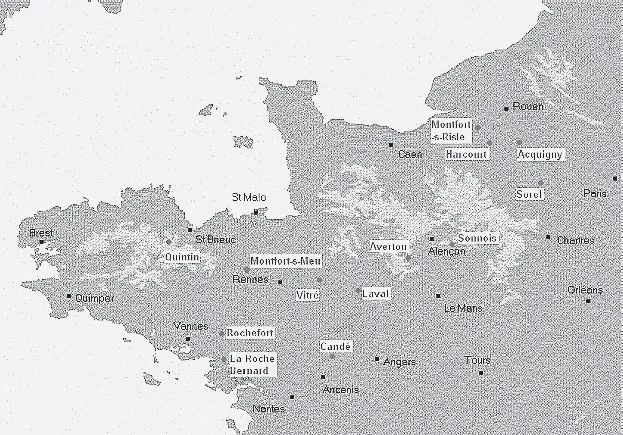
Figure 1.1 Map of main lands of Lavals in western France
Beyond this central territory, the family also had lands in Normandy, such as the barony of Acquigny, and other large fiefdoms in Brittany, such as Bécherel and Tinténiac. Abroad the barons held the substantial county of Caserta in southern Italy and the wealthy county of Gavres in Flanders. Through a judicious matrimonial policy the house of Laval was soon able to increase this landed wealth and power even further. Over the centuries, the family had tried to broker advantageous matches that would guarantee a substantial inheritance or establish new political and social connections. They were thus already linked to the houses of Brittany, Montmorency, Rohan and to the constable of France, Olivier de Clisson. Throughout the fifteenth century, they would continue to look for prestigious marriages but would also be careful to ensure that they did not neglect further opportunities to gather in new territories.
The Hundred Years War
The second half of the Hundred Years War saw a fundamental change in the nature of the conflict. To begin with the main focus of the wars had been the south of France and in particular Aquitaine and Guyenne, though Brittany had suffered because of the war of succession. After 1415, however, the bulk of the fighting shifted northwards to Normandy, Picardy and Maine. This brought the war much closer to the lands of the house of Laval and pushed them into the forefront of the conflict. Henry V’s invasion in 1415 initially threatened northern Normandy, but the disastrous debacle of Agincourt encouraged the English king to aim for a far greater territorial prize. He returned in 1417 with 10,000 fresh troops. With a series of noteworthy victories, Henry quickly overran northern France and by 1419 the whole of Normandy was under his control.15
In 1415, the new count, Guy XIV, and his brothers were all too young to take part in the battle of Agincourt or even in the lesser skirmishes that followed. Nevertheless, the English advance had direct consequences for the family. Most notably, they lost their Norman lands such as the barony of Acquigny that lay just a few leagues to the south of the Seine, lands that the Lavals had owned since the thirteenth century.16 The English advances also endangered other fiefdoms. The barony of Laval’s northern border was ten miles away from the lands controlled by the English and the concerns felt at this proximity were heightened by Henry V’s stated ambitions. For decades the kings of England had claimed many of the provinces that lay to the south of Normandy including Maine, Anjou, Touraine and Poitou – a huge landmass that harked back to the days of the Angevine Empire of the Plantagenets. With three of the five largest English garrisons in 1423-1424 situated in the towns of Fresnay-sur-Sarthe, Alençon and Avranches, at the southernmost point of the English advance, the interest in further expansion was obvious. The immediate proximity of the invading troops directly threatened the lands of the Lavals.
The strategy employed by the English during this campaign was in stark contrast to that of the previous phase of the conflict. The devastating cavalcades and meaningless victories were a thing of the past. Henry V was intent on making more durable gains...
Table of contents
- Cover
- Half Title
- Title Page
- Copyright Page
- Table of Contents
- List of Illustrations and Maps
- Acknowledgements
- Preliminary notes
- Introduction
- 1 Mediaeval Lords: The Rise of the House of Laval
- 2 The Network of Affinity
- 3 The Golden Age
- 4 New Challenges: The Wars of Religion
- 5 Laval versus Rohan
- Conclusion
- Appendix: Genealogy Tables
- Bibliography
- Index
Frequently asked questions
Yes, you can cancel anytime from the Subscription tab in your account settings on the Perlego website. Your subscription will stay active until the end of your current billing period. Learn how to cancel your subscription
No, books cannot be downloaded as external files, such as PDFs, for use outside of Perlego. However, you can download books within the Perlego app for offline reading on mobile or tablet. Learn how to download books offline
Perlego offers two plans: Essential and Complete
- Essential is ideal for learners and professionals who enjoy exploring a wide range of subjects. Access the Essential Library with 800,000+ trusted titles and best-sellers across business, personal growth, and the humanities. Includes unlimited reading time and Standard Read Aloud voice.
- Complete: Perfect for advanced learners and researchers needing full, unrestricted access. Unlock 1.5M+ books across hundreds of subjects, including academic and specialized titles. The Complete Plan also includes advanced features like Premium Read Aloud and Research Assistant.
We are an online textbook subscription service, where you can get access to an entire online library for less than the price of a single book per month. With over 1.5 million books across 990+ topics, we’ve got you covered! Learn about our mission
Look out for the read-aloud symbol on your next book to see if you can listen to it. The read-aloud tool reads text aloud for you, highlighting the text as it is being read. You can pause it, speed it up and slow it down. Learn more about Read Aloud
Yes! You can use the Perlego app on both iOS and Android devices to read anytime, anywhere — even offline. Perfect for commutes or when you’re on the go.
Please note we cannot support devices running on iOS 13 and Android 7 or earlier. Learn more about using the app
Please note we cannot support devices running on iOS 13 and Android 7 or earlier. Learn more about using the app
Yes, you can access The Counts of Laval by Malcolm Walsby in PDF and/or ePUB format, as well as other popular books in History & Early Modern History. We have over 1.5 million books available in our catalogue for you to explore.