- 202 pages
- English
- ePUB (mobile friendly)
- Available on iOS & Android
eBook - ePub
About this book
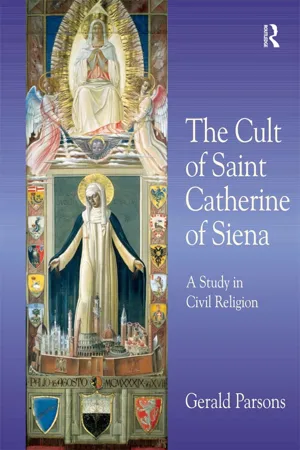
This book examines the origins, development and history of the cult of Saint Catherine of Siena. Gerald Parsons argues that the cult of Catherine of Siena constitutes a remarkable example of the cult of a particular saint which, across more than six centuries, has been the vehicle for an evolving sequence of civil religious rituals and meanings. He shows how the cult of this particular saint developed, firstly, as an expression of Sienese civil religion; secondly, as a focus for Italian civil religion; and finally into an expression of European civil religion. Instead of the predominantly devotional - and frequently essentially hagiographical - approach of much of the literature on Catherine of Siena, Parsons examines the significance of her cult from the perspective of civil religion and the social history of religion.
Trusted by 375,005 students
Access to over 1.5 million titles for a fair monthly price.
Study more efficiently using our study tools.
Information
Topic
Theology & ReligionSubtopic
ReligionChapter 1
‘La santa senese’: Catherine and the Civil Religion of Siena 1384–1857
Catherine of Siena, it has been observed, would never have been made a saint had it not been for the interest of the Dominican Order – and in particular the reformers within the order – in promoting a saint with her profile.1 There is much evidence that may be cited in support of this claim. Thus, as already noted in the introduction to this book, Catherine’s first confessor and spiritual instructor, Tommaso dalla Fonte, was a Dominican and by the end of the 1360s she had associated herself with the group of Sienese Dominican lay-women known as the mantellate.2 As early as 1374, moreover, the Dominican Order had apparently already recognized Catherine’s potential as a prophetic and mystical representative of their interests, especially in relation to the papacy and its future. Consequently, in the summer of 1374, Catherine appeared before the Dominican General Chapter in Florence, as a result of which Raymond of Capua became her official confessor and spiritual director and she effectively began to speak and act with the authority and under the protection of the Dominican Order and the papacy.3 In the final two years of her life in Rome, Catherine and her community of followers lived in a house close to Santa Maria sopra Minerva, the principal Dominican church and community in the city.4 When she died in 1380 her remains were taken to Santa Maria sopra Minerva where they were first placed in a tomb in the cemetery of the community and subsequently, on the initiative of Raymond of Capua, who was by then Master General of the Order, were transferred to a marble tomb in a chapel – customarily referred to as the Capranica chapel – located near to the high altar.5 In 1384, Raymond secured permission from Pope Urban VI for the translation of the relic of Catherine’s head to Siena, where it was received, with great ceremony, by the civic and religious authorities in May 1385 and placed in the sacristy of the church of San Domenico – thereby ensuring that both Santa Maria sopra Minerva in Rome and San Domenico in Siena became sites of pilgrimage and devotion to Catherine’s cult.6
Unsurprisingly, it was also a series of Dominican authors who produced the early accounts of Catherine’s life and thus established her hagiographical tradition. Thus, the Legenda maior, the first ‘vita’ of Catherine, probably compiled between 1385 and 1395, was the work of Raymond of Capua, her confessor and spiritual adviser from 1374 onwards, and subsequently Dominican Master General.7 Similarly, in the first two decades of the fifteenth century, it was the influential Dominican Tommaso di Antonio de Senis – more commonly known as ‘Caffarini’8 – who created the Legenda minor – as its title suggests, an abbreviated version of the Legenda maior – and the much longer Libellus de Supplemento, which provided additional biographical-hagiographical details.9 A native of Siena and a devoted follower of Catherine, Caffarini was a member of the community at San Domenico, Siena, rising to become its prior, and also, in 1380, the year of Catherine’s death, the director of the Sienese mantellate. In 1394 he was called to Venice and assisted in the founding of Corpus Domini, a convent for Venetian mantellate, becoming its spiritual director two years later, and subsequently becoming responsible for the spiritual oversight of the mantellate throughout Italy. Together with Bartolomeo Dominici, another high-ranking Sienese Dominican then in Venice, Caffarini energetically promoted both the interests of the reform movement within the Dominican order and the cause of papal recognition of the mantellate – the promotion of the cult of Catherine of Siena being central to the latter project.10
It was, moreover, in Venice – and as a result of the enthusiastic celebration of her cult by local devotees – that the first formal investigation of the case for Catherine’s canonization took place. Not only had Caffarini had woodcuts of Catherine made in order to further the popular diffusion and dissemination of her reputation,11 but in 1398 Caffarini had returned briefly to Siena, primarily to collect additional evidence of her life, including some of her letters,12 and to obtain various relics of Catherine – including a finger, a tooth and her first habit. These he brought back to Venice, to the convent of Corpus Domini, which became a centre for devotion to Catherine, with a major procession and exposition of her relics on her annual feast day.13 Indeed, so prominent were these and other celebrations of her cult in Venice14 that they prompted complaints that the Dominicans were inappropriately honouring Catherine as if she were already canonized and therefore officially a saint – whereas in reality she was, as yet, no more than a beata, a holy individual, celebrated by her devotees, but not yet recognized as worthy of sainthood by the church.15 As a result of the complaints, Francesco Bembo, the Bishop of Castello, initiated a diocesan investigation to review the charges. The investigation – which became known as the ‘Processo Castellano’ – and was conducted between 1411 and 1416, first rejected the complaints against the Dominicans and then became an enquiry into Catherine’s claim to sainthood. After hearing the evidence of 24 witnesses, the enquiry was favourably impressed by the evidence for Catherine’s sanctity. Despite this, however, her devotees nevertheless remained unable to secure the initiation of a full papal review of the case for Catherine’s sanctity through a formal examination of the case by a committee of cardinals.16
It was, therefore, not until a further four decades had elapsed that the cause of Catherine’s canonization was again – and this time successfully – pursued. Moreover, whilst the early promotion of her cult and the production of the key texts for her hagiography had indeed been the result of the efforts of members of the Dominican Order, the eventual success of the subsequent campaign which led to her canonization in 1461 owed much to the efforts and influence of the Sienese, and especially the Sienese civic authorities. In accounts of Catherine’s eventual canonization it is habitually remarked – and not without reason – that it was a Sienese pope, Pius II, who finally accorded her the status of sainthood.17 Clearly, this was indeed no coincidence. Neither, however, was it merely a simple matter of Pius II favouring the city of his familial origins. Catherine’s canonization was, in fact, also the culmination of a sustained effort on the part of the Sienese to secure such recognition for a figure who had already become an important member of the ‘civic pantheon’ of Sienese saints and beati – and thus also a key figure in the civil religion of Siena.
It is well known that the principal focus of the civil religion and civic devotion of Siena and the Sienese is the Virgin. From 1260 and the famous victory of the Sienese over the Florentines at Montaperti onwards the Sienese have believed the Virgin to be the special and pre-eminent heavenly patron and protector of their city. Devotion to the Virgin has shaped Sienese civil religion throughout the centuries since Montaperti and continues to do so even to the present.18 The city has been formally rededicated to the Virgin on various occasions, most recently in 1944 when the course of the Second World War brought renewed danger to the city.19 Although it is thus the principal historical form of Sienese civil religion, devotion to the Virgin – and to the associated ‘myth of Montaperti’ – is not, however, the only expression of Sienese civic devotion. Alongside devotion to the Virgin, the Sienese and their civic authorities also developed a ‘pantheon’ of civic saints and beati whom they celebrated as subsidiary patrons and protectors of the city.
The origins of the Sienese ‘civic pantheon’ may be traced securely at least to the early fourteenth century. Thus, in both the famous double-sided altarpiece for the high altar of Siena cathedral – known as the Maestà – by Duccio di Buoninsegna, and also in the equally famous Maestà by Simone Martini in the Palazzo Pubblico of Siena, the Virgin is portrayed, surrounded by numerous saints but attended, most particularly, by saints Ansano, Crescenzio, Savino and Victor – the four early Christian patron saints and ‘protectors’ of Siena whose relics were possessed by the cathedral.20 By the early fifteenth century Sienese government documents referred to these four saints as ‘patrons and defenders of the community and people’ and ‘patrons and especial protectors and advocates of the magnificent city of Siena’.21 During the mid fifteenth century, however, there is clear evidence that the Sienese embarked on a conscious and deliberate project to establish and celebrate a much more extensive ‘pantheon’ of civic saints and beati. Between the mid 1440s and the beginning of the 1460s, in a series of works of art – executed, significantly, for three of the most prestigious civic locations in Siena: the baptistery, the Spedale di Santa Maria della Scala and the Palazzo Pubblico – the painter Vecchietta portrayed Ansano, Crescenzio, Savino and Victor accompanied by a series of other local saints and beati including, most notably: the local thirteenth-century Dominican Ambrogio Sansedoni, a renowned preacher and papal diplomat; Andrea Gallerani who was believed to have founded the local charitable institution of the Spedale della Misericordia; Pier Pettinaio a late thirteenth-century layman and Franciscan tertiary renowned for his piety and charity; the blessed Sorore, mythical founder of the prestigious Sienese Spedale di Santa Maria della Scala; the renowned local Franciscan preacher Bernardino, who had died only as recently as 1444 – and Catherine of Siena.22
The promotion of this expanded pantheon of civic saints and beati has been described as ‘visual propaganda for local saints’, an expression of ‘hagiographic chauvinism’23 and also – in the felicitous turn of phrase of the late nineteenth and early twentieth century Sienese scholar Vittorio Lusini – as the cultivation of a community of ‘santi cittadini’.24 It also seems probable, however, that the determined promotion of this expanded civic pantheon in the three works by Vecchietta was closely related to the efforts of the Sienese authorities to secure the canonization – and thus the transition from beati to full sainthood – of two of its most recent members.25 In 1450, a mere six years after his death and after a brief but intense campaign on the part of the civic authorities of Siena – as well as those of Aquila (where Bernardino died, where his body remained and where his tomb rapidly became associated with miraculous cures), and the efforts of the Observant Franciscans – Bernardino of Siena was canonized by Pope Nicholas V.26 The Sienese marked Bernardino’s canonization with extended and elaborate civic celebrations, culminating in a festival in the Campo, in front of the Palazzo Pubblico, which included a celebration of mass and the ascent of an actor representing Bernardino into a wooden ‘paradise’.27 The Sienese civic authorities also resolved immediately that Bernardino should now be invoked as the ‘fifth advocate and protector of the magnificent commune and people of the city of Siena’.28
With one member of their civic pantheon of ‘santi cittadini’ thus raised to sainthood, the Sienese then sought to secure the canonization of Catherine as well. Thus, in May 1458, the Sienese government wrote to its ambassador in Rome, Leonardo Benvoglienti, asking him to raise the possibility of Catherine’s canonization both with ‘our most reverend Cardinal’ (that is to say, Enia Silvio Piccolomini) and with Pope Calixtus III, emphasizing the high regard in which Catherine was held, not only in Siena but also in ‘tutta Italia’.29 In so doing, however, the Sienese were not merely following – and opportunistically trying to capitalize upon – the successful precedent set by the recent canonization of Bernardino, but were also seeking to consolidate a civic commitment to Catherine and her cult that was already well established within Siena. Indeed, the strength of the civic enthusiasm for Catherine and her cult had been evident even in the early 1380s. Following Raymond of Capua’s authorization of the transfer of the relic of Catherine’s head to Siena in 1384, it was transported, in secrecy, to Siena in the care of two Sienese Dominicans, Tommaso della Fonte and Ambrogio di Luigi Sansedoni, and placed in the sacristy of the church of San Domenico. Whilst visiting Siena in 1385, and after consulting other local followers of ...
Table of contents
- Cover
- Half Title
- Title Page
- Copyright Page
- Table of Contents
- List of Illustrations
- Preface
- Introduction: Civil Religion and the Cult of Catherine of Siena
- 1 ‘La santa senese’: Catherine and the Civil Religion of Siena 1384–1857
- 2 From ‘santa senese’ to ‘Patrona d’Italia’: The Cult of Catherine of Siena 1859–1939
- 3 Catherine of Siena and the Second World War: 1940–1945
- 4 From ‘Patrona d’Italia’ to ‘Patrona d’Europa’: the Cult of Saint Catherine of Siena 1946–2007
- Conclusion: Catherine of Siena and the Varieties of Civil Religion
- Bibliography
- Index
Frequently asked questions
Yes, you can cancel anytime from the Subscription tab in your account settings on the Perlego website. Your subscription will stay active until the end of your current billing period. Learn how to cancel your subscription
No, books cannot be downloaded as external files, such as PDFs, for use outside of Perlego. However, you can download books within the Perlego app for offline reading on mobile or tablet. Learn how to download books offline
Perlego offers two plans: Essential and Complete
- Essential is ideal for learners and professionals who enjoy exploring a wide range of subjects. Access the Essential Library with 800,000+ trusted titles and best-sellers across business, personal growth, and the humanities. Includes unlimited reading time and Standard Read Aloud voice.
- Complete: Perfect for advanced learners and researchers needing full, unrestricted access. Unlock 1.5M+ books across hundreds of subjects, including academic and specialized titles. The Complete Plan also includes advanced features like Premium Read Aloud and Research Assistant.
We are an online textbook subscription service, where you can get access to an entire online library for less than the price of a single book per month. With over 1.5 million books across 990+ topics, we’ve got you covered! Learn about our mission
Look out for the read-aloud symbol on your next book to see if you can listen to it. The read-aloud tool reads text aloud for you, highlighting the text as it is being read. You can pause it, speed it up and slow it down. Learn more about Read Aloud
Yes! You can use the Perlego app on both iOS and Android devices to read anytime, anywhere — even offline. Perfect for commutes or when you’re on the go.
Please note we cannot support devices running on iOS 13 and Android 7 or earlier. Learn more about using the app
Please note we cannot support devices running on iOS 13 and Android 7 or earlier. Learn more about using the app
Yes, you can access The Cult of Saint Catherine of Siena by Gerald Parsons in PDF and/or ePUB format, as well as other popular books in Theology & Religion & Religion. We have over 1.5 million books available in our catalogue for you to explore.