eBook - ePub
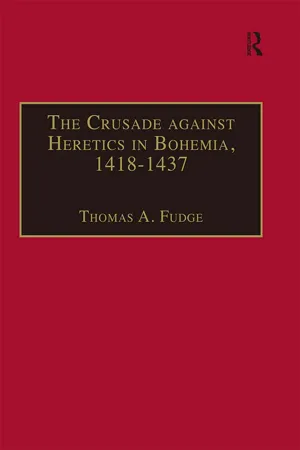
The Crusade against Heretics in Bohemia, 1418–1437
Sources and Documents for the Hussite Crusades
- 446 pages
- English
- ePUB (mobile friendly)
- Available on iOS & Android
eBook - ePub
The Crusade against Heretics in Bohemia, 1418–1437
Sources and Documents for the Hussite Crusades
About this book
This selection of over 200 texts, nearly all appearing for the first time in English translation, provides a close-up look at the crusades against the Hussite heretics of 15th-century Bohemia, from the perspective of the official Church - or at their struggles for religious freedom, from the Hussites' own point of view. It also throws light on the meaning of the crusading movement and on the nature of warfare in the late Middle Ages. There is no single documentary account of the conflict, but the riveting events can be reconstructed from a wide range of contemporary sources: chronicles, sermons, manifestos, songs, bulls, imperial correspondence, military and diplomatic communiqués, liturgy, military ordinances, trade embargos, epic poems, letters from the field, Jewish documents, speeches, synodal proceedings, and documents from popes, bishops, emperors and city councils. These texts reveal the zeal and energy of the crusaders but also their deep disunity, growing frustration and underlying fears - and likewise the heresy, determination and independence of the Hussites. Five times the cross was preached and the vastly superior forces of the official church and the empire marched into Bohemia to suppress the peasant armies. Five times they were humiliated and put to flight.
Trusted by 375,005 students
Access to over 1.5 million titles for a fair monthly price.
Study more efficiently using our study tools.
Information
Chapter 1
From the Council of Constance to War
1 A Hussite comment on the crusades
[Of the several extant manuscripts of an altogether valuable chronicle written by Vavřinec of Březová, secretary of the New Town in Prague, university lecturer and conservative Hussite, one bears the following preface which functions well as an introductory comment despite being written just after the crusading period.]
As I consider the varied and great destruction, which is presently everywhere evident in the one-time famous and renowned Kingdom of Bohemia, and see the devastation caused by internal conflict, my senses are dulled and my mind is bereft of sharpness on account of the confusion and sorrow. Nevertheless, so that future generations of the country of Bohemia may not be left without knowledge of this awful tragedy and thereby on account of negligence fall into similar or even worse insanity, and particularly so that the authentic faith and that which is essential be maintained, guarded and preserved, I have written down in this work as carefully as possible the things which I have come to understand as true through trustworthy eyes and ears.
Hisloria Hussitica, in FRB 5: 329 citing the preface to the oldest manuscript of the chronicle preserved in Wroclaw, City Library MS 199, fols. 121r—199v.
2 Report on the affairs in Bohemia
[After Jan Hus’ death, 452 Czech barons affixed their seals and signatures to a letter defying the council. King Václav IV of Bohemia seemed unwilling or unable to do much to stem the mounting tide of dissent. The Council of Constance urged Sigismund, Václav’s half-brother and King of Hungary, to take action against the open defiance. This urging seems to be the earliest indication of a possible crusade against the alleged heretics. Sigismund’s reply to the conciliar legates, written either in late 1416 or early 1417, reveals hostility towards the Hussites but reluctance to undertake military intervention.]
To the propositions of the deputies of all the nations of this holy council on the matter of heresy and errors thriving in the Kingdom of Bohemia, we respond most devotedly, saying we are prepared to give all of our effort to the honour of God and God’s church for the extirpation of heresies and errors arising everywhere, especially in the Kingdom of Bohemia, for we are committed to the reform of the said realm.
Our brother, the King of Bohemia [Václav IV], directed certain ambassadors most recently to us, whom we have sent back to him with our reply, which is as follows. He should persuade his barons and other subjects, especially the followers of Jan Hus of damnable memory, all of whom defame themselves with their own letters, to desist from errors of this kind, to abstain from the disturbance and pillaging of the clergy, and finally to return cured to the bosom of Holy Mother Church. We will impart [our decision upon] these aforementioned matters and also your petition, which you have made the duty of all nations, by means of this same messenger of our same brother, whom we retain with us. Moreover our brother desired our presence together with the barons of his kingdom, just as he made known to us through messengers. Regarding this desire we decided to send soon our solemn ambassador, to whom we committed to say that we intend the said assembly to be celebrated if they wish to be reconciled to whatever extent to the Church of God, and to obey humbly the decisions and mandates of this holy council – otherwise we do not intend this assembly to meet.
On the contrary, if they do not wish to accept the sound teachings of the holy fathers and dispense with their damned and perverse heresies, we do not intend either to placate them or to meet with them in any way. If, however, they wish to convert to the obedience of the church and do not deviate in this, then with our said brother, or with his counsel and barons, we are prepared to meet in a place and time to be arranged, and following their good appearance and unchanging will we arc prepared to lead the leaders, who are said to be from the sect of Wyclifites, to the place of this holy council.1 We ask for the suspension of opinions and censures, by which they are bound, which we hope to be able to obtain graciously from the holy fathers. And should we find it the case that our brother, as stated previously, has the good will to destroy these errors, but on account of the multitude who support this sect does not have sufficient power to destroy it, then we promise you that we will hasten to help him with all of our power so as to bring about the final extermination of all the mentioned errors and heresies. We will also procure restitution for the despoiled clergy. Indeed we know that the losses and dangers that have arisen out of this heresy in that kingdom are too many to mention. Indeed that kingdom was Catholic before, during and after the time of our father of happy memory [Charles IV], and was praised for its good faith and devotion. Alas for the wickedness of the present days! We also know that it is defamed among many because of these errors, and is cheated of the most divine clerical ministry, whose priests are robbed. Many other crimes have occurred there, from which the good and faithful of that land suffer and are saddened. For in that realm not all are perverted or unfaithful. On the contrary, many more are honest and devoted men, who hold the true faith.2
Our brother, the King ofBohemia, seeing these evils calls upon the judgement of the archbishop, especially against one man [Jan of Jesenice], who is the worst, whom our brother ordered to leave the city, and on account of whom the church and city of Prague have been held under interdict already for so much time.3 But this man responded that he wished to stand in court before the archbishop, and the archbishop excuses himself [Konrad of Vechta] because he wishes to be a confessor rather than a martyr, and because the business of examining and judging this man belongs to this holy council. And so every day about a thousand masses remain uncelebrated in the churches and in the city of Prague, to say nothing of the Kingdom of Bohemia!, and by this measure so many crimes remain unpunished, while one excuses himself for another.
Moreover may God avert that this holy council might wish to proceed against our brother on account of negligence, or invoke the secular arm against the Kingdom ofBohemia or our said brother. We entreat that, should this be the case, the holy council might wish to commit this duty to another than ourselves; but to whomever it deems to entrust with this duty, we will commit ourselves to defending yourprecepts for the Church and sacred council as much as we are able. It is, however, not fitting to our honour for us to do these things against our brother and his kingdom. It could appear to many that we were acting not out of piety or favour of the faith, but on account of a desire for the kingdom. Suspicion could also arise against us, by which men might believe that out of the pretext of an attack of the Wyclifites we wish to accept the lordship of the Kingdom of Bohemia for ourselves, and to oppress our brother, at last robbing him of his kingdom. However, since our intention is always to devote ourselves to the honour owed our brother, and to conserve and defend his position, in these matters we seek to have your encouragement and support.
Documenta, 652–4.
3 An emperor pledges allegiance to the Pope
[Among certain acts of the Council of Constance during its last sessions in 1418 was the confirmation of Sigismund as Holy Roman Emperor and his subsequent oath of obedience to Pope Martin V. Both men would play key roles during the crusades against the Hussites.]
On the day of St Paul’s conversion [25 January] the lord King Sigismund swore an oath and was confirmed by the empire…. The king of the Romans made this oath to the new Pope: ‘I Sigismund, king of the Romans, promise and swear to you, Lord Martin V, through the Father, and Son and Holy Spirit and through the wood of the life-giving cross and by the relics of the saints, that I will lift up the Roman Church and you, as the leader of it, as high as I can. I will never damage your honour willingly, or through my descendants or by my counsel, consent or other failure. If I come to Rome, I will make neither imposition nor disposal of anything belonging to you without your consent. Should any part of the land of St Peter come under my power 1 will restore it. To anyone whom I would commend the Italian kingdom I will cause them to swear to assist you in defending to the best of his ability the land of St Peter.’ Given in Constance on the day of St Paul’s conversion, [25 January] 1418.
Documenta, 675–6.
4 Resolutions against the Hussites
[In February 1418, the Council of Constance published a list of twenty-four resolutions against the Hussite heretics. The king of Bohemia, Václav IV, was called upon to swear that he would do everything possible to suppress the heresies of Jan Hus and his followers. No distinction was made between the various emerging Hussite factions. From the viewpoint of the official church, they were all the same, equally heretical. These articles underscore the basis for the crusade yet to come.]
The decree of the holy Council of Constance and by the present and only supreme pontiff of the holy Roman Church, elected in the same council, our most holy father and lord in Christ, Lord Martin [V] the pope, to Václav, king of Bohemia on how he should proceed in order to extirpate the heresy of John Wyclif and [Jan] Hus in his land. This ordinance is intended to be observed with respect to those who are to be reduced in the Kingdom of Bohemia.
First, and foremost, the king of Bohemia should swear to preserve the Roman Church and other churches under his jurisdiction in their liberties and should not impose the newly introduced ideas of Wyclif or Hus on either the secular or regular clergy.
Second. All priests, masters and clerics, who have spread errors or heresies through teaching or preaching in the aforementioned Kingdom of Bohemia and have infected others there should abjure those errors of John Wyclif and Jan Hus who have been condemned in this holy council. They should renounce those errors which they have taught or preached and should affirm and proclaim this condemnation of doctrines and persons publicly from their pulpits. If they refuse to do this they should be punished according to canonical sanctions. The relevant names follow.
Third. Likewise, the laity who have not cared to set themselves right in the matter of the faith and who have polluted themselves under the same verdict and those who for a year or many years did not care for the penalties and disdained the authority of the keys should abjure as well.
Fourth. Also, other laypeople who adhered to the Wyclifites and Hussites, protected and defended them, should swear to adhere to them no longer but [rather] persecute them and show no favour to them further. They should affirm and hold as correct the deeds of the council with respect to the condemnation of the articles of John Wyclif and Jan Hus and the condemnation of their persons.
Fifth. Likewise, that the laity who alienated the clergy should be forced to pay restitution because the sin cannot be forgiven until that which has been taken is restored. They should also pledge themselves and swear not to impede ecclesiastical freedom anymore.
Sixth. The ejected [clerics] should be restored to their benefices and the intruders put out and punished.
Seventh. In like manner, each and every one who violates in favour of Wyclif, because of the restoration of temporal properties, should be punished according to canonical sanctions so that contempt of the keys will not be seen to be tolerated.
Eighth. Likewise, that all who promoted the cause of the faith of the papal court should be restored to their benefices and have the security to remain within the kingdom. If the [heretics] refuse to do so, or cannot do so effectively, then it is an indication that they really have no intention of returning. Those trying to convince them to revert shall have to proceed specifically with them if they would truly be forgiven and if they would confess themselves to have been in error and thereby seduced.
Ninth. Relics, payments and other treasures of the church in Prague and other estates or confiscated income of the same church or of other churches throughout the Kingdom of Bohemia and the Margraviate of Moravia shall be restored.
Tenth. So that the university in Prague should be reformed and the Wyclifites who destroyed it might be punished and removed for otherwise the university cannot be reformed. Wyclifites and Hussites cannot remain in the university if they do not relinquish their errors.
Eleventh. Similarly, the principal heresiarchs and founders of that sect should be compelled to come to the Roman court and apostolic see. They include the following: Jan of Jesenice, Jakoubek of Střibro, Šimon of Tišnov, Šimon of Rokycany, Křišt’an of Prachatice, Jan Cardinal of Rejnštejn, Zdenĕk of Labouň, the provost of [the chapter of] All Saints’, Marek of Hradec, Zdislav of Zvířetice and Michael of Malenice called Cizek.
Twelfth. All of the laity who communicated under both kinds [sub utraque specie] and who forced other lay people to communicate in like manner, particularly after the prohibition of the sacred council, should abjure that heresy and should promise not to promote but rather to impede that communion.
Thirteenth. Those priests ordained by Hermann, the archbishop’s suffragan, kidnapped by Čenĕk of Vartemberk, should not be pardoned but should be sent directly to the apostolic see.
Fourteenth. Each and every tract of John Wyclif translated into the common language by Jan Hus and Jakoubek, as well as others written by them in the common tongue in which they outlined their errors should be delivered into the hands of the legate or of the ordinary under penalty of excommunication. These should be burned because those which have not been wiped out have not ceased to relinquish error.
Fifteenth. The writings of Jan Hus condemned by the holy council should be handed over under penalty of excommunication and destroyed by fire.
Sixteenth. Likewise, all of the writings of Jakoubek concerning the cucharist under both kinds, concer...
Table of contents
- Cover
- Series
- Dedication
- Half Title
- Title Page
- Copyright Page
- Table of Contents
- List of Documents
- List of Maps
- Preface and Acknowledgements
- List of Abbreviations
- Introduction
- 1 From the Council of Constance to War
- 2 The First Crusade: Prague, 1420
- 3 The Second Crusade: Žatec, 1421
- 4 The Third Crusade: Kutná Hora to the Sázava, 1421–2
- 5 The Fourth Crusade: Tachov, 1427
- 6 The Fifth Crusade: Domažlice, 1431
- 7 New Tactics: Basel to Sión, 1432–7
- Select Bibliography
- Index
Frequently asked questions
Yes, you can cancel anytime from the Subscription tab in your account settings on the Perlego website. Your subscription will stay active until the end of your current billing period. Learn how to cancel your subscription
No, books cannot be downloaded as external files, such as PDFs, for use outside of Perlego. However, you can download books within the Perlego app for offline reading on mobile or tablet. Learn how to download books offline
Perlego offers two plans: Essential and Complete
- Essential is ideal for learners and professionals who enjoy exploring a wide range of subjects. Access the Essential Library with 800,000+ trusted titles and best-sellers across business, personal growth, and the humanities. Includes unlimited reading time and Standard Read Aloud voice.
- Complete: Perfect for advanced learners and researchers needing full, unrestricted access. Unlock 1.5M+ books across hundreds of subjects, including academic and specialized titles. The Complete Plan also includes advanced features like Premium Read Aloud and Research Assistant.
We are an online textbook subscription service, where you can get access to an entire online library for less than the price of a single book per month. With over 1.5 million books across 990+ topics, we’ve got you covered! Learn about our mission
Look out for the read-aloud symbol on your next book to see if you can listen to it. The read-aloud tool reads text aloud for you, highlighting the text as it is being read. You can pause it, speed it up and slow it down. Learn more about Read Aloud
Yes! You can use the Perlego app on both iOS and Android devices to read anytime, anywhere — even offline. Perfect for commutes or when you’re on the go.
Please note we cannot support devices running on iOS 13 and Android 7 or earlier. Learn more about using the app
Please note we cannot support devices running on iOS 13 and Android 7 or earlier. Learn more about using the app
Yes, you can access The Crusade against Heretics in Bohemia, 1418–1437 by Thomas A. Fudge in PDF and/or ePUB format, as well as other popular books in History & World History. We have over 1.5 million books available in our catalogue for you to explore.