eBook - ePub
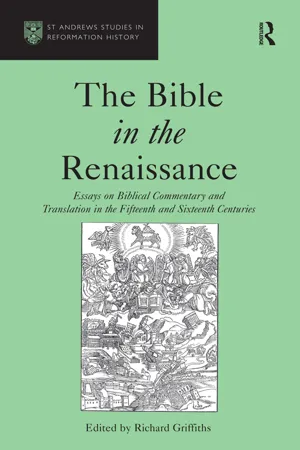
The Bible in the Renaissance
Essays on Biblical Commentary and Translation in the Fifteenth and Sixteenth Centuries
- 232 pages
- English
- ePUB (mobile friendly)
- Available on iOS & Android
eBook - ePub
The Bible in the Renaissance
Essays on Biblical Commentary and Translation in the Fifteenth and Sixteenth Centuries
About this book
This collection of nine essays, with an introduction by Richard Griffiths, examines some of the broad themes relating to the way in which the reading, translation and interpretation of the Bible in the Renaissance could serve the specific and often practical aims of those involved. Moving from humanist issues concerned with the nature of the sacred texts and methods for interpreting them, the volume examines the uses of the Bible in different contexts, and looks at the social, political and religious impact of its translations in the sixteenth century.
Trusted by 375,005 students
Access to over 1.5 million titles for a fair monthly price.
Study more efficiently using our study tools.
Information
Subtopic
World HistoryIndex
HistoryCHAPTER ONE
Introduction
No single book could ever pretend to cover all the aspects – cultural, intellectual, spiritual, exegetical, linguistic, social and even polemical – of the history of the Bible in the fifteenth and sixteenth centuries. This volume, the product of a conference on the subject, makes no pretence of being all-embracing, consisting as it does of a series of ‘soundings’, from different countries and from differing points of view, which produce a series of insights into some of the major issues involved. These issues include the interface between classical learning and the translation and interpretation of the text; the blurred nature of the transition between medieval and modern when it came to methods of exegesis; the complication, at times, of distinguishing between Catholics and Reformers in their attitudes towards the Bible; the ways in which the reading, translation and interpretation of the Bible could serve the specific and often practical aims of those involved; the social, political and religious impact of the translations of the Bible in the sixteenth century; and the issue (crossing the Reformation lines) of the extent to which the Bible should be available to the people, and the extent to which they needed to be led in their interpretation of it. This introduction is an attempt to recapture the debates that took place at the conference, after the individual contributions – debates which revealed the recurrence of these major issues from paper to paper.
The interface between humanist learning and biblical scholarship is nowhere better epitomized than in the writings of Lorenzo Valla (1407–57), who is so often mentioned in the chapters of this book. Valla it was who first challenged the Latin Vulgate New Testament attributed to St Jerome. He was the first person to apply humanist skills (philological and exegetical) to the Bible, treating it as he would any other ancient text. In his Collatio novi testamenti (1444) he returned to the original text, making a critical comparison between the Vulgate and the Greek New Testament. The other side of the coin was that he was also, as a humanist, concerned with the beauties of the ancient tongues, and appalled by what he saw as the barbarities of the Latin Vulgate translation. These two sides to Valla can be seen, to greater or larger extent, in all those concerned with translation in the succeeding century.
As Michael Heath points out, Erasmus owed much to Valla, whose Collatio novi testamenti he published in 1505 as Adnotationes in Novum Testamentum. In 1516 Erasmus published the first-ever printed Greek text of the New Testament, together with a new Latin translation and his notes, the Annotationes. This was to be of great effect upon all later translations of the Bible into the vernacular. Luther, for example, used Erasmus’s New Testament in the preparation of his German translation. In Italy, Santi Pagnini owed much to Erasmus for his translation of the Old and New Testaments. Tyndale relied heavily on Luther. The first Welsh translator, William Salesbury, used for his New Testament Erasmus, Luther and Tyndale (together with later editions of the Greek text of the New Testament).
So the desire to return to the true sources was very real (even if Erasmus’ translation was found to be based on later Greek manuscripts inferior to those Jerome had used). By the sixteenth century it was generally agreed that the Vulgate was often inaccurate, marred as it was by errors, omissions and interpolations, and that scholars should return to the original Greek and Hebrew. But while the return to the Greek of the New Testament was solidly based in the translators’ knowledge of the language, the return to Hebrew was initially less so. Much was made of the new ‘trilingual’ culture (Latin, Greek, Hebrew), with trilingual colleges being founded, and the greatest praise of a scholar being that of vir trium linguarum gnarus; but the reality at times failed to match the ideal. Henry Wansbrough notes that though Erasmus praised Corpus Christi College Oxford for its bibliotheca trilinguis, in 1537 the only Hebrew book in its catalogue was Reuchlin’s Hebrew grammar, De rudimentis hebraicis. Erasmus himself was seriously deficient as far as the knowledge of Hebrew was concerned. In 1504 he had written to Colet that ‘his effort to take up Hebrew [had] faltered through lack of time and the strangeness of the language’, and he was later to say that his knowledge of Hebrew was ‘only a brief taste … with the tip of my tongue as the saying goes’.1 For his Expositions of the Psalms, as Michael Heath has pointed out, Erasmus declared himself obliged to rely on ‘those who know the Hebrew tongue’. Luther, too, though much more at home with Hebrew, still needed the assistance of scholarly friends such as Matthæus Aurogallus for his translation of the Old Testament.
Most of the major translators of the Bible, from Tyndale onwards, were, however, familiar with all three languages, and by the mid-sixteenth century a knowledge of Hebrew went hand in hand with that of Greek and Latin. William Salesbury, for example, was typical of the ‘multi-linguists’ of his time.
For most of those involved, the translation of the Bible, and the establishment of a reliable text, were not just a question of humanistic scholarship, however. They were an essential tool to foster a better knowledge and understanding of the faith among Christians. This aspect of the new learning was not restricted to the Reformers or to those, like Erasmus, who took reformist attitudes within the Catholic Church; as Michael O’Connor points out, Cardinal Cajetan, whose biblical commentaries have been wrongly seen as ripostes to Luther, had in fact an agenda not remarkably different from the Reformers: ‘calling for reform: for a renewal of fidelity to the words and commands of Christ, as contained in the Gospels and the teachings of the apostles; for reform of liturgical and devotional life, of theology and of patterns of leadership’. As Master General of the Dominicans, Cajetan ‘declared Scripture to be the centre of the intellectual life, reform and mission of his order’. Cajetan shows just how much we can be misled if we try to categorize sixteenth-century attitudes too rigidly.
One of the major concerns of the Reformers, however, was to make the Scriptures for the first time available to all, by translating them into the vernacular. Erasmus famously expressed the wish that everyone, men and women, should be able to read the Gospel and the Epistles, the farmworker singing parts of them at the plough, the weaver at his shuttle. This was echoed by Tyndale’s confident assertion that he would cause the boy driving the plough to know more about Scripture than a learned divine. Similarly, Luther lamented that God’s word had too long ‘lain under the bench … almost destroyed by dust and moths’. Like Erasmus and Tyndale, he wanted the Bible to be written in the vernacular as spoken by the people, ‘the mother in the house, the children in the street, the common man in the market place’.2
Savonarola, of course, as Michael O’Connor tells us, ‘unlike Erasmus … did not seek to put the Bible into the hands of every Christian’, and was not so much concerned ‘with the Scriptures as read [as] with the Scriptures as preached’. Savonarola, however, is in some senses, from the biblical point of view, a harking-back to a previous era rather than part of the humanist wave. His forte was exhortation rather than teaching, magisterial rather than trusting in the good sense of the individual Christian.
It is misleading, however, to see Savonarola’s case purely as a question of chronology. Some later Renaissance biblical scholars differed equally from Erasmus’ attitudes. For some, another part of Valla’s legacy, the cultivation of the Bible as literary language (already evident in Erasmus’ rhetorical analysis of the Psalms), took precedence. In some cases, the Renaissance concern for scholarship clashed with the need to communicate with the people, with the latter losing out. John Flood tells us that ‘there were some among late fifteenth-century humanists who believed that the only way to improve the quality of German writing was to model it closely on the style of Latin, the idea being that if one followed the example of Cicero, the result would perforce be elegant Ciceronian Latin’. In Wales in the 1560s, William Salesbury went even further. It was not just Latin style that he copied; he also produced a self-consciously ‘Latinate’ Welsh language which often bore little relationship to everyday Welsh and that would in many respects be ill understood by the people. ‘The consequence’, Ceri Davies tells us, ‘was that an outstanding work, remarkable accurate in its rendering of the Greek text and brilliant in the way it embraced the whole range of Welsh vocabulary and creatively extended it, was vitiated by excessive learning.’ The Renaissance obsession with scholarship, often for its own sake, dominated Salesbury’s work.
The best of the Renaissance translations were, of course, those which combined a directness of communication, in the popular language of their own day, with a profound literary sense. Luther’s, Tyndale’s and Bishop Morgan’s Bibles are literary marvels in their own right, and have had a lasting effect not only on the religious life of subsequent generations, but also on the literary and cultural lives of the countries concerned – Germany, England, Wales. In the case of Bishop Morgan’s Bible, the effect has been even greater, as it was one of the greatest factors in the survival of the Welsh language.
The main thrust of the new efforts to translate the Bible lay in a concern for the emancipation of the people, who would now be able to read it for themselves, and not rely on the teachings of others. It was for this reason that the new trends appeared dangerous in some circles. Though there was, in Catholic humanist circles such as the Dominicans under Cajetan, a humanist desire to study the Bible, and to make it accessible to the people, there was also, within the Catholic Church, a fear of what such emancipation might bring. In England, in particular, the legacy of Lollardy made translation of the Bible appear a recipe for heresy – and the association of it with Luther, and the new Protestant heresy, made it even more suspect. Even humanists like Bishop Tunstall were strongly opposed to vernacular translation, and Sir Thomas More attacked Tyndale’s version as ‘Luther’s Testament’. Tyndale was to pay for his efforts with his life; and it is interesting to note, with John Flood, that Johannes Cochlaeus, the man who betrayed Tyndale’s printing of the New Testament to the city authorities in Cologne in 1525, had this to say about the new universal reading of Luther’s Bible in Germany: ‘Even tailors and cobblers, even women and other simple folk who had only learnt to read a little German in their lives, were reading it with great enthusiasm as though it were the fount of all truth, while others carried it around, pressed to their bosom, and learned it by heart.’ This scornful tone is a far cry from the enthusiasm of Erasmus and Tyndale for working people’s familiarity with the Bible.
Just as it would be misleading to equate all Catholic attitudes to this, so it would be wrong to equate all Protestant rule with unfettered access to the Scriptures.
It is true that Cranmer’s great collect for the second Sunday in Advent presents us with the ideal of Christian use of the Bible: ‘Blessed Lord, who hast caused all holy Scriptures to bee written for our learnyng: graunte us that we maye in suche wise heare them, read, marke, learne, and inwardly digest them; that by pacience, and coumfort of thy holy woorde, we may embrace, and euer holde fast the blessed hope of euerlasting life, which thou hast geuen us in our sauiour Jesus Christe.’3 This was the rhetoric of the English Reformation; but, as Vincent Strudwick notes, after the break with Rome ‘the slow progress of the availability of the Bible in English is surprising’. The attitude of the Church hierarchy was equivocal. On the one hand, the Bible was seen as the basis for a stable society; on the other, it was seen as potentially dangerous, and as needing to be mediated through the Church. A 1543 Act restricted Bible reading, ‘on the grounds that it created disorder among the uneducated’. Only large Bibles were printed, and they were chained in church, to be read and expounded by the educated clergy. The Book of Common Prayer ensured that the biblical readings, and the collects that accompanied them, presented the Bible ‘not as a tool for individualism, but as part of an interpretation of life which had the royal authority at its root and the unity, peace and concord of the nation as its aim’. In the same way, as Luc Borot has shown, the Homilies were printed, and were made a compulsory part of church services, for two major reasons: to instruct the people in the Protestant faith, but also to maintain social order and instil in the people an abhorrence of social disobedience. The unfettered reading of the Bible was seen as being potentially disruptive to the social order; and the split within the Church of England over vernacular translations was, as Vincent Strudwick puts it, ‘not between conservatives who feared Lutheranism and radicals who wanted a true church’, but between those who feared the social effects of such access to knowledge on the part of the people, and those who believed that it was ‘the best way to achieve a godly commonwealth’.
Nowhere is the profound ambivalence of the Elizabethan Church towards the provision of the Bible to the people more evident than in the case of the Welsh translations. At first sight, the State’s encouragement of such translations seems surprising; the tendency, within the new united realm, was towards a desire for uniformity in language, both for questions of social order and because it seemed to many, even the Welsh, to be ‘the way forward’. Yet religious concerns pulled in the other direction. The Acts of Union of 1536 and 1543 show the stresses at work. On the one hand, they outlawed Welsh as a language of administration in Wales; on the other, they applied the English Reformation to Wales, including the use of the Book of Common Prayer and the English Bible in every church. As Ceri Davies points out, ‘For the bulk of the native population, nearly all monoglot speakers of Welsh, this meant being compelled to worship in a language that was no less alien to them than the Latin of the Vulgate and the old Catholic liturgy.’ The religious solution was to provide the Prayer Book and the Bible in Welsh – the latter to be read in church and to provide, in true Elizabethan fashion, the basis for the lessons of the clergy. An Act of Parliament in 1563 required the Welsh bishops to arrange for translations of both. Salesbury’s Prayer Book, Psalter and New Testament appeared in 1567, and William Morgan’s complete translation of the Bible in 1588 – its title-page, otherwise entirely in Welsh, proclaiming in English that it had been printed by the ‘Printer to the Queenes most excellent Maiestie’.4
The contributions to this volume highlight many of the ‘blurred edges’ of Reformation history. We have seen how sections of the Catholic Church shared what are generally believed to be ‘Reformation’ attitudes to the Scriptures; we have learnt how social concerns could make ‘Protestant’ authorities as wary of universal access to the Bible as many Catholics were. A further area where boundaries are uncertain is that of chronology.
Paulo Pereira’s chapter, for example, shows us just how slow the new ideas were in reaching other areas of Europe, such as Portugal, which the influence of Erasmus did, eventually, reach in the 1530s, brought from the rest of Europe mainly by the Portuguese expatriate André de Resende and by the Flemish humanist Clenardo. Gil Vicente’s plays, written mainly in the 1510s and 1520s, share many of the qualities of the medieval theatre, not just in their use of allegory, but also (in the Breve Sumário da História de Deus in particular) in their similarity, as far as dramatic construction is concerned, to the tradition of the mystery plays. Any criticisms of the church and of religious communities that appear in this traditional structure are as likely to have been based on the anticlerical traditions of medieval literature as on a participation in ‘modern’ ideas. And though, in Vicente’s form of spirituality, and in his specific attacks on the Roman trade in pardons, and so on, modern scholars have tried to see an ‘Erasmian’ influence, Pereira shows, in Bataillon’s words, that ‘this spiritualism and this evangelism were in no way unique to Erasmus [and] Vicente had no need of Luther or of Erasmus to mock [Rome’s excesses]’; Vicente, he suggests, was more typical of ‘pre-Reformation’ spirituality. It is also interesting to note that Vicente’s paraphrase of the psalm Miserere mei Deus was, according to Pereira, based on Savonarola’s meditation on the same penitential psalm, for, as we shall see, Savonarola’s exegetical techniques were essentially medieval.
Another area of ‘blurred edges’ is shown to us by Luc Borot, in relation to the transition from Catholicism to Anglicanism in the sixteenth century. ‘Protestantism’, he tells us, ‘was not adopted with spontaneous enthusiasm by the English masses’, and ‘the English people that Elizabeth began ruling at her accession in 1558 were still a Catholic people’. It was only gradually, in Elizabeth’s reign, that the new faith took hold, largely as a result of Protestant teaching, of which the Homilies were a major part. But, as Borot points out, the Homilies contained much that pertained to the old religion, with justification being made for continuing customs seen as ‘papistry’ by the Puritans. Also, ‘the religious imagination of these sermons is still very closely related to the mind of medieval Christianity’. Nevertheless, the moderate teaching of Protestant principles, in a mode that did not offend the susceptibilities of the generations that harked back to what had gone before, was one of the strengths of the Homilies.
Biblical exegesis is another area that does not provide simple answers. Most Renaissance exegetes used the Bible, of course, for their own ends. Savonarola used the Bible to preach morality to the Florentines, naturally; but...
Table of contents
- Cover
- Half Title
- Title Page
- Copyright Page
- Table of Contents
- List of Figures
- Preface
- Notes on Contributors
- List of Abbreviations
- 1 Introduction
- 2 The Ark and the Temple in Savonarola’s Teaching (Winter 1494)
- 3 Erasmus and the Psalms
- 4 Martin Luther’s Bible Translation in its German and European Context
- 5 A Neglected Facet of Cardinal Cajetan: Biblical Reform in High Renaissance Rome
- 6 Strategies of Biblical Exemplarity in Gil Vicente
- 7 Tyndale
- 8 English Fears of Social Disintegration and Modes of Control, 1533–1611
- 9 The Bible and Protestant Inculturation in the Homilies of the Church of England
- 10 The Welsh Bible and Renaissance Learning
- Index
Frequently asked questions
Yes, you can cancel anytime from the Subscription tab in your account settings on the Perlego website. Your subscription will stay active until the end of your current billing period. Learn how to cancel your subscription
No, books cannot be downloaded as external files, such as PDFs, for use outside of Perlego. However, you can download books within the Perlego app for offline reading on mobile or tablet. Learn how to download books offline
Perlego offers two plans: Essential and Complete
- Essential is ideal for learners and professionals who enjoy exploring a wide range of subjects. Access the Essential Library with 800,000+ trusted titles and best-sellers across business, personal growth, and the humanities. Includes unlimited reading time and Standard Read Aloud voice.
- Complete: Perfect for advanced learners and researchers needing full, unrestricted access. Unlock 1.5M+ books across hundreds of subjects, including academic and specialized titles. The Complete Plan also includes advanced features like Premium Read Aloud and Research Assistant.
We are an online textbook subscription service, where you can get access to an entire online library for less than the price of a single book per month. With over 1.5 million books across 990+ topics, we’ve got you covered! Learn about our mission
Look out for the read-aloud symbol on your next book to see if you can listen to it. The read-aloud tool reads text aloud for you, highlighting the text as it is being read. You can pause it, speed it up and slow it down. Learn more about Read Aloud
Yes! You can use the Perlego app on both iOS and Android devices to read anytime, anywhere — even offline. Perfect for commutes or when you’re on the go.
Please note we cannot support devices running on iOS 13 and Android 7 or earlier. Learn more about using the app
Please note we cannot support devices running on iOS 13 and Android 7 or earlier. Learn more about using the app
Yes, you can access The Bible in the Renaissance by Richard Griffiths in PDF and/or ePUB format, as well as other popular books in History & World History. We have over 1.5 million books available in our catalogue for you to explore.