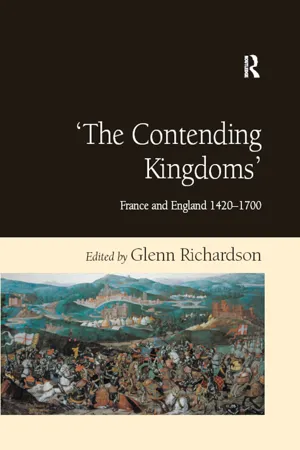
- 210 pages
- English
- ePUB (mobile friendly)
- Available on iOS & Android
eBook - ePub
About this book
The kingdoms of France and England were for many centuries military, economic, cultural and colonial rivals. This is particularly true of the early modern period which witnessed the rise of French military hegemony and the expansion of English commerce. Dealing with the period 1420-1700, this collection offers a snapshot of Anglo-French relations across the three centuries from established historians and younger scholars from France, Britain and Luxembourg. Based broadly on 'diplomatic' history, but incorporating wider perspectives from cultural and social or gender history; each essay uncovers the fascinating and complex arrangements that characterize Anglo-French relations in this period. Competition and hostility between the two kingdoms there certainly was, but it took a surprising variety of forms and often proved intellectually productive for one side or the other and sometimes for both. The chapters mix treatments of broad themes and particular circumstances or individuals and each makes specific comparisons with French and English experience across the early-modern period. In so doing they elaborate and go beyond the evidence of Anglo-French hostility to explore evidence of political co-operation and cultural influences, highlighting just how close early modern England's connections with France were, even at times of crisis.
Chapter 1
Introduction The Contending Kingdoms: France and England 1420–1700
The 2003 Richard Dimbleby Lecture was delivered by Dominique de Villepin, then the French Foreign Minister. He observed that in the century since the signing of the Entente-Cordiale in 1904, the peoples of Britain and France ‘have built a unique relationship, made up of a mixture of irritation and fascination’.1 His words apply equally well to long periods before 1904, and to none better than the sixteenth and seventeenth centuries. Rather than being unremittingly hostile, as they are often popularly assumed to be, early-modern Anglo-French relations are perhaps better described as ambivalent in the true sense of the word. That is, they had both positive and negative strengths at different times and circumstances. From diplomacy and warfare, to trade, exploration and technological development and in the fields of literature, the fine arts, fashion and cuisine, each side did indeed find the other both endlessly irritating and fascinating.
The nine essays in this volume present some of the most recent research and reflections on relations during the late-medieval and early-modern periods. They were originally presented as papers at a conference convened by the Society for Court Studies in November 2004 to mark the centenary of the Entente-Cordiale and their diverse subjects reflect the wide range of research presented on that occasion.2 The essays are of several kinds: those by Anne Curry, Charles Giry-Deloison, David Onnekink and Glenn Richardson use discrete periods or episodes to reflect on the nature of the Anglo-French relationship. The chapters by Robert Knecht and Cédric Michon offer comparative studies of the French and English nobilities and episcopates respectively. Susan Doran, Loïc Bienassis and Sonja Kmec examine personal relations and connections between a number of individuals prominent in the context of Anglo-French relations.
It may be useful to set an initial presentation of these essays in the context of the main diplomatic and cultural developments in Franco-English relations since 1420 and historiographical trends in the field. Beforehand, however, one important distinction must be made. These essays are focused primarily on relations between the kingdom of France and the kingdom of England as such rather than with any other part of the Atlantic archipelago. Anglo-Scottish and Franco-Scottish relations in the early-modern period have been the subject of a number of recent studies, as have Anglo-Irish and Franco-Irish relations.3 The terms ‘Britain’ and ‘British’ are, however, used in this book in order to recognise the existence of the ‘Three Kingdoms’ of which England was a part and the dynastic union of the crowns of England and Scotland from 1603 after which date it would be anachronistic to refer to the crown of England in isolation.
Anglo-French relations have been a natural and important part of the national and diplomatic histories of England, of Britain and of France written since at least the mid-nineteenth century.4 The subject was given particular impetus in the early twentieth century following the cataloguing and publication of manuscript material gathered from royal, private and regional archives. For example, the Letters and Papers of Henry VIII and the series of State Papers appeared in Britain as the Catalogue des actes de François Ier was published in Paris. The vast corpus of material thus made available, together, perhaps, with the conclusion of the Entente-Cordiale and the experience of being allied in the First World War, prompted new interest in the history of past relations.5
Scholarly societies also played significant roles in promoting and supporting the study of French history in Britain. The foundation in 1885 of the Huguenot Society of London, subsequently the Huguenot Society of Great Britain and Ireland, led to the establishment of archives and the publication of scholarly accounts of the experiences of French Protestants in the Three Kingdoms.6 In 1986, the Society for the Study of French History was founded. It created a new forum for historians from Britain, the United States of America and elsewhere to interact with their French colleagues. The Society continues to promote, support and publish research in French history from medieval to modern times. To commemorate the centenary of the Entente-Cordiale, the Centre for the Advanced Study of French History was established in 2004 at the University of Reading in England.7
Although the history of Anglo-French relations as such was not among the primary objects of these societies, their existence has, nevertheless, helped to stimulate research in this area. The Maison Française was established at Oxford after World War II and the last two decades of the twentieth century and the first decade of the present one have seen an increase in publications either specifically concerning Anglo-French relations or ones which make comparisons between the two nations at different periods.8 Much of this has been broad brush work but more detailed studies of particular periods, themes and personalities in Anglo-French relations are also now being published on both sides of the Narrow Sea.9 Studies of the British and French royal or imperial courts feature regularly in the seminars and in the journal of the Society for Court Studies, founded in 1996. The publication of this volume of the early-modern papers presented to the Society’s 2004 conference is intended as a further contribution to this development.10
*
Probably no other period in the history of Anglo-French relations before the reign of Napoleon has been as fully investigated as the Hundred Years War. Histories of the conflict written in the years to the end of the nineteenth century tended to present it in strongly partisan terms, as an integral aspect of nationalistic constructions of French or English history. As late as 1951 Edouard Perroy reflected on comparisons between France’s experience of occupation by the Germans during the Second World War with that by the English during the fourteenth and fifteenth centuries.11 During the later twentieth century, however, the causes and consequences of the Hundred Years War were studied with renewed and rather more detached interest on both sides of the Narrow Sea. A number of sources, such as the Gesta Henrici Quinti were published for the first time or were revised and republished12
Since 1960 greater emphasis has been placed on studying the effects of the war on both kingdoms in tandem. Historians have also studied the conflict in much broader chronological, comparative and thematic contexts.13 They have emphasised the close relationship between the demands of fighting and the growth and consolidation of royal power, particularly in France but in England as well after the domestic turmoil of Henry III’s reign. There is now a greater appreciation of the significance of the conflict in the workings of papal diplomacy and of the complex network of dynastic and marriage alliances contracted by both sides that were to have far-reaching implications for British and French history down to the modern period.14 At the start of the twenty-first century the emphasis has shifted again and scholars are now investigating more closely some of the evidence hitherto passed over in broader chronological narratives. It is to these more recent endeavours that Anne Curry makes a contribution in this volume.15
The treaty of Troyes, agreed in 1420 between Henry V and Charles VI, was supposed to create a ‘dual monarchy’ for Henry and theoretically settle the claims and counter-claims between the two kingdoms that dated back at least to the treaty of Paris of 1259. Yet, as Professor Curry shows, the circumstances of the treaty’s negotiation and agreement were much more complicated than its provisions acknowledged. These were deliberately vague about the core issues in dispute between the kingdoms and avoided any explicit references to Henry’s actual claim to the French throne, its origins or future or the precise nature of Henry’s ‘dual monarchy’. Professor Curry raises some interesting ‘what if’ possibilities based on the provisions as finally agreed. The most intriguing of these is surely that, had Henry outlived Charles VI and the treaty taken effect as its English negotiators envisaged, the ‘united kingdom’ would have been, not England and Scotland, but rather England and France.
In fact, although crowned king of France as a child, Henry VI witnessed the loss of all English territory in France apart from Calais by 1453. England’s defeat contributed to the collapse of its royal authority for a generation as its nobility immersed itself in civil conflict. Having effectively rid France of the English, French monarchs then oversaw the recovery of their kingdom. Its boundaries were extended under Louis XI who asserted royal power against the Valois dukes of Burgundy and under Charles VIII, France began to play a more prominent role in wider European affairs.16 Dynastic claims in the Italian peninsula were pursued successfully by Charles VIII, Louis XII and Francis I, although all that had been won was again lost by 1524. For historians of this period in French history, relations with England, for so long a necessary part of the country’s late-medieval history, began to recede into the background. By contrast French, Breton and Burgundian support for Lancastrian, Yorkist and Tudor claimants to the English crown became important aspects of the history of the Wars of the Roses.17 So, too, did the continuation of the English claim to the French crown. Historians have shown a warranted scepticism about whether either Edward IV or Henry VII was genuinely interested in fighting in France, although during the past decade a case has been made that they were prepared to attack France when it suited their domestic agendas. Nevertheless, both kings saw the advantages of peace and used the threat of a renewal of armed conflict to obtain money and guarantees of non-intervention in English affairs from their French counterparts under the treaties of Picquigny in 1475 and of Etaples in 1492.18
As the political and economic recovery of France gathered pace in the last quarter of the fifteenth century, trade and cultural relations with England also began to improve. As Professor Charles Giry-Deloison points out in his chapter of this volume, commercial interaction has been a comparatively neglected aspect of early-modern Anglo-French relations. Nevertheless, between 1475 and 1513 (and for long periods thereafter) real efforts were made to encourage trade between England, Aquitaine, Normandy and Brittany and to ensure that it could be conducted safely and reasonably profitably. English cloth and tin found ready markets in France and French wine had been assiduously sought by the English since well before the Hundred Years War. The dominance of Flemish culture in and around the court of Henry VII has become axiomatic in the historiography of his reign, but it should not entirely obscure the importance of French influence.19 One instance of this, and a market which saw unprecedented growth in England under Henry VII, was the demand for French illuminated manuscripts and religious books. As Professor Giry-Deloison shows, the king took great interest in the works of French printers such as Antoine Vérard. Printing and propaganda were closely linked in this period and the talents of royal printers like Richard Pynson and Wynken de Worde were used to produce polemical tracts and woodblock prints asserting English claims to the crown of France during the build-up to hostilities in 1492 and 1513. There were parallel French tracts disputing the claim. Yet all the rhetorical posturing seems finally to underscore the fact that England and France had ceased fighting after the battle of Castillon in 1453 and were at effective, if difficult, peace during the final quarter of the fifteenth century.
The sixteenth century witnessed a sudden and dramatic increase in the scale of competitive international relations in Europe. This was due largely to the accession within a decade of three young and ambitious men; Henry VIII of England, Francis I of France and the Holy Roman Emperor Charles V. Their youthful determination to emulate their respective ancestors was characterised by demonstrative royal extravagance, a heightened interest in concepts of princely chivalry and in the sheer scale and expense of warfare.20
For Henry VIII, emulating his ancestors meant nothing less than renewing the Hundred Years War. His claims to territories in the kingdom of France were proclaimed at his coronation. Yet, as his immediate predecessors had also discovered, the consolidation of French royal power in the late fifteenth century and developments in the technology and tactics of warfare meant that an English king could no longer invade France allied only to dissatisfied vassals of the French king such as the dukes of Brittany and Burgundy. Henry VIII’s international status and ambitions were always subjected to wider European politics and to the sometimes quixotic ambitions of his father-in-law, Ferdinand of Aragon and the two Habsburg emperors, Maximilian I and Charles V. Initially lacking these allies, Henry was forced to spend the first four years of his reign at peace with France. It was not until June 1513, 60 years after the battle of Castillon, that an English army once more descended on France and the ancient quarrels between England, France and the Burgundian Netherlands were renewed on a much larger stage.
Henry invaded France three times in the course of his reign in an effort to make his reputation internationally. He first used his inheritance, then the taxes of his subjects and finally the wealth of England’s medieval ecclesiastical heritage and the value of its coinage to fund his wars against Louis XII and Francis I. He took the city of Tournai and the town of Thérouanne in 1513 and captured Boulogne in 1544. That he did not do more was due in part to his own limitations as commander and his unreliable allies whose agendas were always too big for him to control.21
Like his father before him, Henry VIII actually spent most of his reign at peace with France. In 1514, 1518, 1527 and 1532 the king of England made peace and alliance treaties by which he gained large sums of money from the kings of France. These were paid as a pension but were received by Henry as ‘tribute’ for ‘his’ crown of France. Peace was thereby made honourable and profitable for the king. It also allowed his subjects to engage in relatively undisturbed trade with France and the rest of continental Europe for most of his reign, from which he also profited. Henry’s sense of personal competition with Francis I in every facet of kingship never diminished. Relations between them were conducted in the high-flown language of princely chivalry and in the good times they exchanged presents and their most trusted personal serva...
Table of contents
- Cover
- Half Title
- Title Page
- Copyright Page
- Table of Contents
- List of Appendices
- List of Abbreviations
- Notes on Contributors
- 1 Introduction The Contending Kingdoms: France and England 1420–1700
- 2 Two Kingdoms, One King: The Treaty of Troyes (1420) and the Creation of a Double Monarchy of England and France
- 3 France and England at Peace, 1475–1513
- 4 The French and English Nobilities in the Sixteenth Century: A Comparison
- 5 Pomp and Circumstances: State Prelates under Francis I and Henry VIII
- 6 The French Connection: Francis I and England’s Break with Rome
- 7 Elizabeth I and Catherine de’ Medici
- 8 Richelieu and Britain (1634–1642)
- 9 ‘A Stranger Born’: Female Usage of International Networks in Times of War
- 10 Anglo-French negotiations on the Spanish Partition Treaties (1698–1700):A Re-evaluation
- Index
Trusted by 375,005 students
Access to over 1.5 million titles for a fair monthly price.
Study more efficiently using our study tools.
Frequently asked questions
Yes, you can cancel anytime from the Subscription tab in your account settings on the Perlego website. Your subscription will stay active until the end of your current billing period. Learn how to cancel your subscription
No, books cannot be downloaded as external files, such as PDFs, for use outside of Perlego. However, you can download books within the Perlego app for offline reading on mobile or tablet. Learn how to download books offline
Perlego offers two plans: Essential and Complete
- Essential is ideal for learners and professionals who enjoy exploring a wide range of subjects. Access the Essential Library with 800,000+ trusted titles and best-sellers across business, personal growth, and the humanities. Includes unlimited reading time and Standard Read Aloud voice.
- Complete: Perfect for advanced learners and researchers needing full, unrestricted access. Unlock 1.5M+ books across hundreds of subjects, including academic and specialized titles. The Complete Plan also includes advanced features like Premium Read Aloud and Research Assistant.
We are an online textbook subscription service, where you can get access to an entire online library for less than the price of a single book per month. With over 1.5 million books across 990+ topics, we’ve got you covered! Learn about our mission
Look out for the read-aloud symbol on your next book to see if you can listen to it. The read-aloud tool reads text aloud for you, highlighting the text as it is being read. You can pause it, speed it up and slow it down. Learn more about Read Aloud
Yes! You can use the Perlego app on both iOS and Android devices to read anytime, anywhere — even offline. Perfect for commutes or when you’re on the go.
Please note we cannot support devices running on iOS 13 and Android 7 or earlier. Learn more about using the app
Please note we cannot support devices running on iOS 13 and Android 7 or earlier. Learn more about using the app
Yes, you can access 'The Contending Kingdoms' by Glenn Richardson in PDF and/or ePUB format, as well as other popular books in History & World History. We have over 1.5 million books available in our catalogue for you to explore.