- 256 pages
- English
- ePUB (mobile friendly)
- Available on iOS & Android
eBook - ePub
About this book
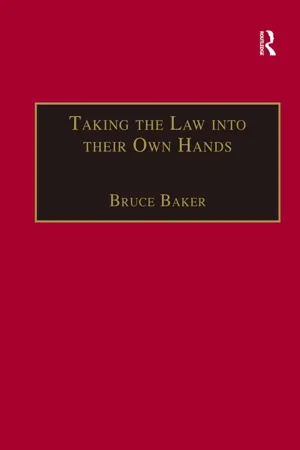
Over much of Africa, crime and insurgency are a serious problem and one in which the distinction between the two is being eroded. Left without state protection people have sought to preserve their lives and property through vigilante groups and militias that pay scant attention to the law or human rights. Likewise, the state security forces, under pressure to cut crime and rebel activity, readily discard lawful procedures. Torture provides them with vital information, whilst extra-judicial executions save the need to go through the prolonged criminal justice system. After a general overview of the role of the rule of law in a democratic society, Bruce Baker provides five case studies that capture the current complex realities and their impact on the new democracies. The citizen responses considered are vigilantes in East African pastoral economies, The Bakassi Boys an anti-crime group in Nigeria and private policing initiatives in South Africa. The state responses are those of the Ugandan Defence Forces towards the Lords Resistance Army, the Senegalese army towards the Casamance secessionists and the Mozambique Police response towards criminals.
Trusted by 375,005 students
Access to over 1.5 million titles for a fair monthly price.
Study more efficiently using our study tools.
Information
PART I
LAWLESSNESS AND DEMOCRACY IN AFRICA
1 The Importance of the Rule of Law in Democracy
Lawless law enforcement is a familiar feature throughout Africa. In their efforts to uphold the law and in their response to those who break it, state and non-state policing agencies use methods that are both contrary to national law and international law. According to the Human Rights Report of 2000, by the US State Department, police in Malawi ‘continued to beat and otherwise abuse detainees and to use excessive force in handling criminal suspects… Police sometimes hide these abuses by keeping prisoners in police custody until wounds heal before turning them over to the prison system for remand’. To the south, members of the security forces in Namibia ‘used excessive violence against citizens and Angolan civilians along the northern border of the country… Senior civilian and military government officials made public statements acknowledging that security forces abused and killed civilians in the Kavango and Caprivi regions during security operations’. To the north a mass grave was found near Lake Chad in Niger in 1999 ‘containing 149 bodies alleged to be those of missing Toubou former rebels… When last seen the Toubous were in the custody of the Nigerian armed forces’. To the west, in Benin, ‘a rural popular leader, the self-styled Colonel Devi, incited mobs [in 1999] to lynch more than 100 suspected criminals in the southwestern part of the country. Most of the victims were burned alive, many after being abducted, beaten, and tortured by Devi’s followers… Individual incidents of mob justice continued to occur nationwide, and police most often ignored vigilante attacks’ (US Department of State, 2001).
This book is an examination of what happens to the polity in general and democratic institutions in particular when those who seek to enforce the state law, be they state security forces or local informal arrangements, do so with scant regard for state legal process. Often the abuses of law enforcers are borne of desperation to impose order when organised violence threatens social stability. When lawful methods fail to restrain the ‘rebels’, ‘bandits’, ‘hoodlums’ and ‘thugs’, then the temptation is to apply methods of detention, interrogation, trial and punishment that offer quick results or at least results more acceptable to the perpetrators. It is worth remembering Tilly’s observation that, ‘Contrary to the image of dissidents lashing out at regimes – the great bulk of killing and wounding in the course of modern collective violence is done by troops, police, and other specialized repressive forces’ (1975, p. 495). Beyond the violent aspect of law enforcement, however, is the issue of their lawlessness.
Lawlessness
By lawlessness is meant conduct by law enforcers that is not subject to or controlled by the national law. This has frequently been found to be closely related to the level of perceived domestic threat by the authorities, whether at national or village level. When the level of threat is high, as is the case in the examples chosen for this book, the greater their willingness to call upon security personnel to restore order and to nullify the threat, if necessary, through repression and unlawful methods. Measuring threat levels is not a scientific process, but authorities will take into account the target of the threat (the political system itself or material assets), support levels, use of violence, and the organisation level (Davenport, 2000, pp. 3–5).
It may well be that law enforcers are only enforcing the orders of those in power and that lawless law enforcement is the response of these leaders to a threat to destabilise or overthrow their rule. But law enforcers also act with varying degrees of independence and it is important to consider what reasons they might have themselves for lawless conduct, whether it be lack of supervision, frustration at the ineffectiveness of lawful procedures, the nature of the recruits, security group culture, revenge, non-liberal views of punishment, pressure for results, or social discrimination.
There is then, potentially, a multiplicity of causes behind lawlessness, both at the level of the political authorities and at the level of the security agents themselves. Can sociological theories of crime and deviancy provide any over-arching explanations of lawlessness among law enforcers? There are three perspectives that warrant consideration. The first is anomie theory, which proposes that people use alternative means, including deviant and illegal activities, to gain access to socially created needs that they are unable to obtain through legitimate behaviour. In societies, for instance, where there is an over-emphasis on the goal of achieving material wealth, but the approved institutional means of attaining it are restricted, this can lead to social strain or anomie. As a result some may embark on ‘innovative’ routes to acquire wealth which society regards as deviant. Lawlessness among law enforcers could therefore be seen as deviant behaviour arising where the societal goals of security from violence and crime cannot be attained through traditional legal methods of policing. This interpretation, however, makes the assumption that society is agreed on the institutional means of deterring and punishing violent crime and rebellion. Though law passed by parliament may represent the legally approved institutional means, in much of Africa there is a sharp division of popular opinion about the legitimacy of conferring human rights on criminals and rebels. It is this contested view of lawlessness that under-girds a second approach.
This is the victimised actor model, which questions how lawlessness and deviancy is defined. It notes that very often deviance is not a property inherent in certain forms of behaviour, but one that is conferred. It is the powerful who determine that elements of the behaviour of the poor and disadvantaged are deviant. They then impose the new rules upon the powerless against their will. Are, therefore, summary punishments, extrajudicial killings, illegal detentions, and similar such abuses by law enforcers, a case of national or international elite labelling of popularly accepted behaviour? Though it might be argued that there are degrees of lawlessness attracting differing levels of support, it does remind us not to view African policing through European spectacles. Actions may be lawless in the sense of being contrary to national law, but not illegitimate in the social context in which they occur.
A third perspective that has relevance to lawlessness is social control theory, which considers why people conform and how restraints on behaviour may break down. A number of circumstances have been explored that lower social constraint, such as periods of rapid modernisation and social change, when new forms of regulation cannot evolve quickly enough to replace the declining force of social integration. No one would doubt that African nations have undergone a severe economic crisis in the last ten years. Further, the states often have weak capacity and penetration and have been unable to inculcate norms of the rule of law. In practice, therefore, policing is not effectively controlled. State agencies and informal groups are allowed to get away with abuses, although whether this is always from ignorance of them or because they are excused for various reasons is disputed. With supervisory control of policing being in such a parlous state, policing has been allowed to become or remain inefficient, corrupt and lawless. Left, as they often are, to their own devices, law enforcement agencies, whether formal or informal, have a low stake in conformity.
None of these approaches provides a total explanation. They appear inadequate when it comes to explaining a specific form of deviance; or why lawless behaviour is undertaken by those who are otherwise lawful; or why not all those involved in policing resort to lawlessness, despite being exposed to similar pressures or the lack of them. Yet despite their limitations, each has something to say about lawless law enforcement; to what degree must be assessed chapter by chapter.
Law Enforcement
Law enforcement is a broad category associated with an array of functions, including regulating society and maintaining order, preserving security, preventing crime, responding to crime and restoring order, and the use where necessary of instruments of coercion to assist in any of these. The nature of these functions has caused it to be widely regarded in the West as an inherently public good, whose provision should reside in the hand of a single monopoly supplier, the democratic state. In the state’s hands, it is argued, policing activities can be required to be accountable, consistent and humane. However, the reality on the ground is outstripping these common sentiments. Law enforcement is ‘being reconstructed worldwide’, with not only a separation between those who authorise it from those who provide the service, but a dispersal of both functions away from government (Bayley and Shearing, 2001). Policing for an array of authorities that includes business interests, residential communities, cultural communities, individuals as well as the state, is now provided by commercial security companies, formal voluntary non-governmental groups, individuals and even governments themselves as private suppliers of protection.
This reconstruction of policing is evident across Africa, where non-state agencies are found engaged in street patrolling, guarding private and public property, order maintenance, arrest, search, detection, surveillance, inspection and personal escort/protection. In fulfilling many of these duties they bear firearms and other means of coercion, such as handcuffs, truncheons and pepper spray to, if necessary, enforce their activities. In other words, such policing groups do everything that the public police force does and do it as the police do it. Or, put another way, law enforcement is a broader activity than simply what The Police do.
The reality, therefore, especially in Africa, is that law enforcement is being reconstructed. There is not only a separation between those who authorise it from those who provide the service, but the dispersal of both functions away from government. It is provided by commercial security companies, formal voluntary organisations, informal groups, individuals, as well as the state, for an array of authorities, formal and informal, that includes business interests (legal and illegal), residential communities, cultural communities, individuals and the state. As Bayley and Shearing note, the relationship between authorisers and providers can have several permutations: public/public, public/private, private/public, private/private:
Without close scrutiny it has become difficult to tell whether policing is being done by a government using sworn personnel, by an agent using a private security company, by a private security company using civilian employees, by a private company using pubic police or by a government employing civilians (Bayley and Shearing, 2001).
The boundary between public and private has lost its distinctiveness. Both public and private entities authorise policing and both public and private entities provide services for those authorisers. Further blurring the divide, governments provide policing for private organisations and private providers offer services to governments. Bringing together into a single analytical category of law enforcement, activity by state and non-state agencies, is not, however, without its problems. Some would insist that collapsing the whole field of law enforcement is to merge phenomena that are inherently separate. It is true that the informal vigilantes, regional state vigilante services, national police and internal security forces that are considered in this book have significant differences in their authority, organisational structure, legality and how they define social deviance and the type of ‘order’ they wish to establish. Nevertheless they do have important features in common. They are all forces of coercion engaged to preserve internal social order, which they do either in co-operation, or in opposition or sometimes in isolation. That they all use similar methods is a reflection of the similar roles they perform. As Hills observes, in Africa at least, talking about policing is more helpful than talking about the police:
policing in Africa goes beyond formal civilian groups… the focus should be on policing (as in the provision of order and enforcement) rather than on what organizations call themselves. How police style themselves is less important than what they do or do not do (Hills, 2000, p. 6).
Hills illustrates her point from Nigeria where, ‘the military, some eight or more paramilitary units, various palace guards, numerous quasi-official units in various states, and miscellaneous thugs associated with strongmen’ all engage at some time or other in what could be called policing (Hills, 2000, p.7). The fact is that the boundary between private and public has lost its clarity. Both public and private entities have assumed responsibility for authorising policing. And both public and private entities provide policing to those providers. Even the government’s role is no longer exclusively public, for it authorises policing, encourages non-government groups to authorise policing and provides policing to specialised consumers on a fee basis. Similarly private providers are not exclusively private, since they sometimes work under public authorisers and are sometimes staffed by public police personnel. Law enforcement as an activity rather than an organisation is, therefore, the approach that will be followed. The book endorses the inclusive views of policing offered by McLean: ‘Policing is an activity of enforcing the criminal law…Typically [the people doing the policing] have been the military, church officials and citizens taking their turn or persons hired by a magistrate’ (McLean, 1996) or Hills, ‘policing concerns the enforcement of a state’s (or regime’s) definition of appropriate public order and behaviour’ (Hills, 2000, p. 7). Despite the rhetoric of governments, state as well as non-state law enforcers are controlled only poorly or not at all by state institutions. It is this minimal accountability to the public that explains their at times violent, self-regarding and lawless conduct.
The Role of the Law
Before the breakdown of law in parts of Africa’s new democracies is examined, it is helpful to be clear about our ideas of what the role of law should be in a democracy and what its relationship with democracy consists of Each individual in a community desires freedom, but paradoxically, to secure and preserve that freedom, a degree of freedom has to be relinquished. Living in a community there is always the danger of the strong members taking advantage of the weak ones. Binding communal rules, whether written or the standard established by reiterated human activity, can limit the strong, but at the same time, they limit all. The inescapable conclusion is that to maximise freedom of action for all, some actions have to be restricted. When it comes to organising the state, libertarians, who see freedom in terms of non-intervention, regard state law as a necessary evil to stop greater interference (Berlin, 1958). To republicans, who see freedom in terms of non-domination, state law is a vital good to maximise such freedom (Pettit, 1999). Whatever the preferred conceptualisation of freedom, however, both agree that freedom is preserved by state law. How can it be, asked Rousseau:
That all should obey, yet nobody takes upon him to command, and that all should serve and yet have no masters?… these wonders are the work of the law. It is to law alone that men owe justice and liberty. It is this salutary organ of the will of all which establishes in civil right the natural equality between men…The first of all laws is to respect laws (Rousseau, 1973, p. 124).
As Kauper has said, ‘Rule of law must mean freedom from private lawlessness and anarchy before it can mean anything at all’ (quoted in Walker, 1988, p. 24). The alternative, of a law-less society, is an environment that allows the powerful to dominate and to use that domination to exploit the weak at will and with impunity (Pettit, 1999, p. 93). Such a community is undesirable whatever the character of the most powerful member. It gives space not just to the brute force of tyrants, but to the arbitrary and unexpected impositions of otherwise benevolent superiors. It creates a condition either of actual suffering, or at best, of living with the anxiety of possible loss that an individual is helpless to prevent and may only delay by subservience and obsequiousness.
Almost every political system establishes binding rules on the whole community, or what Rawls calls, ‘a coercive order of public rules’ to regulate conduct and facilitate co-operation (Rawls, 1971, p. 235). Yet the existence of such rules does not in and of itself provide a harmonious society. The question is the degree to which the rules are obeyed. Do the rules rule? Do they actually constrain the behaviour of the people and, in particular, of those who govern and who enforce the law? Is there a universal consensus, or do they contradict the established rules of minorities? These are questions that lead us from considering law, to considering the rule of law, that is the recognition by rulers and the ruled of the authority and superiority of a single body of law.
Defining the Rule of Law
Law is a code that sets down what is forbidden, whereas the rule of law is a principle of restraint and compliance entailing self-control and the absence of arbitrary coercion of others. Beyond that broad definition, however, there have been various distinct interpretations. One approach to understanding the principle of the rule of law is to see it as making a legal system user-friendly and effective. This is an instrumentalist view of the rule of law, recognising that rules work best when they are con...
Table of contents
- Cover
- Half Title
- Title Page
- Copyright Page
- Table of Contents
- List of Figures
- Acknowledgements
- Introduction
- Part I: Lawlessness and Democracy In Africa
- Part II: The Army Takes The Law Into Its Own Hands
- Part III: The Police and State Militia Take The Law Into Their Own Hands
- Part IV: The People Take The Law Into Their Own Hands
- Part V: The Implications for Democracy
- Bibliography
- Index
Frequently asked questions
Yes, you can cancel anytime from the Subscription tab in your account settings on the Perlego website. Your subscription will stay active until the end of your current billing period. Learn how to cancel your subscription
No, books cannot be downloaded as external files, such as PDFs, for use outside of Perlego. However, you can download books within the Perlego app for offline reading on mobile or tablet. Learn how to download books offline
Perlego offers two plans: Essential and Complete
- Essential is ideal for learners and professionals who enjoy exploring a wide range of subjects. Access the Essential Library with 800,000+ trusted titles and best-sellers across business, personal growth, and the humanities. Includes unlimited reading time and Standard Read Aloud voice.
- Complete: Perfect for advanced learners and researchers needing full, unrestricted access. Unlock 1.5M+ books across hundreds of subjects, including academic and specialized titles. The Complete Plan also includes advanced features like Premium Read Aloud and Research Assistant.
We are an online textbook subscription service, where you can get access to an entire online library for less than the price of a single book per month. With over 1.5 million books across 990+ topics, we’ve got you covered! Learn about our mission
Look out for the read-aloud symbol on your next book to see if you can listen to it. The read-aloud tool reads text aloud for you, highlighting the text as it is being read. You can pause it, speed it up and slow it down. Learn more about Read Aloud
Yes! You can use the Perlego app on both iOS and Android devices to read anytime, anywhere — even offline. Perfect for commutes or when you’re on the go.
Please note we cannot support devices running on iOS 13 and Android 7 or earlier. Learn more about using the app
Please note we cannot support devices running on iOS 13 and Android 7 or earlier. Learn more about using the app
Yes, you can access Taking the Law into their Own Hands by Bruce Baker in PDF and/or ePUB format, as well as other popular books in Law & Law Theory & Practice. We have over 1.5 million books available in our catalogue for you to explore.