eBook - ePub
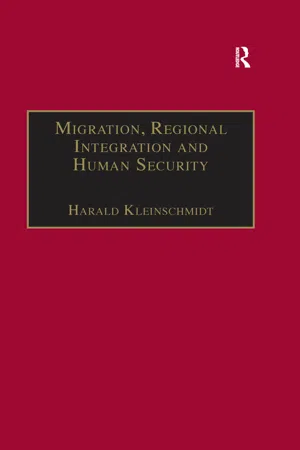
Migration, Regional Integration and Human Security
The Formation and Maintenance of Transnational Spaces
- 304 pages
- English
- ePUB (mobile friendly)
- Available on iOS & Android
eBook - ePub
Migration, Regional Integration and Human Security
The Formation and Maintenance of Transnational Spaces
About this book
This original and timely book is the first to analyze the interconnectedness of migration, regional integration and the new security studies. Exploring the conflict between the actions of transnational migrants and state government policy in a series of theoretical chapters and regional case-studies, the book includes theoretical chapters which look at three key facets of the nation-state: population, territory and government, discussing the ways in which migration, regional integration and new security thinking challenge the accepted role and responsibilities of the state. Regional case-studies are also included which explore the specific challenges faced in regions including Central America, Asia and the Pacific and Central and Eastern Europe. As a book that asks crucial questions about the formulation of migration policies and the consequences of that success of failure, it will be essential reading for students and scholars of migration in sociology, politics and international relations and also for those with professional interests in the area.
Trusted by 375,005 students
Access to over 1.5 million titles for a fair monthly price.
Study more efficiently using our study tools.
Information
Subtopic
Emigration & ImmigrationIndex
Social SciencesPART 1
Approaches to Migration
Chapter One
International Migration: A Development Practitioner’s Perspective
Introduction
Some 175 million people live outside the country of their birth (2000 estimate)2, including some 12 million refugees and 1 million asylum seekers (UNHCR 2000 figures). Each year, more than 5 million people migrate, through formal and informal channels. This paper will refer mainly to migration from developing countries into OECD countries, though significantly, the great majority of international migration takes place among developing countries. The term international migration is used loosely to refer to movement of people across borders, whether as job seekers, refugees or asylum seekers, for shorter or longer periods of time.
While migration has existed throughout the history of humankind, present day international migration is characterized by the greater diversity and often, the lack of predictability of flows. The distinction between economic migrants, refugees and asylum seekers has become blurred. This reflects both the tightening restrictions on immigration, as well as the complexity of factors that result in people leaving their countries. With such tightening, the numbers of undocumented or illegal migrants have increased (UN estimates for 1998 of 4 million people trafficked, producing a profit of 7 billion US$).
With the development of communication and transportation, most migrant communities now maintain close economic, social, political, cultural and religious links with their extended families, communities and institutions in their countries of origin, exercising significant impact on the latter. Repeat, return and onward migrants are not uncommon, thus intensifying the multiple identities of migrants straddling multiple societies and cultures.
Public apprehension over the perception of haphazard and uncontrolled immigration has intensified in recent years in OECD receiving countries, though not necessarily proportionate to actual numbers. The so-called ‘immigration crisis’ has become a hotly debated political issue. In addition to the grievance that immigrants are taking away jobs and abusing generous social services benefits, September 11 has added fuel to the terror of being swamped by great waves of unwanted foreigners who are causing a threat to internal security through terrorism, crime, drugs, disease, and so forth.3 In the months following September 11, immigration featured as a key election issue in several EU countries, resulting in part in centre/right coalition governments in Denmark and Netherlands, or, at least tightly fought elections as in the cases of Sweden and Germany. Niessen and Schibel summarize the current situation as follows:
It is probably fair to say that in the nineties, Europe saw itself confronted with unsolicited and undesired immigration. This is reflected in the terms used in the debates. Asylum-seekers and refugees were indeed admitted in great numbers, but seen as a burden that had to be shared among countries. Policies became based on suspicion: asylum was granted when not proven manifestly unfounded. Spouses were reunited after the primary purpose of their marriage was established. Bogus asylum seekers, economic refugees – terms frequently used in official parlance – and clandestine migrants were out to enter Europe’s backdoor in order to benefit from the welfare state. Migration management and prevention came to mean migration restriction, border control and combating clandestine migration, trafficking in and smuggling of human beings. Migration became associated with organized crime and terrorism (especially after the 11th of September). Immigrants were associated with criminals and terrorists. Security issues began to dominate the policy agendas at national and European level, just as re-admission began to dominate the relationship with countries of origin.4
Terrorism was being associated with lack of democratic values, and thus, post September 11, the ‘uncontrolled outflow’ from poor countries is perceived as being linked not just with development failure, but also with failure of governance. Is the ‘migration crisis’ a misguided fallacy or can it be substantiated? Zolberg and Benda conclude as their most significant finding in Global Migrants, Global Refugees, that ‘recent developments in the sphere of international migration, including both voluntary and forced movements, do not provide evidence of a “crisis” and that this holds as well for realistic projections into the near future’.5 Crises or not, the perception is real, and there is mounting pressure for rationalizing policies and practices surrounding international migration.
Rationalizing, from a receiving, OECD country perspective, focuses on strengthening the control of international population flows, or put bluntly, keeping out unwanted immigrants, rejecting and returning bogus asylum seekers.
From an emigrating developing country perspective, however, international migration, whether permanent or temporary, is one among a mix of strategies, which households, communities and countries activate to improve their well being, and is thus part and parcel of the development process. Thus, rationalization would imply policy mixes that optimize the gains from migration while minimizing the losses, namely more of the right kind of migration under the right conditions.
This fundamental disparity manifests itself in two other ways. One is in the commonly accepted notion of ‘globalization’, which covers the free flow of money, goods and services, but not of people, especially when it comes to unskilled workers. For example, a World Bank document describes globalization as
the growing interdependence of countries resulting from the increasing integration of trade, finance, people, and ideas in one global marketplace. International trade and cross-border investment flows are the main elements of this integration.6
While the movement of certain categories of professionals and managers is encompassed under the World Trade Organization’s General Agreement on Trade in Services (‘movement of natural persons’), that of skilled and unskilled workers is not. Given that for a significant number of developing countries, skilled and unskilled workforce are their biggest resource, restrictions on their flow prevent them from maximizing the benefits of globalization. Thus, Dollar and Kraay state: ‘Migration from poor locations is the missing factor in the current wave of globalization that could make a large contribution to reducing poverty’.7 According to an applied equilibrium model study, if people were money, and enjoyed the same freedom of mobility enjoyed by finance today, the world could expect an efficiency gain as high as 3.4 trillion US$.8 Some economists, including Rodrik, have argued for total liberalization in the flow of labour, for ‘it is time to redress this balance’.9
A developmental perspective to international migration calls for recognizing these disparities and exploring pragmatic measures that reconcile competing policy objectives which can meet the needs of emigrating countries and immigrating countries alike, a highly aspirational goal but nonetheless one that needs to be placed on the global agenda.
International Migration: A Sustainable Livelihood Strategy
The impact of international migration on economic development is, in the main, encapsulated in the ‘migration hump’ theory. That is, it is not the poorest countries, nor the poorest sections of developing countries, where international migration is most prevalent. Rather, it is countries that have ‘taken off’, when people’s incomes as well as aspirations rise, that they are more likely to emigrate. The incentive to emigrate declines, however, when the country reaches a higher level of development, with per capita incomes above 4,000 US$, and the disparity with the industrialized countries become marginal. This then creates the migration hump. According to Peter Stalker, the migration hump is evident first for short distance unskilled migrants and later for the more skilled workers.10
The logical extension of the migration hump theory is that, once a country or society has reached a ‘higher level’ of economic development, migration would more or less cease. Consider, however, that according to the 2001 UK Census, three million people emigrated from the UK over the previous decade, a much higher figure than estimated, and this, notwithstanding the number of immigrants into UK. Many migrated to Australia, where they constituted 9.8 per cent of immigrants between July 2001 and June 2002, second only to New Zealand as country of origin. Among the immigrants into UK in turn, there were 3,500 Danes in 2003, a small number in proportion to the total of immigrants but significant as a proportion of the population of Denmark (6 million). These Danes were largely motivated by the UK tax laws which are among the most attractive in EU, according to the daily newspaper, Politiken, which adds that it is the Danes who earn more than 400,000 Danish crowns that consider moving out.11 The many British migrating to Australia and the Danes to UK are surely not migrating because of ‘poverty’, and UK and Denmark are usually not branded as ‘development failures’. Reasons for such migration are varied – better opportunities for jobs and education, better living environment for self and family (including better climate which is especially important for retirees), lower taxes. In a word, better lives and livelihoods.
Is it not then more appropriate to regard migration as normal human behaviour, that some people will choose migration as their strategy for achieving the goal of better lives and livelihood for themselves and their families whatever the level of societal development?
Many migrants maintain a constant flow of communication, money, visits with their countries of origin, often over generations. This flow over time creates strong linkages between specific regions in emigration and immigration countries, as new migrants follow the channels that have been opened up by earlier migrants.
Families go to considerable lengths to enable migration, often selling meager family assets including land; such investments are made in expectation of returns. Many families dispatch family members to different locations, depending on the opportunities, comparative advantages of these locations and family composition, with young children and the elderly often remaining in the rural area. With time and shifting family composition, the mobility roles of family members change.
Salazaar Parrenas’ description of Filipino migrant families vividly illustrates their mobility and resourcefulness:
Ruth Mercado works in Rome, while her oldest sister is a barmaid in Switzerland, her brother a tricycle driver in Manila, and her other sister a provider of elderly care in Saudi Arabia. Her retired parents stay in the Philippines, where they depend on the remittances sent by their daughters from three different nations. A domestic worker in Los Angeles, Dorothy Espiritu had previously worked in Saudi Arabia, during which time her husband passed away in the Philippines, her oldest daughter began working in Japan, and another daughter was working in Saudi Arabia. Finally, there is the family of Libertad Sobre...
Table of contents
- Cover Page
- Migration, Regional Integration and Human Security
- Copyright Page
- Contents
- PART 1 Approaches to Migration
- PART 2 The Restructuration of Transnational Spaces
- PART 3 Regional Approaches to Migrants’ Security Concerns
- Epilogue
- Bibliography
- Index
Frequently asked questions
Yes, you can cancel anytime from the Subscription tab in your account settings on the Perlego website. Your subscription will stay active until the end of your current billing period. Learn how to cancel your subscription
No, books cannot be downloaded as external files, such as PDFs, for use outside of Perlego. However, you can download books within the Perlego app for offline reading on mobile or tablet. Learn how to download books offline
Perlego offers two plans: Essential and Complete
- Essential is ideal for learners and professionals who enjoy exploring a wide range of subjects. Access the Essential Library with 800,000+ trusted titles and best-sellers across business, personal growth, and the humanities. Includes unlimited reading time and Standard Read Aloud voice.
- Complete: Perfect for advanced learners and researchers needing full, unrestricted access. Unlock 1.5M+ books across hundreds of subjects, including academic and specialized titles. The Complete Plan also includes advanced features like Premium Read Aloud and Research Assistant.
We are an online textbook subscription service, where you can get access to an entire online library for less than the price of a single book per month. With over 1.5 million books across 990+ topics, we’ve got you covered! Learn about our mission
Look out for the read-aloud symbol on your next book to see if you can listen to it. The read-aloud tool reads text aloud for you, highlighting the text as it is being read. You can pause it, speed it up and slow it down. Learn more about Read Aloud
Yes! You can use the Perlego app on both iOS and Android devices to read anytime, anywhere — even offline. Perfect for commutes or when you’re on the go.
Please note we cannot support devices running on iOS 13 and Android 7 or earlier. Learn more about using the app
Please note we cannot support devices running on iOS 13 and Android 7 or earlier. Learn more about using the app
Yes, you can access Migration, Regional Integration and Human Security by Harald Kleinschmidt in PDF and/or ePUB format, as well as other popular books in Social Sciences & Emigration & Immigration. We have over 1.5 million books available in our catalogue for you to explore.