- 432 pages
- English
- ePUB (mobile friendly)
- Available on iOS & Android
eBook - ePub
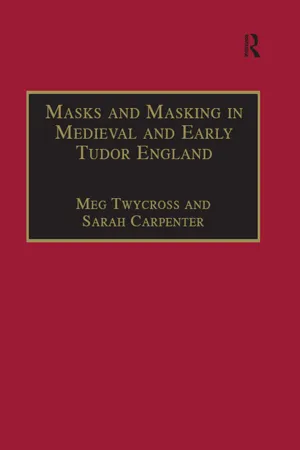
Masks and Masking in Medieval and Early Tudor England
About this book
Drawing on broad research, this study explores the different social and theatrical masking activities in England during the Middle Ages and the early 16th century. The authors present a coherent explanation of the many functions of masking, emphasizing the important links among festive practice, specialized ceremonial, and drama. They elucidate the intellectual, moral and social contexts for masking, and they examine the purposes and rewards for participants in the activity. The authors' insight into the masking games and performances of England's medieval and early Tudor periods illuminates many aspects of the thinking and culture of the times: issues of identity and community; performance and role-play; conceptions of the psyche and of the individual's position in social and spiritual structures. Masks and Masking in Medieval and Early Tudor England presents a broad overview of masking practices, demonstrating how active and prominent an element of medieval and pre-modern culture masking was. It has obvious interest for drama and literature critics of the medieval and early modern periods; but is also useful for historians of culture, theatre and anthropology. Through its analysis of masked play this study engages both with the history of theatre and performance, and with broader cultural and historical questions of social organization, identity and the self, the performance of power, and shifting spiritual understanding.
Trusted by 375,005 students
Access to over 1.5 million titles for a fair monthly price.
Study more efficiently using our study tools.
Information
Chapter 1
Introduction
This book began from an apparently simple observation: some characters in some medieval English mystery plays wore masks. Why should this have been, and what did it contribute to the plays and their performance? As we explored this question it became clear that it vibrated across a vast web of masking activities stretching across time and space. Huge numbers of people from the fifth to the fifteenth centuries, in countries from Sweden to Sicily, were involved in masking: in Provence in the early sixth century, New-Year revellers ‘put on the heads of wild animals, celebrating and leaping about’; in thirteenth-century Paris the clergy wore monstrous masks to parody the Mass in the church itself; fourteenth-century London sees groups of men in false faces going around at night to challenge householders to games of dice, while the court was entertained with sophisticated shows of dancers wearing faces of women, silver masks of angels, or ‘heads of men with elephants’; in Rome in 1502 the Pope watched a parade of maskers ‘with great long noses like penises’, while fifty years later in Venice the ‘lustie yong Duke of Ferrandin’ was killed in a private argument as he and another masker both attempted to flirt, in their visors, with the same gentlewoman; the devils in the 1536 mystery play at Bourges wore masks spouting fire from the ears and nostrils, while God in the fifteenth-century English morality Wisdom put on a wig and half-mask with ‘a bearde of golde of sypres curlyed’, and the corrupted king of the 1570s morality play The Cradle of Security was tricked into the mask of a pig.1
The variety seems bewildering: these masks are worn, or watched, by people from very different areas of society, in very different kinds of public and private encounter. Should these activities be seen as part of a single masking phenomenon, or as the parallel development of many quite separate traditions? It quickly became clear that the masked characters of the English mystery cycles could not be considered in isolation. They are only one aspect of a multi-faceted cultural phenomenon in which masks and masking contribute to play of all kinds – popular and courtly, spiritual and worldly, sporting and theatrical.
Given this variety it is important to define, if also to question, some boundaries for this study. We are looking primarily at masking in England, through the Middle Ages and into the sixteenth century. This necessitates an awareness both of temporal change and of geographical and national difference. Although masking traditions appear remarkably durable and widespread, they and their functions will change with changing societies. While it is significant and revealing that European customs involving masks are associated with the New Year for at least a thousand years, that does not mean that a fifth-century Spanish Kalends masker and a fifteenth-century English mummer both visiting households with covered faces at the beginning of January were necessarily doing and meaning the same thing. On the other hand cultural traditions of this period were not strictly respectful of national boundaries, and England shared many masking practices with the Continent. Certainly, by the early sixteenth century, trade, travel, and the marriages that linked the royal courts of Europe meant that countries knew of and sometimes imitated each other’s fashions in festivity and drama. English masking needs both to be seen within, and to be distinguished from, the wider European tradition.
If the diversity of masking activities is dazzling, modern perceptions are also diffracted by the slippery and shifting terms used to refer to them. Like the activities themselves, the vocabulary of medieval masking is both elusive and elastic. The multitude of words for face-covering objects frequently blurs together variously related senses. Visor shifts between a particular term for a helmet-piece and a general word for any face-cover; head and face are used interchangeably for real and artificial forms. Latin words cover even wider semantic fields: persona, the term for a theatre mask inherited from the classical period, also signified ‘individual’ or ‘personality’; larva, the common late-medieval term for a mask, also meant ‘malignant ghost’. References need to be unpicked with care in such a fluid semantic field. Equally, although words for masking activities are spread widely across Europe, the same word dos not always refer to the same practice. A mumming did not mean the same to a fifteenth-century English tradesman as a mommerij did to his courtly German contemporary. This consonance of terms sometimes suggests a seductive homogeneity to medieval masking which turns out to be at least partly illusory. Readers with an interest in these issues might well wish to read the chapter on ‘Terminology’ before rather than after the rest of the book.
This book consciously perpetuates one such ambiguity. The term mask did not acquire our primary sense of ‘an object used to cover the face’ until the later sixteenth century. Earlier in the century mask much more commonly designated a particular kind of court entertainment, the forerunner of what later became known as the Stuart masque. This later spelling variation usefully separates the object from the performance; but we have resisted using masque for the earlier disguisings, since its current association with a very specific Stuart genre imports misleading assumptions into the discussion of earlier masked performances. Yet throughout this study we also use mask a-historically for the object. Our choice mirrors the rich but confusing overlap in the vocabulary associated with masking throughout the medieval and Tudor periods.
Masks have fascinated virtually all human societies, including our own, and activities which involve the deliberate covering of the face remain compelling and paradoxically revealing of the cultures of their participants.2 Our aim is not, however, to address directly any one of the cultural, psychological, philosophical, and anthropological questions raised by the various forms of medieval masking. Instead this study seeks to historicise and contextualise the moments and patterns of mask-wearing in the Middle Ages. By unravelling more fully the contexts of particular activities we are better placed to draw out the meanings, both traditional and topical, they appeared to carry within their own communities.
An activity as suggestive, as openly symbolic, and indeed as unsettling as masking inevitably demands theoretical interpretation. Yet for masking behaviour as multifarious and complex as we find in medieval and Tudor England, to adopt any single theoretical approach is to run the risk of imposing rather than elucidating meaning. Its very diversity warns us that no one explanation or theory can account for all its different manifestations. This is not to say that both recent and earlier theoretical models for medieval customs are not enlightening: but often their value is primarily in alerting us to possibility rather than in defining purpose or effect. So E.K. Chambers’ inclusive study of folk custom, closely related to J.G. Frazer’s early-twentieth-century anthropological theories of ritual, influentially encouraged recognition of the undoubted cultural significance and the enduring structures of apparently trivial popular games. But his tendency to draw scattered fragments of evidence into a single, a-historic, overarching pattern of residual pre-Christian worship can seriously distort the local and immediate meanings and functions of particular masking customs. More recently, Bakhtin’s influential notion of medieval carnival as a conflict between ‘official’ and ‘unofficial’ cultural expression prompts us to recognise the profound importance of the social relationships between those involved in any medieval masking practice. Yet the very complexity of those social relations at different moments and places quickly undermines any simple model of social repression or of a straightforward opposition between popular and élite. Recent trends in medieval studies are recognising the need for flexibility, variety, and difference in understanding the complexity especially of popular cultural forms.3 With masking, all theoretical models need to be tested against the complex particularity of the evidence.
Of course neither evidence nor contexts are transparent. Records of medieval masking are partial and often uncertain, distorted not only by chance and time but by the biases and preconceptions of the recorders as well as by our own assumptions and cultural attitudes. All interpretations of these records need to be questioned and tested in the light of whatever can be recovered of their linguistic, cultural, religious, and political contexts. Our interrogation of both evidence and context begins from the question of what those involved at the time appear to have thought they were doing. Although the participants’ beliefs will never provide a complete explanation, they are one crucial root of the meaning of any cultural activity.4
This approach involves questioning the sometimes conflicting views of mask-wearers, of those who watched or interacted with maskers, and of those who discussed them, both at the time and later. Of these it is most difficult to rebuild the views of the maskers, whose personal responses are rarely recorded. We are almost always reliant on indirect evidence for any access to the opinions of those who went mumming, played the devil on stage, or courted young women in masks. The occasional glimpses of apparently personal experience themselves suggest differences, between both individual maskers and activities. Podalirius, an eighteen-year-old German carnival masker of the end of the fifteenth century, argues that masking is a valuable outlet for the playful and fiery energies of his age group, asserting his own delight in change and transformation; the young men in Shakespeare’s Romeo and Juliet, more pragmatically, see masking as a socially accepted opportunity to survey the looks and enjoy the company of young women. Similar differences of emphasis or opinion are apparent among those who observe masking activities. Podalirius’ friend Cato sees in the maskers’ riotous release of energy only ‘dizzy madness’ and lasciviousness; but more sympathetic observers of masking practices can offer us keys to unlock contemporary meanings that may be invisible to us. Edward Hall’s lovingly detailed accounts of the lavish spectacle of the Tudor court’s masked disguisings reveal not just naive propaganda or impressionability, but a recognition of the subtle operations of power through courtly display and through Henry VIII’s play with royal identity in his masking games. Theoretical commentators on masking activities may have different views again: critics of popular masking games might perceive a spiritually dangerous submission to irresponsibility, or rejection of the image of God in oneself, views that were presumably not shared by the maskers themselves.
Understanding of a masking event was therefore unlikely to be simple or consensual even in its own time: contemporary meaning must be seen as the sum and interaction of many, often conflicting, interpretations. The famous episode of the Bal des Ardents in 1392, in which four members of a masking team led by King Charles VI of France were horribly burned to death, demonstrates the variety of interpretations which might, even at the time, feed into a single event.5 This disguising was initially understood as devised to give pleasure – to the King as performer, to the ladies as spectators, and to the court celebrating a wedding – a pleasure especially ascribed to youth. When tragedy fell, it was first blamed on culpable carelessness, and then interpreted more generally as a warning from God, though this itself affirmed the first interpretation since the warning was seen as directed at ‘yonge ydell wantonnesse’, improper for a king. Yet very quickly other observers were reading different meanings: the Roman Pope understood the disaster as divine dissuasion from the King’s support for the Pope of Avignon, the English as an assassination attempt by the King’s brother. Although this last seems literally unlikely, it drew on an apparently common recognition of masked disguising as a moment partly out of normal control which might offer an opportunity for confusion and violence.6 As the vivid anecdote was passed down, sixteenth-century analysts came to record it more broadly as an example of God’s implacable hostility to masking itself.7 The tragedy became a locus for conflicting contemporary understandings of masking, all of which must contribute to our understanding of the event in its own context.
While our study begins from the attempt to recover contemporary meanings, the aim is also to try to recreate for readers today some degree of imaginative understanding of these events. Apart from the intrinsic fascination, such engagement helps to give an insight into the experience of medieval maskers, and enhances our awareness of cultural and historical difference. Such heightened imaginative awareness may rest in simple and practical recognitions. The fact, for example, that courtly disguisings all took place by torchlight throws a particular kind of emphasis on the extensive use of cloth of gold, reflective materials, and spangling. Shadows, inevitable in pre-modern indoor performance, may not be simply inhibiting but can modify and enhance the expressiveness of masks. Readers today with no direct experience of masking may fail to realise how completely mask-plus-costume can conceal identity, and consequently fail to understand the impact of many popular and courtly disguising games. Such physical observations affect our interpretations; but imaginative reconstruction may also involve recognition of more complex cultural beliefs. We need, for example, to consider what ordinary people were likely to have thought and believed about devils and their operation in the human world, if we are to realise properly the effect of the hideously masked devil of a mystery or morality play. Hidden social assumptions may need to be made explicit. The community relationships between maskers, or between those who masked and those they encountered, may powerfully affect the experience of a masking event. A mumming encounter between friends may be very different from one between strangers, or the relative social positions of householder and mummer may modify the meaning of the custom. An imaginative recreation of the physical, temporal, and social context in which masking took place is needed to help us realise the possibilities and purposes of the experiences of masking.
Evidence and its interpretation are central to this study. Yet the sources of evidence on which we depend, though rich, are partial, ambivalent, and sometimes contradictory, each presenting its own issues of interpretation. Accounts and inventories of stage property may appear relatively factual and objective but they are in fact highly self-selecting depending upon the needs of the account-keepers. Such accounts are inevitably biased toward institutional masking activities, but spontaneous popular games have left traces of a different kind in regulations, laws, and resulting court records which can record vivid instances of informal masking. Yet since regulations are only drawn up, court cases only brought, if a problem has been perceived, the focus is inevitably on restraint or repression, distorting our impression of contemporary attitudes. The fact that a masking activity was forbidden does not necessarily mean it ceased; indeed, a ban or prosecution is more likely to reveal the continuance than the death of a custom, testifying to popular support as well as official disapproval. Frequently, moralising objection is our prime source of evidence about masking practices. Although revealing, such comment is almost always by non-participants and by its nature unlikely to empathise with the intentions and experiences of the maskers, to describe their actions clearly, or even to understand what is going on. Encyclopaedists traditionally rely on repeating earlier writers rather than first-hand observation; travel-writers tend to focus on customs they consider exotic and unfamiliar which they may well therefore misinterpret; diarists are influenced by their personal preoccupations; historians, then as now, have their own principles of historiography, which will shape their selection and presentation of material. Visual images, which provide one of the most vivid and informative sources of evidence for medieval masking, often capturing the flavour and mood of masking activities more sharply and fully than any written account, are unfortunately very rarely from England: the standard picture-researchers’ illustrations tend to come from the Low Countries or Italy. With all these materials, we are left having to balance the revelations and limitations of different kinds of evidence against each other in our attempt to recreate as fully and sensitively as possible the experience and the context of the masking activities they record.
Putting on a mask can mean ...
Table of contents
- Cover
- Half Title
- Title Page
- Copyright Page
- Table of Contents
- Dedication
- Preface
- 1. Introduction
- Part 1: Popular Masking
- Part 2: Courtly Masking
- Part 3: Theatrical Masking
- Part 4: Theory and Practice
- Illustrations
- Bibliography
- Index
Frequently asked questions
Yes, you can cancel anytime from the Subscription tab in your account settings on the Perlego website. Your subscription will stay active until the end of your current billing period. Learn how to cancel your subscription
No, books cannot be downloaded as external files, such as PDFs, for use outside of Perlego. However, you can download books within the Perlego app for offline reading on mobile or tablet. Learn how to download books offline
Perlego offers two plans: Essential and Complete
- Essential is ideal for learners and professionals who enjoy exploring a wide range of subjects. Access the Essential Library with 800,000+ trusted titles and best-sellers across business, personal growth, and the humanities. Includes unlimited reading time and Standard Read Aloud voice.
- Complete: Perfect for advanced learners and researchers needing full, unrestricted access. Unlock 1.5M+ books across hundreds of subjects, including academic and specialized titles. The Complete Plan also includes advanced features like Premium Read Aloud and Research Assistant.
We are an online textbook subscription service, where you can get access to an entire online library for less than the price of a single book per month. With over 1.5 million books across 990+ topics, we’ve got you covered! Learn about our mission
Look out for the read-aloud symbol on your next book to see if you can listen to it. The read-aloud tool reads text aloud for you, highlighting the text as it is being read. You can pause it, speed it up and slow it down. Learn more about Read Aloud
Yes! You can use the Perlego app on both iOS and Android devices to read anytime, anywhere — even offline. Perfect for commutes or when you’re on the go.
Please note we cannot support devices running on iOS 13 and Android 7 or earlier. Learn more about using the app
Please note we cannot support devices running on iOS 13 and Android 7 or earlier. Learn more about using the app
Yes, you can access Masks and Masking in Medieval and Early Tudor England by Meg Twycross,Sarah Carpenter in PDF and/or ePUB format, as well as other popular books in Literature & Literary Criticism. We have over 1.5 million books available in our catalogue for you to explore.