eBook - ePub
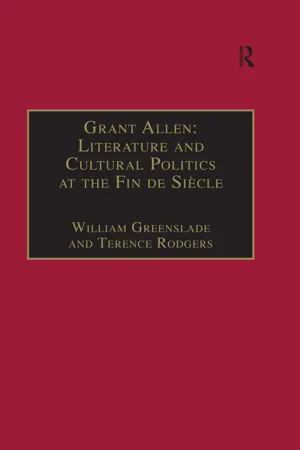
Grant Allen
Literature and Cultural Politics at the Fin de Siècle
- 264 pages
- English
- ePUB (mobile friendly)
- Available on iOS & Android
eBook - ePub
About this book
A strikingly interdisciplinary figure in Victorian literary history, Grant Allen (1848-1899) has thus far managed to elude the focused scrutiny of contemporary scholarship. This collection offers a valuable analytical and bibliographical resource for the exploration of the man and his work. Grant Allen was a prolific novelist, essayist, and man of letters, who is best remembered today for his The Woman Who Did (1895), which gained fame and notoriety almost overnight through its exploration of female independence and sexuality outside marriage, precipitating rabid denunciations of the 'new woman.' Allen engaged with a span of literary and cultural concerns in the late-Victorian period that extended beyond gender politics, however; equally important was his sustained intervention in debates about Darwinism, Spencerism, and evolution, on which subjects he was recognized as an authority and as the foremost popularizer alongside T. H. Huxley and Benjamin Kidd. Not only did Allen's work link the literary and the scientific, it traversed the boundaries between elite and popular culture, demonstrating their interconnectedness. This was notable in his travel and environmental writings and in his experiments in orientalist and detective fiction, fantasy, and science fiction. The contributors to this collection approach the figure of Allen from diverse fields within Victorian studies, showing him to be a late-Victorian innovator but also an example of fin-de-siècle modernity. Grant Allen: Literature and Cultural Politics at the Fin de Siècle revisits the richly variegated profile of one of the most intriguing and significant polymaths of the turn of the century, recognizing his contribution to and influence on the key modernizing debates of the period.
Trusted by 375,005 students
Access to over 1.5 million titles for a fair monthly price.
Study more efficiently using our study tools.
Information
Subtopic
Literary CriticismIndex
LiteratureChapter 1
Resituating Grant Allen: Writing, Radicalism and Modernity
William Greenslade and Terence Rodgers
I
‘On the whole I was pleasantly surprised with Grant Allen; he is a simple, genial fellow, absorbed in scientific studies – caring not a rap for the kind of work by which he lives’, wrote George Gissing to his brother in June 1895 after a weekend as the guest of Edward Clodd.1 While it was unlikely that as a fellow-guest of the trustworthy Clodd, Allen would disappoint, Gissing’s surprise could be forgiven, since on two counts alone – earnest Spencerian controversialist and potboiling novelist – Allen might have given the hard-to-please Gissing reason to be wary. What kind of man, one wonders, did Gissing expect? Quite possibly a more self-regarding, combative, self-important figure than the man who greeted him at Aldeburgh; the embattled author, certainly, of the phenomenally successful novel The Woman Who Did which had been published that February and which Allen told Gissing was currently earning him £25 per week.2 This succès de scandale and Allen’s high-profile involvement in the aftermath of its publication, offered the only possible conversational topic to rival inevitable ruminations over the sentence of Oscar Wilde the Saturday before.3
After Allen’s death in October 1899, Clodd’s Memoir and tributes paid to Allen by, for example, the man of letters Andrew Lang, and the historian York Powell, rightly emphasised his variousness as a writer, the ‘most versatile, beyond comparison, of any man in our age’, as Lang put it.4 His extraordinary productivity was matched only by the output of Lang himself. Clodd recalled for Allen’s contemporaries just what a various career it was: ‘naturalist, anthropologist, physicist, historian, poet, novelist, essayist, critic – what place is to be assigned to this versatile, well-equipped worker?’, he asked.5 Clodd and company were keen to set the record straight, but it is a record, of course, dominated by the The Woman Who Did affair and the curious solipsism of Allen’s ‘hill-top’ project, which he eventually abandoned after the disappointing response to his second novel of 1895, The British Barbarians. The poor reaction to it was partly at least revenge on Allen for previously enticing out of the public large sales for a work which proved a literary disappointment, and for many feminists and critics an intellectual and progressive sham. If this was all Allen could manage by writing ‘wholly and solely to satisfy … [his] … own taste and conscience’,6 then disenchantment was not so surprising. But there were other factors at work in these months after Wilde’s trial, not least the affinities between The British Barbarians and writerly strategies, perceived to be Wildean, as Nick Freeman shows in his examination of the novel in the context of the backlash of 1895.
No doubt Clodd and company were mightily relieved when Allen relinquished, albeit silently, his ‘hill-top’ aspirations. Certainly, there was relief from the Times reviewer of two of Allen’s Historical Guide Books when they appeared in 1897. Keen to acknowledge ‘this clever writer’, he spiced his praise for Allen with distaste for what had just preceded it: ‘when a man has so distinct a turn for history and science, and … can do such good work in the way of showing students the right manner of approaching the history of a great city, it is a thousand pities that he should waste his time on ‘hill-top novels’ and similar foolishnesses.’7
Surprisingly, until very recently Clodd’s text and a few biographical entries were all that readers could turn to for a synoptic account of Allen’s work and career.8 Part of the explanation surely lies in the hiatus created by the noisy impact of The Woman Who Did. This single novel still dominates subsequent discussion of Allen, as it would have dominated at Aldeburgh, or any literary gathering, in 1895. The dubious standing of his highest-selling work (whose title became an immediate and lasting catchphrase for its times and the subject of numerous parodies)9 has skewed subsequent commentary and has almost certainly contributed to making it less possible to see Allen plainly as a versatile fin-de-siècle progressive and writer. The result of such concentration of attention, we would argue, has been to marginalise other aspects of Allen’s achievement, putting his formidably various literary career almost beyond the reach of critical scrutiny.
Nor has Allen been favoured with bibliographical attention, for again, until quite recently, there has been no reliable record of his writings, still less of the location of his papers and manuscripts.10 However, a number of writers, notably Peter Morton, with an industry worthy of its subject, have made progress in filling this gap.11 Thus for example, there is now an accurate entry, by Joanne Shattock, in the revised Cambridge Bibliography of English Literature (1999),12 and with Peter Morton’s synoptic essay, ‘Grant Allen 1848-1899: A Centenary Reassessment’ and Barbara Arnett Melchiori’s study, Grant Allen: The Downward Path Which Leads to Fiction (2000), critical re-evaluation and recovery of Allen’s work is well under way.13
After Allen’s death a great deal of his work, non-fiction as well as fiction, was assimilated into the interests of the specialist by, for instance, devotees of scientific rationalism and readers of the imprints of the Rationalist Press for whom The Evolution of the Idea of God (1897) (which had sold 55,000 copies by 1903), with its improbable Spencerian theory of ancestor-worship, was kept alive in Watts’s Rationalist Press through until the 1940s and beyond by a variety of niche publishers.14 But Patrick Parrinder develops in his essay a more complex and unusual line of influence in which, as he puts it, the ‘ghost of Allen’s theory lingered on’ into Sigmund Freud’s elevation of the father, and beyond into Harold Bloom’s ‘anxiety of influence’. From the 1970s, readers of late-Victorian science fiction, ghost stories and detective fiction, would have found odd stories appearing by Allen in a variety of specialist anthologies, and occasional reprints.15 And there is at least one fascinating case of fin-de-siècle homage, that of Michael Moorcock in his trilogy of novels The Dancers at the End of Time (1983).16
In the first half of the twentieth century Grant Allen received slight and mixed notice. Respectful treatment was extended by Holbrook Jackson in a typically well-informed assessment in his (for its time definitive) The Eighteen Nineties (1913), and briefly, in Malcolm Elwin’s Old Gods Falling (1939). By contrast, in a collection of essays published in 1930, Allen’s work was dismissed as ‘difficult by any effort of the imagination to reanimate today’ and was conspicuously overlooked a few years later in Frank Swinnerton’s personal reminiscences of early twentieth-century literary life and the late Victorian influences upon it.17 There was little other attention except from those who had a stake in putting the record straight, such as Allen’s nephew, the publisher, Grant Richards, whose affectionate memories of the literary fin de siècle, Memories of a Misspent Youth, appeared in 1932, or Allen’s rival H.G. Wells, in a somewhat guilt-laden account in his Experiment in Autobiography (1934). Overall, Allen seems to be an extreme case of a writer whose entrance into the academy, even at the most junior of levels, was destined to be indefinitely postponed.
Indeed, not until the 1970s was Allen’s work to attract serious academic attention. In that decade, and the years which followed, the rise of feminist criticism, coupled with a heightening interest in women’s movements, non-canonical fiction, radical politics and in the wider, particularly scientific, intellectual culture of the late nineteenth century, gave impetus to serious consideration of Allen’s work, although the selection was limited.18 Nonetheless for studies of the woman question and the New Woman in literature and cultural politics, The Woman Who Did, and essays such as ‘Plain Words on the Woman Question’ (1889), ‘The Girl of the Future’ (1890) and ‘The New Hedonism’ (1894), quickly became, and have remained standard reference points. Of these studies John Goode’s treatment of The Woman Who Did in his essay ‘Women and the Literary Text’ was amongst the most important. For Goode the novel was an ‘instructive’ text, which showed how the ‘ideology of the project can demolish the coherence of its fictional realization’.19 It was difficult for subsequent critics to contest the fact that this earnestly promoted serious fiction to which he so publicly nailed his literary credentials, was an artistic disaster. It was simple enough to conclude that in the area of serious fiction, at least, Allen was not so much the man who didn’t, as the man who, in the end, couldn’t. In a later essay, Goode enlisted Allen as one of a number of late nineteenth-century ‘disaffected intellectuals’ dominated by the ‘new spirit’, hovering on the margins, a protagonist of the age of post-Darwinian revolt.20 Of these, Havelock Ellis, Edward Carpenter, Olive Schreiner and Karl Pearson, to name a few of his radical contemporaries, eventually received their due attention, albeit some more so than others.21 Allen, however, was left behind; how is this to be explained?
Part of the reason surely is that Allen’s Spencerianism has dated as relentlessly as has the reputation of his mentor, Herbert Spencer (1820-1903). The political philosopher D.G. Ritchie argued in 1905 against the ‘dogmatism’ of writers such as Allen who apply ‘some one conception with which he has worked successfully in his own space, to unlock all mysteries’ – the generation of synthesisers and generalisers of which Allen represented a late example.22 As Morton shows in his essay, Allen’s unswerving commitment to ‘science as organised commonsense’ made him vulnerable to criticisms of oversimplification, while defects in the empirical basis of his anthropology, biology and physics left his armchair science open to attack from the new professional academy. Similarly Parrinder, in his essay, provides a full exposition of Allen’s own persistence in propagating what was later held to be mistaken anthropological theory, derived from Spencer, as in The Evolution of the Idea of God, where, in Parrinder’s words, he ‘replaces the belief that God is the origin of everything with a theory attributing a huge range of cultural phenomena to ghosts and the fear of the dead’.
Yet notwithstanding these blind alleys and confusions in Allen’s thinking, much recent scholarship on the literature, politics and culture of the fin de siècle continues to underline his enduring presence as a figure of controversy. Allen’s representative significance as a writer and cultural mediator in his time – as novelist, educator, successful scientific populariser, social philosopher and exponent of radical cultural politics – invites critical revaluation.
II
As Lyssa Randolph suggests in her essay, Allen’s relationship with the literary marketplace was fraught with difficulties and contradictions as he sought to balance the financial rewards that came from professional writing with his desire to accrue ‘cultural capital’ in the shape of a literary reputation. Ostensibly, Allen had few illusions about the quality of the bulk of his fiction, or his motives for writing it: ‘I never cared for the chance of literary reputation’, he told his friend George Croom Robertson, ‘except as a means of making a livelihood for Nellie and the boy.’ He was, he said, ‘learning to do the sensational things which will please the editors. I am trying with each novel to go to a step lower to catch the market.’23 Following the disappointing sales of his first serious novel Philistia (1884), Allen had concluded that only less than serious fiction would pay. Robertson had suggested that Allen t...
Table of contents
- Cover
- Half Title
- Title
- Copyright
- Contents
- Contributors
- Acknowledgements
- 1 Resituating Grant Allen: Writing, Radicalism and Modernity
- 2 Grant Allen: A Biographical Essay
- 3 Grant Allen: 'Writing to the Moment'
- 4 Grant Allen, Spencer and Darwin
- 5 'The Romance of Race': Grant Allen's Science as Cultural Capital
- 6 The Woman Who Did and 'The Girl Who Didn't': The Romance of Sexual Selection in Grant Allen and Ménie Muriel Dowie
- 7 Grant Allen and the New Politics
- 8 'Intentional Rudeness'?: The British Barbarians and the Cultural Politics of 1895
- 9 Grant Allen's Impersonal Secretaries: Rereading The Type-Writer Girl
- 10 The Detective's Doppelgänger: Conflicting States of Female Consciousness in Grant Allen's Detective Fiction
- 11 Grant Allen and the Business of Travel
- 12 The Old Man and His Ghost: Grant Allen, H.G. Wells, and Popular Anthropology
- 13 Grant Allen's Publications: A Checklist
- Bibliography
- Index
Frequently asked questions
Yes, you can cancel anytime from the Subscription tab in your account settings on the Perlego website. Your subscription will stay active until the end of your current billing period. Learn how to cancel your subscription
No, books cannot be downloaded as external files, such as PDFs, for use outside of Perlego. However, you can download books within the Perlego app for offline reading on mobile or tablet. Learn how to download books offline
Perlego offers two plans: Essential and Complete
- Essential is ideal for learners and professionals who enjoy exploring a wide range of subjects. Access the Essential Library with 800,000+ trusted titles and best-sellers across business, personal growth, and the humanities. Includes unlimited reading time and Standard Read Aloud voice.
- Complete: Perfect for advanced learners and researchers needing full, unrestricted access. Unlock 1.5M+ books across hundreds of subjects, including academic and specialized titles. The Complete Plan also includes advanced features like Premium Read Aloud and Research Assistant.
We are an online textbook subscription service, where you can get access to an entire online library for less than the price of a single book per month. With over 1.5 million books across 990+ topics, we’ve got you covered! Learn about our mission
Look out for the read-aloud symbol on your next book to see if you can listen to it. The read-aloud tool reads text aloud for you, highlighting the text as it is being read. You can pause it, speed it up and slow it down. Learn more about Read Aloud
Yes! You can use the Perlego app on both iOS and Android devices to read anytime, anywhere — even offline. Perfect for commutes or when you’re on the go.
Please note we cannot support devices running on iOS 13 and Android 7 or earlier. Learn more about using the app
Please note we cannot support devices running on iOS 13 and Android 7 or earlier. Learn more about using the app
Yes, you can access Grant Allen by Terence Rodgers, William Greenslade in PDF and/or ePUB format, as well as other popular books in Literature & Literary Criticism. We have over 1.5 million books available in our catalogue for you to explore.