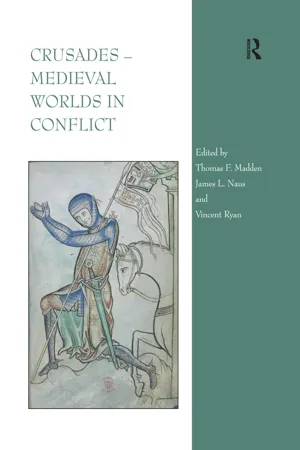
eBook - ePub
Crusades – Medieval Worlds in Conflict
- 226 pages
- English
- ePUB (mobile friendly)
- Available on iOS & Android
eBook - ePub
Crusades – Medieval Worlds in Conflict
About this book
These essays, selected from papers presented at the International Symposium on Crusade Studies in February 2006, represent a stimulating cross-section of this vibrant field. Organized under the rubric of "medieval worlds" the studies in this volume demonstrate the broad interdisciplinary spectrum of modern crusade studies, extending far beyond the battlefield into the conflict and occasional cooperation between the diverse cultures and faiths of the Mediterranean. Although the crusades were a product of medieval Europe, they provide a backdrop against which medieval worlds can be observed to come into both contact and collision. The range of studies in this volume includes subjects such as Muslim and Christian understandings of their wars within their own intellectual and artistic perspectives, as well as the development of memory and definition of crusading in both the East and West. A section on the Crusades and the Byzantine world examines the intersection of western and eastern Christian attitudes and agendas and how they played out - particularly in the Aegean and Asia Minor. The book concludes with three studies on the crusader king, Louis IX, examining not only his two crusades in new ways, but also the role of the crusade in his later sanctification.
Part I
The Crusades and Conflicting Worlds of Sanctity
Chapter 1
Jihad Poetry in the Age of the Crusades
Introductory Comments
Medieval Arabic poetry, spanning the period from around 500 to 1800, has rarely found favour with Westerners. It has been criticized for its lack of “spontaneity,” the absence in it of the personal note, its emphasis on form over content, and its excessive indulgence in verbal pyrotechnics – antithesis, synonyms, puns, and other devices – not to mention its self-consciously inkhorn vocabulary. Indeed, the extraordinarily rich vocabulary of classical Arabic – with literally hundreds of words denoting, for example, the camel, the camel’s trappings and the beauties of the desert – does not lend itself easily to translation into other languages. The frustrated and impotent translator ends up with a prose version, which is workmanlike, but flat and lifeless, in comparison with the resonance and force of the original.
In the period before Islam, poetry recited orally within the tribe was the vehicle for recording the genealogies of the ancient Arabs and for lauding their heroic exploits. After the advent of Islam, and the creation of a vast world empire, caliphs and governors encouraged court poets to compose panegyrics to vaunt their regimes and their personal prestige. Nobody thought that the writing of verse was easy; poetry was recalcitrant material, to be tamed only by painful and prolonged effort. The words had to be fashioned by constant arrangement and rearrangement. Rarely are medieval Arab poets found boasting of their ability to compose verse quickly. Poems had to be meticulously crafted. Nevertheless, inspiration and natural talent were indispensable; no amount of effort could succeed without an innate disposition towards poetry.1
The Concept of Jihad and Its Manifestation in Poetry before the Coming of the Crusades
Jihad is enjoined on the believer several times in the Qur’an and indeed has sometimes been called the sixth pillar of Islam. From the earliest period, the notion of jihad (struggle) as a spiritual concept for individual Muslims was paramount. Two kinds of jihad were identified, however: the greater jihad and the lesser jihad. The greater jihad is the struggle which man has to wage against his lower self and is, indeed, more meritorious than the lesser jihad, the military struggle conducted against infidels, either to defend or to expand the world of Islam.2
The conflict of the Crusades did not create the first jihad poetry in Arabic. The pre-Islamic poetic tradition with its weapons of glorification of the tribe and satire of the enemy could be used to extol the new faith and castigate polytheists and infidels. The ‘Abbasid poet Abu Tammam (floruit c.805–45) laid a number of the foundations for later jihad poetry in his praise of the annual campaigns against the Byzantines led by the caliph al-Muta‘sim in the ninth century, and in particular the Muslim victory at the battle of Amorium in 836: the poem is a literary tour de force, with every line ending in the letter “b”:
O day of the battle of ‘Ammuriyya, hopes have returned from you overflowing with honey-sweet milk.
You have left the fortunes of the sons of Islam in the ascendant,
And the polytheists and the abode of polytheism in decline.3
You have left the fortunes of the sons of Islam in the ascendant,
And the polytheists and the abode of polytheism in decline.3
Thus we see a single Muslim military triumph being elevated to the status of a grandiose struggle between Islam and polytheism.
The favourite classical Arabic poet of all time is the Syrian al-Mutanabbi (d. 965), a professional panegyrist who travelled with his poetic wares in search of patronage.4 The religious flavour of his name – al-Mutanabbi – meaning “he who aspires to be a prophet” – indicates some politico-religious activities in his youth which caused him to end up in prison for a while. Later, he spent nine years in the service of an Arab prince, the remarkable Hamdanid ruler of Aleppo, Sayf al-Dawla, who fought more than 40 battles against the Byzantines. Bedridden from 962 onwards, Sayf al-Dawla would be carried into battle on a litter and when he died, he was buried in his mausoleum, in the manner of a martyr, with a brick covered in dust from one of his campaigns placed under his cheek. He was a real model for later jihad warriors to follow. The period he spent with Sayf al-Dawla brought al-Mutanabbi the most satisfaction and it was then that he produced his finest poetry, excelling in the description of fierce combat, often put into the mouth of the warrior himself:
Now I face war and I will go to the end.
I will leave horses startled by the burning battle.
They are so pierced with blows, so panic-stricken by shouting,
That they seem to be afflicted by a kind of madness …
More delicious than the generous wine,
More gentle than the clinking of goblets
Are for me the handling of sabres and lances
And the impact, at my command, of one army against another.
To expose myself to death, in combat, is my life.
For me living is spreading death …
I have exhausted the utmost measure of patience. I will
Now hurl myself into the perils of war …
Tomorrow is the rendezvous between slender blades.5
I will leave horses startled by the burning battle.
They are so pierced with blows, so panic-stricken by shouting,
That they seem to be afflicted by a kind of madness …
More delicious than the generous wine,
More gentle than the clinking of goblets
Are for me the handling of sabres and lances
And the impact, at my command, of one army against another.
To expose myself to death, in combat, is my life.
For me living is spreading death …
I have exhausted the utmost measure of patience. I will
Now hurl myself into the perils of war …
Tomorrow is the rendezvous between slender blades.5
The capture by Sayf al-Dawla of the Byzantine border fortress of al-Hadath in 954 gives al-Mutanabbi the opportunity to conjure up a most memorable poetic tour de force, replete with rhetorical devices and powerful images:
According to the degree of the people of resolve come resolutions,
And according to the degree of noble men come noble actions.
Small deeds are great in the eyes of the small
And great deeds are small in the eyes of the great.6
And according to the degree of noble men come noble actions.
Small deeds are great in the eyes of the small
And great deeds are small in the eyes of the great.6
Here we see the rigidly symmetrical antitheses so beloved of classical Arab poets. But we see and hear more than this – the hypnotic rhythmic succession of a torrent of words which sound similar – paronomasia – and which fit together in ways that defy easy definition. The jihad evoked in the poetry of al-Mutanabbi is not limited to his master’s campaigns; it is viewed on a much wider canvas:
You were not a king routing an equal,
But monotheism routing polytheism,
We put our hope in you and your refuge, Islam.
Why should merciful God not guard it, when through you
He cleaves the unbeliever asunder?
But monotheism routing polytheism,
We put our hope in you and your refuge, Islam.
Why should merciful God not guard it, when through you
He cleaves the unbeliever asunder?
Al-Nami, a much lesser-known poet than al-Mutanabbi, who held public poetry competitions with his great rival, also gives fulsome praise to his patron Sayf al-Dawla, and he hints at the link between jihad and martyrdom, should his master fall on the field of battle in the path of jihad:7
Illustrious prince! Your lances gain you glory in this world and in Paradise thereafter.
Every year which passes finds you with your sword in the necks of enemies
And your steed harnessed with bit and saddle.
Time rolls on, and still your deeds are all for glory.
Every year which passes finds you with your sword in the necks of enemies
And your steed harnessed with bit and saddle.
Time rolls on, and still your deeds are all for glory.
But such jihad campaigns as those of Sayf al-Dawla on the Byzantine border, and those of others on the Central Asian steppes against the pagan Turks or in Muslim Spain against the Christians of the north, should not blind us to the prevailing context of the Muslim world before the coming of the Crusades. The predominant ethos, after the initial Arab conquests of the seventh century, was not one of jihad; it was rather one of fairly fixed frontiers and of generally pragmatic tolerance of Christians and Jews. An intensifying of the Muslim jihad spirit was to return as a result of the coming of the Crusaders.
An Overview and Analysis of Jihad Poetry Written During the Muslim/Crusader Conflict
The body of poetry about jihad that has survived from the twelfth and thirteenth centuries is quite substantial. It is therefore somewhat surprising that such poetry has not been discussed, either under the category of religious or political poetry, in any of the standard works of scholarship on classical Arabic literature. Take the example of Saladin’s famous friend and biographer, ‘Imad al-Din al-Isfahani (d. 1201), whose historical works, written in a formidably difficult ornate prose, are frequently mentioned in surveys of Arabic literature, usually as models to be avoided.8 But his poetry is almost totally ignored, despite its value as a background to Saladin’s career. And this neglect extends to the whole corpus of jihad poetry, which is scattered through Muslim chronicles, biographical dictionaries and medieval anthologies.
It is well known that when the forces of the First Crusade hit the Muslim world in 1098, the spirit of jihad was far from being in the forefront of Muslim minds and that it was a good half-century before the inhabitants in Syria and Palestine were able to forget their political and religious squabbles sufficiently to reunite under strong leadership and the banner of revitalized jihad. The prospect of Jerusalem lost to the Crusaders would provide an intense spur to the Muslims in their struggle. In a period almost totally devoid of contemporary Muslim chronicles, the poetry which has survived from the early twelfth century provides valuable testimony to the Muslim experience of grief and anguish at the loss of Jerusalem and to the gradual reawakening of the jihad spirit. These poems, composed by poets such as al-Abiwardi and Ibn al-Khayyat,9 reflect the anguish and shame of loss.10 The Franks are portrayed as religious infidels and despoilers of all that the Muslims hold sacred, both in the public domain and in their homes, since the sanctity of their mosques and their women is endangered. Sadly for the Muslims, the warnings contained in these poems remained unheeded for several decades, but their themes would be adopted and elaborated by poets later in the twelfth century and thereafter.
The great Muslim leader who began to turn the tide significantly in the fight against the Franks, Nur al-Din (d. 1174), is often portrayed as the very prototype of the jihad warrior. Ideally, personal and public jihad combine in the person of the ruler and this is certainly the way in which Nur al-Din is presented in the Muslim sources. During his period in power, jihad books, jihad sermons, and works praising the Holy City – the Merits of Jerusalem genre – proliferate. But perhaps the most rousing literary vehicle for jihad was the poetry written for and about Nur al-Din. This poetry stresses the spiritual dimensions of his jihad much more than the usual public ones. Saladin’s future biographer, ‘Imad al-Din al-Isfahani, joined the service of Nur al-Din and he wrote poetry in praise of his master’s pursuit of jihad, putting the following line...
Table of contents
- Cover
- Half Title
- Title
- Copyright
- Contents
- List of Plates
- Contributors
- Abbreviations
- Introduction
- Part I The Crusades and Conflicting Worlds of Sanctity
- Part II The Crusades and Contested Worlds of Ideas
- Part III The Crusades and the Byzantine World
- Part IV The Crusades and the World of Louis IX
- 10 Saints and Sinners at Sea on the First Crusade of Saint Louis
- 11 Louis IX, Charles of Anjou, and the Tunis Crusade of 1270
- 12 The Place of the Crusades in the Sanctification of Saint Louis
- Index
Trusted by 375,005 students
Access to over 1.5 million titles for a fair monthly price.
Study more efficiently using our study tools.
Frequently asked questions
Yes, you can cancel anytime from the Subscription tab in your account settings on the Perlego website. Your subscription will stay active until the end of your current billing period. Learn how to cancel your subscription
No, books cannot be downloaded as external files, such as PDFs, for use outside of Perlego. However, you can download books within the Perlego app for offline reading on mobile or tablet. Learn how to download books offline
Perlego offers two plans: Essential and Complete
- Essential is ideal for learners and professionals who enjoy exploring a wide range of subjects. Access the Essential Library with 800,000+ trusted titles and best-sellers across business, personal growth, and the humanities. Includes unlimited reading time and Standard Read Aloud voice.
- Complete: Perfect for advanced learners and researchers needing full, unrestricted access. Unlock 1.5M+ books across hundreds of subjects, including academic and specialized titles. The Complete Plan also includes advanced features like Premium Read Aloud and Research Assistant.
We are an online textbook subscription service, where you can get access to an entire online library for less than the price of a single book per month. With over 1.5 million books across 990+ topics, we’ve got you covered! Learn about our mission
Look out for the read-aloud symbol on your next book to see if you can listen to it. The read-aloud tool reads text aloud for you, highlighting the text as it is being read. You can pause it, speed it up and slow it down. Learn more about Read Aloud
Yes! You can use the Perlego app on both iOS and Android devices to read anytime, anywhere — even offline. Perfect for commutes or when you’re on the go.
Please note we cannot support devices running on iOS 13 and Android 7 or earlier. Learn more about using the app
Please note we cannot support devices running on iOS 13 and Android 7 or earlier. Learn more about using the app
Yes, you can access Crusades – Medieval Worlds in Conflict by Thomas F. Madden, James L. Naus, Vincent Ryan, Thomas F. Madden,James L. Naus,Vincent Ryan in PDF and/or ePUB format, as well as other popular books in History & European Medieval History. We have over 1.5 million books available in our catalogue for you to explore.