- 352 pages
- English
- ePUB (mobile friendly)
- Available on iOS & Android
eBook - ePub
About this book
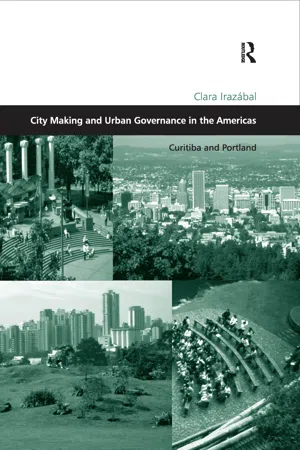
Cities in both North and South America are confronting tremendous challenges in urban growth and management as they enter the new century. Curitiba in Brazil and Portland in Oregon, US are cities that have achieved recognition for exemplary urban planning programmes over the past three decades. As such, they provide particularly useful illustrations of the intense development pressures that many urban areas currently face. This book explores the dynamics of their urban governance, arguing that, in general, there has been a unique synergy derived from the combination of visionary leadership, innovative urban plans and effective citizen involvement. The book argues that, while urban design and architecture are key to the success in making cities livable and in augmenting the global reputations, such sensitive, innovative urban planning and design projects first need to be governed effectively and grounded within the specifics of their local cultures and existing built environments.
Trusted by 375,005 students
Access to over 1.5 million titles for a fair monthly price.
Study more efficiently using our study tools.
Information
PART I
Citizens and their City-States: A Governance Approach to Urban Development
Chapter 2
Urban Governance and Citizen Participation: Definitions and Models
Such is the central question to which political thought and action must respond: how to restore a link between the excessively open space of the economy, and the excessively closed, and fragmented world of cultures?... The fundamental matter is not seizing power, but to recreate society, to invent politics anew, to avoid the blind conflict between open markets and closed communities, to overcome the breaking down of societies where the distance increases between the included and the excluded, those in and those out.
Touraine, Alain, Lettre a Lionel, Michel, Jacques, Martine, Bernard, Dominique... et vous (cited and translated by Castells, 1995b: 42)
Part I, “Citizens and their City-States: A Governance Approach to Urban Development”, serves as theoretical foundation for Part II, which deals with the politics of urban development in Curitiba and Portland. This chapter opens with a definition of governance, discusses several governance models, and ends with instrumental definitions and a model of citizen participation.
Governance: Definitions
This book studies the politics of urban and regional development in Curitiba and Portland through the notion of governance as an analytical tool. It distinguishes governance from government. Thus, governance refers to ‘the relationship between civil society and the state, between rulers and the ruled, the government and the governed’. The factors of credibility and legitimacy of both governing institutions and community institutions—and their respective politicians and leaders—play important roles in governance. The paths to improvement in credibility and legitimacy lead through ‘accountability, transparency, responsiveness, real participation, empowerment of groups in civil society and public consultation’. The assumption is that these factors ensure an open and legitimate relationship between society and the state. It is this relation that distinguishes the study of governance from studies of government (McCarney et al., 1995: 95-6). Given its inclusive definition, from this point on I refer to governance as including citizen participation.
Since the 1980s, the use and appeal of the concept of governance to assess processes of urban politics has significantly grown. In the process, severalinternational institutions have adopted the term. In 1992, for instance, the World Bank started using the concept of ‘good governance’ as a factor in lending to developing countries (World Bank, 1992). For that institution, governance referred to changes in the public sector due to privatization and marketization. These neoliberal reforms were supposed to achieve more efficiency in public services. Governance, however, has been invoked with other, contrasting, meanings. For example, the Local Government and Whitehall Programmes (organized by the British Economic and Social Research Council) used governance to refer to a new pattern of relations between civil society and the state (Stoker, 1999; 2000a): governance was made of networks, as opposed to markets or hierarchies, and was the political consequence of the neoliberal policies that aimed to establish a minimal state through changes in public management, privatization, and marketization (Ansell, 2000; Rhodes, 1997; Bevir and Rhodes, 2001b).
For its part, the United Nations Development Programme (UNDP) defined governance as
the exercise of political, economic and administrative authority to manage a society’s affairs. This broad concept encompasses the organizational structures and activities of central, regional, and local government; the parliament; the judiciary; and the institutions, organizations, and individuals that constitute civil society and the private sector. This concept of governance stresses the nature and quality of interactions among social actors and between social actors and the state (UNDP, 1997:4-5).
There is a useful distinction between the two aspects of governance described by the UNDP: the technical and the representational. The technical refers to the how and what of development—to the processes and procedures of plan formulation, technical application, resource mobilization and allocation, etc. The representational refers to how (and by whom) decisions are made—and thus includes issues of representation, participation, accountability, and empowerment. My analysis of Curitiba and Portland concentrates on this latter, representational facet of governance.
From the point of view of the government, three aspects of accountability are basic to governance: political, legal, and bureaucratic. A system is politically accountable when the political leadership is subject to credible electoral processes with limited periods in office; legal accountability requires an objective and reliable judicial system, as well as trustworthy law enforcement agencies and efficient court administrations. Bureaucratic accountability requires the effective disclosure of information by public agencies and officials in their relations with the public. On the other side of governance is the society, where, for the aforementioned aspects of accountability to be effective, citizens and community groups have to be educated and empowered to participate and seek access to governmental decision-making processes. This also implies access to information and to officials who make decisions in their representative capacity (McCarney et al., 1995).
The enlarged degree of analytical freedom that the term governance allows—as compared to government—derives from the fact that it enables one to range widely in determining where effective control of societies lies, rather than prejudging the locus or character of real decisional authority (Lofchie, 1989). This dimension of governance allows for the inclusion of groups and individuals in society that are increasingly instrumental in political relationships. Taking this broader analytical view, the incorrectness of equating ‘good government’ with ‘governance’ becomes obvious. A ‘good government’ approach simply applies a normative perspective to the quality of government itself, ignoring the essence of the society-government relationship. This latter dimension of governance involves two aspects: ‘[0]ne involving the state, where legitimacy rests upon accountability, and one involving society, where participation, empowerment and access are the critical components’ (McCarney et al., 1995: 97).
Thus, there are three major facets of governance that urban research should address, namely, the society, the state and its institutions, and, most importantly, the relationship between society and the state. The first facet involves the growth of the participation of society and its capacity to engage the state, to complement it as well as to act as a countervailing force. The second facet involves the manner in which the state creates the conditions and the space for the growth of civil society. Civil society organizations play an important role as the voice of citizens and as vehicles through which they can achieve their social aims. The third facet relates to the interface mechanisms and methods of linking institutions of society and the state in the process of decision-making, maintaining law and order, providing social and economic services, and promoting economic development (Ibid).
Increasingly, then, the focus is on the process of governance rather than the exercise of power of the institutions of government. In many countries, the hegemony that many governments have ruled with in the past is increasingly giving way to a more enlightened approach that values the continual engagement of citizens. In this expanded process of governance, civil society has both demand and supply functions. On the demand side, civil society should both monitor the state’s exercise of power—demanding transparency, accountability, and fairness— and broaden citizen participation in public policymaking—serving as an advocate for those without power and voice. On the supply side, civil society should share the role of implementing public policy with state institutions (Kumi, 1999).1
My interest transcends governance’s general recognition as a functional construct, which has emerged as a style of management aimed at increasing regime effectiveness. Rather, I appreciate the notion because it represents an acknowledgment of the inseparability of society from the process of governance, recognizing the existence of complex societies and the magnitude of their impact on the processes of urban and regional development. Yet, since societies and cities are dynamic entities, there is no universal model of urban governance that can fitall localities, or even a single city, over time. In general terms, however, I work with the premise that good governance is created through the development and adjustment of (governing and social) networks, the restructuring of government and fiscal organization, and an increase in community involvement (GURI, 1998). As I engage in the analysis of case studies through the notion of governance, there is an important caveat that ought to be made explicit.
There is a growing consensus—from the World Bank to NGOs to civil society theorists—around the idea of governance and participation. Yet, despite the opportunities that this consensus presents for the development of convergence in approaches to the solutions of urban problems, a potentially troubling aspect is that—because of this consensus—these social agents often fail to problematize the issues of power and inequality that lie at the heart of governance and development dynamics. In this latter scenario, governance is in fact a concept that implies states acting as neutral mediators of local conflicts, when in fact states and their élites are usually fully implicated in these conflicts. It is therefore important to be cautious about powerful proponents of ‘governance’ who may have a particular urban agenda in mind—one that ignores the inevitable inequalities of late capitalism, and that does not recognize that localities are rife with conflict.
Adding to this latent problem with the term governance, Michael Keating expresses a complementary criticism. For him, the word governance is merely a neologism, since according to him, ‘government was always about more than the formal structures of the state’. Therefore, ‘the vaguely pluralistic basis of the idea [of governance] seems to represent a loss rather than a gain in analytical capacity’. He adds:
Perhaps more worrying is its normative bias. Combined with some interpretations of the new developmen...
Table of contents
- Cover Page
- Title Page
- Copyright Page
- Contents
- List of Figures
- List of Tables
- Acknowledgments
- INTRODUCTION: Local Spatiality in a Global World
- PART I Citizens and their City-States: A Governance Approach to Urban Development
- PART II Governance and the Practices of Urbanism in the Americas (1960-2003): Curitiba and Portland
- PART III The Built Environment in the Era of Globalization: City Making and the (Re)production of Social and Spatial (In)equality in Curitiba and Portland
- EPILOGUE: Urban Governance and City Making in the Americas
- Bibliography
- Index
Frequently asked questions
Yes, you can cancel anytime from the Subscription tab in your account settings on the Perlego website. Your subscription will stay active until the end of your current billing period. Learn how to cancel your subscription
No, books cannot be downloaded as external files, such as PDFs, for use outside of Perlego. However, you can download books within the Perlego app for offline reading on mobile or tablet. Learn how to download books offline
Perlego offers two plans: Essential and Complete
- Essential is ideal for learners and professionals who enjoy exploring a wide range of subjects. Access the Essential Library with 800,000+ trusted titles and best-sellers across business, personal growth, and the humanities. Includes unlimited reading time and Standard Read Aloud voice.
- Complete: Perfect for advanced learners and researchers needing full, unrestricted access. Unlock 1.5M+ books across hundreds of subjects, including academic and specialized titles. The Complete Plan also includes advanced features like Premium Read Aloud and Research Assistant.
We are an online textbook subscription service, where you can get access to an entire online library for less than the price of a single book per month. With over 1.5 million books across 990+ topics, we’ve got you covered! Learn about our mission
Look out for the read-aloud symbol on your next book to see if you can listen to it. The read-aloud tool reads text aloud for you, highlighting the text as it is being read. You can pause it, speed it up and slow it down. Learn more about Read Aloud
Yes! You can use the Perlego app on both iOS and Android devices to read anytime, anywhere — even offline. Perfect for commutes or when you’re on the go.
Please note we cannot support devices running on iOS 13 and Android 7 or earlier. Learn more about using the app
Please note we cannot support devices running on iOS 13 and Android 7 or earlier. Learn more about using the app
Yes, you can access City Making and Urban Governance in the Americas by Clara Irazábal in PDF and/or ePUB format, as well as other popular books in Social Sciences & Geography. We have over 1.5 million books available in our catalogue for you to explore.