eBook - ePub
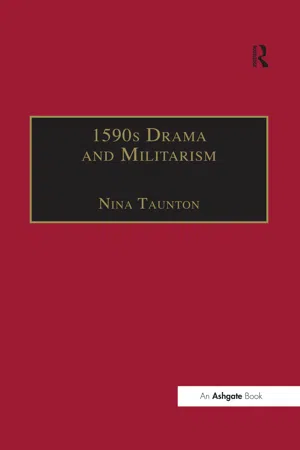
1590s Drama and Militarism
Portrayals of War in Marlowe, Chapman and Shakespeare's Henry V
- 256 pages
- English
- ePUB (mobile friendly)
- Available on iOS & Android
eBook - ePub
1590s Drama and Militarism
Portrayals of War in Marlowe, Chapman and Shakespeare's Henry V
About this book
1590s Drama and Militarism is a fascinating interdisciplinary study of various textual interventions into the military realities of the late Elizabethan period. Its major strength is its insistence on the discursive nature of militarism, and the author convincingly uses literary and non-literary texts-including manuals and contemporary military correspondence-to reconstruct the particular anxieties which surrounded the military exigencies of the 1590s, a particularly fraught and unstable period of the aging queen's reign. The literature of the 'art of war' has been little studied by literary scholars, despite their richly rhetorical nature. Dr Taunton's analysis thus brings to light a neglected but culturally significant form of Renaissance textuality. In doing so she is able to shed new light on the Renaissance drama, which she shows to have responded sensitively (and sometimes critically) to these textual constructions of actual warfare, and problematised the anxious idealisations of the military manuals. The particular readings of plays here are richly rewarding for the scholar of Renaissance drama-the significance of Henry's nocturnal surveillance of his own camp on the eve of the battle of Agincourt, for example, benefits immeasurably from being contextualised in the light of contemporary theories of encampment. The role of the women in Tamburlaine's camp in Marlowe's plays is also given particular significance when viewed in the light of the contemporary proscriptions regarding the presence of women in camps during the military campaigns in the Low Countries. In this study Dr Taunton makes appropriate (and critically inflected) use of Foucault's theories of surveillance, Lefebvre's theories about the ideological production of social space, and Michel de Certeau's theories of social practice are put to good use in her analysis of military strategy. These theoretical perspectives are usefully combined with highly specific and well-documented historical analyses.
Trusted by 375,005 students
Access to over 1.5 million titles for a fair monthly price.
Study more efficiently using our study tools.
Information
Subtopic
Literary CriticismIndex
LiteraturePart I
Generals
i The real and the ideal: Sutcliffe, Essex
The treatises and the correspondence on military matters in the 1590s share a preoccupation with boundary insecurities caused by Spanish rearmament and repeated threats of invasion. They also reveal by diverse means a mutual lack of confidence between monarch and generals, and a conflict of objectives in the various Continental military campaigns. Border insecurities combined with friction between ruler and those in high command, and among members of the high command themselves, to deepen fissures in attempts to deal with trouble spots in Portugal, France, the Netherlands and Ireland. The sources of this lack of confidence stemmed to a considerable degree from the commanders’ own self-defining agendas, against the monarch’s insistence on masterminding military operations. These were live issues in the plays. They stage the antagonism between royal and high command, and explore the nature of the conflict between strong, idealized, sometimes tyrannical figures of supreme command (both royal and military) whose judgement and authority is challenged by their own appointed deputies. As such they work as fictions of real events and people and also as wish-fulfilment fantasies (in the apprehension of its imminent loss) of the triumph of royal and military power. In certain respects, they may be regarded as a kind of mediation between real situations and the military idealizations of the treatises, thereby providing a means of airing anxieties about the ways in which Continental campaigns were being conducted, about coping with the ambitions, jealousies and rivalries of the generals themselves, and about juggling the competing claims from the various battlefronts for ever-increasing amounts of money and numbers of men.
Both manuals and plays engage in debates concerning the conduct of the actions and the competing sources of control over military operations. These operations were mounted by monarchs in opposition to alternative agendas defined by the baronial ambitions and chivalric concepts of honour of commanders who felt that their noble birth conferred upon them rights to plan and lead campaigns which should not be open to challenge. Put more specifically, the aim here is to examine a number of ways in which this body of texts negotiates the conflicting interests of a Queen beset by the need to protect vulnerable frontiers and the problem of how to pay for a security threatened not only by places but by the people chosen to secure those places against attack. In a further complicating twist, the texts negotiate, at the same time, the generals’ altogether different projects for personal glory and conspicuous investments in the strategies of high-profile command.
In his treatise The Practice, Proceedings and Laws of Armes (1593), dedicated to the Earl of Essex, Matthew Sutcliffe devotes an entire chapter to setting forth the need for the existence of councils of war. Since wars should be managed by ‘wisedome, value, and experience’1 rather than by ‘fauour, nobilitie … or great countenance’, there is a need to regulate a commander’s actions in situations where ‘princes and states’ invest authority in ‘men young in yeares, and greene in experience, and destitute in merite’. Thus Sutcliffe, himself employed for a time as Judge Advocate in the Netherlands,2 obliquely rebukes his young patron and dedicatee Essex for his waywardness and impatience at the criticism levelled at him by his monarch and her Privy Council on the way he conducted his campaigns against Spain. In a work which directly addresses itself to Essex, any discussion on the scope of a commander’s right to independent decision-making needs to be read carefully, alongside accounts of Essex’s campaigns in Portugal, the Azores and France. Sutcliffe’s treatise and its connection to Essex’s campaigns may be read as a mediation between the monarch’s assumed right to control military operations in their entirety and the rival claims of the commanders-in-chief appointed by (or at the very least in the name of) that monarch to independent decision-making. The treatise begins the mapping out of the role of the general as both an agent and a target of vigilance and supervision.
One of the ways in which the Queen, her councillors and her military commanders struggled to establish and maintain control of borders (both as actualities and as metaphors for mental states of being) was to adopt the same principles of surveillance taken up and theorized by Michel Foucault as a system of panopticism nearly 400 years later. The maxim that ‘[m]any eyes see more than one’3 with which Sutcliffe begins his discussion of controlling gazes provides a means of overviewing the regulatory procedures that subordinate the general himself. The leader of an army must be a ‘supervisor supervized’4 because soldiers perform better when decisions based on common consent issue from the proceedings of ‘wise counsell’ which draw upon a variety of opinion.5 This is all the more important if princes and states entrust their military campaigns to young and inexperienced men. In such circumstances (the very circumstances surrounding Essex’s first command) these greenhorns (though Essex himself was not destitute of merit in leadership) must be checked by the appointment of wise and experienced captains.6 Essex’s dealings with Henri IV of France, and Essex’s dislike of constraint upon his own actions, lead Sutcliffe to remind his noble reader how the royal French leader’s predecessor Charles IX wisely delegated command to his brother Henri Valois. In turn, Valois’s executive decisions had to be ratified by his war council, composed of such men of war as the Dukes of Nemours and Longueville, and Marshalls Tavanes, Martigues and Camavalet – all considered by Sutcliffe to have been leaders of tested military judgement and worth. His belief that ‘so pretious a thing is good counsell, that not onely chiefe commanders, and men of authority, but also euery one that speaketh reason is to be heard’ is exemplified by Xenephon, who, Sutcliffe states, was not above heeding the advice of ‘any private souldier’.7
Clearly Sutcliffe is expressing concern about the wisdom of investing too much responsibility in any one figure of command, particularly in one so young and green. Yet at the same time he acknowledges the importance of freedom for those in high-ranking positions to make on-the-spot decisions. To give weight to misgivings about entrusting command to the too-young or too-headstrong, and also to furnish details on counsel, Sutcliffe provides a list of the calamities which have fallen upon those who refused counsel. Councils of war should be composed of impartial advisers – if they are made up of the general’s ‘familiars’ (relatives) they will be divided, slow in resolution and weak in expedition.8 He warns generals against taking bad advice over good, and making decisions on the basis ‘of every light rumour’. A general should be neither rash nor slow but should ‘speedily resolve, and presently execute’.9 Sutcliffe is not alone in urging counsel upon leaders of military expeditions. Digges’s theoretical ideal is a general who combines personal qualities with learning and experience so that he ‘should euermore be able to make fare better Resolutions, then the grauest Senate’ and possess the authority to reward and punish according to merit, but his ‘patent’ should include the requirement to use the advice of a council. Representative counsellors from every nation fighting under his charge should be appointed who must be consulted on all matters.10 Reinforcing Sutcliffe’s warning against appointing ‘familiars’ as officers, Digges advocates that on receipt of his commission, a general must ensure that all his officers are able to perform their duties. Therefore, they should be chosen for their virtues and not out of favour. In other words, a general should himself be able to discern his men’s capabilities and need not go by report and appearance.11 The responsibility of command should be spread over a number of seasoned officers, and all actions should be regulated by a multinational council of war.
To what extent are Sutcliffe’s prescriptions shaped by the rash, unreflective behaviour of the military leader and courtier to whom his treatise is addressed? There is a strong case to be argued for the specificity of Sutcliffe’s advice – that it was in large measure written as a reproach and a corrective to Essex and his perceived military transgressions. The circle of commanders in which Essex moved and against whom he competed for glory provide the background of waywardness and disobedience that define Sutcliffe’s objectives for generalship. In the immediate context of Essex’s actions in the expedition to Portugal and his first command in France (both in 1589), Sutcliffe targets his advice for action only on the basis of agreement reached by a council of war and decision-making by common consent. Sutcliffe’s requirements take their place in the prescriptive military literature of the 1590s which seeks to identify and critique a trend. Essex was not alone in infringing the bounds of authority and responsibility; historians like Corbett and Haigh have long been aware of the extent to which Elizabeth’s military and naval commanders flew in the face of her and her Council’s directives, thereby placing what were perceived as already weak boundaries even further at risk. When Elizabeth’s courtiers
were sent overseas with the power of the Queen’s commission, they forgot their obedience – they even forgot their orders – and they strutted battlefield and poop as independent leaders.12
Essex’s actions in Portugal and France illustrate the ways in which Elizabeth’s commanders challenged and frustrated her directives at every strategic juncture. They also provide an immediate context for the manuals’ insistence on the provision of wise counsel for princes and their appointed leaders. It was evidently ...
Table of contents
- Cover Page
- 1590s Drama and Militarism
- Copyright Page
- Contents
- List of illustrations
- Acknowledgements
- Introduction: The brazen throat of war
- Part I Generals
- Part II Stratagems of war
- Part III Camps
- Coda
- Bibliography
- Index
Frequently asked questions
Yes, you can cancel anytime from the Subscription tab in your account settings on the Perlego website. Your subscription will stay active until the end of your current billing period. Learn how to cancel your subscription
No, books cannot be downloaded as external files, such as PDFs, for use outside of Perlego. However, you can download books within the Perlego app for offline reading on mobile or tablet. Learn how to download books offline
Perlego offers two plans: Essential and Complete
- Essential is ideal for learners and professionals who enjoy exploring a wide range of subjects. Access the Essential Library with 800,000+ trusted titles and best-sellers across business, personal growth, and the humanities. Includes unlimited reading time and Standard Read Aloud voice.
- Complete: Perfect for advanced learners and researchers needing full, unrestricted access. Unlock 1.5M+ books across hundreds of subjects, including academic and specialized titles. The Complete Plan also includes advanced features like Premium Read Aloud and Research Assistant.
We are an online textbook subscription service, where you can get access to an entire online library for less than the price of a single book per month. With over 1.5 million books across 990+ topics, we’ve got you covered! Learn about our mission
Look out for the read-aloud symbol on your next book to see if you can listen to it. The read-aloud tool reads text aloud for you, highlighting the text as it is being read. You can pause it, speed it up and slow it down. Learn more about Read Aloud
Yes! You can use the Perlego app on both iOS and Android devices to read anytime, anywhere — even offline. Perfect for commutes or when you’re on the go.
Please note we cannot support devices running on iOS 13 and Android 7 or earlier. Learn more about using the app
Please note we cannot support devices running on iOS 13 and Android 7 or earlier. Learn more about using the app
Yes, you can access 1590s Drama and Militarism by Nina Taunton in PDF and/or ePUB format, as well as other popular books in Literature & Literary Criticism. We have over 1.5 million books available in our catalogue for you to explore.