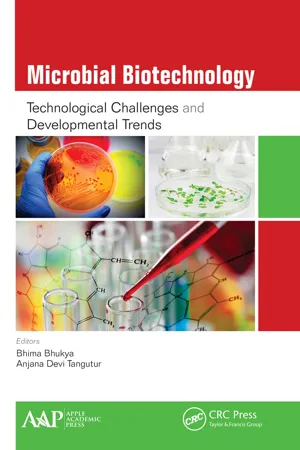
The new volume takes an interdisciplinary look at current technical challenges and recent developmental trends in microbial biotechnology. It covers an avalanche of new information available through research by focusing on a broad spectrum of issues on different microorganisms and their recent applications and implications in agriculture, soil science and forestry, industry, and public health and medicine.
Microbes present in our immediate environment have a direct or indirect influence leading to either a harmful or beneficial effect. Microbial Biotechnology: Technological Challenges and Developmental Trends is divided into four major sections that focus on
Part I: Antimicrobial Agents: Role and Applications in Medicine and Health Care
Part II: Role of Microorganisms in Agriculture and Plant Biotechnology
Part III: Microbial Enzymes and Their Potential Industrial Applications
Part IV: Microorganisms in Environment: Role and Industrial Applications
Topic include organic chemistry, biomass conversion, optimal production processes for different microbes, screening methods, and application of omics approaches such as (meta) genomics, proteomics, and metabolomics, or other biotechnology tools, to provide a deeper understanding of the microbial-based new and emerging products, trends, processes, and technologies.
The chapters present unbiased original research results on microbes by incorporating case studies wherever appropriate. Providing research findings applicable to the development of new methodologies, applications, and technologies, the book will be a valuable resource for people working in various fields of microbiology.
Department of Microbiology and Biotechnology Center, The Maharaja Sayajirao University of Baroda, Vadodara, Gujarat – 390002, India, E-mail: [email protected]
Preethi Badrinarayan
Center for Molecular Modelling, CSIR-Indian Institute of Chemical Technology, Uppal Road, Hyderabad 500007, Telangana, India
Kavita Barot
Department of Microbiology and Biotechnology Center, The Maharaja Sayajirao University of Baroda, Vadodara, Gujarat – 390002, India
Hitarth B. Bhatt
UGC-CAS Department of Biosciences, Saurashtra University, Rajkot, Gujarat – 360005, India
B. Bhima
Department of Microbiology, University College of Science, Osmania University, Hyderabad, Telangana – 500007, India, E-mail: [email protected]
S. Burgula
Department of Microbiology, Osmania University, Hyderabad, Telangana – 500007, India, E-mail: [email protected]
B. Chandrasekhar
Department of Microbiology, University College of Science, Osmania University, Hyderabad, Telangana – 500007, India
Amrita Dutta Chowdhury
Biotechnology Laboratory, Directorate of Rice Research, Rajendranagar, Hyderabad, Telangana – 500030, India
Biswanath Das
Natural Products Chemistry Division, CSIR-Indian Institute of Chemical Technology, Uppal Road, Hyderabad 500007, Telangana, India
Payal Das
Acharya Narendra Dev College, University of Delhi, Govindpuri, Kalkaji, New Delhi – 110019, India.
Narender Reddy Godumagadda
Medicinal Chemistry and Pharmacology Division, CSIR-Indian Institute of Chemical Technology, Uppal Road, Hyderabad 500007, Telangana, India
S. D. Gohel
UGC-CAS, Department of Biosciences, Saurashtra University, Rajkot, Gujarat – 360005, India
N. Hanumalal
Department of Microbiology, University College of Science, Osmania University, Hyderabad, Telangana – 500007, India
A. Hindumathi
Mycology and Plant Pathology Laboratory, Department of Botany, Osmania University, Hyderabad, Telangana, – 500007, India
Access to over 1.5 million titles for a fair monthly price.
Study more efficiently using our study tools.
Frequently asked questions
Yes, you can cancel anytime from the Subscription tab in your account settings on the Perlego website. Your subscription will stay active until the end of your current billing period. Learn how to cancel your subscription
No, books cannot be downloaded as external files, such as PDFs, for use outside of Perlego. However, you can download books within the Perlego app for offline reading on mobile or tablet. Learn how to download books offline
Perlego offers two plans: Essential and Complete
Essential is ideal for learners and professionals who enjoy exploring a wide range of subjects. Access the Essential Library with 800,000+ trusted titles and best-sellers across business, personal growth, and the humanities. Includes unlimited reading time and Standard Read Aloud voice.
Complete: Perfect for advanced learners and researchers needing full, unrestricted access. Unlock 1.5M+ books across hundreds of subjects, including academic and specialized titles. The Complete Plan also includes advanced features like Premium Read Aloud and Research Assistant.
Both plans are available with monthly, semester, or annual billing cycles.
We are an online textbook subscription service, where you can get access to an entire online library for less than the price of a single book per month. With over 1.5 million books across 990+ topics, we’ve got you covered! Learn about our mission
Look out for the read-aloud symbol on your next book to see if you can listen to it. The read-aloud tool reads text aloud for you, highlighting the text as it is being read. You can pause it, speed it up and slow it down. Learn more about Read Aloud
Yes! You can use the Perlego app on both iOS and Android devices to read anytime, anywhere — even offline. Perfect for commutes or when you’re on the go. Please note we cannot support devices running on iOS 13 and Android 7 or earlier. Learn more about using the app
Yes, you can access Microbial Biotechnology by Bhima Bhukya, Anjana Devi Tangutur, Bhima Bhukya,Anjana Devi Tangutur in PDF and/or ePUB format, as well as other popular books in Medizin & Biotechnologie in der Medizin. We have over 1.5 million books available in our catalogue for you to explore.