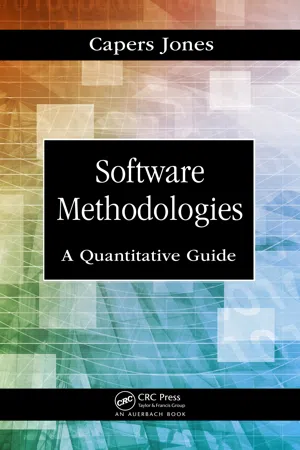
This comprehensive reference uses a formal and standard evaluation technique to show the strengths and weakness of more than 60 software development methodologies such as agile, DevOps, RUP, Waterfall, TSP, XP and many more. Each methodology is applied to an application of 1000 function points using the Java language. Each methodology produces a characteristic set of results for development schedules, productivity, costs, and quality. The intent of the book is to show readers the optimum kinds of methodologies for the projects they are concerned with and to warn them about counter indications and possible harm from unsuitable methodologies.
- 544 pages
- English
- ePUB (mobile friendly)
- Available on iOS & Android
eBook - ePub
About this book
Information
Publisher
Auerbach PublicationsYear
2017Print ISBN
9781032339566
9781138033085
Edition
1eBook ISBN
9781315314464
Chapter 1
Overview of 60 Software Development Methodologies
Executive summary: Software has developed 60 different methodologies due in part to sociological reasons and in part to bad metrics and measurement practices which prevent accurate measurements of methodology productivity and quality.
Sociological factors are the primary reason why software has over 25 size metrics, 60 methodologies, and over 3000 programming languages. The existence of so many variations is proof that none are fully adequate for all sizes and types of software. Truly effective general-purpose methodologies or programming languages would become standards practices, and none are good enough for this to happen as of 2017.
No matter what software development methodology is selected, all software projects have certain common features and common tasks that must be performed. The following section lists 20 essential activities that are part of all 60 methodologies discussed in this book.
Essential Activities for All 60 Software Development Methodologies
1.Cost and schedule estimates must be created.
2.Quality and risk estimates must be created.
3.User requirements must be studied and documented.
4.Government mandates such as Federal Aviation Administration (FAA) or Food and Drug Administration (FDA) approval must be planned.
5.For large applications, a formal architecture may be needed.
6.Software designs must be created for features and interfaces.
7.Software code must be developed or reusable code acquired.
8.Software code...
Table of contents
- Cover
- Half-Title
- Title
- Copyright
- Contents
- Preface
- Acknowledgements
- Author
- Introduction
- 1 Overview of 60 Software Development Methodologies
- 2 Life Cycles and Life Expectancies of Software Development Methodologies
- 3 A Method of Scoring Software Methodologies
- 4 Detailed Evaluations of 60 Software Development Methodologies
- 5 Agile/Scrum Software Development
- 6 Animated 3D Full Color Software Design Methodology
- 7 Anti-Pattern-Based Development
- 8 CASE Software Development
- 9 Cleanroom Software Engineering (CSE)
- 10 CMMI Level 3 (Capability Maturity Model Integrated) Software Development
- 11 Commercial Off-the-Shelf Software (COTS) Customization
- 12 Container Software Development
- 13 Continuous Development
- 14 Cowboy Development
- 15 Crystal Methods
- 16 DevOps
- 17 Disciplined Agile Development (DAD)
- 18 Dynamic Systems Development Method (DSDM)
- 19 Enterprise Resource Planning (ERP) Customization
- 20 Evolutionary Development (EVO) Methodology
- 21 Extreme Programming (XP)
- 22 Feature-Driven Development (FDD)
- 23 Git Software Development
- 24 Global 24 Hour Development
- 25 Hybrid Agile/Waterfall Software Development
- 26 Information Engineering (IE) Software Development
- 27 IntegraNova Development
- 28 Iterative Software Development
- 29 Kaizen
- 30 Lean Software Development
- 31 Legacy Data Mining
- 32 Legacy Renovation Development
- 33 Legacy Repair Development
- 34 Legacy Replacement Development
- 35 Mashup Development
- 36 Merise
- 37 Micro Service Software Development
- 38 Microsoft Solutions Framework (MSF) Development
- 39 Model-Based Development
- 40 Object-Oriented (OO) Methods
- 41 Open-Source Software Development
- 42 Pair Programming Software Development
- 43 Pattern-Based Development
- 44 Personal Software Process (PSP) Development
- 45 Prince2
- 46 Product Line Engineering Software Development
- 47 Prototype Development (Disposable)
- 48 Prototype Development (Evolutionary)
- 49 Rapid Application Development (RAD)
- 50 Rational Unified Process (RUP)
- 51 Reengineering
- 52 Reuse-Based Software Development (85%)
- 53 Reverse Engineering
- 54 Robotic Software Development Using Standard Parts
- 55 Service-Oriented Architecture
- 56 Specifications by Example Development
- 57 Spiral Development
- 58 Structured Development (Design, Programming)
- 59 Test-Driven Development (TDD)
- 60 Team Software Process (TSP) and Personal Software Process (PSP)
- 61 T-VEC Development
- 62 Virtual Reality Global Development
- 63 V-Model
- 64 Waterfall Development
- 65 Summary and Conclusions about Software Methodologies
- References and Readings on Software Methodologies and How to Measure Them
- Index
Trusted by 375,005 students
Access to over 1.5 million titles for a fair monthly price.
Study more efficiently using our study tools.
Frequently asked questions
Yes, you can cancel anytime from the Subscription tab in your account settings on the Perlego website. Your subscription will stay active until the end of your current billing period. Learn how to cancel your subscription
No, books cannot be downloaded as external files, such as PDFs, for use outside of Perlego. However, you can download books within the Perlego app for offline reading on mobile or tablet. Learn how to download books offline
Perlego offers two plans: Essential and Complete
- Essential is ideal for learners and professionals who enjoy exploring a wide range of subjects. Access the Essential Library with 800,000+ trusted titles and best-sellers across business, personal growth, and the humanities. Includes unlimited reading time and Standard Read Aloud voice.
- Complete: Perfect for advanced learners and researchers needing full, unrestricted access. Unlock 1.5M+ books across hundreds of subjects, including academic and specialized titles. The Complete Plan also includes advanced features like Premium Read Aloud and Research Assistant.
We are an online textbook subscription service, where you can get access to an entire online library for less than the price of a single book per month. With over 1.5 million books across 990+ topics, we’ve got you covered! Learn about our mission
Look out for the read-aloud symbol on your next book to see if you can listen to it. The read-aloud tool reads text aloud for you, highlighting the text as it is being read. You can pause it, speed it up and slow it down. Learn more about Read Aloud
Yes! You can use the Perlego app on both iOS and Android devices to read anytime, anywhere — even offline. Perfect for commutes or when you’re on the go.
Please note we cannot support devices running on iOS 13 and Android 7 or earlier. Learn more about using the app
Please note we cannot support devices running on iOS 13 and Android 7 or earlier. Learn more about using the app
Yes, you can access Software Methodologies by Capers Jones in PDF and/or ePUB format, as well as other popular books in Computer Science & Project Management. We have over 1.5 million books available in our catalogue for you to explore.