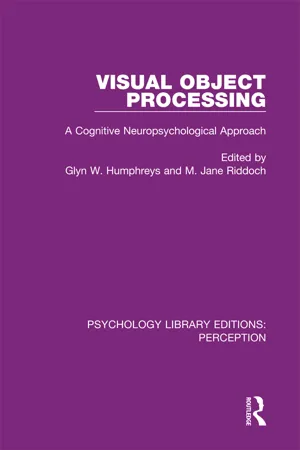
Originally published in 1987, this book, attempted to bring together work by researchers concerned with the functional and neurological mechanisms underlying visual object processing, and the ways in which such mechanisms can be neurologically impaired. The editors termed it a 'Cognitive Neuropsychological' approach, because they believed it tried to relate evidence from neurological impairments of visual object processing to models of normal performance in a new and important way. Two broad aims are apparent. One is to test models of normal performance by evaluating how well the models account for the patterns of impairment and preservation of abilities that can occur following brain damage. The other is to use models of normal performance to further their understanding of acquired disorders of visual object processing. These aims distinguish the approach from neuropsychological work whose primary aim is to relate acquired deficits to the sites of damage, and from work in the field of cognitive psychology which attempts only to develop models of normal performance.
eBook - ePub
Visual Object Processing
A Cognitive Neuropsychological Approach
- 330 pages
- English
- ePUB (mobile friendly)
- Available on iOS & Android
eBook - ePub
Visual Object Processing
A Cognitive Neuropsychological Approach
About this book
Information
Table of contents
- Cover
- Half Title
- Title
- Copyright
- Original Title
- Original Copyright
- Contents
- List of Contributors
- Preface
- Dedication
- 1. Introduction: Cognitive Neuropsychology and Visual Object Processing
- 2. Visual Object Perception from a Computational Perspective
- 3. Normal and Pathological Processes in Visual Object Constancy
- 4. Picture Naming
- 5. Information Processing and Laterality Effects for Object and Face Perception
- 6. The Clinical Spectrum and Localisation of Visual Agnosia
- 7. Apperceptive Agnosia: The Specification and Description of Constructs
- 8. Object Concepts and Object Names: Some Deductions from Acquired Disorders of Word Processing
- 9. Dementia and Visual Agnosia
- 10. The Fractionation of Visual Agnosia
- Author Index
- Subject Index
Trusted by 375,005 students
Access to over 1.5 million titles for a fair monthly price.
Study more efficiently using our study tools.
Frequently asked questions
Yes, you can cancel anytime from the Subscription tab in your account settings on the Perlego website. Your subscription will stay active until the end of your current billing period. Learn how to cancel your subscription
No, books cannot be downloaded as external files, such as PDFs, for use outside of Perlego. However, you can download books within the Perlego app for offline reading on mobile or tablet. Learn how to download books offline
Perlego offers two plans: Essential and Complete
- Essential is ideal for learners and professionals who enjoy exploring a wide range of subjects. Access the Essential Library with 800,000+ trusted titles and best-sellers across business, personal growth, and the humanities. Includes unlimited reading time and Standard Read Aloud voice.
- Complete: Perfect for advanced learners and researchers needing full, unrestricted access. Unlock 1.5M+ books across hundreds of subjects, including academic and specialized titles. The Complete Plan also includes advanced features like Premium Read Aloud and Research Assistant.
We are an online textbook subscription service, where you can get access to an entire online library for less than the price of a single book per month. With over 1.5 million books across 990+ topics, we’ve got you covered! Learn about our mission
Look out for the read-aloud symbol on your next book to see if you can listen to it. The read-aloud tool reads text aloud for you, highlighting the text as it is being read. You can pause it, speed it up and slow it down. Learn more about Read Aloud
Yes! You can use the Perlego app on both iOS and Android devices to read anytime, anywhere — even offline. Perfect for commutes or when you’re on the go.
Please note we cannot support devices running on iOS 13 and Android 7 or earlier. Learn more about using the app
Please note we cannot support devices running on iOS 13 and Android 7 or earlier. Learn more about using the app
Yes, you can access Visual Object Processing by Glyn W. Humphreys, M. Jane Riddoch, Glyn W. Humphreys,M. Jane Riddoch in PDF and/or ePUB format, as well as other popular books in Psychology & Cognitive Neuroscience & Neuropsychology. We have over 1.5 million books available in our catalogue for you to explore.