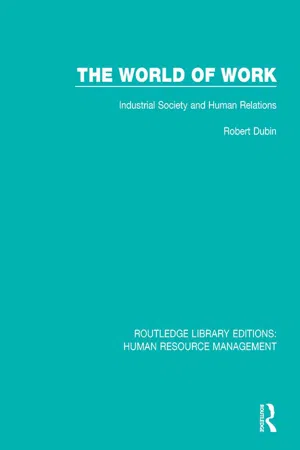
This book, first published in 1958, concerns American industry and commerce, and is devoted to what people do while they are working and reasons for their behaviour. This volume should prove valuable as an attempt to make systematic sense out of work in our industrial world. The balance of fact and theory is useful to those interested in understanding this complex world of working behaviour, and will be of interest to students of human resource management.
- 462 pages
- English
- ePUB (mobile friendly)
- Available on iOS & Android
eBook - ePub
Part I
WORK IN MODERN SOCIETY
Chapter 1
WORLD OF WORK
The historic dream of mankind is of a utopia where human work is moderate or unnecessary. The real facts of life are that almost all adults work, everywhere in the world. Work is a central fact of our lives. This book is all about work in urban-industrial United States.
Industrial work is carried out in organizations. The business firms of commerce and industry are complex, permanent organizations whose operations display some characteristic features that are the consequence of organization. Continuous production of goods and services for mass markets requires organization to secure, and keep together, materials, machines, and men.
There are other factors leading to permanent work organizations. We need only mention some at this point. For many productive activities, considerable investment in plant, material, and equipment is necessary. The investment in capital equipment and materials often exceeds the resources of single individuals, but a corporate group is capable of raising money to finance these expenditures.
Another factor requiring continuous organization of work activities is the division of labor into specialized tasks and functions. In order that the janitor, lathe operator, accountant, salesman, purchasing agent, production control manager, engineer, and file clerk can all perform their several duties in unison, it is necessary for the tasks to be organized systematically with respect to each other. This can best be done through formal organization—tying the individual jobs together and coordinating their activities.
Continuity of output is a consequence of the fulfillment of all specialized tasks involved in production at the required time, and in the required quantities. This means that work activities must be at least partially independent of the individual workers involved. Were this not so, the whole productive enterprise might grind to a temporary halt with the absence of one or several persons from their work stations. In order, therefore, to achieve continuity of output, it is necessary to organize the total productive activity so that rapid substitution can be made of one worker by another when this is necessitated by illness, quitting or dismissal. An organization is capable of handling problems of staffing. A collection of independent craftsmen working together might be very much less efficient in handling such problems, particularly those of staff turnover.
Work organizations exist because an organizing system is necessary to meet the conditions of modern work. Indeed, one of the great social inventions of the industrial revolution was the modern business organization. We do not often think of inventiveness being displayed in the area of social arrangements. It is notably true that major inventions have, indeed, been made in the social structuring of work relationships.
One of the themes of this book is the social inventiveness of man. New ways of working together and new systems of social relationships have been, and are still being, invented. These social inventions incorporated in business, productive, and service organizations of our society are just as important to output and efficiency as machines, materials, and industrial processes.
WORK IN INDUSTRY
We are concerned with behavior of people at work. It is clear, however, that work has a variety of meanings. Our first task is to indicate the special meaning assigned to work in this volume.
WORK
By work we mean continuous employment, in the production of goods and services, for remuneration. This definition has three elements: (A) that work is continuous; (B) that it results in production of goods and services; and (C) that the work is performed for pay. These three elements in the definition of work are necessary to differentiate work behavior from other kinds of human activities.
CONTINUITY OF WORK
It is necessary to limit attention to work that is continuous. This means that the work is carried out regularly over a period of time. The importance of emphasizing continuity of work lies in two basic facts.
The production of goods and services almost universally requires continuous effort. Without continuity of effort, goods or services produced are either trivial, or immaterial to the total output of a society.
In addition, emphasis on continuity of work has significance for the context of work, and for the life history of workers. When work is performed continuously, it tends to take place in a permanent organization. In our society we call this a business firm. We therefore deal exclusively with work as it takes place in some kind of business firm.
From the standpoint of the life history of the individual, the significant work he performs is done continuously by him. We describe a major segment of everyone’s career by the kind of work performed. We point to a man’s profession or occupation as an important characteristic of his total life history. We even discover that social standing is intimately associated with the continuous work that he performs in the society. We certainly become aware of the fact that a major share of waking hours is devoted to work performed on a continuous basis.
It should be clear, then, why it is that only work carried on continuously over a significant period of time will be considered as our central subject matter.
PRODUCTION OF GOODS AND SERVICES
Production of goods and services as part of our definition of work is important to differentiate it from other human efforts. There are many daily activities involving expenditures of human energy. Human energy is expended on recreational activities; personal care including eating, washing, and dressing; affectional relations as among people in families; and physical activities like walking, driving, and talking. In a physiological sense, an expenditure of energy is defined as work. In a sociological sense, only those expenditures of human ener...
Table of contents
- Cover
- Half Title
- Title Page
- Copyright Page
- Table of Contents
- PART I WORK IN MODERN SOCIETY
- PART II ORGANIZATION OF WORK
- PART III WORKING POPULATION
- PART IV GETTING WORK DONE
- PART V MANAGEMENT OF WORK ORGANIZATIONS
- Bibliography
- Index
Trusted by 375,005 students
Access to over 1.5 million titles for a fair monthly price.
Study more efficiently using our study tools.
Frequently asked questions
Yes, you can cancel anytime from the Subscription tab in your account settings on the Perlego website. Your subscription will stay active until the end of your current billing period. Learn how to cancel your subscription
No, books cannot be downloaded as external files, such as PDFs, for use outside of Perlego. However, you can download books within the Perlego app for offline reading on mobile or tablet. Learn how to download books offline
Perlego offers two plans: Essential and Complete
- Essential is ideal for learners and professionals who enjoy exploring a wide range of subjects. Access the Essential Library with 800,000+ trusted titles and best-sellers across business, personal growth, and the humanities. Includes unlimited reading time and Standard Read Aloud voice.
- Complete: Perfect for advanced learners and researchers needing full, unrestricted access. Unlock 1.5M+ books across hundreds of subjects, including academic and specialized titles. The Complete Plan also includes advanced features like Premium Read Aloud and Research Assistant.
We are an online textbook subscription service, where you can get access to an entire online library for less than the price of a single book per month. With over 1.5 million books across 990+ topics, we’ve got you covered! Learn about our mission
Look out for the read-aloud symbol on your next book to see if you can listen to it. The read-aloud tool reads text aloud for you, highlighting the text as it is being read. You can pause it, speed it up and slow it down. Learn more about Read Aloud
Yes! You can use the Perlego app on both iOS and Android devices to read anytime, anywhere — even offline. Perfect for commutes or when you’re on the go.
Please note we cannot support devices running on iOS 13 and Android 7 or earlier. Learn more about using the app
Please note we cannot support devices running on iOS 13 and Android 7 or earlier. Learn more about using the app
Yes, you can access The World of Work by Robert Dubin in PDF and/or ePUB format, as well as other popular books in Business & Business generale. We have over 1.5 million books available in our catalogue for you to explore.