The quote above could apply to many situations around the world where murals are painted on outdoor walls. While the motivations for painting murals may be different, ranging from personal expressions of the artists, to political messages, to enhancement of a destination’s tourist appeal, murals are a form of public art that is accessible to all who walk by them. We suggest, then, in this volume that murals matter. They are bold, imaginative, revolutionary, emblematic and visionary; they inspire, inform, confront and overshadow the viewer. Murals have compound meanings, often reflecting upon or communicating aspects of the heritage, politics and/or identity of a place. In this introductory chapter, we review in detail why murals matter and then examine the relation of murals to their three themes of heritage, politics and identity that frame the investigation of visiting murals within this volume. This is followed by an introduction to the organization and contributed contents of the volume. In a final section, we conclude by briefly discussing the contributing chapters in the book.
Why murals matter
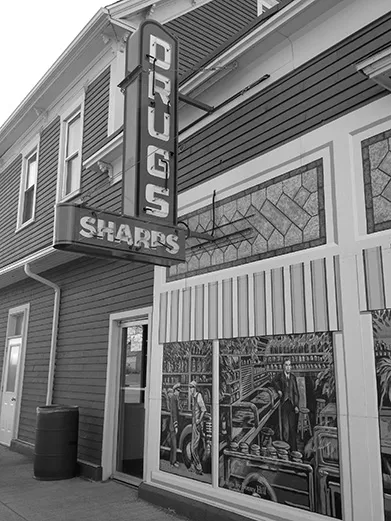
Chemainus, noted above as a murals destination, is a small town numbering about 3,000 in population (as of 2011) located on Vancouver Island, British Columbia (Canada). Dependent upon the sawmill industry, the community came together in the early 1980s when their sole industry went into decline with a loss of employment due to mechanization of the mill. To counter the economic downturn and to diversify community dependence, the local community response was to develop an art tourism experience about the town (Barnes and Hayter 1992). They saturated the town with forty-two community history images on the sides of buildings, developing the blank canvas of a side or gable end into an attractive eye-catching feature. This ‘al fresco gallery’ gained the town some 400,000 annual tourists, sustains over 300 small businesses and points to the town’s sobriquet: ‘The Little Town That Did’. The international recognition of the unique collection of murals that represent the history of the town is now seen as one of the strengths of the region in terms of the development of art- and culture-related tourism (Community Tourism Foundations Programme 2010). Furthermore, the murals of Chemainus have provided a development model and example of employing nostalgia-related murals’ subjects that has been pursued by other small towns across Canada, such as in Sussex, New Brunswick (Canada), that now promotes itself of as ‘The Mural Capital of Atlantic Canada’ (Sussex Murals, n.d.). The example of the mural on Sharps Drugs in Sussex shows how a contemporary mural superimposed on a historic building and complimentary to the heritage neon sign brings alive the long history and importance of this business to the town (Historic places.ca 2007) (Figure 1.1).
Seeing a mural, growing up under its gaze, viewing a piece of outside art, is different from looking at an art in a gallery. Murals are a form of public art that can be viewed at all times and from many different physical viewpoints in the context of the urban environments of towns and cities. Forming ‘open air’ galleries of art, murals can be viewed without the constraint of visitor fees and gallery hours and therefore have a very large audience. Murals hence have a broad appeal as popular art and are accessible, so it is not a surprise that they have become assets for the development of heritage-related tourism. They can regenerate or reanimate a dead zone created by walls, or soften a boundary wall or divide such as the Berlin Wall. They are also used, deliberately, to create a readable, marketable public space – recall the iconic colour and fonts of ‘Drink Coca Cola’ campaigns that now fade across the walls of US streets. Where Silberman, Till and Ward (2012, 17) write of the wall as border that fulfils our dehumanizing territorial imperatives, it is the mural that humanizes and lives up to our imagination. It brings colour and sometimes a little chaos to the uniform anonymity and regularity of a brick wall. It adds features and expression to that face, depending upon the nature of the wall (brick, concrete, wood, mud). Its signification can shift too, from revolutionary art to official culture (cf. Coffey 2012, 178) and national acclaim for one’s patria for Mexican muralism: the great populist and indigenist iconography and revolutionary realism of Diego Rivera in the 1920s repurchased as expression of modern Foucauldian governmental power in the Palacio Nacional de Mexico, Mexico City, for example. The changing networks of signification and reception in the murals of Belfast would be another (see below and Lisle 2006).
Moreover, murals can inform and educate with warnings about HIV/AIDS across South Africa (Marschall 2004). They can warn of the afterlife such as the sixteenth-century Biblical frescoes on the exterior walls of monasteries in Moldavia, Romania, now UNESCO world heritage sites in their own rights. They can signal ideological commitment, solidarity and social identification from Belfast and Berlin to Tehran, Havana and Managua. David Kunzle’s The Murals of Revolutionary Nicaragua 1979–1992 (1995) proves an excellent starting point with detailed case/material of Nicaragua’s late-twentieth-century mural movement that both provided and showed support for the country’s Sandinista popular revolution. The murals became an adjunct to the revolution, a form of visual language: defiant, transformative and internationalist. Though often now deleted, painted over by neo-fascists (Kunzle 1995, 21), defaced, ignored, at their heights – both literal and figurative – these murals exemplified citizens taking power into their own hands. Brigades of artists painted for the movement, with support – mural aid – coming from volunteers from the USA, Europe and other countries in Latin America. A Mural School founded by Italian artist Sergio Michilini institutionalized this development of the plastic arts across the country. Religious and postcolonial symbolic imagery, primitivism, indigeneity and jungle themes, Utopian and ‘magical realism’, historical and worker iconography and expressionism were all used to reframe contemporary identity debates on the walls of Nicaragua. The Dream of Bolívar was 100 metres long, a public mural in the centre of Managua sponsored by the army and painted by Chilean artists Victor Canifrú and Alejandra Acuňa. It honoured Bolívar as a leader and the freedom he inspired through hyperreal magnified images. It depicted a nation and a continent gaining independence through political struggle and industriousness. The mural lasted from 1983 to 1990/1991. Kunzle (1995, 51) describes it as ‘an epic that situated the revolution as the culmination of a while Latin American history of struggle for freedom, with Simon Bolívar as the pivot’. The murals movement that swept across Nicaragua de-alienated the members of this grassroots democracy; Kunzle (1995, 40) suggests that the voluntaristic nature of this mass participation in the murals made it decidedly ‘moral’. Muralists created public art for a purpose, for social commentary and social action. The work captured the zeitgeist moment or set the scene for local and national developments and so was left to dry on the walls, not defaced or graffitied over (Kunzle 1995, 64).
In terms of expressions on walls, Kunzle (1995, 64) suggests that mural painting lies at one end of a continuum with graffiti placed at the other end. Spray-can art falls in-between. This suggests that murals (with their image-based focus) contrast with graffiti (with the name- and character-based focus). The one is legal, acceptable and authorized; the other effectively rebellious, typically subversive and equating with vandalism; in terms of legislation, graffiti is uncommissioned ‘nuisance’ that many civic ordinances such as in the USA require the property owner to clean up (Mettler 2012, 257). Both are dubious arts, as Norman Foster and his team (Foster et al. 2003) found, unearthing and displaying Soviet graffiti on the Nazi Reichtag dating from the end of World War II. And yet, both are forms of ‘landscape expression’ (Moreau and Alderman 2011).
‘Banksy’ biographer Will Ellsworth-Jones (2012, 37) writes, however, that graffiti can in fact be a way out of vandalism. It is redemptive in turning actors towards the arts, and their works are no less murals for the materials (from stencil to aerosol) used in their production. This puts Banksy, with his satirical anthropomorphic rats, ironically smiling policemen, and saboutaged signposts and CCTV cameras, into the muralist category despite his sharp stencil designs. His work sits alongside the vivid street art of US graphic activist Shepard Fairey and the progressive stencil posters that change over time by Italians Sten and Lex. An ideological tourist attraction and international political commentary came from Banksy and his team’s 2005 visit to Israel and subsequent series of trompe d’œil images ‘hacking’ the monstrous 425-mile-long barrier that separates Israel from the Palestinian territories (Parry 2005). They imagine gaps and breaks in the wall; a vision of the other side. As such, the images allow us to imagine an alternative social order and possibilities for different political relations.
In a world of walls, imagining a world without them, clearly seeing that kind of world in our imagination may, in some cases, lead us to see it in reality (Murakami 2014). The writer Haruki Murakami paints with the words in his novels but has the same objective as Banksy. Here, murals and novels engage the imagination in the same way. Banksy’s concrete canvas in the Middle East – first daubed the ‘Window on the West Bank’ (Jones 2005) – was extended to Gaza in 2015 with a series of satirical travel advert murals to show sympathy for the 62 children who were killed by Israeli bombardment and destruction of some 18,000 Palestinian homes. Concrete is this artist’s canvas whether monolithic block or obliterated chip off the old block. The wall – an impediment and boundary marker establishing territory on either side of it – becomes co-opted in a new expression of territoriality, namely one with verticality to it (cf. Brighenti 2009).
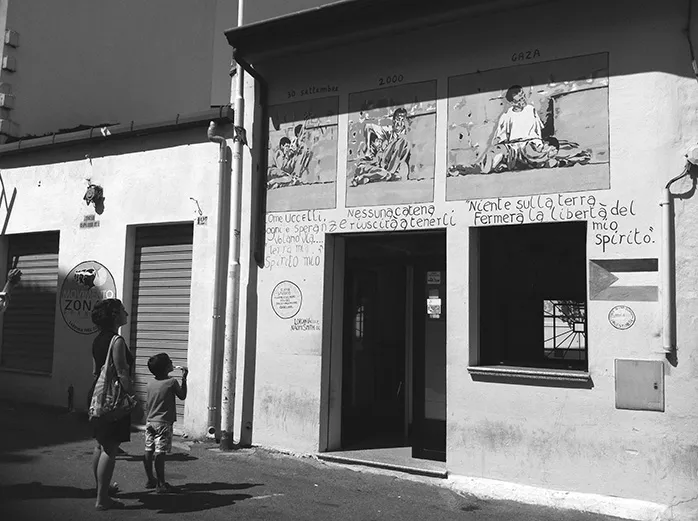
Murals have also very often become symbols of places, as with the murals of Detroit, USA, or of Northern Ireland or Orgosolo, Sardinia. Although the historic murals depicting Detroit industry painted in the 1930s by the Mexican artist Diego Rivera are indoors, at the Detroit Institute of Arts, outdoor murals are today part of the rejuvenation of the city. Such murals offer hope to residents of priority neighbourhoods where, to give an example, one project created murals on the walls of elementary schools (Rhea 2004). In Northern Ireland, due to the large number of murals there, it has been observed that Belfast and Derry/Londonderry could be the most famous murals destinations in Europe (Rolston 2010a). The political murals may be viewed as forming part of dark or political tourism (Simone-Charteris and Boyd 2010) and also reflective of the politics of community heritage (Crooke 2010). This is not always the case, however, as the meaning of murals can change over time, along with the community’s identification with them. The development of the murals through Orgosolo shows a shift from political expression along the lines of resistance, war and internationalism (Rolston 2014) by left-wing artist and art teacher Francesco Del Casino in the late 1960s to contemporary satire, art competition and tourist commoditization in the past two decades. Anthropologist Tracey Heatherington (2002, 19) suggests that the murals have come to represent different identity narratives as though a form of structural nostalgia has taken place for the protests of old; the murals signify an idealized Orgosolo community that was at once exclusive and isolated, proud and independent; critics contend that this is the opportunistic imposition of an outsider’s leftist agenda on the town (Rolston 2014, 83). This is how art becomes, according to Francesca Cozzolino who examined the production and heritagization of the murals between the 1960s and the 1990s. Such ‘artification’ leads to an ‘anesthetization’ of the politics surrounding their production (Cozzolino 2014, 175). The collective artwork nature of the unsigned original murals has been lost for newer individualized pieces mapped and labelled in tourist guide books. All are now protected by the municipality in defence of the burgeoning tourist trade. Gone is the grey tourism industry, diluted down from the kidnapping experiences or lunches with partisans, bandits and shepherds to posing for a selfie before one’s choice cause célѐbre (Figure 1.2).
Whether viewed as heritage asset, legacy leftover or contested art space, outdoor murals are complex and each is more than a simple tourist attraction or accidental aspect of material culture. Cultural tourists experiencing murals may be unintentional visitors, not planning to visit but nonetheless viewing murals, or intentional visitors, choosing to visit in order to view a mural or a series of murals, or to participate in a murals tourism experience. At many locations, murals have been linked together into tours, either as additional means for groups to get their political message across or just as tourism product and activity. The former has happened with well-known mural destinations such as Belfast and Derry (Londonderry) in Northern Ireland, and the latter with lesser-known locales. In Winnipeg, Manitoba (Canada), a tour of the murals commemorating the ethnic and cultural diversity of the west end of the city is offered daily during the summer tourist season providing an additional heritage tourism experience (Tourism Winnipeg 2016). The website promoting these murals tours states, “Murals are more than just a colourful piece of art painted on a wall. Murals are a great asset for the neighbourhood” (West End Business Improvement Zone 2016). Murals, therefore, not only take art out of the gallery setting, but they also bring them down to the community level where, as public art, they form part of the everyday life of residents. This sense of community embodied in an area’s expression on walls is an important theme in the study of murals.
Murals located outdoors reflect a long tradition of mural painting, originating indoors, for example, in the churches and public buildings of the Renaissance period. Today’s murals located outside are fragile works of popular art, as weather can be quite damaging to these expressions on walls. There is consequently often a need to restore them, or when the damage is beyond repair, or the message no longer deemed viable (by state entities) or indeed acceptable politically, many murals are just painted over with a new mural, as has often happened with the murals of Northern Ireland (Rolston 1970). The walls upon which some murals are painted also serve as barriers, be...