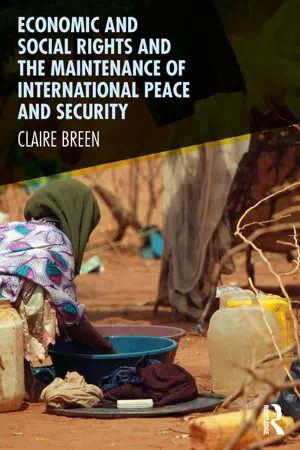
This text comprises cutting-edge research on one of the greatest global challenges: the failure to address systematic economic and social exclusion, and attendant violations of economic and social rights (ESR), as a driver of conflict. The text explores what the UN's obligation to maintain international peace and security can mean when it is informed by the requirement to protect and promote ESR, rights that play a crucial role in maintaining international peace and security but which are often overlooked. The book considers the extent to which Security Council mandated peace operations have been informed by human rights and efforts to promote economic and social development. The approach is to analyse the extent to which the Security Council has interacted with the General Assembly, the Economic and Social Council as well as other Charter-based mechanisms such as the Human Rights Council, and its predecessor, with particular reference to the role of the Special Procedure Mechanisms. The role of the UN High Commissioner for Human Rights is also considered. In this way, the text shows that the connection between peace and security and human rights is well recognised by these organs. In addition, the text considers States' ESR obligations stemming from the extraterritorial application of such rights in the context of peace operations. Given that States' obligations stemming from ESR have often been neglected, the book examines how such provision could be improved using ESR-grounded plans reflecting the rights to health, food, water, education, work and life. The text concludes with a call to reimagine what international peace and security can look like when it is informed by the need to recognise the emergence of post-conflict legal obligations based on broader concepts of international peace and security that draw from ESR. This text will appeal to legal scholars, policy advisors, members of the military, those working in the area of development, NGOs and final-year undergraduate and/or postgraduate students working in the areas of international law, political science and international relations, and associated fields of research.
eBook - ePub
Economic and Social Rights and the Maintenance of International Peace and Security
- 212 pages
- English
- ePUB (mobile friendly)
- Available on iOS & Android
eBook - ePub
Economic and Social Rights and the Maintenance of International Peace and Security
About this book
Trusted by 375,005 students
Access to over 1.5 million titles for a fair monthly price.
Study more efficiently using our study tools.
Information
Subtopic
International LawIndex
Law1 The significance of economic and social rights to peace and security
1 Introduction
Evidence of concern for the poor and the oppressed is to be found in various political, philosophical and religious systems spanning millennia, but the social and economic exploitation that was endemic in Western Europe and North America, particularly from the early 19th century, led to an array of philosophical, social and legal responses. Such responses were not always altruistic and reveal broader concern with maintaining a stable and secure society. Nonetheless, such responses did serve to improve the economic and social – and ultimately political – situation of those whose marginalisation at the social and economic level precluded their full participation in society. In due course, philosophical, and then political, responses found expression in legal change. Initially, such changes came at the domestic level as States moved to secure improved socio-economic conditions and then, at the international level, as States began to recognise the benefits of international cooperation. Whilst many of the developments were driven by advances in technology and communications from the mid-19th century, the cost of regional and then global conflict had a strong influence.
It is against this background that this chapter traces various philosophical and legal responses to secure improved economic and social conditions at the domestic and the international level. What emerges is a recognition of the interrelated nature of economic and social conditions and stability and security in the national and international arenas. Such recognition informed the founding documents of the League of Nations1 and the United Nations (UN or the Organisation).2 Both organisations were premised upon notions of economic and social progress and cooperation. However, the latter took a step further as it expressed its determination to ‘save succeeding generations from the scourge of war’, to reaffirm ‘faith in fundamental human rights, in the dignity and worth of the human person’ and ‘to promote social progress and better standards of life in larger freedom’.3 With the taking of this first step, international legal standards elaborating the content of economic and social rights, and concomitant State obligations, began to emerge, albeit with some challenges. This chapter demonstrates that today there is a clear legal framework underpinning economic and social rights, which rests on a detailed elaboration of what these rights entail and what States must do to meet their obligations stemming from those rights. This chapter serves as a reminder of the centrality of just economic and social conditions to stable societies and international law’s endeavours to capture and advance that centrality. It also demonstrates what steps can be taken to eliminate the social and economic marginalisation that often drives conflict.
2 The relationship between economic and social conditions and a stable domestic and international order
The origins of the modern concept of economic and social rights (as well as civil and political rights) can be found in various political, philosophical and religious systems that made provision for the oppressed and the poor, though such systems also were based on a need to maintain an orderly society. The Magna Carta (1215) was premised on the assumption that inequality creates conflict and should be mitigated by governmental or other intervention. The demise of the feudal system and the emergence of the Age of Enlightenment, and the accompanying political philosophy of the 17th and 18th centuries, allowed traditional authority and beliefs, including the proper relationship between the State and the market, to be challenged. This development also facilitated challenges to the endemic exploitation of the poor and their marginalisation at the social, economic and political levels.4 The adoption of the British Bill of Rights (1690–1691), the American Declaration of Independence 1776 (and the ensuing Bill of Rights of the Constitution of the newly emergent United States) as well as the French Declaration of the Rights of Man and Citizen 1789 are best known for their advancement of what we now regard as civil and political rights. However, their calls for democracy and equality set in motion the recognition of economic and social rights as an aspect of developing democratic ideals. For example, the impact of the French Declaration can be seen in the provisions of the French Constitution mandating public relief for the poor and free public education, which subsequently influenced many other European and Latin American civil codes. Although these Declarations were underpinned by the rights to equality, the inclusion of the principles of brotherhood reveals that the rights that they contained extended to only a limited portion of society, predominately free, land-owning men. In spite of the adoption of the Declaration of the Rights of Woman and Citizen5 and A Vindication of the Rights of Woman6 and the abolition of the Trans-Atlantic slave trade, the impact of efforts to achieve equality remained uneven in the face of on-going discrimination against women and minorities.
The extension of property rights to include the right to public assistance was advocated by Thomas Paine in the late 18th century. He contended that society owed a debt to individuals that they had a right to collect in the form of education and public assistance.7 Paine expanded his views in Agrarian Justice wherein he called for a basic income scheme for young families, the elderly and the disabled. Such payments were to be derived from a national fund, which would be financed by tax on inherited property to be paid by landowners for the needs of those who had no land. Most notably, such payments were to be a matter of right, rather than charity.8 In 1797, Thomas Spence went further by calling for the abolishment of the aristocracy and for the equal distribution of rents to be given to parishes to administer and to make land available for use by all inhabitants as a source of basic, unconditional income, which would be used to support families.9
The contribution of the philosophical, legal and political movements underpinning the developing ideals around democracy and economic rights as property rights were further advanced in response to the negative effects of the unrestricted expansion of capitalism during the Industrial Revolution and the economic and social inequities that stemmed from the exploitation of an ever-expanding class of marginalised poor, mainly in Europe and North America. In addition to the exploitation of workers, widespread poverty, starvation, epidemics and crime comprised a further combination of factors that prompted social and legal reform. Natural law principles of equality, mutuality and justice informed such social legislation. In terms of workers’ rights, the right to possess property had already been identified as an economic right,10 but the expansion of welfare legislation in the late 19th and early 20th centuries was a means to deal with the new social problems that had been caused by the Industrial Revolution. The extension of the right to vote (at least amongst male voters) and the introduction of compulsory education facilitated political participation and the resultant social legislation for better working conditions, the introduction of systems of public health and overall improved standards of living. In the 19th century, (Western) industrialised States began to see that concern with the health and welfare of their citizens was a way to look after a key resource of State power – the working population – and by the late 19th and early 20th centuries, medicine had come to provide much of the focus on the discourse on social issues, both nationally and internationally.
Socio-economic legislation relating to work and trade unions, social security, education, health and an adequate standard of living (encompassing rights to food and water, clothing and housing) was enacted in a number of countries by the end of the 19th century. National campaigns sought to ensure that every house had access to clean water and an on-site toilet. Water supply was regarded as the material expression of political inclusion and so that citizenship was cast not only in terms of political representation but also in terms of services provision. Access to water was important not only because it prevented disease but also because it was regarded as being critical for a ‘minimum level of dignity to which all citizens have a right’.11 Further initiatives included Britain’s Education Act 1870, which made education compulsory for all children under the age of 13 years and extended access to education to working-class children. In Germany, Chancellor Bismarck introduced social insurance schemes in the 1880s. In the context of the introduction of social legislation in New Zealand in the early to mid-1880s, it has been observed that this initiative reflected ‘the fledgling notion that all citizens should be able to achieve a level of participation in New Zealand society.’12 Elsewhere, the dangers of ignoring dire socio-economic conditions was highlighted by a number of revolutions, which led to new constitutional protections.13
Developments such as these at the national level were facilitated by some specific international developments in the late 19th and early 20th centuries, including the increasing internationalisation of trade, communication and the recognition of the value of transnational conversations amongst philanthropists, experts, scholars and, ultimately, policy- and law-makers. Between 1840 and WWI, increasingly frequent international congresses were held to discuss charity, sponsorship, assistance or penal reform. These networks and congresses disseminated information, helped develop national models for social welfare and were behind the adoption of many national policies on education, welfare and sanitation.14 From the latter part of the 19th century, States increasingly began to understand that many domestic provisions could be strengthened through international legal cooperation, leading to the advent of modern treaty law. For example, cooperation on public health can be traced back to national and then international efforts to develop conventions to prevent the spread of communicable diseases, in particular the adoption of sanitary conventions on cholera and the plague. A number of these conventions were adopted into a single text in 1903,15 and, in 1907, the Office International d’Hygiene Publique was established. Early international cooperation regarding the right to education was more limited and included the establishment of the International Bureau of Education in 1924, which was a private organisation. Particular efforts to minimise the increasing burden of suffering imposed by war on the civilian population began to underpin international treaties such as the Hague Conventions of 1899 and 1907,16 which ushered in a new era in international law where the plight of the individual co...
Table of contents
- Cover
- Title
- Copyright
- Dedication
- Contents
- Preface
- Acknowledgements
- Introduction
- 1 The significance of economic and social rights to peace and security
- 2 Peace and security, socio-economic progress, and human rights: The inseparable roles of the Security Council, the General Assembly and the ECOSOC
- 3 Peacebuilding and peace operations: The nexus of peace, economic and social progress and human rights
- 4 Economic and social rights in peacebuilding and peacekeeping: A measurable legal basis for the economic and social dimensions of peace
- 5 Reimagining peace and security in the post-conflict environment
- Conclusion
- Bibliography
- Index
Frequently asked questions
Yes, you can cancel anytime from the Subscription tab in your account settings on the Perlego website. Your subscription will stay active until the end of your current billing period. Learn how to cancel your subscription
No, books cannot be downloaded as external files, such as PDFs, for use outside of Perlego. However, you can download books within the Perlego app for offline reading on mobile or tablet. Learn how to download books offline
We are an online textbook subscription service, where you can get access to an entire online library for less than the price of a single book per month. With over 1.5 million books across 990+ topics, we’ve got you covered! Learn about our mission
Look out for the read-aloud symbol on your next book to see if you can listen to it. The read-aloud tool reads text aloud for you, highlighting the text as it is being read. You can pause it, speed it up and slow it down. Learn more about Read Aloud
Yes! You can use the Perlego app on both iOS and Android devices to read anytime, anywhere — even offline. Perfect for commutes or when you’re on the go.
Please note we cannot support devices running on iOS 13 and Android 7 or earlier. Learn more about using the app
Please note we cannot support devices running on iOS 13 and Android 7 or earlier. Learn more about using the app
Yes, you can access Economic and Social Rights and the Maintenance of International Peace and Security by Claire Breen in PDF and/or ePUB format, as well as other popular books in Law & International Law. We have over 1.5 million books available in our catalogue for you to explore.