- 206 pages
- English
- ePUB (mobile friendly)
- Available on iOS & Android
eBook - ePub
Colonial Administration and Land Reform in East Asia
About this book
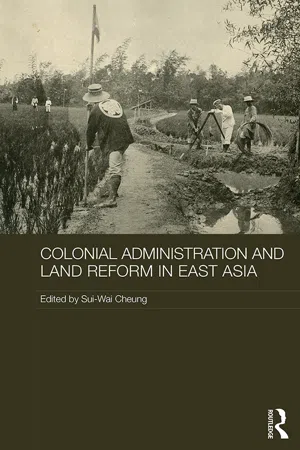
This book argues that as colonialism brought the concept of individual, as opposed to collective, land ownership to indigenous society, along with Western surveying techniques, the changes that resulted altered the relationship of the state to its citizens, and, thereby, the structure of local societies. The book considers these issues in all of East Asia, including China, Japan and Korea, focusing in particular on Hong Kong, which was subject to British rule from 1842 to 1997, and on Taiwan, which was subject to Japanese rule from 1895 to 1945. The book discusses how, although the main impact of land ownership by individuals and modern surveying were felt after colonialism had ended, it is by studying the introduction of these factors that their impact can be most clearly understood.
Trusted by 375,005 students
Access to over 1.5 million titles for a fair monthly price.
Study more efficiently using our study tools.
Information
Part I
One plot one owner
1 Landlords, squatters, and tenants
Fundamental concepts of land administration in early colonial Hong Kong
Sui-Wai Cheung
Hong Kong became a British colony (1842–1997) as a result of three treaties with the Qing government in the nineteenth century. The 1842 Treaty of Nanking allowed Britain to take Hong Kong Island in perpetuity; the 1860 Convention of Peking extended that agreement to the Kowloon Peninsula, and the 1898 Second Convention of Peking leased additional territory north of British Kowloon for ninety-nine years. The Hong Kong colonial government named the leased area the New Territories.
A striking difference between the ceded region (Hong Kong Island and Kowloon Peninsula) and the leased region (the New Territories) was the duration of land rights, or policy of “estate”. When Britain first took over Hong Kong Island, the Crown claimed all of the land as its own, and only granted 75-year leases for building land and 21-year leases for agricultural land. In 1848 the Crown extended those leases to 999 years. When Kowloon Peninsula was ceded in 1860, Chinese landowners who had been in possession were also granted 999-year leases. Since the New Territories were not ceded but leased to the British for 99 years from 1898, the Crown granted leases there for only 99 years less three days, starting from 1 July 1898. Indigenous owners in the New Territories, who had held the land from the Chinese emperor in return for paying land taxes, were given 99-year leases for their holdings.1
The details of the indigenous lineage-based land-holding system on which the British colonial government imposed its leases will be left to Chapter 6. This chapter outlines several fundamental ideas of land administration that underpinned those leases. It is important to realize that, in coming to terms with land management, the British colonial government in 1842 had not come onto the local scene with a fully developed land law that they could impose at will. Its ideas about land management evolved as it encountered the local situation. It balanced the demand for land with its need for revenue, and it drew upon legal concepts that had developed in Britain and elsewhere in the British empire as it did so. In establishing its rule over Hong Kong Island, the colonial government also had to sever the control of its land by the Xin’an county magistrate, who, prior to the cession of the island to Britain, had purview over Hong Kong, and even its landlords on the mainland (in the portion that eventually became the New Territories) who claimed a right to the “subsoil” (more on that in Chapter 6). Those decisions also had an impact on colonial land administration.
Land usurpers: whose land was it?
The details of a legal case that unfolded even as the Opium War was raging illustrate well the insistence of the colonial regime on direct administration of its tax regime on land. That insistence remained fundamental to colonial land policy in Hong Kong. The case involved the absentee landlords of land located on Hong Kong Island, the Xin’an magistrate, and the British colonial government.
Before the cession of Hong Kong, people of the Deng surname of Jintian village in what later became the New Territories had owned subsoil land rights to a vast tract of the island as well as other districts in Xin’an county, out of which the colony of Hong Kong was carved. The Dengs had emerged as a prominent land-owning lineage in the mid-seventeenth century. They were among the “big surnames” of the county, that is to say, land-owning lineage villages that were also successful in the imperial examination and recognized for their gentry status by the county magistrate. Like other “big surnames” of Xin’an county, their home villages, such as Jintian, were located on the mainland portion of the county, not on the islands dotting its coast, such as Hong Kong.2
The interests of the Jintian Dengs were invaded even before the Treaty of Nanking was signed. In January 1841, after a series of military defeats at the mouth of Pearl River, Guangdong-Guangxi Governor-general, Qishan, had agreed to a truce which came to be known as the Convention of Chuenpi in which he ceded Hong Kong Island to Britain. Only days after the truce was declared, a naval force landed and raised the British flag at the top of a small hill on the island. Captain Charles Elliot, who had negotiated the truce with the governor-general, declared himself responsible for governing the island.
Right away, Captain Elliot sought to finance his government from land sales. On the promise that he would persuade the home government to allow land holding in perpetuity, on 14 June at public auction, Elliot’s new government sold 40 lots, all situated along the shore, with a sea frontage of 100 feet each. Elliot ordered that a road be built through those lots, and laid out rules for private land transactions so Westerners could purchase land directly from natives. One of Elliot’s rules was that the government would only consider natives who actually lived on the land as its rightful owners. This particular rule would change the nature of land holding in Hong Kong; it ruled out the Jintian Dengs as rightful landowners.
Elliot was not in office for long. On 29 July 1841, dispatches arrived in Hong Kong to say that the British government had refused to ratify the Chuenpi Convention. Britain wanted territory at the mouth of the Yangzi River, and had appointed Sir Henry Pottinger as the new plenipotentiary. The Daoguang Emperor, also, had refused to ratify the convention and had removed Governor-general Qishan from office in February. As both countries were determined to continue fighting, the status of Hong Kong hung in the balance until the Emperor admitted defeat. By the time he ceded Hong Kong to Britain, the game plan for the China trade had changed, for he also agreed to open some Chinese ports for foreign trade, thus ending its restriction to Guangzhou.3
As landlords who did not live on the land they claimed to own (that is to say, as “absentee” landlords), the Dengs of Jintian suffered great losses when Britain took over Hong Kong Island. According to James Hayes, who has made in-depth analysis of various documents from the time, the story is as follows.4 After the British took Hong Kong, the Dengs dared not come to the island to collect rent or see to their holdings there. Their tenant-farmers travelled to Jintian in the New Territories to tell their Deng landlords that they could no longer pay rent, because the “English barbarians” had destroyed their crops to make way for roads, and built huts on their unplowed fields. Due to the fierce and violent nature of the barbarians, the farmers dared not negotiate with them. Since as landlords, the Dengs were responsible for the tax that was applied to the land they owned, when they could no longer collect rent on it, on 28 May 1841, their elders filed a joint petition to the Xin’an county magistrate to request tax exemption on their Hong Kong land of 272 mu (41.2 English acres).5
The Dengs stopped paying taxes on this land after petitioning for tax-exemption, but the magistrate had to file the case through the Qing official bureaucracy. Tax exemption was possible only after the magistrate had investigated the case, and presented it to the provincial governor for submission to the Board of Revenue in Beijing which made the ultimate decision. The problem for him, however, was that Britain and China were still at war with each other, and that made it impossible for him to carry out his investigation. In his reply to the Dengs’ petition, therefore, the magistrate stated that when Hong Kong Island became peaceful again he would investigate into the case, and then report to the provincial governor.
Hostilities between China and Britain ended with the Treaty of Nanking in 1842; in 1843 the Dengs sent rent collectors to the island again. When the rent collectors arrived, they discovered that much of their land had been taken for commercial enterprises; there were now over one hundred shops on what had been their farmland. The rent collectors demanded rent, but the shopkeepers refused to pay, saying that the land was now their property. These “land usurpers” went so far as to threaten to turn the British authorities on them if their harassment continued. The rent collectors fled.
On 13 March 1843 the Dengs filed a new petition, this time demanding direct intervention from the Xin’an county magistrate so that they could collect their rent and pay their land taxes. Five days later, the magistrate asked the Dengs to provide more information on the land in question to help him investigate the case. In reply, on 25 June 1843, the Dengs listed the names of four “evil tenants” who had usurped their land and were either renting it to locals or had sold it to the barbarians. They submitted a long list of their properties, accounting for 912 mu (138 acres) on Hong Kong Island, with an eye to requesting tax exemption for them. The magistrate replied that it was impossible that all of the Dengs’ land on the island had been usurped, and illogical that the barbarians would pay for the land they had forcibly taken. He demanded clarification on those points.
Although Hong Kong was formally a British colony by then, the Xin’an county magistrate’s reply possibly arose out of his belief that he still had the authority to collect land tax there. The concept of “colony” was utterly new to Chinese officials of the time. Macau, which had been inhabited by the Portuguese since the mid-sixteenth century, was their basis for comparison, and it was not a colony in any sense. The Portuguese were allowed to stay in Macau by a special imperial favour, and in return, as stipulated by regulations, they had to pay rent to the Xiangshan county magistrate who had jurisdiction over Macau. The Portuguese had developed a form of self-governance in their own communities, but otherwise the Qing government controlled Macau in every way. For example, the Xiangshan county magistrate collected tax from Chinese inhabitants, and had judiciary power over them. The maritime customs in Macau was a Chinese institution, controlled by the head office in Guangzhou.6
Moreover, the Treaty of Nanking did not state explicitly that Chinese officials had no more authority in Hong Kong. It only stated, in Article III:
It being obviously necessary and desirable that British Subjects should have some Port whereat they may careen and refit their Ships, when required, and keep Stores for that purpose, His Majesty the Emperor of China cedes to Her Majesty the Queen of Great Britain, etc., the Island of Hongkong, to be possessed in perpetuity by Her Britannic Majesty, Her Heirs and Successors, and to be governed by such Laws and Regulations as Her Majesty the Queen of Great Britain, etc., shall see fit to direct.
To the Xin’an county magistrate, therefore, Hong Kong seemed like another Macau, and he assumed that he should continue to collect taxes there.
On 8 June 1844, the Dengs sent another petition to the Xin’an county magistrate which stated that half of their land in Hong Kong had been occupied by the English barbarians, and the remaining farmland, accounting for 400 to 500 mu (60–76 acres), had been usurped by their “evil tenants”. The Dengs provided the names of 14 “evil tenants” who were refusing to pay rent in Xiaoxianggang village, Huangniyong village, and Saoguanpu village. The magistrate replied five days later, still unhappy about insufficient information and proof of ownership, but quite angry about the refusal to pay rent. He ordered his subordinate officials in Kowloon to arrest and interrogate those tenants.
Meanwhile, the colonial government was taking measures to eliminate any interference from Chinese officialdom. In the following month, John Davis, appointed in May 1844 as the second governor of Hong Kong, stated in a public notice that he had translated into Chinese that as Hong Kong had been taken over by Britain, the stonecutters in Shitangzui district were not allowed any longer to pay taxes to Qing officials, and if they did so they would be severely punished.7 There might have been action behind the scenes to clarify the authority of the Guangdong provincial officialdom in Hong Kong, for by December, he received an official letter from the Guangdong Provincial Treasurer conceding that as Hong Kong had become British territory, it was inappropriate for Chinese officials to collect taxes from the Dengs for their holdings located there. In January 1845 Davis issued a public notice to restate the colonial government’s order that landowners in Hong Kong should pay land taxes only to British officials.8
As absentee landlords the Dengs lost all their properties on Hong Kong Island, and they were not the only ones. Rather than applying to the county magistrate, who had declared hands off, some tried a different tack. In June 1845, for example, two people of the Zhu surname who lived in Kowloon submitted a petition to the colonial government for justice because their land in Shitangzui had been taken by a “scoundrel”. There is no record of a response from the colonial government.9 Others did not give up. In July 184...
Table of contents
- Cover
- Half Title
- Title Page
- Copyright Page
- Table of Contents
- List of illustrations
- List of contributors
- Acknowledgements
- Preface
- Introduction: Colonial administration: the missing link in East Asian land reform
- PART I: One plot one owner
- PART II: Academies, lineages, and temples
- PART III: The Torrens System
- PART IV: Mapping colonies by trigonometrical survey
- PART V: Land reform in China to the 1930s
- Glossary of Chinese characters
- Index
Frequently asked questions
Yes, you can cancel anytime from the Subscription tab in your account settings on the Perlego website. Your subscription will stay active until the end of your current billing period. Learn how to cancel your subscription
No, books cannot be downloaded as external files, such as PDFs, for use outside of Perlego. However, you can download books within the Perlego app for offline reading on mobile or tablet. Learn how to download books offline
Perlego offers two plans: Essential and Complete
- Essential is ideal for learners and professionals who enjoy exploring a wide range of subjects. Access the Essential Library with 800,000+ trusted titles and best-sellers across business, personal growth, and the humanities. Includes unlimited reading time and Standard Read Aloud voice.
- Complete: Perfect for advanced learners and researchers needing full, unrestricted access. Unlock 1.5M+ books across hundreds of subjects, including academic and specialized titles. The Complete Plan also includes advanced features like Premium Read Aloud and Research Assistant.
We are an online textbook subscription service, where you can get access to an entire online library for less than the price of a single book per month. With over 1.5 million books across 990+ topics, we’ve got you covered! Learn about our mission
Look out for the read-aloud symbol on your next book to see if you can listen to it. The read-aloud tool reads text aloud for you, highlighting the text as it is being read. You can pause it, speed it up and slow it down. Learn more about Read Aloud
Yes! You can use the Perlego app on both iOS and Android devices to read anytime, anywhere — even offline. Perfect for commutes or when you’re on the go.
Please note we cannot support devices running on iOS 13 and Android 7 or earlier. Learn more about using the app
Please note we cannot support devices running on iOS 13 and Android 7 or earlier. Learn more about using the app
Yes, you can access Colonial Administration and Land Reform in East Asia by Sui-Wai Cheung in PDF and/or ePUB format, as well as other popular books in Social Sciences & Ethnic Studies. We have over 1.5 million books available in our catalogue for you to explore.