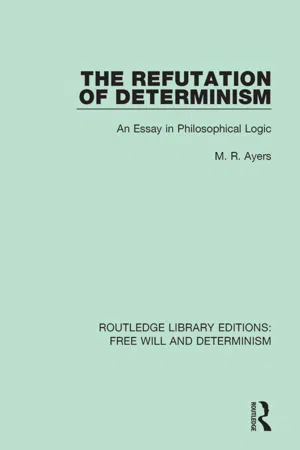
Perhaps everyone who can think has the concept of possibility, but no one understands it. The metaphysical theory of Determinism is a symptom of this lack of understanding, and the inconclusiveness of its opponents' arguments indicates that the lack is universal. In this book, first published in 1968, the author shows that there are a number of different kinds on non-logical possibility, subtly interrelated, each requiring separate explanation. An original contribution to the subject, it is essential reading for all students of philosophy.
- 194 pages
- English
- ePUB (mobile friendly)
- Available on iOS & Android
eBook - ePub
About this book
Trusted by 375,005 students
Access to over 1.5 million titles for a fair monthly price.
Study more efficiently using our study tools.
Information
Topic
PhilosophySubtopic
Philosophy History & Theory1
Introduction
In spite of its title, the primary aim of this book is constructive. It is to offer a reasonable and explanatory account of the concept of potentiality and related concepts. The freewill problem is certainly the heaviest millstone around the neck of anyone who inquires into the nature of potentiality, and it is impossible to imagine a satisfactory treatment of either the concept or the problem that does not involve the other at a fundamental level. But a well-known remark about can, that in philosophy we seem so often to uncover it, ‘just when we had thought some problem settled, grinning residually up at us like the frog at the bottom of the beer mug’, is right in its suggestion that a careful investigation of possibility and potentiality is likely to be philosophically rewarding in many areas of dispute.
It is my constructive purpose that will largely determine the order of exposition in what follows. Consequently my critical purpose, which is primarily the refutation of the arguments that give rise to the freewill dilemma, may seem to be pursued in a rather haphazard and subordinate way. My preferred method of warfare may often seem to be sniping rather than frontal assault. As an aid to orientation, I shall start by directly considering some of the crude but compelling reasoning on the basis of which determinism is usually advanced. I shall take a glance at the wood from this too familiar viewpoint, before properly coming to grips with the trees.
The common premiss of both determinist and indeterminist is, of course, the alleged incompatibility of causation and freedom of choice. This supposition is usually supported by the argument that, if an event is in all respects causally explicable, then it could not have been any different, since to explain an event completely just is to shew that nothing else was possible in the circumstances. If one thing is the whole cause of another, then given the occurrence of the first thing, the other must occur. This is the meaning of ‘cause’. Likewise, to say that something is a law is to say that anything different is impossible. So if everything that happens is governed by a law, nothing that fails to happen is possible, or ever was possible. On the other hand, everyone agrees, or should agree, that for there to be freedom of choice or, therefore, any real choice at all, the agent must be presented with alternatives that are all genuine possibilities. It follows that a free choice cannot be causally determined, and it can have no complete explanation.
Some may think that this argument is simply absurd, but it can appear almost as plausible as it is well-known. I shall contend that is fallacious, but I shall also contend that all attempts to explain what is wrong with it have been inadequate. Any argument of which this is true deserves respect. Although it may not be explicitly involved in every formulation of determinism, I shall call it the ‘Basic Argument’ for determinism.
The ‘Basic Argument’, as so far expounded, presents us, of course, with a dilemma. Either we accept that actions are causally explicable, in which case we are committed to the startling proposition that there is no such thing as free choice, and nobody is ever really responsible for his actions; or else we protest that, since we obviously do often or at least sometimes act freely and know it, we can only conclude that some of our actions are in some respects uncaused. At this stage in the argument, the indeterminist’s position might well seem the stronger. He does not, like the determinist, deny something that seems to be certainly true. He merely makes a definite assertion about a subject on which we might suppose a lack of anything like complete evidence. His assertion is surprising and may seem in some way repugnant to reason. Nevertheless, apart from further developments in the dispute, the least that could be said for the indeterminist would be that he is less unreasonable than the determinist.
It should perhaps be mentioned that we do not avoid difficulties by withholding judgement between determinist and indeterminist, for this impartiality itself involves adopting the view that we do not know whether we are ever responsible for our actions. It is nearly, if not equally as paradoxical to assert that nobody ever knows that he can do an action unless he actually performs it, as it is to say that no action ever is possible unless it is actually performed. In other words, the Basic Argument can figure as part of an argument for a kind of metaphysical scepticism, which is about as puzzling and paradoxical a philosophical doctrine as any other. Our dilemma is really a trilemma.
There are, however, a number of additional arguments designed to make determinism the most attractive theory. Some of these arguments are now rightly regarded as feeble or fallacious. For example it has been supposed that it can be known a priori that ‘every event has a cause’, either because this proposition is logically necessary or because it is some kind of necessary presupposition of scientific, or any other kind of thought. Such a view is based on arguments that may be of great interest but that no longer have a wide appeal. I shall not discuss them. Another typical attempt to bully us into agreeing that every action is completely caused is based on a philosophy of mind that nowadays, if it is not always seen as palpably naïve, is at least generally viewed with strong suspicion. In its exteme form, every action is represented as necessarily entirely the result of an entity called a ‘strongest motive’ or ‘greatest desire’, a mental spring that provides the energy for the curious, irreversible clockwork of choice, volition and act. This mechanistic theory of mind is not convincing.
Nevertheless, even if some of his guns misfire, the determinist can call on an argument that really does seem extremely powerful, and that might seem to make his doctrine invulnerable. It is a sort of reductio ad absurdum of indeterminism, which runs more or less as follows. Let us suppose that some human actions are not caused, that they are indetermined and so really could have been otherwise. This is simply to suppose them accidental, random, unpredictable and unrelated to the agent’s personality. How can we even ascribe such an event to an agent as an action of his, unless it can be related to his character and past performances? How can we judge it, unless we can relate it to a specific and intelligible motive, and how can we do this if it is a bolt from the blue? It was a complaint against the determinist Hobbes that the only kind of ‘liberty’ he allowed within his system was the kind of freedom a river has to flow down its channel; but the indeterminist must face the complaint that he gives us nothing more than the freedom of a microparticle to move at random. Why should a man be held responsible for something supposed to be unrelated to all antecedents and perhaps to all that comes afterwards, something that came into his head from nowhere?
On the other hand, responsibility certainly does require that the agent could have done otherwise. The only conclusion left to draw, it is argued, is one drawn by C. D. Broad in a classic formulation of this argument,1 that responsibility and freedom of choice are self-contradictory notions, requiring that an agent both could and could not have acted otherwise, that his action both was and was not causally determined. Determinism, if this is the right name for the doctrine that no person is ever responsible for his actions or ever makes a free choice, is no longer presented as the lesser of two evils, the more acceptable horn of a dilemma, but as the only possible conclusion of a rigorous argument. It is also, interestingly enough, made wholly independent of what is also sometimes not unreasonably called ‘determinism’: the view simply that every event has a scientific explanation. It should be understood that it is the first kind of determinism that I am concerned to refute. Where it is necessary, I shall mark the distinction by calling the denial of the existence of any free choice ‘metaphysical determinism’, and the view that everything that happens is in principle explicable by. reference to its antecedents and laws of nature, ‘scientific determinism’.
The charge that indeterminism would merely make some actions random and inexplicable events, not really personally significant actions at all, has been and remains, I think, the strongest obstacle to its acceptance, largely explaining the relative popularity of determinism among English-speaking philosophers. No satisfactory answer has been given. Even if, in their presentation of the argument, determinists have sometimes misrepresented ‘motives’ as ghostly thrusts logically required to trigger off actions, or ‘character’ as a pre-existing and wholly determinate substrate uniquely determining them, or laws of nature as ubiquitous tram-lines through time, nothing at all seems to be achieved by the indeterminist’s mysterious notion of ‘contra-causal’ choice towards a more reasonable and accurate philosophical account of choice, action and the logic of the explanation of action. If the determinist often talks as if a human being is the helpless onlooker and victim of the clanking machinery of his own mind and body, set apart in some unintelligible way from his own plannings and decidings, the indeterminist has even more notoriously seen the situation in the same terms, with the single difference that the Self is now supposed capable of twitching a metaphysical muscle occasionally in order to deflect those plannings. The picture of the transcendent agent is not convincing, and it is a more plausible theory that to call an action mine is at least to bring it into relation with my past actions and the personality that I and others know. Nothing very clear or persuasive has been brought against this point in the determinist’s position.
It is the thesis of this book, however, that an earlier part of the argument is fallacious, the ‘Basic Argument’ that presents the dilemma. This is not a particularly original view in itself, for the forces of compromise have a long history in the dispute, and have recently been largely victorious. We shall see that these peacemakers tend to commit the same mistakes as the extremists. But it must be admitted that they do very often direct critical attention to the right place – the steps taken in the Basic Argument. I shall discuss the most popular remedies in detail later on, but it may help to consider some suggestions now. It may help us to see what determinism is.
Hobbes offers a definition of ‘liberty’, which we need not go into, but according to which a man may be said to do an action freely even though he acted necessarily and could not have acted otherwise, at least in any categorical sense. In other words, Hobbes attacks that premiss of the Basic Argument that seems to be its strongest, the premiss that, for there to be freedom of action, the agent must be presented with alternatives that are genuine possibilities. Hobbes is nevertheless renowned as a determinist, and, I think, rightly so. One reason is simply that he is a scientific determinist, and indeed argues that it is necessarily true that every event has a cause. But he is also regarded as a determinist because his view that no one ever could have done anything, except what he did, really leaves no room for ‘liberty’. Hobbes thought otherwise, but in any case the assertion that every action that is performed is necessary or unavoidable is at least as paradoxical as the assertion that there is no liberty. So although Hobbes may reject a part of the ‘Basic Argument’ as it is formulated above, it is justifiable to call him and anyone else who goes so far as to hold that everyone acts necessarily, and could not act differently, a ‘determinist’. More precisely, I shall call this kind of view necessitarianism (i.e. the view that everything happens necessarily, and everyone has to do what he does) or actualism (i.e. the view that nobody ever could do anything different, except what he actually does, and, in general, that only the actual is possible). It is ‘actualism’ that I shall mostly be concerned with, when I talk of ‘determinism’. It should also be said that I shall very often neglect the fact that a philosopher who accepts the Basic Argument could as well be an indeterminist as a determinist, and I shall treat a refutation of the Basic Argument as a ‘refutation of determinism’. The doctrine that if everything is caused, everything happens necessarily and so no one ever could act otherwise, might equally well be a part of an argument for indeterminism as for determinism, but I shall refer to it as a determinist doctrine, partly for the sake of brevity. A further justification for this practice is that indeterminism is a negative theory, as its name indicates, and parasitic on determinism. Philosophers are frightened into indeterminism by the bogey of determinism, and we are justified in regarding the determinist as our main adversary.
It may seem very surprising, but it is possible to be a determinist in virtue of being an actualist, without also being a necessitarian. Hume, or at any rate the position that Hume seems most inclined to adopt, is a case in point. Many people have thought that his account of causation undermines the Basic Argument radically, since he denies that an effect ever really follows its cause necessarily. It is still an argument of some who offer resolutions of the ‘free-will’ dilemma, that, in introducing the notion of necessary connections between events, the determinist has simply confused the causal relation (‘constant conjunction’) with logical implication, and has allowed a logical must to creep into a non-logical argument. It is true that many determinists are open to this charge, and they are always vulnerable to Humean criticism. But their mistake is not an essential element of the Basic Argument. For one thing, there is a concept of non-logical, ‘natural’ or ‘empirical’ necessity, which is not, as Hume thought, purely subjective. To say that an event is necessary is simply to say that it is not possible that it should not take place. If the Humean insists that such a notion makes no sense, the question to ask is whether he admits empirical, as well as logical, possibility. If he does allow that there is such a thing, as most now would, then the Basic Argument can easily be formulated for his benefit entirely in terms of possibility, without bringing in the correlative term ‘necessary’. If, however, the Humean follows his master in questioning even the notion of empirical possibility, then he has already arrived, by a short cut, at the determinist (actualist) position that there are no real possibilities beyond what actually happens, unless what is meant is logical possibilities. Hume’s actualism will receive much fuller discussion later, but the fact is that exactly the same epistemology as leads him to deny necessity in events, also leads him, as in all consistency it should, to limit his conception of possibility and potentiality so severely that it is one of his central doctrines that ‘the distinction between a power and its exercise is entirely frivolous’. That is to say, the Humean attack on the notion of necessity, popular as it is in discussions of freewill, not only fails to provide a satisfactory answer to determinism, but even breeds a separate argument for it. This argument will later be of particular interest in the attempt to give an analysis of potentiality.
G. E. Moore was another peacemaker. In a famous passage (Ethics, Ch. 7) Moore makes two important moves, neither of which is entirely original to him. The first is extremely simple, but none the less important. He emphasises the prima facie unacceptability of the consequences of the determinist’s claim that if every action is caused then no one ever could have acted otherwise. He brings it forcibly before our minds that this claim is in conflict with what no sane man would normally doubt, that there really is a distinction holding between what people (and for that matter, cats or ships) can do, and what they cannot do, even among the things that they do not do. It does seem more probable, to say the least, that something is wrong with the bewildering metaphysical argument presented to us by the determinist, than that the propositions that I could have walked a mile in twenty minutes this morning, and that a particular ship could have steamed twenty knots on a particular occasion, are bound to be false unless these performances actually took place. Moore’s appeals to ‘common-sense’, of which this is one, are the topic of much debate, often being condemned as mere denials of what is asserted, or praised as an appeal to a subtle (but, as it seems, incorrect) theory of meaning. In fact their force stems very largely from the reminder that it can be certain that an argument is invalid, even if we cannot say exactly what is wrong with it – a simple point that is frequently forgotten in the heat of debate.
Moore goes on to improve his case by a second move, which is simply a suggestion as to the kind of fallacy the determinist has committed. He suggests that the words ‘can’ and ‘could’ are ambiguous, and that the Basic Argument hinges on this ambiguity.
It is easy to see how this might be so, simply by considering the move from, say,
A. If every event is caused, no event ever could have been otherwise than it was to
B. If every event is caused, nothing could ever do anything that it does not actually do.
If language is ever anything to go by, there is obviously some ground for distinguishing the meaning of ‘could’ as it appears in A from its meaning in B. For example, in B it might be replaced by ‘has the power to’ without any apparent change in meaning. But the same transposition in A would not even produce sense, since events neither have nor lack powers, except perhaps such odd powers as the power to surprise people. It is interesting that Hobbes does argue directly for the proposition that nothing ever possesses a power unless it actually ‘produces’ the appropriate act (Elements of Philosophy, Ch. X, especially sections 3 and 4). His argument is worth special consideration, but it is undeniably less plausible than one that uses only ‘possible’ or ‘can’. It is not really very convincing to be told, in effect, that if there is (as no doubt there is) an explanation for a car’s doing 60 m.p.h. on some occasion, then it follows that the car lacked the power to do 80 m.p.h. or even, remarkably enough, a steady 50 m.p.h. It seems somehow more attractive to suppose that the event ‘could not have been otherwise’ than that the car lacked the power to perform differently. This alone should make us wonder whether ‘could’ is not more slippery than seems to be envisaged by one who propounds the Basic Argument.
We should surely be even more suspicious of the move from either A or B to
C. If every event is caused, no person ever could do anything that he does not actually do.
For we certainly talk in a way to suggest that the ability of a person to...
Table of contents
- Cover
- Half Title
- Title Page
- Copyright Page
- Table of Contents
- PREFACE
- 1 INTRODUCTION
- 2 PROBABILITY AND POSSIBILITY FOR CHOICE
- 3 PROBABILITY AND NATURAL POWERS
- 4 SOME UNOBSERVABLE PROPERTIES
- 5 SOME PUZZLES ABOUT POTENTIALITY
- 6 THE POWERS OF PEOPLE AND THE POWERS OF THINGS
- 7 IFS AND CANS
- 8 DELIBERATION, FREEDOM AND MEANING
- BIBLIOGRAPHY
- INDEX
Frequently asked questions
Yes, you can cancel anytime from the Subscription tab in your account settings on the Perlego website. Your subscription will stay active until the end of your current billing period. Learn how to cancel your subscription
No, books cannot be downloaded as external files, such as PDFs, for use outside of Perlego. However, you can download books within the Perlego app for offline reading on mobile or tablet. Learn how to download books offline
Perlego offers two plans: Essential and Complete
- Essential is ideal for learners and professionals who enjoy exploring a wide range of subjects. Access the Essential Library with 800,000+ trusted titles and best-sellers across business, personal growth, and the humanities. Includes unlimited reading time and Standard Read Aloud voice.
- Complete: Perfect for advanced learners and researchers needing full, unrestricted access. Unlock 1.5M+ books across hundreds of subjects, including academic and specialized titles. The Complete Plan also includes advanced features like Premium Read Aloud and Research Assistant.
We are an online textbook subscription service, where you can get access to an entire online library for less than the price of a single book per month. With over 1.5 million books across 990+ topics, we’ve got you covered! Learn about our mission
Look out for the read-aloud symbol on your next book to see if you can listen to it. The read-aloud tool reads text aloud for you, highlighting the text as it is being read. You can pause it, speed it up and slow it down. Learn more about Read Aloud
Yes! You can use the Perlego app on both iOS and Android devices to read anytime, anywhere — even offline. Perfect for commutes or when you’re on the go.
Please note we cannot support devices running on iOS 13 and Android 7 or earlier. Learn more about using the app
Please note we cannot support devices running on iOS 13 and Android 7 or earlier. Learn more about using the app
Yes, you can access The Refutation of Determinism by M.R. Ayers in PDF and/or ePUB format, as well as other popular books in Philosophy & Philosophy History & Theory. We have over 1.5 million books available in our catalogue for you to explore.