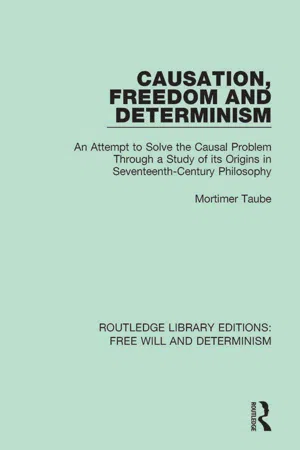
This book, first published in 1936, divides into roughly two parts: a re-examination of historical material; and a positive theory of causation suggested by the results of this re-examination. The historical study discloses an ambiguity in the meanings of causation and determinism; it discloses also that this ambiguity is transferred to the meaning of freedom.
eBook - ePub
Causation, Freedom and Determinism
An Attempt to Solve the Causal Problem Through a Study of its Origins in Seventeenth-Century Philosophy
- 264 pages
- English
- ePUB (mobile friendly)
- Available on iOS & Android
eBook - ePub
Causation, Freedom and Determinism
An Attempt to Solve the Causal Problem Through a Study of its Origins in Seventeenth-Century Philosophy
About this book
Trusted by 375,005 students
Access to over 1.5 million titles for a fair monthly price.
Study more efficiently using our study tools.
Information
Topic
PhilosophySubtopic
Philosophy History & TheoryCHAPTER II
THE ARGUMENTS FOR DETERMINISM IN SEVENTEENTH-CENTURY PHILOSOPHY
IT is sometimes the case that a conclusion, accepted because certain premises upon which it is seen to rest are accepted, attains through the influence of custom and habit a degree of plausibility in its own right. That is, we may believe that A is true because we know that B and c are true. At a later date we may cease to believe B or C, or, what is more likely, forget that we ever believed them. Nevertheless, we may still continue to believe that A is true. This tendency to retain a conclusion after the arguments upon which it rests have been given up is a common and, many believe, a pernicious phenomenon. For example, the existence of frontiers may be advanced as the reason why unrestricted individual economic activity is desirable. And even when there are no more frontiers people may continue to believe that such activity is desirable, which, of course, it may be, and that independently of any justification in terms of the existence of frontiers. But if the existence of frontiers is the only reason why one should believe that certain kinds of behaviour are desirable, then the absence of frontiers leaves us without any reason for the belief. However, when the premises upon which any conclusion depends have been discarded or are no longer believed, the desire to retain the conclusion can lead to a search for other premises. Although psychologically we can condemn such a procedure as rationalization, logically the new argument may be every bit as satisfactory as the old. These considerations make it possible to limit definitely the scope of this chapter. I shall not be concerned with the question of the truth or falsity of the conclusions; nor with what arguments in general might be advanced to support them; nor with the validity of specific arguments. My only object is to discover the arguments which actually led certain thinkers to certain conclusions. But here another qualification must be inserted. I am well aware of the fact that all sorts of psychological and sociological factors may be advanced as the reason for certain beliefs or conclusions, and that explicit reasons may not be the psychological and sociological causes which led any particular individual to conclusions explicitly asserted. Thus it may be that Descartes was led to the conclusion that God is the efficient cause of everything that happens1 because he feared a possible repetition of the indignity which Galileo had endured. It may be that Leibniz’s doctrine of the “pre-established harmony” arose from his desire to conciliate Protestantism and Catholicism. But it should be obvious that one can only speculate upon such reasons or hidden premises, and that investigation must confine itself to the explicit statement of premises.
The issue here will be completely clarified if a distinction is made between logical and psychological reasons. We have a logical reason to believe A, when the truth of A follows necessarily from the truth of B, and B is believed. It should be noticed that I have excluded from the class of logical reasons all cases in which the truth of B makes it only probable that A is true. This exclusion implies no decision as to the nature of probability judgments, but only that I shall not consider them. A psychological reason for believing something can be defined as any reason unrelated to the question of truth or falsity.1
More concretely, my purpose in this chapter is to illustrate the fact that when certain seventeenth-century philosophers asserted the truth of determinism and the falsity of freedom, these assertions followed as conclusions from premises asserting the existence of God and describing His relation to the world. I say “certain philosophers” when I might have said “the important philosophers.” But such a judgment, although it may have the full weight of accepted critical opinion as a support, is really unnecessary. I propose to consider the argument for determinism as it appears in the writings of Hobbes, Descartes, Spinoza, Leibniz, and Malebranche. Now there are undoubtedly important names omitted from this list, but none of those omitted are names of explicit determinists.
Except when necessary for purposes of exposition, I shall reserve all comparison of the arguments as used by each individual until the last section of this chapter. Little actual comparison will be necessary, since the similarity of the arguments will be apparent in the statement of them.
Section 1.—THE ARGUMENT FOR DETERMINISM IN DESCARTES
As we have seen (Chapter I), Descartes believed that a consideration of the nature of God and His relation to the world led necessarily to the assertion of determinism. It is not merely a belief in God that makes a man a determinist; Locke and Newton were undoubtedly more pious than Descartes, yet they cannot be called determinists. Only when the proposition that God is omniscient and omnipotent becomes a basic tenet of a philosophic system is it implied that determinism is asserted in such a system.
Descartes’ discussion of the relation of God to the world can be divided into two parts: first, the proof of God’s existence based upon a consideration of the nature of finite substance and time; second, the conclusions concerning the connection of entities in the world once God’s existence has been demonstrated. Under the first division I shall not consider Descartes’ use of the ontological argument, since this argument, although it tells us something of God’s nature, namely, that He is infinite and perfect, does not in itself contain a reference to the relation of God to the world. This last is the province of the causal argument.1
In his version of the causal argument Descartes does not depend upon the usual difficulty of an infinite regress: “Firstly, then, I have not drawn my arguments from observing an order or succession of efficient causes in the realm of sensible things….”2 Instead he depends on the independence of successive moments of time. This independence requires, he believes, a ground of connection in order that any finite substance can endure through successive moments. “For all the course of my life may be divided into an infinite number of parts, none of which is in any way dependent on the other; and thus from the fact that I was in existence a short time ago it does not follow that I must be in existence now, unless some cause, so to speak, produces me anew, that is to say, conserves me. It is as a matter of fact perfectly clear and evident to all those who consider with attention the nature of time that, in order to be conserved in each moment in which it endures, a substance has need of the same power and action as would be necessary to produce and create it anew, supposing it did not yet exist; so that the light of nature shows us clearly that the distinction between creation and conservation is solely a distinction of reason.”1 It seems plain that what Descartes means here by the independence of moments of time is only that from the existence of a substance at any one moment its existence at any subsequent moment does not necessarily follow. (“… it does not follow that I must be in existence …”) This point becomes clearer in Descartes’ reply to Gassendi. Gassendi had argued that the moments of time are necessarily connected in the sense that any given moment is necessarily followed by another. To this argument Descartes answers: “This can plainly be demonstrated from what I explained about the independence of the parts of time, which you in vain attempt to elude by propounding the necessary character of the connection between parts of time considered in the abstract. Here it is not a question of abstract time, but of the time or duration of something which endures; and you will not deny that the single moments of this time can be separated from their neighbours, i.e. that a thing which endures through individual moments may cease to exist….”1 Here it is apparent that what Descartes means by the independence of the moments of time is that it is conceivable that anything which exists may cease to exist. But Descartes is not content with any possibility of a thing existing or ceasing to exist. He requires some ground for asserting that successive stages of existence are dependent upon one another, that is, that what follows any one moment of existence is necessarily determined. Now Descartes was completely aware that necessary connection between successive moments of time or of existence could only be grounded in God Himself. That is, the only Being who can secure necessary connection between existents is a being capable of creating or annihilating the world, that is to say, God.
In asserting that the distinction between creation and conservation is only a distinction of reason, Descartes is supposed to have laid the foundation of occasionalism. I can find in the above passages no explicit denial of causal efficacy. The conclusion that God determines everything that happens and all connections between happenings does, of course, imply the denial of. causal efficacy. But the point is whether or not this denial was implied in Descartes’ doctrine of the independence of successive moments of time. I do not think this denial is so implied if, as seems clear, Descartes meant by “independence” only the absence of necessary connection (“… it does not follow that I must be in existence …”). But from this definition of independence it does not follow that it is “perfectly clear and evident to all those who consider with attention the nature of time” that there are no relations between successive moments. Causal influence is one relation, at least, which does not imply necessary connection. It is conceivable that I shall die tomorrow, but it is also true that if I live I shall carry with me some of the influence of to-day. If we suppose Descartes really to mean that there is no connection or relation of any kind between my life now and my life two minutes hence, then we suppose Descartes to be meaning nonsense. However, as I have said, the conclusion that all things and all moments are necessarily connected because God is the ground of their connection, does imply a denial of causal efficacy. If what happens is a result of God’s activity, it cannot be the result of causal influence or activity on the part of finite things.
This conclusion, that finite activity is incompatible with necessary connection based upon the constant activity of God, brings us to the second part of our discussion of Descartes (see page 42). Descartes, unlike Malebranche, had no intention of denying finite efficacy; he wishes only to establish necessary connection. That he virtually denied it was recognized by the Occasionalists; but it must not be supposed that, for either Descartes or Malebranche, the inconceivability of finite efficacy was a premise or the first step. This point cannot be too strongly emphasized, and the failure to understand it is responsible for a good deal of the muddle which invests the concept of causation. For example, Norman Kemp Smith, in commenting upon the Cartesian source of occasionalism, says: “If finite bodies have so little hold on reality that they require at each moment to be recreated, they cannot be capable of causing changes in one another: not having sufficient reality to persist, they cannot have sufficient force to act….”1 Now this is not Descartes’ explicit position. He repeatedly speaks of the causal activity of particular existents.2 But the causal activity of finite existents cannot give rise to any necessary connections and, further, is opposed to determinism. Hence Descartes holds that finite entities are recreated from moment to moment, not because it is inconceivable that they may exist from moment to moment, but because their connection from moment to moment cannot be necessary unless God does recreate them. God is required, not because finite entities have not the power to act, but because necessary consequences cannot be supposed to follow from this power alone. To be sure, once we have concluded that God’s power and conservation (i.e. re-creation) accounts for all things, we find that we have ruled out finite efficacy, but the denial of finite efficacy is not a premise in Descartes’ argument.
The evidence supporting the alternative interpretation, i.e. that Descartes began with a denial of causal efficacy, seems to me limited to the following passage: “The present time has no causal dependence on the time immediately preceding it. Hence in order to secure the continued existence of a thing no less a cause is required than that needed to produce it at first.”1 But here Descartes obviously repeated in an attenuated form the same argument used in his Meditations and in his reply to Gassendi. This being so, we may conclude that in this passage he does not mean abstract time,2 and that by the lack of “causal dependence” he means the lack of “necessary connection.” Also, in spite of the attempt at clear axiomatic statement, the phrase “secure the continued existence of a thing” is ambiguous. If what is meant is that the continued existence of a thing shall be necessary or determined, then God is indeed required to secure it. But God is not required to insure the passage of causal efficacy. In his answer to Gassendi, where we may suppose Descartes to have been particularly careful, he does not say that the independence of moments of time implies that it is impossible for anything to endure through successive moments. He says only that “a thing which endures through individual moments may cease to endure.” And if it may cease to endure, then it may also continue to endure. As we have said, God is required only to make whatever happens necessary.
In short, the argument for the existence of God based upon the independence of moments of time says nothing at all about causation. It starts with the recognition of the absence of necessary connection and holds that God can be the only ground of necessary connection. That is, A does not determine B, but both A and B are determined by c. However, according to our definition, if c determines A and B, then neither A nor B can be causes. But Descartes did not perceive this implication, or at least did not draw it consistently.
The failure to draw this implication cons...
Table of contents
- Cover
- Half Title
- Title Page
- Copyright Page
- Preface
- Table of Contents
- I. PRELIMINARY DEFINITIONS
- II. THE ARGUMENTS FOR DETERMINISM IN SEVEN TEENTH-CENTURY PHILOSOPHY
- III. SCIENCE AND DETERMINISM
- IV. HUME’S SCEPTICISM IN ITS RELATION TO CAUSATION AND DETERMINISM
- V. THE PERCEPTION OF CAUSAL EFFICACY
- VI. MATTER, CAUSATION, AND DETERMINISM
- VII. FREEDOM AND UNIFORMITY
- Appendix
- Bibliography
- Index
Frequently asked questions
Yes, you can cancel anytime from the Subscription tab in your account settings on the Perlego website. Your subscription will stay active until the end of your current billing period. Learn how to cancel your subscription
No, books cannot be downloaded as external files, such as PDFs, for use outside of Perlego. However, you can download books within the Perlego app for offline reading on mobile or tablet. Learn how to download books offline
Perlego offers two plans: Essential and Complete
- Essential is ideal for learners and professionals who enjoy exploring a wide range of subjects. Access the Essential Library with 800,000+ trusted titles and best-sellers across business, personal growth, and the humanities. Includes unlimited reading time and Standard Read Aloud voice.
- Complete: Perfect for advanced learners and researchers needing full, unrestricted access. Unlock 1.5M+ books across hundreds of subjects, including academic and specialized titles. The Complete Plan also includes advanced features like Premium Read Aloud and Research Assistant.
We are an online textbook subscription service, where you can get access to an entire online library for less than the price of a single book per month. With over 1.5 million books across 990+ topics, we’ve got you covered! Learn about our mission
Look out for the read-aloud symbol on your next book to see if you can listen to it. The read-aloud tool reads text aloud for you, highlighting the text as it is being read. You can pause it, speed it up and slow it down. Learn more about Read Aloud
Yes! You can use the Perlego app on both iOS and Android devices to read anytime, anywhere — even offline. Perfect for commutes or when you’re on the go.
Please note we cannot support devices running on iOS 13 and Android 7 or earlier. Learn more about using the app
Please note we cannot support devices running on iOS 13 and Android 7 or earlier. Learn more about using the app
Yes, you can access Causation, Freedom and Determinism by Mortimer Taube in PDF and/or ePUB format, as well as other popular books in Philosophy & Philosophy History & Theory. We have over 1.5 million books available in our catalogue for you to explore.