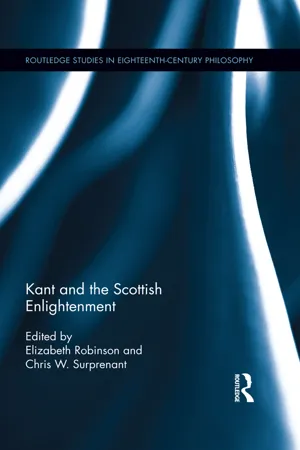
Most academic philosophers and intellectual historians are familiar with the major historical figures and intellectual movements coming out of Scotland in the 18th Century. These scholars are also familiar with the works of Immanuel Kant and his influence on Western thought. But with the exception of discussion examining David Hume's influence on Kant's epistemology, metaphysics, and moral theory, little attention has been paid to the influence of the Scottish Enlightenment thinkers on Kant's philosophy. This volume aims to fill this perceived gap in the literature and provide a starting point for future discussions looking at the influence of Hume, Thomas Reid, Adam Smith, and other Scottish Enlightenment thinkers on Kant's philosophy.
eBook - ePub
Kant and the Scottish Enlightenment
- 368 pages
- English
- ePUB (mobile friendly)
- Available on iOS & Android
eBook - ePub
Kant and the Scottish Enlightenment
About this book
Trusted by 375,005 students
Access to over 1.5 million titles for a fair monthly price.
Study more efficiently using our study tools.
Information
Topic
PhilosophySubtopic
Modern Philosophy1
Hutcheson on the Unity of Virtue and Right
I. Introduction
From his earliest work, An Inquiry into the Original of Our Ideas of Beauty and Virtue published in 1725, to the posthumously published System of Moral Philosophy that appeared thirty years later, Francis Hutcheson argued for a unified account of morality. The unifying principle was the moral sense and what was to be unified was natural law and Virtue or moral goodness.1 Philosophers in the Protestant natural law tradition from Hugo Grotius onward had attempted to accommodate virtues within a broader account of rights, most often in the category of imperfect duties. Hutcheson was not interested in the natural law project of accommodating virtues to right. Rather, he wished to explain the relation between what he understood as the source of our distinctively moral approbation for virtues and the source of our approval of rights as such. This can be stated as a problem: in what sense are rights, and the obligations connected with rights, moral? In the conclusion of the essay I will argue that responding to Hutcheson’s diagnosis was important for the next generation of moral philosophers: David Hume, Adam Smith, Thomas Reid, and Immanuel Kant.2
II. The Natural Law Tradition
Natural law, for Hutcheson, was a tradition initiated by Grotius.3 Hutcheson’s teacher Gershom Carmichael taught in and through this tradition. Carmichael’s commentary on Samuel Pufendorf’s De Officio hominis et civis (one of the main teaching texts of natural law) was used by Hutcheson in delivering his own moral philosophy lectures at Glasgow.
Unlike his teacher and other natural lawyers, Hutcheson did not equate natural law with moral and political philosophy as such. After graduating from Glasgow, Hutcheson studied classics for a year and then returned to Dublin where he belonged to a circle influenced by Robert, Viscount Molesworth, a friend and advocate of Lord Shaftesbury.4 The combination of Cicero and Shaftesbury led Hutcheson to advocate for an approach to moral philosophy focused on moral goodness and virtue (in distinction from rights). Hutcheson thought of this tradition as continuous from the Old Academy to the Renaissance to Lord Shaftesbury.5
With the revival of humane letters in the West, philosophy too was improved, especially through the strenuous efforts of those who have earned the gratitude of the human race by editing and interpreting the books of the ancients. With great acclaim, however, [moderns] have pointed out or entered upon a new road: in physics, Bacon, Descartes, Kepler, Galileo, and Newton; in ethics Grotius, Cumberland, and Pufendorf (for it was the Old Academy that was revived by Mirandula, Ficino, and the Earl of Shaftesbury); and Locke in logic and metaphysics.6
As the quotation makes evident, Hutcheson saw natural law—unlike the Virtue tradition—as a modern philosophical movement, like the new science and the new theory of knowledge. As I will discuss shortly, Hutcheson was strongly influenced by Locke’s theory of knowledge and very admiring of Newton and the new science. But unlike in the special sciences or the theory of knowledge, the Virtue tradition was not superseded by a new science of morality. Indeed it had an important modern advocate, Shaftesbury, who was highly critical of the Epicurean accounts7 of motivation and justification associated with Hobbes and with natural law. The problem confronting Hutcheson was how to coherently combine the ancient and the modern, natural law with virtue.
As just noted, from Grotius onwards, natural lawyers had assumed that particular moral virtues could be accommodated within a system of natural law.8 They also attempted to accommodate virtue or moral goodness as such. Richard Cumberland and Samuel Pufendorf used a voluntarist strategy to unite the obligation to the natural law with our obligation to virtue.9 For both, the obligation to the natural (and civil) law is due to the legation of a superior and the obligation to moral goodness is a consequence of this legation and God’s creative power. Hutcheson, like Shaftesbury and Leibniz,10 thought that this strategy tended to make morality arbitrary and reduce all moral obligations to self-interested motivations.
Unlike Leibniz, a cornerstone of Hutcheson’s account was the rejection of moral rationalism. Hutcheson expressly criticized Leibniz’s use of the Principle of Sufficient Reason in An Inquiry Concerning Beauty and Order to make a more general methodological criticism (a point I will return to shortly).11
Mr. Leibnitz had an equal Affection for his favorite Principle of a sufficient Reason for every thing in Nature, and brags to Dr. Clarke of the Wonders he had wrought in the intellectual World by its Assistance; but his learned Antagonist seems to think he had not sufficient Reason for his Boasting. If we look into particular Sciences, we may see in the Systems learned Men have given us of them, the Inconveniences of this Love of Uniformity.
(IBV III.5)
For Hutcheson, Mr. Leibnitz achieved demonstrative unity and methodological uniformity at the expense of plausibility by overstating his ratio-nalist principles. A successful moral theory would instead exemplify the empiricism of Locke (and of the natural law tradition) but in a way that avoided voluntarism and instead drew on the moral goodness associated with the Old Academy back. This ruled out rationalist perfectionism as a means of explaining the obligation to justice within a non-voluntarist theory.
The problem was then how to explain obligation without recourse to the voluntarist’s attractive explanation of how and why we were obligated to the law and why the obligation was binding: the will of a superior. One might look to Grotius of course for a Stoicism friendly account of natural law. But since Grotius had no one cogent answer to this—indeed one might think of the post-Grotian tradition as forging a variety of answers for him—Hutcheson resurrected the Old Academy in a novel way. As I will discuss in the next sections, he drew on Newton and Locke in order to argue for the centrality of Virtue in ethics. But first, the Old Academy itself needed defending from a different Epicurean threat.
III. Mandeville and Shaftesbury
The subtitle of the first edition of the Inquiry was “In Which The Principles of the late Earl of Shaftesbury are Explain’d and Defended, against the Author of the Fable of the Bees.” Mandeville had included a pointed polemic against Shaftesbury in the 1723 edition of The Fable of the Bees entitled “A Search into the Nature of Society” and Hutcheson’s Inquiries attempted to counter Mandeville’s criticisms.
For the purposes of this essay I will focus on Mandeville’s criticism of Shaftesbury’s claims concerning pulchrum et honestum, the Ciceronian standard of morality and beauty and a focal point of Shaftesbury’s moral philosophy.12 The phrase was not unique to Shaftesbury. Grotius, for example, invokes it in the dedication of De Jure Belli ac Pacis. But Mandeville was using the phrase to characterize and attack Shaftesbury and the Virtue tradition:
In respect to our Species he looks upon Virtue and Vice as permanent Realities that must ever be the same in all Ages, and imagines that a Man of sound Understanding, by following the rules of Good Sense may not only find out that Pulchrum & honestum both in Morality and the Works of Art and Nature, but likewise Govern himself by his Reason with as much ease and readiness as a good Rider manages a well taught Horse by the Bridle.
(FOB I:372)
Mandeville characterized Shaftesbury as offering a paradigmatic example of the revival of the Stoic and Platonic models of self-governance13 or self-mastery. Reason allows us to directly access the standards of morality and beauty and to govern ourselves with (relative) ease.
In attacking Shaftesbury and the revival of the Old Academy Mandeville denied that we actually have access to the pulchrum et honestum and argued that virtue and beauty can be explained wholly via self-interest with no need to posit such occult qualities. He concluded, “It is manifest then that the hunting after this Pulchrum & Honestum is not much better than a Wild-Goose-Chace that is but little to be depended upon.” (FOB 332) Indeed the belief in the pulchrum et honestum and the ease of the bridle of virtue promoted vice:
But this is not the greatest Fault I find with it. The imaginary Notions that Men may be Virtuous without Self-denial are a vast Inlet to Hypocrisy, which being once made habitual, we must not only deceive others, but likewise become altogether unknown to our selves, and in an Instance I am going to give, it will appear, how for want of duly examining himself this might happen to a Person of Quality of Parts and Erudition, one every way resembling the Author of the Characteristicks himself.
(FOB 331)
Consequently, Shaftesbury’s position was actively self-undermining. With no honestum to access attempts at self-mastery only promoted hypocrisy.
In responding to Mandeville and in defending the Old Academy against his criticisms, Hutcheson attempted to show that we can access the pulchrum et honestum via sense: the sense of beauty and the moral sense. The expression “moral sense” was taken from Shaftesbury, but Hutcheson filled in Shaftes-bury’s elusive discussion with a Lockean account of perception.14 In the Inquiry on Virtue Hutcheson defined virtue or “moral goodness”—the object of the moral sense—as “our idea of some Quality apprehended in Actions, which procures Approbation and Love towards the Actor, from those who receive no Advantage by the Action” (IGE 85). Virtue was an idea acquired from perceptions of qualities in actions, as with other forms of Lockean perception.
Furthermore, the ideas that are object of the moral sense track or respond to the pulchrum et honestum in the same way that our ideas of sensible qualities represented real facts about the world on a Lockean theory of perception. But because virtue was an idea there was no need to offer direct access to the pulchrum as such. We are instead considering virtue as an idea that arises from our empirical perceptions of actions and characters. How the relation between the idea and the quality is to work is unclear. Perhaps the sensible qualities were like colors and signaled dispositions to give rise to benevolent actions. Or perhaps they directly represented moral properties or qualities like Locke’s primary qualities.15 But however the mechanism was to work, Hutcheson thought that our sentiments and ideas provided immediate first-person empirical evidence of the nature of virtue on analogy with the Lockean theory of perception.
Contra Mandeville, Hutcheson thought the evidence unearthed by the moral sense was not reducible to interest. When we read of a benevolent action in a history this raises ideas of virtue and feelings of moral approval in us. But there is no obvious interested motivation to feel this. The simplest explanation seems to be that we are approving benevolent actions via our immediate apprehension of ideas of virtue. Hutcheson thought that this provided one with an honestum impervious to Mandeville’s reductionist strategy.16
There are many puzzles connected with Hutcheson’s moral sense, not the least of which the aforementioned relation between ideas of virtue and the qualities apprehended in the actions.17 What is evident, though, is that Hutcheson saw the moral sense as effectively countering Mandeville insofar as it explained how we had access to moral standards that were independent of interest (and not self-undermining).
The independence of morality from interest was particularly important and distinctive. As Simon Grote has pointed out, it distinguished Hutcheson not just from Mandeville but from Shaftesbury:
Whereas Shaftesbury held virtue to be natural in the sense that, in contradistinction to Locke’s view, human beings are able to develop a desire for the private happiness specifically afforded by it, by recourse merely to the exercise of their innate affection for beauty and the cultivation of their powers of rational contemplation, Hutcheson held virtue to be natural in the sense that human beings are naturally endowed with an instinct which, if properly cultivated, allows them to pursue it without any regard whatever to the happiness it affords them.18
Crucially, even if virtue educe...
Table of contents
- Cover
- Title
- Copyright
- Dedication
- Contents
- A Note on Abbreviations and References
- Preface
- Kant and the Scottish Enlightenment: An Introduction
- 1 Hutcheson on the Unity of Virtue and Right
- 2 Hutcheson and Kant: Moral Sense and Moral Feeling
- 3 Hutcheson’s and Kant’s Critique of Sympathy
- 4 Kant and Hutcheson on Aesthetics and Teleology
- 5 Outer Sense, Inner Sense, and Feeling: Hutcheson and Kant on Aesthetic Pleasure
- 6 Taste, Morality, and Common Sense: Kant and the Scots
- 7 Kant and Hume on Feelings in Moral Philosophy
- 8 Hume’s Principle and Kant’s Pure Rational System of Religion: Grace, Providence, and the Highest Good
- 9 A Writer More Excellent than Cicero: Hume’s Influence on Kant’s Anthropology
- 10 Kant and Hume on Marriage
- 11 Hume and Kant on Imagination: Thematic and Methodological Differences
- 12 Hume and Kant on Space, Divisibility, and Antinomical
- 13 Hume and Kant on Identity and Substance
- 14 An Alternative to Heteronomy and Anarchy: Kant’s Reformulation of the Social Contract
- 15 Kant, Smith, and the Place of Virtue in Political and Economic Organization
- 16 Adam Smith’s Kantian Phenomenology of Moral Motivation
- 17 Kant and Smith on Imagination, Reason, and Personhood
- 18 Seeing a Flower in the Garden: Common Sense, Transcendental Idealism
- 19 Kant’s Heuristic Methods: Feeling and Common Sense in Orientation and Taste
- List of Contributors
- Index
Frequently asked questions
Yes, you can cancel anytime from the Subscription tab in your account settings on the Perlego website. Your subscription will stay active until the end of your current billing period. Learn how to cancel your subscription
No, books cannot be downloaded as external files, such as PDFs, for use outside of Perlego. However, you can download books within the Perlego app for offline reading on mobile or tablet. Learn how to download books offline
Perlego offers two plans: Essential and Complete
- Essential is ideal for learners and professionals who enjoy exploring a wide range of subjects. Access the Essential Library with 800,000+ trusted titles and best-sellers across business, personal growth, and the humanities. Includes unlimited reading time and Standard Read Aloud voice.
- Complete: Perfect for advanced learners and researchers needing full, unrestricted access. Unlock 1.5M+ books across hundreds of subjects, including academic and specialized titles. The Complete Plan also includes advanced features like Premium Read Aloud and Research Assistant.
We are an online textbook subscription service, where you can get access to an entire online library for less than the price of a single book per month. With over 1.5 million books across 990+ topics, we’ve got you covered! Learn about our mission
Look out for the read-aloud symbol on your next book to see if you can listen to it. The read-aloud tool reads text aloud for you, highlighting the text as it is being read. You can pause it, speed it up and slow it down. Learn more about Read Aloud
Yes! You can use the Perlego app on both iOS and Android devices to read anytime, anywhere — even offline. Perfect for commutes or when you’re on the go.
Please note we cannot support devices running on iOS 13 and Android 7 or earlier. Learn more about using the app
Please note we cannot support devices running on iOS 13 and Android 7 or earlier. Learn more about using the app
Yes, you can access Kant and the Scottish Enlightenment by Elizabeth Robinson, Chris W. Surprenant, Elizabeth Robinson,Chris W. Surprenant in PDF and/or ePUB format, as well as other popular books in Philosophy & Modern Philosophy. We have over 1.5 million books available in our catalogue for you to explore.