- 172 pages
- English
- ePUB (mobile friendly)
- Available on iOS & Android
eBook - ePub
Little Ethiopia of the Pacific Northwest
About this book
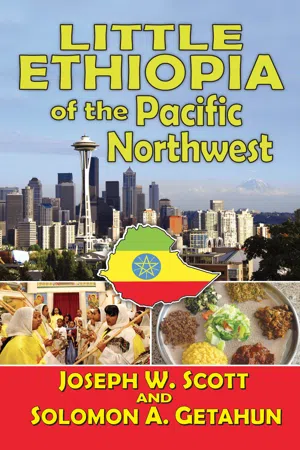
Little Ethiopia of the Pacific Northwest tells the story of the Ethiopian community in Seattle. The community began with approximately two dozen college students who came to the city during the Ethiopian revolution of 1974. These sojourning students earned college and university degrees, but were unable to return home to use them to modernize the developing nation. These stranded students became pioneers who built a micro-community in inner-city Seattle.Providing background with an analysis of Seattle's geographic, demographic, social, and economic challenges, this volume studies the students who became asylum seekers; their falls in position, power, prestige; and the income of these elite and non-elite settlers. The authors analyze examples of those who became entrepreneurs and the ingenuity and determination they employed to start successful businesses.The authors examine the challenges imposed on them by a school system that assigned their children to grade levels according to age rather than knowledge. They explore how the American welfare system worked in practice and explain how and why Ethiopians die young in Seattle. This fascinating study will be of interest to sociologists, ethnographers, and regional analysts.
Trusted by 375,005 students
Access to over 1.5 million titles for a fair monthly price.
Study more efficiently using our study tools.
Information
1
Seattle’s Challenges
Seattle’s geography. Seattle is exceedingly challenging to travel in, around, and through. This city has lakes, rivers, and streams that carve up the landmass of Seattle Metro into islands and peninsulas. On an aerial map, Seattle Metro appears to be a collection of odd-shaped puzzle pieces of land and water, with almost all north-south and east-west arterials being discontinuous. Crossing Seattle Metro east to west, using side streets, is virtually impossible.
Refugees and immigrants from remote, rural, non-mechanized areas of the world find traveling in, around, and through Seattle unfathomable and prohibitive. They have to learn what Seattleites know: Traveling to and from these discontinuous landmasses requires the use of a wide variety of transportation—buses, trolleys, ferries, taxis, trucks, helicopters, trains, vans, airplanes, seaplanes, bicycles, motorcycles, and other vehicles. Workers, students, shoppers, tourists, and interlopers use these modes of transportation to move from their residences to factories, offices, stores, warehouses, shopping centers, universities, schools, and back.
Diversity challenges. Seattle is extremely diverse—culturally, economically, and demographically. In point of fact, Seattle’s census tract 98118 is the most ethnically diverse in the United States. Asians, Europeans, Africans, Latinos, Native Americans, and Middle East migrants and others coexist there peacefully and cooperatively without any visible racial or ethnic dissension. Newcomers disembarking from cruise ships remark when seeing downtown Seattle that this city appears to be composed mostly of people of color. But in actuality, Seattle’s white population is by far the largest of all in the Seattle metropolitan area. New migrants from racially and culturally homogenous societies find Seattle’s diversity greatly challenging.1
Migrants who come from racially and culturally homogeneous societies take a considerable amount of time to feel comfortable with such multiracial, multilingual, and multicultural diversity. Many newcomers say that they feel insecure from not knowing how to behave when interacting with so many unfamiliar cultural and linguistic groups. They feel uncomfortable rubbing shoulders with, transacting business with, and neighboring with such a vast array of “strange” (that is, unfamiliar) human beings.
Discrimination challenges. On the surface, racial and ethnic harmony reigns in Seattle. Seattle’s surface appearance of harmony is facilitated by the hidden nature of institutional and individual discrimination. Seattleites discriminate in everyday life in benign ways. Seattleites, for example, are generally polite. They rarely appear to be blatantly avoiding, shunning, or rejecting others as playmates, seat-mates, teammates, workmates, or neighbors, because of race, color, and ethnicity. They mask their prejudices by making their discrimination appear as aesthetic or socioeconomic choices.
Residential segregation. Seattle has a long, nasty history of residential discrimination inscribed in laws and enforced by policing agencies. Seattle’s founding European settlers were Northern European Americans—mostly Scandinavians. They legislated restrictive covenants to initiate and perpetuate segregated neighborhoods by race, religion, and ethnicity. For most of Seattle’s history, these restrictive covenants targeted Africans, Asians, Latin Americans, Malaysians, and Middle Eastern populations to segregate residentially. These covenants prohibited these populations from renting or purchasing housing in neighborhoods designated “white only.” Only in 2006 did the Seattle City Council officially repudiate restrictive covenants, even though the federal government had repudiated, outlawed, and made restrictive covenants unenforceable in the 1940s. Notwithstanding that federal government court decision in the 1940s, prejudiced sellers and buyers maintained residential segregation by transforming the old legal covenants into informal “gentlemen’s agreements.” Developers, builders, mortgagers, and realtors then informally maintained residential segregation by covertly steering prospective customers to and from various neighborhoods according to race, ethnicity, and religion. Their informal practices have kept Seattle neighborhoods segregated until well into the 2000s.
New migrants to Seattle continue to find neighborhoods with a disproportionately high number of Asians, Africans, Europeans, Latinos, and Jews. But these neighborhoods today are inhabited by more than one racial or ethnic group. All neighborhoods have two or more races or ethnic groups living in them.
Housing quality challenges. Seattle has no city blocks considered slum areas. In a word, Seattle does not have city blocks completely filled with run-down houses or uninhabited buildings. Seattle’s private housing stock and its public housing stock (the projects) are better than average, compared to other large cities. Most asylees, refugees, and immigrants that have come from impoverished areas of the world in which slums predominate find Seattle’s public housing, better than the private housing they had back in their home countries. In recent years, virtually all public housing projects have been removed and replaced with mixed-income housing, where the poorest city residents live in subsidized units. City officials strive hard to keep Seattle clean and slum-less. New migrants from other countries are forced immediately to adopt new customs of cleanliness and habitation. They and all other Seattle residents must refrain from throwing trash on lawns, streets, sidewalks, and other outdoor spaces. They must dispose of garbage, solid waste, and yard waste in separate bins, because virtually all waste is recycled. They are financially responsible, by law, for maintaining the quality of the housing units they lease or rent. Seattle is at the top of the list of clean cities.
Sexual diversity challenges. Washington state has legalized same-sex marriages. Seattle, like San Francisco and New York, has a large population of gays, lesbians, transgenders, transsexuals, and individuals of other sexual orientations. Same-sex waist hugging, hand holding, and lip kissing on streets, in bars, in cafes, and in hotel lobbies are common sights. Gay and lesbian newspapers, magazines, and advertisements are as visible on newsstands as “straight” publications. Virtually all church congregations welcome people of all sexual orientations—without question.
Homophobic refugees and immigrants from cultures and societies with a low tolerance for sexual orientations that are not heterosexual have been forced to conform in ways to which they are not accustomed, because non-heterosexual orientations are extremely visible in Seattle. For example, refugees and immigrants must appear to be tolerant and not offend or abuse people who publicly appear to be in same-sex unions. Homophobic newcomers must explain to their children that people of other societies and cultures have concepts of love and marriage different from their own.
Educational challenges. Seattle is “the most educated” city in the United States, measured by the number of residents with post–high school degrees and diplomas.2 Seattle Metro facilitates that reputation by having a high number of educational institutions. Seattle Metro, for example, offers three University of Washington campuses, one Seattle University campus with satellite sites, one Seattle Pacific University campus, and one City University campus, along with dozens of public and private community colleges, technical schools, and professional schools. Refugees and immigrants from all over the world have expressed astonishment upon seeing this vast array of educational institutions available for personal development. Most newly arriving refugees and immigrants have never seen such an array of educational opportunities in their home countries, where their cities are up five to ten times larger than Seattle. And even more astonishing, most have never seen such a vast array of public and private financial support for individuals to access. But the most astonishment is expressed about these educational institutions and the financial aid being accessible to native-born citizens, foreign-born citizens, refugees and immigrants from all countries of the world.
Employment challenges. Seattle Metro is the locus of several dominant global companies such as Boeing, Microsoft, Starbucks, Costco, Nordstrom, Amazon.com, and the University of Washington Medical Center. They have driven up Seattle’s growth in population, employment, and income over the past three decades.3 They have generated thousands of high-tech and low-tech jobs researching, engineering, constructing, computing, accounting, designing, programming, manufacturing, merchandising, assembling, packaging, housekeeping, and providing medical services. Because of this incredible job creation, thousands of migrants have come from around the world to Seattle Metro with skills and educations for these jobs. These migrants from around the world have driven up Seattle Metro’s job competition for the past three decades.
Notes
1. Audrey Singer and Jill H. Wilson, (2007), “Refugee Resettlement in Metropolitan America,” (Washington: Brookings Institution) Migration Information Source. Available at http:// www. migrationinformation.org/Feature/display. Cfm?id=585> accessed 9/27/2011; Audrey Singer and Jill H. Wilson, (2006), “From ‘There’ to ‘Here’: Refugee Resettlement in Metropolitan America,” (Washington: Brooking Institution) Metropolitan Policy Program; Mary Mederios Kent, (2007), “Immigration and America’s Black Population,” Population Bulletin, 62;4, 1–16, also available at www.prb.org.
2. “City Factsheet, Seattle, Washington.” The Federation for American Immigration Reform (FAIR, accessed 9/22/2009): Also available at http://www.fairus.org/site/Page Serverr?page name=research_researche16 e-sup>; “Seattle (city) Quick Facts from the US Census Bureau,” available at http://quickfacts.census.gov/qfd/states/53/5363000.html> accessed 1/15/2012; Aubrey Cohen, “Seattle’s Growth Is at Its Fastest in Decades,” Seattle PI June 27, 2007; “Seattle’s Population and Demographics,” Seattle.gov, Department of Planning and Development, accessed at http://www.Seattle.gov/dpd/Research/Population_Demographics/ . . . 11/9/2011.
3. “City Factsheet, Seattle, Washington.” The Federation for American Immigration Reform (FAIR, accessed 9/22/2009): Also available at http://www.fairus.org/site/Page Serverr?page name=research_researche16 e-sup>; “Seattle (city) Quick Facts from the US Census Bureau,” available at http://quickfacts.census.gov/qfd/states/53/5363000.html>, accessed 1/15/2012; Aubrey Cohen, “Seattle’s Growth Is at Its Fastest in Decades.” Seattle PI June 27, 2007; “Seattle’s Population and Demographics,” Seattle.gov, Department of Planning and Development, accessed at http://www.Seattle.gov/dpd/Research/Population_Demographics/ . . . 11/9/2011.
2
From Sojourners to Asylum-Seekers
Students studying abroad. Emperor Selassie—after he became head of state in 1941—created a program for sending thousands of Ethiopian students to Europe and North America to earn advanced college degrees. Before these students were sent to America, England, and other parts of Europe, Emperor Selassie brought American and European educators, missionaries, and soldiers to Ethiopia to transfer their skills and knowledge to public school students. Before bringing Western instructors to Ethiopia, Emperor Selassie built public boarding schools in remote rural areas, semi-rural towns, and small cities throughout the provinces, with the aim of having the American and European educators introduce Western-style arts and sciences to the children enrolled. After building the schools, the government provided the necessary transportation to bring children from remote farms, villages, and cities to these boarding schools.1 By 1970, Americans and others who had come to Ethiopia to teach skills numbered about 10,000.
The children of the elite—the wealthy royalty and wealthy commoners—who were usually enrolled in the private church boarding schools prior to the establishment of the public boarding schools, were also the first students to be enrolled in the public schools. Despite this, Emperor Selassie’s ultimate goal was to build a new public school system to teach Western arts and sciences to children of the non-wealthy and non-elite. And, before he was deposed, his goal was realized: the majority of the public boarding school students enrolled were the children of the poor and the near-poor. They were taught Western arts and sciences so that they could help build the new Ethiopia that Emperor Selassie had envisioned.
Emperor Selassie’s public boarding school system always remained small. It graduated a small number of students who came to be known as the “best and brightest” of Ethiopia. Emperor Selassie then provided financial support for a selected number of the “best and brightest” graduates to go abroad to earn bachelor’s, master’s, and doctor’s degrees in America and Europe. When these students returned home with their diplomas, they were rewarded with high governmental, professional, military, and business positions. These high-ranking individuals in the public and private sectors then became known as “the elite of Ethiopia.”
Student sojourners. Virtually all Ethiopians who came to Seattle in the late 1960s and early 1970s were college students who ordinarily would have returned home to assume high positions. But, when the revolutionary war started and a Marxist-oriented faction of the armed forces deposed Emperor Selassie in 1974, these students studying in colleges and universities throughout the state of Washington became stranded in the United States. Overnight, these student sojourners became asylum-seekers.
A majority of the former students whom we interviewed claimed to be children of wealthy royalty or wealthy commoners. They described their fathers as “elite”—high-ranking governmental, professional, agricultural, industrial, and entrepreneurial leaders. A smaller number of former students we interviewed described their fathers as owners of small farms, small stores, policemen, rank-and-file soldiers, and low-ranking government employees.
From all of their stories, we learned that the Marxist-oriented, Soviet-style regime destroyed the imperial monarchy and the rest of the economic and political leadership class of Ethiopia. We also learned that the revolution completely changed the economic, political, and social lives of all classes of people, because the Soviet-style regime confiscated or nationalized the large rural estates, the large urban real estate, and large businesses, thereby destroying the landed aristocracy’s feudalistic system.
The political, economic, and financial fortunes of our respondents’ parents were either wiped away completely or drastically reduced in size. Their parents faced one or all of the following possibilities: divestment, imprisonment, persecution, expulsion, or execution. Those parents and family member who could escape sought asylum in other parts of Africa, Europe, North America, the Middle East, Sudan, Djibouti, Kenya, or Yemen. Those whose families could not escape suffered mightily at the hands of the Soviet-inspired regime, because it turned murderous toward dissenters and resisters.
Reversal of fortunes. The revolution ended the only security the students had ever known. The fall of their parents from their positions of power, privilege, and income changed their lives forever. The students experienced immediate cut offs of their revenue streams (from their families and the Selassie government). Those cut offs interrupted their studies, threatened their economic survival, and made them undocumented aliens over the course of time. Their reversals of fortunes immediately sent the stranded students rushing from one federal and state government office to another to seek asylum, grants, scholarships, loans, and jobs. They needed to find a modicum of political, economic, and educational security. But no immediate solutions to any of their dilemmas were forthcoming. The students were then cast into social, financial, emotional, and political limbo—as nearly-penniless undocumented residents—without any clear and present remedies. Their plans of graduating with college and university diplomas and returning home to live high-class lives were nullified, and they had to completely rechart the courses of their lives.
No legal solutions. If these stranded students were not enrolled, it was not legally possible under the laws at the time of the revolution to remain indefinitely in the United States. In 1974, there was no enabling legislation yet passed by the US government for any black African asylum seekers to remain in the country indefinitely after their visas expired. These stranded students had no choice but to overstay their allotted time and try to avoid detection and deportation while trying to work to support themselves.
Several years passed before the Carter Administration (1977–1981) granted these stranded, undocumented former student...
Table of contents
- Cover Page
- LITTLE ETHIOPIA of the Pacific Northwest
- Copyright Page
- Contents
- Preface
- Acknowledgments
- Organization of the Book
- Introduction
- 1 Seattle’s Challenges
- 2 From Sojourners to Asylum-Seekers
- 3 Falls from Grace
- 4 Entrepreneurs and Entrepreneurship
- 5 Schooling Their Children
- 6 Changing Husband-Wife Relations
- 7 Use and Abuse of Welfare
- 8 Victors and Vanquished
- 9 Starting Church Congregations
- 10 From Elation to Alienation
- 11 Dying and Memorializing
- 12 To Return or Not Return?
- 13 Conclusion
- Index
Frequently asked questions
Yes, you can cancel anytime from the Subscription tab in your account settings on the Perlego website. Your subscription will stay active until the end of your current billing period. Learn how to cancel your subscription
No, books cannot be downloaded as external files, such as PDFs, for use outside of Perlego. However, you can download books within the Perlego app for offline reading on mobile or tablet. Learn how to download books offline
Perlego offers two plans: Essential and Complete
- Essential is ideal for learners and professionals who enjoy exploring a wide range of subjects. Access the Essential Library with 800,000+ trusted titles and best-sellers across business, personal growth, and the humanities. Includes unlimited reading time and Standard Read Aloud voice.
- Complete: Perfect for advanced learners and researchers needing full, unrestricted access. Unlock 1.5M+ books across hundreds of subjects, including academic and specialized titles. The Complete Plan also includes advanced features like Premium Read Aloud and Research Assistant.
We are an online textbook subscription service, where you can get access to an entire online library for less than the price of a single book per month. With over 1.5 million books across 990+ topics, we’ve got you covered! Learn about our mission
Look out for the read-aloud symbol on your next book to see if you can listen to it. The read-aloud tool reads text aloud for you, highlighting the text as it is being read. You can pause it, speed it up and slow it down. Learn more about Read Aloud
Yes! You can use the Perlego app on both iOS and Android devices to read anytime, anywhere — even offline. Perfect for commutes or when you’re on the go.
Please note we cannot support devices running on iOS 13 and Android 7 or earlier. Learn more about using the app
Please note we cannot support devices running on iOS 13 and Android 7 or earlier. Learn more about using the app
Yes, you can access Little Ethiopia of the Pacific Northwest by Joseph W. Scott in PDF and/or ePUB format, as well as other popular books in Social Sciences & Emigration & Immigration. We have over 1.5 million books available in our catalogue for you to explore.