- 260 pages
- English
- ePUB (mobile friendly)
- Available on iOS & Android
eBook - ePub
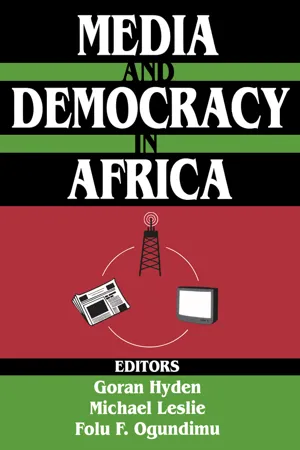
Media and Democracy in Africa
About this book
Recent discussion of democratization in Africa has focused primarily on the reform of formal state institutions: the public service, the judiciary, and the legislature. Similarly, both scholars and activists have shown interest in how associational life-and with it a civil society-might be enhanced in the countries of the African continent. Much less concern, however, has been directed to the communications media, although they form a vital part of this process. Media and Democracy in Africa provides the first comprehensive and up-to-date assessment of the role of the media in political change in sub-Saharan Africa. The central argument of the volume is that while the media may still be relatively weak compared to their positions in liberal democracies, they have come to play a much more important role than ever before since independence. Although they have not yet demonstrated sufficient effectiveness as public watchdogs and agenda setters, they have succeeded in creating new communicative spaces for people who have previously been intimidated or silent. Building on this the contributors argue that a different conceptualization of democratization than the mainstream currently uses may be necessary to capture the process in Africa where it is characterized by contestation rather than consolidation. This volume shows that the media scene in Africa is diverse. It stretches from the well-developed and technologically advanced situation in South Africa to the still fledgling media operations that are typical in sub-Saharan Africa. In these countries, print media as well as television and radio are just beginning to take their place in society and do so using simple and often outdated technology. The volume also examines how these growing outlets are supplemented by informal media, the so-called radio trottoir, or rumor mill whereby the autocratic and bureaucratic direction of public affairs are subject to private speculation and analysis. Media and Democracy in Africa is organized to provide a historical perspective on the evolution of the African media, placing the present in the context of the past, including both colonial and post-colonial experiences. It will be of interest to Africa area specialists, students of media and communications, political scientists and sociologists.
Information
1
Communications and Democratization in Africa
Goran Hyden and Michael Leslie
Introduction
There is a rapidly growing literature on democratization in Africa but very little of it deals with the role that communications, or the media, play. This is all the more surprising given that social movements and other voluntary associations, that have played a significant role in democratizing countries in regions such as Latin America and Eastern Europe, have been quite weak in African countries. Therefore, our assumption is that media have been relatively more influential in shaping the emerging, but still fledgling, democratic culture in Africa.
The purpose of this volume is first and foremost to fill this gap by providing an overview of the more salient aspects of the interaction between communications and democratization in contemporary Africa. We recognize that in the political process, these two factors interact in many different ways. Communications shape democratization, as suggested above, but the causal link also goes the other way. For example, the extent to which political actors allow freedom of expression will influence the behavior of media personnel.
The subject matter of this volume is also multi-disciplinary in nature. It is impossible to understand the interface between media and democratization without considering multiple dimensions, notably political, cultural, economic, and technological. In addition, communications here do not only refer to the formal media. Any study of communications in Africa must pay attention to the informal side, that is, the way Africans communicate by word of mouth and by other means than conventional mass media. This is as true for the political realm as it is for any other sector. A volume like this, therefore, because it deals with Africa, speaks both to issues that are universally applicable to the study of communications and politics and to those that are more specific to that region of the world.
This chapter sets the stage for the remainder of the book by first introducing the various components or dimensions of the subject matter under consideration and secondly making references to how the other contributions fit into this project. After providing a brief historical overview of the study of communications and democracy, especially as it pertains to Africa, the chapter will deal, in turn, with (a) the political, (b) technological, (c) economic, and (d) cultural dimensions of the interface between communications and democratization.
A Historical Perspective
The place of communications in national development received considerable attention in the heyday of modernization thinking in the later 1950s and early 1960s. The focus in those days was not directly on democracy but rather on socio-economic development, the assumption being that democracy would only be feasible once society had been modernized. Industrialization, urbanization, modern education, in combination with the spread of the market economy, would provide the conditions that are congenial to the growth of democracy. In a seminal study, Lipset (1959) confirmed the positive correlation between these features of modern society, on the one hand, and democracy, on the other.
No one, however, articulated this belief in the formative role of modernization more persuasively than Daniel Lerner did in his famous study of the "passing of traditional society" (Lerner 1958). In contrast with Edward Banfield's study of "amoral familism" in Montegrano in southern Italy, which concentrated on the parochialism of local communities because of the absence of modernizing forces (Banfield 1958), Lerner treated communication as a magic multiplier in its own right. The site of his study was the small village of Balgat, located some eleven miles from Ankara, the Turkish capital. Because of this vicinity, Balgat was subject to rapid social transformation. The interesting thing was that villagers did not hesitate to exchange the security and rigidity of traditional culture for the uncertainty and opportunity of the twentieth century industrial age. Empathy, defined as "the capacity to see oneself in the other fellow's situation," was the key that set in motion the process of embracing modernity. Lerner suggested that empathy is learnt from either travel to other places or encounters through the mass media:
Radio, film and television climax the revolution set in motion by Gutenberg. The mass media opened to the large masses of mankind the infinite vicarious universe. Many more millions of persons in the world were affected directly, and perhaps more profoundly, by the communication media than by the transportation agencies. (Lerner 1958:53)
Mass media became an important link in modernization, replacing personal experience as the font of new ideas. These media, however, would only grow if supported by a critical mass of people. That is why Lerner saw urbanization and literacy as other prerequisites of modernization. These forces would together help produce democratic government, an outcome that Lerner saw coming only much later in the development process.
Lerner's book was not written as a guide for development planning, but it managed to demonstrate in a convincing fashion that the wealth, power and stability of the West could be attained by the poor, weak, and unstable nations. The pieces of the development process that he sketched out were straightforward and direct, so obvious that the theory seemed beyond question. The publication of The Passing of Traditional Society in 1958 was propitious. It was the same year that the United Nations General Assembly called for a program to help developing nations expand their mass media. Following preparatory work under the auspices of UNESCO, the General Assembly decided four years later to encourage its member governments to include mass media in their economic development plans (Stevenson 1988:22). Americans and Europeans who themselves had experienced the revolutionary influence of the television medium in the 1950s readily bought the idea that communication could propel the new nations of the Third World toward the take-off point where, as Rostow (1960) argued from his analysis of industrialization in the West, development would become self-sustaining and accelerating.
It was not Lerner, however, but Wilbur Schramm of Stanford University who was to play the most influential role in putting these ideas into practice. Schramm was involved in the preparatory work by UNESCO and edited a volume on Mass Media and National Development (Schramm 1964) that sold some 15,000 copies before going out of print. Drawing on anecdotal cases from Africa, Asia, and Latin America, Schramm tried to describe not only the dismal state of communication in developing countries but also its potential to make a difference, whether in agricultural development or public health care. Mass media needed to be mobilized to play a more constructive role and in this pursuit government would serve as the prime mover. The question was not really whether or not government should promote and control mass communication, but what kind of control it would exercise and how it would involve itself in the development of the media. Communication development in the 1960s grew out of practical concerns, such as agricultural extension, so it is not surprising that the lead was taken by several U.S. land-grant institutions. Funded by the United States Agency for International Development, these and institutions like United States Information Agency, the Peace Corps, the United Nations, and a host of private international foundations set out to harness the power of the mass media in promoting national development.
We know that the optimism that characterized the early efforts to employ the mass media for development purposes proved excessive. Development turned out to be a much more complex equation than Lerner and Schramm had argued. Individuals were not as ready to take risks as the villagers in Balgat may have been, either because they lacked material resources or they were outright prevented from making progress by other more powerful individuals or groups in society. The relatively linear and simple development model that they had advocated was gradually abandoned in favor of other approaches that highlighted different aspects of development, notably the redistribution of economic resources in favor of the poor.
One thing that they had accepted, however, continued to be a prominent feature of the development efforts in the 1970s and into the 1980s: the lead role of government as engine of development. Government was seen as the solution and it was not until the 1980s that the international community conceded that government was also part of the problem and might be as much a liability as an asset to national development.
It is against this background that we need to take a closer look at where we are today. For many of its strongest advocates, communication for national development in the 1960s and 1970s was meant to be a one-way operation. People were being spoken to, not listened to. Development took precedence over democracy, the latter being viewed as a by-product of the improvement of socio-economic conditions.
This has changed in the past fifteen or so years. Today people are at the center of development. It is no longer viewed as for the people but by the people. As "stakeholders" they are believed to be as concerned—and as knowledgeable—as any other group of actors, be they policymakers or experts. Their voice, therefore, should count as much as any one else's. Secondly, there is much more emphasis on deliberation to arrive at public choices and decisions. It is no longer merely the technical or instrumentalist rationality which guided modernization in the 1960s that matters, but also "communicative rationality" (Habermas 1987), that is, the importance of socially constructed solutions to problems. Bourgault (1995:247ff) reflects the influence of this new way of looking at development when she emphasizes its interactivity, implying a non-hierarchical, dialogical communication through popular participation.
The implication of this new approach is that it places communications in a fresh and more central place than before. In the past government went out of its way to control the flow of news to make information more attuned to what it conceived as its national priorities, but the current interactive approach facilitates a discursive process that can be locally programmed and managed as well as attuned to meeting specific local demands. The redefinition of development in the 1990s, therefore, has given rise to new forms of communication, to convey messages downwards, upwards, and sideways. Oral traditions in song, music, or theater are examples of how the communications scene has been reordered, as are the many newsletters that circulate within the rapidly growing community of nongovernmental organizations (NGOs). The use of these non-conventional media has been deemed especially valuable in fields such as family planning and health care where the issues effect the personal lives of the listeners (Ansu-Kyeremeh 1998). Because of their potential empowering effects, these media are also making their way into politics. For example, civic education programs have often found the use of theatrical performances helpful in getting messages about gender equality across to communities where cultural change might otherwise prove virtually impossible.
This perspective on the current media scene in Africa is important because there is a tendency to interpret changes as stemming largely from the privatization of the mass media. While the latter is obviously an important component, it is not as important as the literature on democratization typically implies. What we are arguing here is that ongoing efforts to enhance democratization in Africa can gain their inspiration from the global spread of liberal democracy as well as from a restatement of development that stresses interactivity, dialogue, and grassroots participation.
Apart from the contribution by Bourgault (1995), the current literature on communications and the way such measures relate to democracy and development has centered largely on how mass media are seen as fostering democracy. Some of the early contributions in this genre originated in studies of the popular challenges to communist rule in Eastern Europe. For example, the former secretary of state, Madeleine Albright, examined the role of the press in political change in Poland as early as the beginning of the 1980s (Albright 1983). The role of the media in transition to democracy in that part of the world became a topic also for indigenous scholars once communism as a system of rule had collapsed in the Soviet Union. One such study, again of Poland, is by Goban-Klas (1994). A more recent contribution to this field of the media in political transitions covers several of the democratizing regions of the world as it tries to answer the twin questions of what difference the media really make to democratization and what kind of influence the global media forms may have on the cause of democracy (O'Neil 1998).
Turning now to Africa, there have been relatively few publications dealing with the media in politics after independence. The account by Ainslee (1966) of the press in Africa from those days constitutes a significant effort to examine the role of the media in its broader socio-political setting, as does a similar effort by Mytton (1983). Once African governments began to control the media and compel them to serve primarily as instruments of official propaganda (Ziegler and Asante, 1992), the subject matter understandably lost its luster. It is only in the 1990s that the communications/democracy nexus was resuscitated as an interesting concern for academics and media practitioners alike. The African Council of Communication Education (ACCE)—recently led by Dr Charles Qkigbo, a contributor to this volume—was in the forefront of this effort by letting its Sixth Biennial Conference, held in 1990, deal with the emerging issues of mass communication in the democratic process in Africa (ACCE 1990). It should be pointed out that this meeting was held well before democratization had taken hold on the continent. Also Africans in the diaspora have been active in contributing views on the subject. Thus, a conference organized at the University of East Carolina resulted in a volume on how media exposures influence democratization efforts in Africa (Eribo et al. 1993). A subsequent volume by Eribo and Jong-Ebot (1997) examined the legal constraints that inhibited press freedom in Africa.
This volume builds on these earlier important but rather scattered contributions on the role of communications in political transition in Africa. Recognizing its multi-disciplinary character, we believe that the subject matter needs to be studied in four separate domains: political, technological, economic, and cultural. Each raises its own set of issues that are important for understanding the interaction between communications and democratization. What happens in one domain, however, is not isolated from what goes on elsewhere. There is a constant flow of influences in several directions. For example, modern information technology may shape both media ownership patterns and cultural tastes, while also being subject to political manipulation by either state or societal actors. Similarly, an expansion of freedom of expression may enhance the confidence of citizens to participate in the political process, but it may also create its own backlash resulting in politically more repressive measures. The anticipated causal links, therefore, do not go in just one direction, but several. In addition, they often go in opposite directions with communications and democratization having reciprocal influences on each other. The conceptual scheme which underlies the discussion in this volume is summarized in the following table:
Table 1.1 The Conceptual Scheme Used in This Volume
| Domain | Principal Issues | Anticipated relations |
| Political | Freedom and watchdog role | Both ways |
| Technological | Reorganization of space and power | One way |
| Economic | Concentration of ownership | One way |
| Cultural | Dependency and resistance | Both ways |
The Political Domain
The boundaries of the freedom of expression have continuously been contested in African countries, but perhaps no more explicitly so than in the last ten years. With growing domestic pressures for political reform there has been an accompanying demand for greater freedom of expression in the public realm. Wherever democratic reforms have been genuinely carried out, the expanded boundaries of what can be spoken and written have enabled the growth of a stronger political opposition to the ruling elite in government. The latter, however, have not always agreed to the political enlargement of the communicative space. Presidents, or governmen...
Table of contents
- Cover
- Half Title
- Title
- Copyright
- Contents
- Preface
- 1. Communications and Democratization in Africa
- 2. The Media and the Two Waves of Democracy
- 3. Media Laws in Political Transition
- 4. Broadcasting and Political Reform
- 5. The Internet and Democratization
- 6. Media Ownership and Democratization
- 7. African Politics and American Reporting
- 8. Alternative Small Media and Communicative Spaces
- 9. Media and Democracy in Twenty-First-Century Africa
- Contributors
- Index
Trusted by 375,005 students
Access to over 1.5 million titles for a fair monthly price.
Study more efficiently using our study tools.
Frequently asked questions
Yes, you can cancel anytime from the Subscription tab in your account settings on the Perlego website. Your subscription will stay active until the end of your current billing period. Learn how to cancel your subscription
No, books cannot be downloaded as external files, such as PDFs, for use outside of Perlego. However, you can download books within the Perlego app for offline reading on mobile or tablet. Learn how to download books offline
Perlego offers two plans: Essential and Complete
- Essential is ideal for learners and professionals who enjoy exploring a wide range of subjects. Access the Essential Library with 800,000+ trusted titles and best-sellers across business, personal growth, and the humanities. Includes unlimited reading time and Standard Read Aloud voice.
- Complete: Perfect for advanced learners and researchers needing full, unrestricted access. Unlock 1.5M+ books across hundreds of subjects, including academic and specialized titles. The Complete Plan also includes advanced features like Premium Read Aloud and Research Assistant.
We are an online textbook subscription service, where you can get access to an entire online library for less than the price of a single book per month. With over 1.5 million books across 990+ topics, we’ve got you covered! Learn about our mission
Look out for the read-aloud symbol on your next book to see if you can listen to it. The read-aloud tool reads text aloud for you, highlighting the text as it is being read. You can pause it, speed it up and slow it down. Learn more about Read Aloud
Yes! You can use the Perlego app on both iOS and Android devices to read anytime, anywhere — even offline. Perfect for commutes or when you’re on the go.
Please note we cannot support devices running on iOS 13 and Android 7 or earlier. Learn more about using the app
Please note we cannot support devices running on iOS 13 and Android 7 or earlier. Learn more about using the app
Yes, you can access Media and Democracy in Africa by Michael Leslie in PDF and/or ePUB format, as well as other popular books in Politics & International Relations & African Politics. We have over 1.5 million books available in our catalogue for you to explore.