- 364 pages
- English
- ePUB (mobile friendly)
- Available on iOS & Android
eBook - ePub
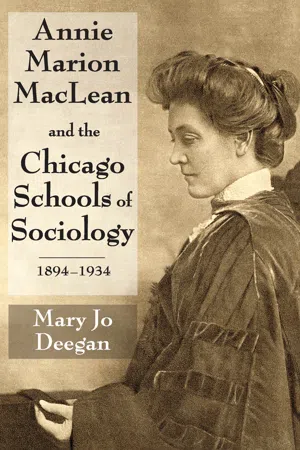
Annie Marion MacLean and the Chicago Schools of Sociology, 1894-1934
About this book
Although Annie Marion MacLean, teacher, sociologist, and leader, gained international fame as an expert on working women's issues, her significant contributions are overlooked by contemporary scholarship. MacLean was extraordinary by any standard her level of education; her precedent-setting behaviors, research, methodological innovations, public impact, and writing; her dedication to women's freedom and social justice; and her love for family and friends.MacLean was a vigorous and creative exponent of the forceful spirit of Chicago sociologists. As a graduate of the department of sociology at the University of Chicago, MacLean became one of the founders of the discipline. MacLean was an ally and friend to other sociologists in Chicago who were both students and faculty at the university and at another world-class institution, the social settlement Hull-House. She gained fame as an expert on working women, using ideas to expand their options and respond to their need for social justice.Mary Jo Deegan documents the life, accomplishments, and works of this noted scholar. Deegan explores such topics as Annie Marion MacLean and sociology at the University of Chicago and Jane Addams' Hull-House, MacLean and feminist pragmatism, women and the sociology of work and occupations, women's labor unions and the feminist pragmatist welfare state, the sociology of immigration and race relations, and MacLean's legacy to sociology and society. Her inspiring story will be of interest to those exploring the roots of the discipline of sociology.
Trusted by 375,005 students
Access to over 1.5 million titles for a fair monthly price.
Study more efficiently using our study tools.
Information
Subtopic
SociologyIndex
Social Sciences1
Annie Marion MacLean and Sociology at the University of Chicago and Hull-House
The work of which I am to speak was undertaken in all seriousness with the hope that it might throw some light upon the evolution of the ready-made clothing industry, and thus incidentally aid the Consumers’ League in its crusade against sweated garments, and in this way to awaken in the minds of buyers an appreciation of the danger lurking near them.
—MacLean 1903, 290
Annie Marion MacLean was a vigorous and creative exponent of the forceful, founding spirit of Chicago sociologists. As a graduate of the department of sociology at the University of Chicago1 with a MA in 1897 and a PhD in 1900, and as a member of its extension faculty from 1903 until her death in 1934, MacLean became one of the founders of the discipline (Faris 1967; Kurtz 1984). She represented the “Chicago school of sociology” (CSS) during these exciting and tumultuous times when both the profession and the city of Chicago were experiencing explosive growth and change. The city had been rebuilt after the Great Chicago Fire of 1871 which had leveled large portions of it, including the downtown. Chicago triumphantly emerged from this tragedy and became the epicenter of new money, transportation, immigration, industrialization, urbanization, as well as crime and corruption.
MacLean was an ally and friend of other sociologists in Chicago who worked both as students and faculty at the university and at another world-class institution, the social settlement Hull-House (Deegan 1978, 1988a). Hull-House, headed by the charismatic sociologist and Nobel Laureate Jane Addams, opened its doors to its neighbors and the tumultuous chaos of the poor and immigrants looking for a new life in 1889. They wanted a chance to make a home and find employment in this promising, already legendary, city on the prairie. This social settlement was the home to another way of doing sociology, the Hull-House school of sociology (HHSS). MacLean benefited from both institution’s professional visions and practices, two schools of sociology in Chicago.
MacLean gained international fame as an expert on working women, using innovative ideas to expand their options and respond to their need for social justice. At the height of her reputation, in 1911, she contracted infectious rheumatism and was forced to spend more than twenty years in a sickroom. Despite this devastating physical restriction, she continued to write books and articles, to teach through correspondence courses, and to hone her skills as a beloved friend and family member who enjoyed life. This book is the story of this remarkable woman.
Introducing MacLean
In the spring of 1869, Annie was born on St. Peter’s Bay on Prince Edward Island (P.E.I.) in Canada.2 This small and geographically isolated island could be lush in the summertime but bitterly icy and wind-swept in the winter. Located on the continental edge of North America, this became the home to hardy immigrants from other stunning yet harsh lands—the Isles of Mull and Skye. These islands are part of the Inner Hebrides, found off the coast of Scotland. Like the celebrated but mythical Anne of Green Gables,3 this real island girl, Annie Marion MacLean, burned with the desire for education, new worlds to conquer, and making her mark on the world.
Her grandparents and their communities journeyed from Scotland to the New World where they carved out farms and homes and established the hamlets of Orwell and Uigg. Here, her parents were born, her father in Orwell and her mother in Uigg, just a mile or so apart. They were devout Baptists, and ultimately her father became a minister in that religion.
Their daughter Annie became part of the first generation of “new women,” educated women who wanted to bring women into public life and social equality with men (Smith-Rosenberg 1985). She attended the Baptist-affiliated Acadia Seminary, a preparatory school, followed by undergraduate and graduate training at Acadia University in Wolfville, Nova Scotia (NS). After earning her first master’s degree, Annie immediately turned to new challenges and worlds to conquer. Hundreds of miles away and in another country, she found what she wanted: at another Baptist-affiliated academy, the University of Chicago. It was then an educational experiment, located on the Midwestern prairie on the edge of Lake Michigan. From the day the University opened in the fall of 1892, it was coeducational and on the forefront of academic innovations, including the new-fangled subject of “sociology.” A few months later, in the summer of 1893, the World’s Columbian Exposition boasted that their White City by the lake was more stunning and impressive than any other World’s Fair4 and people flocked to the city’s rough-hewn promises for wealth and a new life.
By 1894, Annie Marion MacLean had heard about these wonders on the American prairies from her brother, Haddon MacLean, who had enrolled at the untried University in 1892. She was ready to join these pioneers in higher education, and she wrote the University for admission as a graduate student in the exciting new field of sociology. But it took her two more years to garner enough resources, by teaching at Mt. Carroll Seminary in Illinois, before she could begin her doctoral studies (Forbes 1900, 303). She then headed for the University of Chicago to make her name and help the world become a better place.
Thus, the life of MacLean reveals the city, society, and groups she studied as well as the extraordinary world of sociologists from the two most powerful centers in the new discipline who dramatically shaped their profession and nation.5 MacLean was pivotal in creating a powerful and coherent epistemology and practice concerning race, class, and gender during the classical era of the discipline. She analyzed immigration; the city and rural life; women’s work and occupations; social movements; race relations; pedagogy; distance education; and her lived experience of physical disability. She also actively participated in the foundation of the feminist pragmatist welfare state in the United States. She was an organic intellectual and pragmatist who helped women, especially working women, find new homes in the modern world (West 1989).
She used qualitative, experiential, and quantitative methodologies making her a leader in the development of data collection techniques. This mixed methods approach characterized both the HHSS and the CSS. Many of her qualitative studies were predecessors to later works including Edwin Sutherland’s (1937) now famous use of the case study, contemporary critical ethnography (J. Thomas 1993), and feminist ethnography (Naples 2003).
She was among the earliest sociologists in the world to embark on a professional career. Her work was influenced profoundly by the gender segregated Victorian era, by her graduate training at the most eminent center for the discipline, the University of Chicago, and her alliance with sociologists from another famous sociological institution, Hull-House. She was a professional during the golden era of women in sociology and part of an elaborate Chicago female world of love and ritual, a world where single, highly educated, and talented women worked together to create new opportunities for all people (Deegan 1988a, 1991, 1995, 1996). Her areas of expertise were profoundly influenced by these historical factors. She embodied the expectations of religious, never-married women that early male sociologists considered ideal, but her mind and ambitions exceeded the confines of her “proper place.”
MacLean’s work has contemporary significance, for she has examined the areas of race, class, disability, and gender—subjects again on the forefront of intellectual debate. Similarly, she analyzed the politics of work and occupations, examined women’s relation to the state, and raised questions about quantitative, qualitative, and experiential ways to analyze social life. This is the first book-length study of this outstanding intellectual.
The Outline of the Chapters
MacLean’s biography is the focus of Chapter 2. Although I discuss her life and career throughout the book, this chapter provides a narrative for her thoughts and praxis. The conceptual and applied apparatus accompanying the CSS and HHSS are presented systematically in Chapter 3. The remaining chapters focus on MacLean’s work organized by topic areas.
Women’s status in the marketplace was a central question to Ma-cLean and the focus of Chapters 4 to 6. MacLean also played a significant role in the development of ethnographic studies in the CSS (see Chapter 4). Although this is often considered a trademark technique for data collection in the CSS after 1920, MacLean used it over two decades earlier. Her careful, early use of what is now called “participant observation” was powerful and precedent-setting (Platt 1996). She studied “Two Weeks in Department Stores” (1899a, 1899b; Reading 4A), “The Sweat-Shop in Summer” (1903a; Reading 4B), and “The Diary of a Domestic Drudge” (1905c; Reading 4C). Her analyses of “Women in the Industrial World” (1905d) and vignettes in “Silhouettes from Life” (1905e) directly influenced the subsequent work of Sutherland, whom she introduced to sociology in 1906.
One of her more acclaimed ethnographies, and a subsequent chapter in Wage-Earning Women (1910a, 99–115), was her work “With Oregon Hop Pickers” (1909c; Reading 4D), published in the leading professional journal, the American Journal of Sociology (AJS). She brought her own standpoint and experience to these studies, employing a feminist experiential method characteristic of the HHSS rediscovered by Shulamit Reinharz in 1992. “Chicago Garment Workers” is a brief report of a central thrust of both the HHSS and CSS on labor unions in Chicago’s booming industry (1910d; Reading 4E). MacLean’s (1923e) “Four Months in a Model Factory” again documents that her sympathies resided with laborers and not with capitalists.
Critical quantitative methods, including MacLean’s political goals, are part of her perspective and the topic of Chapter 5. Her greatest intellectual achievement, Wage-Earning Women (1910a), drew on her participatory background and an impressive team of investigators. MacLean used the women’s sociology network to hire a research staff that included twenty-nine women. This massive study surveyed 13,500 women laborers employed in 400 institutions in more than twenty cities. Amy Tanner, a Chicago-trained sociologist, played a major role in collecting the data to study “Life in the Pennsylvania Coal Fields, with Particular Reference to Women” (MacLean 1908a, 1910a; Reading 5A). MacLean summarized all this work in an “Abstract of an Address on Industrial Conditions for Women” for an international meeting of women held in Toronto, Canada (1910b; Reading 5B). After publishing Wage-Earning Women in 1910, she created a more popular version in Women Workers and Society in 1916(a) with recommendation to improve the lives of working women.
Changes in Gender and Race Relations and Their Social Movements
MacLean studied the sociology of social movements in labor, the welfare state, social science, and women. She was strongly influenced by Florence Kelley, a Hull-House resident, sociologist, and lawyer, who studied and helped shape women’s labor legislation. MacLean’s master’s thesis and first major sociology publication (1897a, Reading 6A), “Factory Legislation for Women in the United States,” emerged directly from her contacts with Kelley. Her next work, done with the Chicago sociologist Charles R. Henderson, reviewed the welfare services in “France” (1904, Reading 6B). MacLean (1906b) summarized “Methods of Industrial Betterment” in the pages of the YWCA magazine, Evangel, finding labor unions to be strong advocates for women. She participated in the “Discussion of James B. Reynolds, ‘Reasonable Restrictions upon Freedom of Speech’” in the 1915(c) American Sociological Society (now the American Sociological Association, or ASA as it is referred to here) meeting where she concentrated on the liberal rights of working women to organize against capitalists’ injustice (1915b Reading 6D). She wrote about “Trade Unionism Versus Welfare Work for Women” (1915a, Reading 6C), as an example of industrial betterment. She published her ideas and experiences while being “On Picket Duty” in 1923(e), although she had had these experiences in 1906 before the onset of her disability.
Women’s organizations permeate MacLean’s activities, and these are analyzed in Chapter 7. A significant early pamphlet on Public and Social Service as Vocations for College Women was compiled and written by a committee of the Association of Collegiate Alumnae, including Alice Peublot Norton, Sophonisba Breckinridge, MacLean, Mary Morrison, and Angeline Loesch (1904). This was part of a national effort to expand the opportunities for educated women’s paid labor.
Women’s work in sociology often resulted in new occupations making “Social Service—A New Profession for Women” (1910c; Reading 7A), and MacLean spoke on this topic several times. The selection on this issue is from an abstract of a speech before a Toronto, Canada, audience in 1909. Another national initiative was finding affordable and safe housing for these laborers. MacLean summarized these efforts in 1905 (1905j; Reading 7B), praising in particular the work of the Jane Club at Hull-House. In 1914, she concentrated on the Eleanor Clubs of Chicago (1914b; Reading 7C). Her work for the YWCA was evident in Wage-Earning Women, discussed earlier. She also celebrated the fifty years of association work among young women in 1916 (1916a, 1916b; Reading 7D).
The study of race relations between Whites and African Americans was a significant specialization for the men and women of the Chicago school of race relations (CSRR) and the Hull-House school of race relations (HHSRR). MacLean also shared this scholarly and moral concern in her alliance with the great sociologist W.E.B. DuBois and the National Association for the Advancement of Colored People (NAACP; Deegan 2002a, 2002b). In 1903(b), she conducted one of the first community studies of a black town (Reading 8A) that she presented at DuBois’ Atlanta Conference along with her graduate school friends, Monroe Work and Richard Wright, Jr. They, too, were trained in the CSRR and participated in the HHSRR. Her community study was one of the earliest ethnographies of the CSRR and linked DuBois, the University of Chicago, and Hull-House. MacLean (1922b; Reading 8B) studied African Americans again when she analyzed “the color line” (DuBois 1903a) for the popular, political journal, the Survey. This article dealt with the aftermath of World War I (WWI), especially for Blacks moving from the rural South to the urban North in the Great Migration (Grossman 1989). Her work here and elsewhere explored the pragmatist concept of “social reconstruction” which fascinated both Dewey (1920) and Mead (Deegan 2008a). Significantly, she published this work following a period of bitter political unrest in the United States, including a “red scare” that vilified Addams and many other female sociologists who were pacifists during WWI.
MacLean’s concern with labor, discussed in Chapters 5 and 6, was a consistent thread in her books on immigration, her other major area of study, again echoing the interests of both the HHSS and the CSS (Faris 1967; Thomas and Znaniecki 1918–1920/1958; Chapter 6). She wrote two books, Modern Immigration (MacLean 1925a) and Our Neighbors (MacLean 1922a) for popular audiences. Of the two, Our Neighbors (MacLean 1922a) is the more “folksy” book. Here, MacLean focused on the cooperative aspects of democracy. Despite her simplification of democratic principles, the book reveals the humanity often hidden by abstract statistics.
In 1911, MacLean began a long odyssey with a deeply debilitating disability. She took a leave of absence from her position at A...
Table of contents
- Cover Page
- Title Page
- Copyright Page
- Dedication
- Contents
- List of Tables
- Preface
- 1. Annie Marion MacLean and Sociology at the University of Chicago and Hull-House
- 2. The Real Annie of Prince Edward Island
- 3. MacLean, Feminist Pragmatism, and the Schools of Sociology at the University of Chicago and Hull-House
- 4. Women and the Sociology of Work and Occupations: Fusing the HHSS, the CSS, and Critical Qualitative Methods
- 5. Women and the Sociology of Work and Occupations: Fusing the HHSS, the CSS, and Critical Quantitative Methods
- 6. Women‘s Labor Unions and the Feminist Pragmatist Welfare State: Fusing the FCSS and the HHSS
- 7. Women‘s Organizations and the Sociology of Social Movements: Fusing the FCSS and the HHSS
- 8. The Sociology of Immigration and Race Relations: Fusing the HHSRR and the CSRR
- 9. Socioautobiography: Disability and Everyday Life—Perfecting the Critical Experiential Method
- 10. Socioautobiography: Teaching and Everyday Life Perfecting the Experiential Method
- 11. MacLean‘s Legacy to Sociology and Society
- Appendices
- Bibliography
- Index
Frequently asked questions
Yes, you can cancel anytime from the Subscription tab in your account settings on the Perlego website. Your subscription will stay active until the end of your current billing period. Learn how to cancel your subscription
No, books cannot be downloaded as external files, such as PDFs, for use outside of Perlego. However, you can download books within the Perlego app for offline reading on mobile or tablet. Learn how to download books offline
Perlego offers two plans: Essential and Complete
- Essential is ideal for learners and professionals who enjoy exploring a wide range of subjects. Access the Essential Library with 800,000+ trusted titles and best-sellers across business, personal growth, and the humanities. Includes unlimited reading time and Standard Read Aloud voice.
- Complete: Perfect for advanced learners and researchers needing full, unrestricted access. Unlock 1.5M+ books across hundreds of subjects, including academic and specialized titles. The Complete Plan also includes advanced features like Premium Read Aloud and Research Assistant.
We are an online textbook subscription service, where you can get access to an entire online library for less than the price of a single book per month. With over 1.5 million books across 990+ topics, we’ve got you covered! Learn about our mission
Look out for the read-aloud symbol on your next book to see if you can listen to it. The read-aloud tool reads text aloud for you, highlighting the text as it is being read. You can pause it, speed it up and slow it down. Learn more about Read Aloud
Yes! You can use the Perlego app on both iOS and Android devices to read anytime, anywhere — even offline. Perfect for commutes or when you’re on the go.
Please note we cannot support devices running on iOS 13 and Android 7 or earlier. Learn more about using the app
Please note we cannot support devices running on iOS 13 and Android 7 or earlier. Learn more about using the app
Yes, you can access Annie Marion MacLean and the Chicago Schools of Sociology, 1894-1934 by Mary Jo Deegan in PDF and/or ePUB format, as well as other popular books in Social Sciences & Sociology. We have over 1.5 million books available in our catalogue for you to explore.