- 260 pages
- English
- ePUB (mobile friendly)
- Available on iOS & Android
eBook - ePub
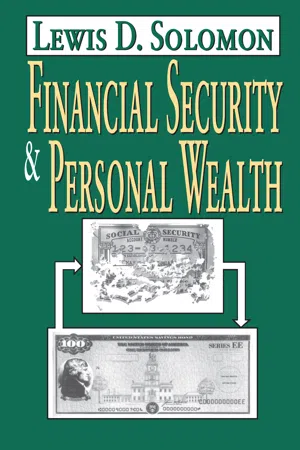
Financial Security and Personal Wealth
About this book
America's elderly population is soaring, presenting numerous challenges for policymakers in the United States. Other developed nations with aging populations face similar problems. There will be fewer workers relative to retirees in coming decades and the elderly are also expected to live longer. The impact of these demographic changes in the United States is likely to be challenging, especially for America's system of social security. Solomon offers new perspectives on how to meet the future costs of social security without bankrupting the next generation or gravely damaging the U.S. economy. He also shows, more broadly, how to provide for the financial security of America's senior populations.Over the past two decades, primary responsibility for providing a financially adequate retirement has shifted from the federal government and employers to individuals. For most Americans, social security alone will not provide enough income. Most companies have shed their pension plans for 401(k) plans, to which companies and employees contribute, and in which participants must make their own investment decisions. Consequently, achieving financial security in retirement has increasingly become one's personal responsibility.Solomon deals extensively with the politics of social security, past and present. He examines the presidential leadership of Franklin D. Roosevelt and Ronald Reagan, both of whom revived the nation's spirit in times of crisis, both of whom introduced economic policies that remain controversial to the present day. He also considers in detail contemporary efforts to rethink social security, focusing on fundamental reform of the social security system and the expansion and simplification of employer-sponsored retirement plans and individual retirement arrangements.Richly textured, informed, and informative, Financial Security and Personal Wealth encompasses history, demography, political economy, public finance, social policy.
Trusted by 375,005 students
Access to over 1.5 million titles for a fair monthly price.
Study more efficiently using our study tools.
Information
Subtopic
Business GeneralIndex
Business
1
Introduction
In the twenty-first century, Americans face a lengthy period of retirement at the end of their working lives. During the last century, the U.S. developed a mixed public-private system, combining Social Security and tax-favored retirement plans, to help ensure that seniors would have adequate income.
A current, pressing concern among many Americans, especially those in their forties and fifties, is whether they will enjoy a financially comfortable retirement. For most, Social Security alone cannot provide enough income. With life expectancies on the rise, sufficient funds must be set aside so that individuals and couples do not outlive their assets. It is far from certain whether private retirement arrangements, along with personal savings, will enable most Americans to close the gap between what Social Security and employer-sponsored retirement plans provide and what is needed for a retirement without financial worries.
We face the challenge of how to enlarge the number of Americans who will reach retirement with sufficient assets to maintain their accustomed standard of living. The United States, however, lacks a coherent policy to promote financial security in retirement. The current system is dysfunctional. Baby boomer retirements will likely plunge Social Security into financial chaos. The private system is complex and costly, with many not taking advantage of the current federal income tax benefits and huge amount of tax revenue foregone to encourage employer-sponsored retirement plans.
For decades, the stock market crash of 1929 and the ensuing Great Depression, defining twentieth-century events, destroyed public confidence in securities markets—investments in corporate shares and bonds—as the means to finance not only retirement but also higher education and healthcare. Two generations of Americans entrusted more of the financing of significant life-cycle events to the federal government. As a result, the federal government came to protect Americans from life’s biggest and most expensive financial challenges.
Twentieth-century federal programs sought to relieve Americans of the need to prepare financially for costly events—retirement from work, higher education for children, and caring for elderly parents. Social Security and Medicare provide for retirement financial security; government grants and loans pay for children’s higher education; and Medicaid covers an elderly parent’s long-term care. Through Social Security, federal government claimed to take over the worry about saving and investing for retirement. The federal government came to replace one’s own savings and one’s family as the main sources of old-age financial support and sustenance.
With the creation of Social Security in the 1930s and then Medicare in the 1960s, Americans came to look to the federal government as the institution to take care of them in their old age. They became more dependent on the federal government, demanding more services and benefits. For decades, political power resided with those who received services and benefits, not those who paid taxes.
However, Wall Street and Main Street must first create the income and wealth for Washington to tax to finance these entitlement programs. More and more Americans now feel that their financial security and well-being depend on markets, not the federal government. Increasingly, individuals and families want to exercise more control over their financial futures.
In this changing context and in the midst of America’s soaring population of seniors, the nation needs to solve what is perhaps its most important long-term fiscal problem: how will people fund their retirement and how will the federal government meet the high cost of paying the retirement benefits and healthcare costs for an aging population, particularly the baby boomers. The public sector fiscal cloud emanates from the impending retirement of the baby boomer generation who will soon collect Social Security and Medicare benefits in droves. Their coming retirement will place enormous strains on these two federal entitlements.
Social Security and Medicare as presently structured are unsustainable over the long run. Over the next seventy-five years, spending on Social Security and Medicare (the latter program is beyond the scope of this book) will surge.
The Role of Social Security in the American Political Economy
Now seventy years old, Social Security has become one of the most successful and enduringly popular federal government programs. It has proven a great success in serving as a savings vehicle through which people provide financially for their retirement and as an insurance vehicle to protect loved ones in the event of the death or disability of the family breadwinner. It also serves to redistribute retirement income to those with low lifetime earnings.
Social Security is the nation’s largest and most comprehensive federal governmental program.1 Social Security expenditures comprise the biggest single item in the federal budget. The system’s revenues in 2003 totaled $632 billion; most ($534 billion) of the revenues came from payroll taxes. A smaller amount ($13 billion) was from federal income taxes levied on benefits. The system was credited with interest of $85 billion in that year. However, no cash changed hands. The interest was “paid” by the U.S. Treasury issuing more bonds. Social Security outlays to pay retirement, survivor, and disability benefits totaled $472 billion in 2003, slightly less than 23 percent of all federal expenditures.
Social Security is part of nearly every American’s life. It has been a virtually universal program since the 1950s, collecting tax revenues in 2002 from some 153 million workers and paying benefits to approximately 46 million people, including 32 million retirees and their dependents, seven million survivors of deceased workers, and seven million disabled workers and their dependents.
Although Social Security was never designed to be one’s sole source of retirement income, it provides a financial foundation for retirement. Working adults know that they will not live in poverty after they stop gainful employment. Accounting for nearly 40 percent of all elderly income, Social Security provides an important source of income for most of today’s senior Americans. Other sources (earnings, pensions, income from assets, including interest, dividends, and capital gains) provide nearly 60 percent of the aggregate income of those sixty-five and above as well as 80 percent for those seniors in the nation’s top income quintile. However, about one-third of all U.S. retirees rely nearly exclusively (90 percent or more) on the Social Security benefits for their retirement income. For sixty-five percent of the Social Security recipients, benefits make up more than half of their income.2
Along with the general rise in incomes in the American economy, Social Security has played a significant role in dramatically decreasing poverty among the elderly. Social Security has helped reduce the proportion of seniors with incomes below the federal poverty line by more than two-thirds from 35.2 percent as recently as 1959 to 10.1 percent in 2001, about the same percentage as the general population.3
A number of today’s seniors would live in poverty except for benefits received from the system. The income of nearly half of the current elderly would fall below the poverty line if they did not receive Social Security benefits.
However, the existence of the Social Security system, with its progressive benefit structure and high payroll taxes, discourages individuals and families, particularly low-income earners, from building wealth and passing it onto the next generation. The non-saving, non-investing portion of the American population has substituted public sector benefits for private wealth accumulation. The Social Security system discourages many from saving on their own and reduces the amount of savings by those who do, with significant negative consequences for the American economy. According to the Harvard University economist Martin Feldstein:
Although none of these studies establishes definitively a precise substitution of Social Security wealth for other household wealth, I believe that, taken together, these studies do imply that the Social Security program causes each generation to reduce its savings substantially and thereby to incur substantial loss of real investment income.
That the displacement of private savings by social security is less than complete reduces the loss each generation incurs from the imposition of an unfunded program. But, even if each dollar of Social Security wealth displaces only fifty cents of private wealth accumulation, the annual loss of national income would exceed 4 percent of GDP.4
The Great Investment Transformation
The winds of change are blowing. Thus, this book examines the evolution of and future prospects for the complete spectrum of devices providing financial security in retirement from mandatory Social Security to voluntary, tax-advantaged employer-sponsored and individual retirement arrangements.
An investment revolution has occurred over the past twenty some odd years. Responsibility for one’s future financial needs, especially in retirement, has shifted to individuals, away from the federal government (through Social Security) or corporations (through employer-directed defined benefit pension plans). The percentage of U.S. households owning equities, either directly (individual stocks) or indirectly (through mutual funds and various retirement accounts), increased from 19 percent in 1983, to 32.5 percent in 1989, to 36.6 percent in 1992, to 41 percent in 1995, and 48.2 percent in 1999, reaching 49.5 percent in 2002. Estimates indicated that the about 58 percent of adult Americans have some investments, direct or indirect, in the stock market. By 2002, some 52.7 million U.S. households representing about 91.2 million individuals owned equities, directly or indirectly, through employer-sponsored retirement plans and individual retirement accounts (IRAs).5
Over the past twenty-five years, major changes have occurred in employer-sponsored plans with the decline in the percentage of the workforce covered by traditional defined benefit plans and the rapid growth of defined contribution plans, particularly 401(k) plans. Corporations sought to throw off the costly liabilities of defined benefit plans which offer participants a monthly check in retirement based on an employee’s age, length of service, and final pay, not the investment performance of one’s account. Increasingly complex regulations, imposed beginning in the 1970s, and the resulting administrative costs coupled with the federal government’s revenue-driven fiscal policies of the 1980s and 1990s that targeted defined benefit plans led, in part, to their decline. Americans also began changing employers more often than in the past, a trend that limited the usefulness of plans where benefits rise dramatically after long years of service at one firm. Giant corporations, in unionized, manufacturing industries, that continue to sponsor defined benefit plans face huge retiree costs while their newer competitors do not. Many of these plans are presently underfunded so that if terminated today their assets would be insufficient to pay the promised benefits. Businesses have become more reluctant to bear the risks inherent in defined benefit plans, particularly the need for adequate funding and the dramatic rise in longevity.
Corporations, specifically the younger, growing firms offering employer-sponsored retirement plans, shifted to participant-directed defined contribution plans, where employees chose investments that are not guaranteed to provide an income stream in retirement. Unlike defined benefit plans in which employers decide where to invest, defined contribution plans make the amount of funds available at retirement dependent on whether workers opt into the plans, their level of contributions over many years, and whether they make wise investment choices. With responsibility placed on the participants’ shoulders, they bear the risks and rewards of their investment decisions.
One type of defined contribution plan, the 401(k) plan, boomed from having just 10 million participants in 1985, rising to 31 million in 1996, and reaching over 50 million at the end of 2002. By year-end 2002, 401(k) plan accounts totaled nearly $1.8 trillion in assets, up from just $616 billion in 1993.6
Non-employer-sponsored retirement plans also blossomed. For example, by mid–2003, 45.2 million (41.4 percent) of American households had put more than $2.3 trillion into IRAs.7
In short, Americans are reclaiming more personal responsibility for their retirement and other financial needs. Mutual funds, IRAs, and 401(k) plans have made investing a part of everyday life across a wide income spectrum. They represent the hopes of tens of millions of Americans for a financially secure retirement. The investment revolution gave the non-rich an incentive to accumulate capital. Though continuous saving and investing over decades coupled with the miracle of compound interest, average Americans could end up with personal wealth.
The 2000–2002 stock market implosion that reduced 401(k) and IRA account balances, among other stock market vehicles, placed a temporary damper on the investment revolution. The vicious bear market demolished investors’ happy assurance about the prospect for eve...
Table of contents
- Cover Page
- Title Page
- Copyright Page
- Contents
- Acknowledgments
- 1 Introduction
- 2 Personal Responsibility and the Growth of Employer-Sponsored Pension Plans: 1870 to 1930
- 3 The Growth of Social Security and Other Retirement Plans: 1930 to 1980
- 4 Putting Social Security on a Sound Financial Footing and the Continued Development of Tax-Advantaged Retirement Arrangements: 1980 to 2000
- 5 The Contemporary Quest for Fundamental Social Security Reform
- 6 Enhancing Tax-Advantaged Retirement Savings, Strengthening Defined Benefit Plans, and Improving Defined Contribution Plans
- 7 Financial Illiteracy and Efforts to Promote Investor Education
- 8 Conclusion
- Selected Bibliography
- Index
Frequently asked questions
Yes, you can cancel anytime from the Subscription tab in your account settings on the Perlego website. Your subscription will stay active until the end of your current billing period. Learn how to cancel your subscription
No, books cannot be downloaded as external files, such as PDFs, for use outside of Perlego. However, you can download books within the Perlego app for offline reading on mobile or tablet. Learn how to download books offline
Perlego offers two plans: Essential and Complete
- Essential is ideal for learners and professionals who enjoy exploring a wide range of subjects. Access the Essential Library with 800,000+ trusted titles and best-sellers across business, personal growth, and the humanities. Includes unlimited reading time and Standard Read Aloud voice.
- Complete: Perfect for advanced learners and researchers needing full, unrestricted access. Unlock 1.5M+ books across hundreds of subjects, including academic and specialized titles. The Complete Plan also includes advanced features like Premium Read Aloud and Research Assistant.
We are an online textbook subscription service, where you can get access to an entire online library for less than the price of a single book per month. With over 1.5 million books across 990+ topics, we’ve got you covered! Learn about our mission
Look out for the read-aloud symbol on your next book to see if you can listen to it. The read-aloud tool reads text aloud for you, highlighting the text as it is being read. You can pause it, speed it up and slow it down. Learn more about Read Aloud
Yes! You can use the Perlego app on both iOS and Android devices to read anytime, anywhere — even offline. Perfect for commutes or when you’re on the go.
Please note we cannot support devices running on iOS 13 and Android 7 or earlier. Learn more about using the app
Please note we cannot support devices running on iOS 13 and Android 7 or earlier. Learn more about using the app
Yes, you can access Financial Security and Personal Wealth by Lewis D. Solomon in PDF and/or ePUB format, as well as other popular books in Business & Business General. We have over 1.5 million books available in our catalogue for you to explore.