eBook - ePub
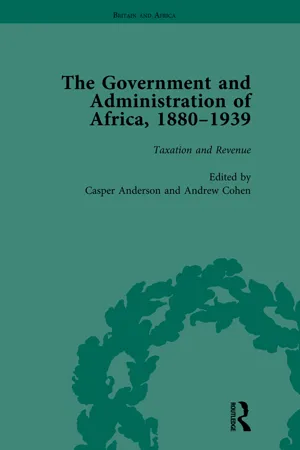
The Government and Administration of Africa, 1880-1939 Vol 3
- 2,080 pages
- English
- ePUB (mobile friendly)
- Available on iOS & Android
eBook - ePub
The Government and Administration of Africa, 1880-1939 Vol 3
About this book
This collection makes available rare sources on the aims, functions and effects of British administration in Africa. Topics examined include: land and urban administration, law and jurisprudence, taxation and administration of natural resources.
Trusted by 375,005 students
Access to over 1.5 million titles for a fair monthly price.
Study more efficiently using our study tools.
Information
W. J. A. Jones, Memorandum on the Introduction of Direct Taxation in the Gold Coast Colony (Accra: Government Printing Office, 1931).
POSSIBLE RESULT OF DELAY IN INTRODUCTION OF A DIRECT TAX.
In his book “The Dual Mandate in British Tropical Africa”, which is acknowledged to be the authoritative work on the principles of indirect rule and their application to native states or communities in different stages of constitutional development, Lord Lugard1 writes:
“For the time must come as it has come to every community in the world when some form of direct tax for revenue purposes must be imposed. That necessity has been recognised (with I believe the sole exception of the Gold Coast) by every administration in British and foreign tropical Africa. If delayed its imposition is certain to be resented and to lead to trouble and bloodshed.”
NEED FOR PROPAGANDA BEFORE A DIRECT TAX IS INTRODUCED.
2. If there can be no exception to Lord Lugard’s statement as to the result of delay in the imposition of direct taxation, then the prospect before the Government of the Gold Coast is one of inevitable widespread disturbance as soon as steps are taken to introduce a direct tax in any form. The object in quoting this definite prediction is not to deter Government from embarking on a change in fiscal policy, which has now become necessary for reasons which I will state in subsequent paragraphs, but to emphasize at the outset the need for caution and intensive propaganda if the troubles which have occurred in Nigeria and other Colonies consequent on the introduction of direct taxation are to be avoided or experienced to a lesser degree in this Colony.
HISTORY OF DIRECT TAXATION IN THE GOLD COAST, SIERRA LEONE AND NIGERIA.
NO FORM OF DIRECT TAX IS POPULAR.
3. Except in Northern Nigeria where the people had for so long been accustomed to pay the taxes authorised by the Koran, as well as other irregular imposts, that they welcomed the substitution for them of an annual tax of a definite amount, it has not been found possible in any Colony in West Africa to devise a form of direct tax or machinery for its collection which proved immediately acceptable by the people as a whole. It will be of value therefore if I examine briefly the history of direct taxation in this and two other West African Colonies, i.e. Nigeria and Sierra Leone to ascertain the cause of dissatisfaction other than the dislike of a direct tax in any form which is common to all men and not peculiar to the natives of West Africa.
HISTORY OF THE POLL-TAX ORDINANCE IN THE GOLD COAST.
4. To take the Gold Coast first: in the year 1852, the revenue from import duties having then decreased to such an extent owing to the absence of a tariff agreement with the Dutch that funds were not available to pay the salaries of officials, the Governor, Major Hill,2 decided to introduce direct taxation and this he succeeded in doing with the co-operation of the Chiefs who constituted themselves a “Legislative Assembly of Native Chiefs upon the Gold Coast” and passed, among other measures, the Poll Tax Ordinance. By the terms of that Ordinance the Chiefs agreed, doubtless through fear of Government withdrawing its protection, to assist in the collection of one shilling a head each year for every man, woman and child in their respective territories. It was estimated that the tax would yield £20,000 per annum but during the eight years that it remained in force only £30,286 was collected and that at the cost of an expedition into the Krobo country and of the bombardment of Christiansborg, Accra and Labadi. It is noteworthy that no trouble was experienced at Cape Coast or among the Akans or Akwapims, the latter, indeed, professing a readiness to continue payment of the tax provided the other tribes were compelled to do so. In 1861 it was decided to cease the collection of the poll-tax. Four years previously the Governor, Sir J. Pine,3 had established Municipal Corporations with the power to impose taxes. / Their demands clashed with those of the poll-tax collectors and it may be that that fact actually led to the abandonment of the poll-tax. There were, however, other important reasons for its failure, the principal one being that the collection of the tax was not entrusted to the Chiefs who, it was thought, would use the authority conferred on them to extort large sums from their people, but was carried out by semi-literate men employed and paid by Government. These men worked independently of, and were consequently obstructed by, the Chiefs whom they probably professed to despise because of their illiteracy: further they were doubtless guilty of far greater extortion than would have been the Chiefs if the collections had been carried out through them. Another complaint urged by the Chiefs before Major Ord,4 Special Commissioner, who was appointed by the Secretary of State to enquiry into the failure of the Poll-Tax Ordinance, was that Government neglected to consult them with regard to the expenditure of the money collected and that none of the improvements which they had been promised such as the provision of schools, hospitals and roads had taken place.
LESSONS TO BE LEARNT FROM THE HISTORY OF THE POLL-TAX ORDINANCE.
5. There are three valuable lessons to be learnt from the history of the Poll-Tax Ordinance –
(a)the necessity for treating towns where Town Councils are established on an entirely different basis from the remainder of the Colony. The Native Authorities in such towns can be given no part in the assessment and the collection of income tax – which, as in the case of Lagos, will have to be governed by an Ordinance distinct from a Native Revenue Ordinance and applicable only to such towns. I propose to deal more fully with this question when making my recommendations.
(b)the necessity for the closest co-operation with the Native Authorities in the assessment and collection of tribute or income tax, whichever term is considered the more appropriate. It is to the Native Authorities that we must look to provide the machinery for the collection of the tax,
(c)the desirability of allowing the Native Authorities as wide a discretion as the interests of their people will permit in the settlement of the expenditure side of their estimates.
HUT-TAX IN SIERRA LEONE.
6. The introduction of a hut-tax in Sierra Leone was followed by a serious rising in 1898 - but whether the one was the direct cause of the other appears to be open to question. The malpractices of Government police, who were used to enforce payment of the tax, and the discontent among the Chiefs resulting from Government’s attempt to check their misrule were at least contributory causes. Further the fact that they were subjected to a tax from which the inhabitants of Freetown were exempt probably occasioned considerable resentment among the people in the Protectorate. I have referred to the hut-tax in Sierra Leone principally because I have seen it stated that a similar form of direct taxation would be more acceptable to the people of this Colony than any other. I question the accuracy of this statement, as the people of the Gold Coast are particularly jealous of their rights over their houses and their lands, and, any tax which could not in their minds be easily distinguished from a demand for the payment of rent for them, would I feel sure be strongly opposed. If they are persuaded that direct taxation is inevitable, they will demand that it be applied to them in a form based on the income tax system and not in a form such as hut-tax or poll-tax which is generally regarded as applicable only to a people in a primitive stage of development. In this connection, I would observe that in one of his political memoranda Lord Lugard lays it down that “a tax should not be levied on a man’s hut or cultivated land to neither of which has the State any right, and any claims to which he will cordially resent” and also quotes the statement of Miss Mary Kingsley5 that “the African assumes that the thing you pay anyone a fee for is a thing which is not your own.” The terms “house rate” and “house tax” are, needless to remark, not synonymous.
HUT-TAX NOT RECOMMENDED.
7. In the foregoing paragraph, I have, I think, given adequate reasons for not following the example of Sierra Leone and introducing the “hut-tax” in this Colony and at the same time I have drawn attention to two dangers which we have / to avoid, namely: the use of police to enforce the payment of taxes and the exemption from taxation, when once it has been introduced, of any class of the community. A tax should be levied on the income and profits of each individual according to his ability to pay regardless of the source from which he derives his income. Further all Africans, who are amenable to the Native Administration Ordinance, should be made to pay their tax through the Native Authorities of the State in which they reside and earn their livelihood. The others will pay direct to Government.
INTRODUCTION OF DIRECT TAX IN NORTHERN NIGERIA NOT OPPOSED.
8. Turning now to Nigeria, we find, as I have already stated, that in the Northern Provinces there was no serious opposition raised to the introduction of direct taxation which in effect relieved the people of the far heavier burdens imposed upon them by their Chiefs. But the relief, which the tax afforded, was not the principal reason for the almost complete absence of disturbances in that territory. Lord Lugard’s rapid appreciation of the difficulty, if not impossibility, of administering so large a country by any method other than by indirect rule, his clear exposition of a definite policy to that end, and the enthusiasm with which he was able to inspire his subordinate...
Table of contents
- Cover
- Half Title
- Title Page
- Copyright Page
- Table of Contents
- Taxation and Revenue
- Report on the Administration of the Niger Coast Protectorate, August 1891 to August 1894 (1895)
- Southern Rhodesia Custom Management Ordinance (1906)
- British South Africa Company, Administration Revenue and Expenditure in Southern and Northern Rhodesia (1914)
- ‘Customs Tariff. An Ordinance to Consolidate and Amend the Duties of Customs, Ordinance No. 4 of 1899’ and ‘Ground Nuts. An Ordinance to Regulate the Import and Export of Ground Nuts into and from the Colony and Protectorate, Ordinance No. 5 of 1899’ (1900)
- Harry L. Stephen, ‘Rebellion in Sierra Leone’ (1899)
- Edmund Dene Morel, The Sierra Leone Hut-Tax Disturbances (1899)
- Confidential Despatch to Colonial Office on Toll Collection in Abeokuta and Ibadan (1903)
- Frederick D. Lugard, Administration of Tropical Colonies (1906)
- Frederick D. Lugard, Memorandum on the Taxation of Natives in Northern Nigeria (1907)
- Percy Girouard, ‘Political Memo. No. 26. Directions for Taxation and Land Revenue’ (1908)
- Donald Cameron, Tanganyika Territory, Native Administration Memoranda No. III: Native Treasuries, 2nd edn (1930)
- Sir Bernard Bourdillon, Apportionment of Revenue and Duties as between the Central Government and Native Administrations (1939)
- Earl of Cromer, Reports by His Majesty’s Agent and Consul-General on the Finances, Administration, and Condition of Egypt and the Soudan in 1902 (1903), excerpt
- ‘The Local Taxation Ordinance 1912’, Sudan (1912)
- Report on the Administration, Finances and Condition of the Sudan in 1936 (1937), excerpt
- High Commissioner of Swaziland, Proclamation Consolidating and Amending the Laws relating to the Taxation of Natives in Swaziland (1916)
- C. K. Dain, Instructions for the Use of Administrative Officers in regard to the Collection of Native Poll Tax (1927)
- Income Tax Uganda Protectorate Despatch and Petitions (1932)
- Alan W. Pim, ‘Colonial Finance and Native Administration’, Oxford Summer School on Colonial Administration (1938)
- Alan W. Pim, Report of the Commission Appointed to Enquire Into and Report on the Financial Position and System of Taxation in Kenya (1936), excerpt
- W. J. A. Jones, Memorandum on the Introduction of Direct Taxation in the Gold Coast Colony (1931)
- Minutes of the Meeting of the Joint Conference of the Provincial Councils held at Saltpond in April, 1932 (1933)
- Editorial Notes
Frequently asked questions
Yes, you can cancel anytime from the Subscription tab in your account settings on the Perlego website. Your subscription will stay active until the end of your current billing period. Learn how to cancel your subscription
No, books cannot be downloaded as external files, such as PDFs, for use outside of Perlego. However, you can download books within the Perlego app for offline reading on mobile or tablet. Learn how to download books offline
Perlego offers two plans: Essential and Complete
- Essential is ideal for learners and professionals who enjoy exploring a wide range of subjects. Access the Essential Library with 800,000+ trusted titles and best-sellers across business, personal growth, and the humanities. Includes unlimited reading time and Standard Read Aloud voice.
- Complete: Perfect for advanced learners and researchers needing full, unrestricted access. Unlock 1.5M+ books across hundreds of subjects, including academic and specialized titles. The Complete Plan also includes advanced features like Premium Read Aloud and Research Assistant.
We are an online textbook subscription service, where you can get access to an entire online library for less than the price of a single book per month. With over 1.5 million books across 990+ topics, we’ve got you covered! Learn about our mission
Look out for the read-aloud symbol on your next book to see if you can listen to it. The read-aloud tool reads text aloud for you, highlighting the text as it is being read. You can pause it, speed it up and slow it down. Learn more about Read Aloud
Yes! You can use the Perlego app on both iOS and Android devices to read anytime, anywhere — even offline. Perfect for commutes or when you’re on the go.
Please note we cannot support devices running on iOS 13 and Android 7 or earlier. Learn more about using the app
Please note we cannot support devices running on iOS 13 and Android 7 or earlier. Learn more about using the app
Yes, you can access The Government and Administration of Africa, 1880-1939 Vol 3 by Casper Anderson, Casper Anderson,Andrew Cohen in PDF and/or ePUB format, as well as other popular books in History & World History. We have over 1.5 million books available in our catalogue for you to explore.