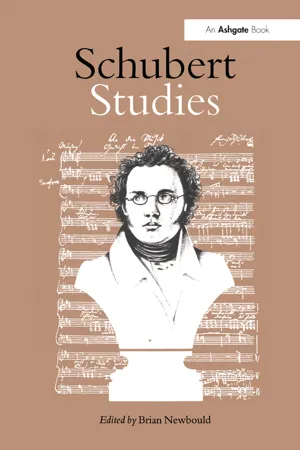
Schubert Studies comprises eleven essays by renowned Schubert scholars and performers. The volume sheds light on certain aspects of Schubert's music and biography which have hitherto remained relatively neglected, or which warrant further investigation. Musical topics include analyses of tempo conventions, transitional procedures and rhythmic organization. There are reassessments of several works, using autograph research, performing experience and other approaches; while assumptions as to the extent of Schubert's influence on later Czech composers are also brought into question. Concerns with aspects of Schubert's biography, in particular the social and musical circles in which he moved, come under examination in several essays. The final two chapters deal specifically with the composer's relationships with women, and the psychological and physiological illnesses from which he suffered. Each of the essays here charts new and existing evidence to provide fresh perspectives on these aspects of Schubert's life and music, making this volume an indispensable tool for scholars concerned with his work.
Trusted by 375,005 students
Access to over 1.5 million titles for a fair monthly price.
Franz Schubert was eight years old when Friedrich Guthmann published the first of his ‘Expectorations on Modern Music’ in the Allgemeine musikalische Zeitung, with the subtitle ‘On the all-too-great rapidity of allegro, and on tearing, excessive hurry in general’. Guthmann contrasted the spacious tempi adopted by Rode and other members of the Viotti school of string players in their own repertoire, with the fast allegro tempi that he generally heard in concerts and operas, which he considered to be so fast ‘that the notes resemble the utterances of a dreamer and the ear is unable to follow them’; and he asked ‘where will this end? – Only the most practised and greatest players are in a position to perform a moderately difficult piece with the necessary precision and the requisite expression, if it is taken so immoderately fast.’1 Among the types of piece in which he identified the worst excesses were ‘the so-called Minuets of symphonies and the allegro of overtures’.2
Guthmann’s comments draw attention to two strongly contrasting styles, not only of performance, but also of composition. Each of these styles derived some of its most prominent characteristics from different aspects of 18th-century Italian music. The lively allegros to which Guthmann took exception reflect, among other things, the buffa tradition that had reached its highest artistic manifestations in the vocal and instrumental works of the Viennese Classical masters, but which was also to bear other fruit in the work of Rossini: the broader, more lyrical style of the Viotti school, whose preference for moderate tempi is well documented, took its inspiration from the great Italian tradition of string playing personified in the middle of the 18th century by Tartini and by Viotti’s own master Pugnani. These divergent traditions were to find their first important point of synthesis in the style of Spohr and his immediate imitators, before blending more homogeneously in music of the generation of Mendelssohn and Schumann. It may nevertheless be noted that in Mendelssohn’s and Schumann’s own music there is a marked propensity for the fast tempi of the direct Classical tradition rather than the more spacious ones of the Viotti School.
At the time Guthmann committed his objections to paper, however, the contrast between the two divergent approaches was at its sharpest. By 1805 Beethoven had completed his first three symphonies, his Septet, and his first nine string quartets, to all of which he later gave metronome marks that appear to indicate a liking for extremely rapid tempi, sometimes bordering on the unplayable. There is no reason to suppose that Beethoven had radically changed his tempo preferences when, in 1818, he fixed the Menuetto/Scherzo movements of the first three symphonies (all containing quavers as their fastest notes) at ♩=108,100 and 116 respectively, and the Scherzo of the Septet even faster at ♩=112 or the opening movements of his first two symphonies (both allegro con brio, containing semiquavers) at ♩ =60.and 100, and the
first movement of the ‘Eroica’ Symphony, which contains a considerable number of semiquavers, at ♩=60. Beethoven does not seem to have been alone among early 19th-century composers in his desire for far greater rapidity in allegro movements than has been customary in twentieth-century performances of this repertoire. Metronome marks for numbers in Rossini and Spontini operas often approach, though seldom reach, the fastest of Beethoven’s tempi. Hummel’s and Czerny’s metronome marks for Haydn and Mozart also show this tendency and the Haslinger collected edition of Beethoven’s works,3 begun in the year of the composer’s death, allotted metronome marks to works for which the composer had not fixed them that, in the case of allegro, are quite as fast as Beethoven’s own. There are good grounds to believe that Franz Schubert, too, may have shared this predilection for very rapid tempi, which seems to have been particularly strong in Vienna, and that he may also have adhered to the same basic principles upon which, before the advent of the metronome, Beethoven, and probably Haydn and Mozart, relied for indicating their desired tempo. This depended on a subtle equation involving the tempo term, the metre and the note values employed in the music.
The fundamental consistency of the principles by which Mozart and Beethoven, in particular, attempted to convey their tempo conventions to performers has been discussed at length in a number of recent studies.4 In Mozart’s case it is possible to postulate persuasively, on the basis of circumstantial evidence, that he adhered to a coherent system, involving quite precise relationships between tempo term, metre and note values to indicate the tempo of his music; but, notwithstanding Jean-Pierre Marty’s attempts to specify metronome tempi for Mozart’s music, we have no firm information on which to base assumptions about the absolute speed he might have conceived for an allegro, allegretto or andante in a given set of conditions. In the case of Beethoven’s music, the composer’s own metronome marks make it possible not only to demonstrate that he employed a coherent system with a high degree of precision, but also to understand what this meant to him in terms of absolute tempo, and they make it f...
Table of contents
Cover
Half Title
Title Page
Copyright Page
Table of Contents
List of plates
Notes on contributors
Introduction
1 Schubert’s tempo conventions
2 Schubert’s transitions
3 Schubert’s string and piano duos in context
4 ‘Am Meer’ reconsidered: strophic, binary, or ternary?
5 Schubert’s ‘Great’ C major Symphony: the autograph revisited
6 ‘Biding his time’ – Schubert among the Bohemians in the mid-nineteenth century
7 Architecture as drama in late Schubert
8 Schubert’s piano sonatas: thoughts about interpretation and performance
9 Schubert and the Ungers: a preliminary study
10 Schubert’s relationship with women: an historical account
11 Adversity: Schubert’s illnesses and their background
Index of Schubert’s works
General Index
Frequently asked questions
Yes, you can cancel anytime from the Subscription tab in your account settings on the Perlego website. Your subscription will stay active until the end of your current billing period. Learn how to cancel your subscription
No, books cannot be downloaded as external files, such as PDFs, for use outside of Perlego. However, you can download books within the Perlego app for offline reading on mobile or tablet. Learn how to download books offline
Perlego offers two plans: Essential and Complete
Essential is ideal for learners and professionals who enjoy exploring a wide range of subjects. Access the Essential Library with 800,000+ trusted titles and best-sellers across business, personal growth, and the humanities. Includes unlimited reading time and Standard Read Aloud voice.
Complete: Perfect for advanced learners and researchers needing full, unrestricted access. Unlock 1.5M+ books across hundreds of subjects, including academic and specialized titles. The Complete Plan also includes advanced features like Premium Read Aloud and Research Assistant.
Both plans are available with monthly, semester, or annual billing cycles.
We are an online textbook subscription service, where you can get access to an entire online library for less than the price of a single book per month. With over 1.5 million books across 990+ topics, we’ve got you covered! Learn about our mission
Look out for the read-aloud symbol on your next book to see if you can listen to it. The read-aloud tool reads text aloud for you, highlighting the text as it is being read. You can pause it, speed it up and slow it down. Learn more about Read Aloud
Yes! You can use the Perlego app on both iOS and Android devices to read anytime, anywhere — even offline. Perfect for commutes or when you’re on the go. Please note we cannot support devices running on iOS 13 and Android 7 or earlier. Learn more about using the app
Yes, you can access Schubert Studies by Brian Newbould in PDF and/or ePUB format, as well as other popular books in Media & Performing Arts & Music. We have over 1.5 million books available in our catalogue for you to explore.