eBook - ePub
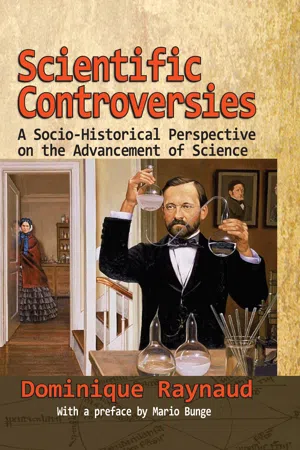
Scientific Controversies
A Socio-Historical Perspective on the Advancement of Science
- 320 pages
- English
- ePUB (mobile friendly)
- Available on iOS & Android
eBook - ePub
Scientific Controversies
A Socio-Historical Perspective on the Advancement of Science
About this book
In Scientific Controversies, Dominque Raynaud shows how organized debates in the sciences help us establish or verify our knowledge of the world. If debates focus on form, scientific controversies are akin to public debates that can be understood within the framework of theories of conflict. If they focus on content, then such controversies have to do with a specific activity and address the nature of science itself. Understanding the major focus of a scientific controversy is a first step toward understanding these debates and assessing their merits.Controversies of unique socio-historic context, disciplines, and characteristics are examined: Pasteur's germ theory and Pouchet's theory of spontaneous generation; vitalism advocated at Montpellier versus experimental medicine in Paris; the science of optics about the propagation of visual rays; the origins of relativism (the Duhem-Quine problem). Touching on the work of Boudon, Popper, and others, Raynaud puts forward an incrementalist theory about the advancement of science through scientific controversies.The debates Raynaud has selected share in common their pivotal importance to the history of the sciences. By understanding the role of controversy, we better understand the functioning of science and the stakes of the contemporary scientific debates.
Trusted by 375,005 students
Access to over 1.5 million titles for a fair monthly price.
Study more efficiently using our study tools.
Information
1
Relativism and Rationalism: A Metacontroversy
It is an irony of fate that the study of controversies should itself be prey to controversy in terms of its methodology, and that it cannot develop in a coherent manner if we do not first of all clarify the terms of a longstanding meta-controversy between the relativists and the rationalists.
The social turn (which is, broadly speaking, a movement dedicated to the exploration of the social, practical and cultural aspects of science) has raised a sometimes quite animated debate on the interest and possibility of constructing a sociology that infers scientific knowledge from the social context out of which it sprang. Many labels have been used to designate the supporters and opponents of such analyses: modernists and post-modernists, functionalists and constructivists, rationalists and relativists.
The first coupling—modernists versus post-modernists—has a historical context, and implies that the debate is subject to an inter-generational conflict of interest. This was Pierre Bourdieu’s (1994) interpretation of the mainspring behind the new sociology of the sciences (93), and while his analysis doubtless contains some truth, a deeper investigation of the issue shows that the questions being raised by the relativists date to long before the emergence of the social turn. The linkage of these two terms diverts attention from the true object of the debate.
The second pairing—functionalists versus constructivists—focuses the spotlight on two sociological theories that presently dominate the study of science, the latter of which assumes that everything is subject to social construction, and therefore the natural world plays no direct role in the construction of scientific knowledge. However, not only do these terms fail to capture and render immediately intelligible the grounds for the conceptual opposition, but their use in this context has been shown to be inappropriate by recent developments in the sociology of the sciences. The pairing of the two concepts is asymmetrical because the discussion almost always focuses on the question of constructivism and only rarely on functionalism.
There remains the last pairing—relativists versus rationalists—which in contrast to the others addresses a key question in the debate,1 and the fact that this opposition is recognized by the leading players in the two camps—for example, Hollis and Lukes (1981), Bloor (1983), Siegel (1987), Woolgar (1988), Laudan (1990), Boudon (1994), Boghossian (2006), Schantz and Seidel (2011)—would seem to confirm its appropriateness.
1. The Guiding Notions in the Debate
The more literally minded will doubtless assume that the debate that has agitated the sociology of the sciences is of recent date, ensuing because the scientific approach that developed so rapidly since the 1970s has reached its limits and can go no further. But another possible interpretation of the phenomenon must be considered.
If one reasons on a longer timescale, the present situation echoes the discussions that set rationalists against relativists at the end of the eighteenth century and, no solution having been found then, the debate has passed from generation to generation down to the present day. This more sophisticated interpretation deserves at least to be examined. Is what we have here the same debate extending from the eighteenth to the twentieth centuries, or two different debates linked by superficial resemblances? If the latter, should one take into account the historical gap by utilizing such expressions as neo-relativism and neo-rationalism?
It must be recalled that the philosophy of the Enlightenment was not received with unanimous acclaim in eighteenth-century Europe. Other currents were being defended in the name of the Volksgeist by such influential thinkers as Johann Gottfried Herder, whose ideas were disseminated in France by Joseph de Maistre and Louis de Bonald.2 Adopting a position diametrically opposed to that of D’Holbach, Helvetius and the contributors to the Encyclopédie of D’Alembert and Diderot (1751–72), they insisted that all knowledge should be based on common sense, local traditions, national prejudices, religious faith, and accepted authorities. As Herder (1964) writes: “Prejudice is good—It forces peoples to rest in their center, attaches them more firmly to their stems, to flourish in their own way, makes them more ardent and thus also more happy in their inclinations and purposes” (185). This form of protorelativism was not confined to aspects of methodology. It led to value judgments on how civil society should be organized, and in its wake congruent political ideologies were born, ideologies that exalted the mystique of national roots and the collective imagination.3
It remains to be determined whether and how this form of relativism may have been transmitted down to contemporary sociologists. Aron (1967, 73, 130–131, 300), Nisbet (1984, 26), Bloor (1984, 71–94), Boudon (1986, 43) and Caillé (1989, 28) all proposed different answers to the question. There is no doubt that Joseph de Maistre and Louis de Bonald had a profound influence on the work of Henri de Saint-Simon and Auguste Comte and, through them, on the French school of sociology. All the same, this hypothesized series of links is not sufficient to demonstrate a consonance of the relativist position between the eighteenth and twentieth centuries. There was a rupture in the chain during the transmission of these influences.
Primo, the reactionary positions of the eighteenth century are not supported by today’s proponents of relativism. Secundo, signs of a modulation in these doctrines were already detectable in the work of the first sociologists, for example, Durkheim who in the nineteenth century advanced the principle of a “secular religion.”4 If a single generation was sufficient for such inflections to appear, what form might they take during the course of six or seven generations?5 Tertio, even scholars such as Caillé (1989, 28–29), who grant the influence of early relativist thought on modern sociology, recognize that the recent spread of economic models can be explained by the diminishing influence of doctrines that had previously served as a “barrier” to the rational, objective analysis of society. Relativism has therefore been propagated in inverse rather than direct proportion to the proliferation of sociological studies.
These arguments are sufficient to disprove the notion of a direct line of descent between the debates of the eighteenth century and those of today. If no nexus of transmission existed between Herder and the modern relativists, it is difficult to argue that the terms of the debate have remained the same. There exist in fact two conventional responses to this conundrum:
- The nature of the debate between relativism and rationalism has changed since the Enlightenment, and any similarities are limited to the outward-most aspects of these concepts, or
- The relativist notions between then and now are the same in that they constitute a reaction to rational thought, and a congruence in their conclusions can be deduced from the identical nature of their causes.
Of these two solutions the second appears to be more convincing, because the similarities between the relativism of the eighteenth century and the relativism of today do not end with their more super-ficial aspects (see Holton 1998, 49–61). It would be prudent therefore to mark this distinction, however laborious from a semantic point of view, by employing the terms neo-relativism and neo-rationalism when describing the current debate in order to avoid the risk of confusion. This would require, at the very least, an explanation of what is meant when the labels relativism and rationalism are used in this context.
1. The Relativist Approach
In the discussion that follows, the term relativism will be used to designate all approaches to science which envisage the possibility that social factors may have a determining influence on scientific knowledge. This semantic restriction could appear excessive, but it implies the existence of certain derived propositions that cover all the major aspects of relativism. We can see first of all that within such a framework two distinct domains of knowledge will produce knowledge that is not only different, but also incommensurable,6 because knowledge is local and conventional rather than universal.
Martin Hollis (1992, 77) distinguished between “strong” and “weak” versions of relativism. In the strong version, the explication of the contents should not introduce any judgment regarding its veracity, because the notion of truth is irrelevant to the generation of the explanation. However, as David Bloor (1991) writes, “This poses a problem about the notion of truth, for why not abandon it altogether?” (40). From this perspective, the sociologist must consider that “instead of defining it as true belief, knowledge for the sociologist is whatever men take to be knowledge” (2). In the weak version of relativism, the notion of truth may have some meaning (i.e., as a truth that, while universalizable, is produced locally), but the sociological explanation must avoid making any pronouncements on this. It should study the content and leave the question of truth to the epistemologist. However, difficulties remain even with these stipulations.
For the purposes of this discussion it will be appropriate to adopt a more restricted definition of the term “relativism.” I will not concern myself here with aspects of relativism that may manifest themselves beyond the sphere of the sciences, even though many can be found. Any conclusions with regard to cognitive relativism will therefore not be extrapolated to the realms of ethical or aesthetic relativism, despite the existence of a certain continuity between these domains. Last, but not least, the way the word “relativism” is used here is not intended in any way to underestimate the nuances in position that can and do exist among the relativists themselves. The debate is being conducted not only between relativists and rationalists, but also between those advocating different forms of relativism.
2. The Rationalist Approach
Just as a narrow definition of relativism can embrace various positions, “rationalism” may be described—in an equally restrictive sense—as an approach that refuses to consider scientific theories as the emanations of a constantly variable and fluctuating state of society. On the contrary, the specific mode in which scientific knowledge is constructed allows one to conclude that different societies are capable of producing knowledge that is commensurable because it stems from the universal ability of human beings to understand the objective structures of the world. As with relativism, however, the term should not serve as a pretext to impose an artificial unity on all forms of rationalism. The collection of studies edited by Boudon and Clavelin (1994) testifies to the existence of marked nuances in the understanding of the concept by various scholars. However, every one of their authors questions the thesis that truth can be socially determined. Moreover, one must guard against assuming that all forms of rationalism are, in the final analysis, the same. What will be explored here is rather a “sophisticated rationalism,” to paraphrase Lakatos, or a “neo-rationalism” that questions how knowledge is constructed and indeed the notion of rationality itself. Boudon’s research on cognitive rationality (1990, 1995) illustrates the distinction that must be made between “classical” rationalism and present conceptions of the same notion.
2. The Debate within the Sociology of the Sciences
With these semantic provisos, we will now attempt to identify the sources of the disaccord between relativists and rationalists that lies at the heart of the sociology of the sciences, beginning with a discussion of the positions held by a branch of the SSK that today has largely been taken over by the relativists.
1. The Relativist Arguments
The program espoused by the new sociology of the sciences was born of an intersection between schools of thought that embrace more or less explicitly the constructivist and relativist points of view (Lynch 1992, 215–216). It is difficult to capture the essence of the various relativist positions in a few lines, because nowhere in the literature is a succinct exposition to be found. The various positions do not even coincide with specific areas of study. The relativist attitude is highly visible in—but in no way limited to—SSK. For example, the studies of laboratory practices produced by the new field of ethnomethodology bear clear indications of an affiliation to the principles of relativism. Therefore, many variants of relativism exist and the intention here is not to list them one by one but to capture their most salient arguments.
In his review of developments in the sociology of the sciences, Michael Mulkay (1980) identifies some of the fundamental propositions of relativism. According to him, it was important to recognize that:
Empirical observations or mathematical calculations depend for their meaning on the different background hypotheses shared by particular groups; the acceptability of a particular claim to knowledge depends on its social context; the hypotheses and the repertoires of significations used by different groups engaged in the production of knowledge are often drawn from the broader social milieu; the rules for concrete reasoning depend for their signification on informal social negotiation (126).
Mulkay notes that these conclusions, while not unanimously accepted, have been taken into consideration in many studies in the sociology of science.7
A somewhat extreme version of relativism is often posited in SSK studies. The most characteristic trait of this orientation is to postulate that scientific knowledge, far from imposing itself on the evidence through some mysterious adherence to reality, is actually bound by convention and is contingent in nature. This version of relativism denatures “scientific knowledge” into “scientific content” and “scientific content” into “scientific belief” in a process that effectively obliterates all distinctions between scientific knowledge and magical-religious beliefs. Woolgar (1988) states explicitly that “there is no essential difference between science and other forms of knowledge production; that there is nothing intrinsically special about the ‘scientific method’” (12). This idea is deduced from a strong version of relativism, which Woolgar moreover judges to be insufficiently radical: “Relativism has not yet been pushed far enough. Proponents of relativism (both within and beyond SSK) are still wedded to an objectivist ontology, albeit one slightly displaced” (98). It is the very notion of scientific objectivity that should be banished.
The basic propositions laid out above can be arranged in a sequence that illustrates how the idea of a sociology of scientific knowledge was born:
R1 The objects of the natural world that scientific statements are related to are nothing other than “literary inscriptions” (Woolgar, Latour).
R2 The natural world plays a negligible role in the construction of scientific statements (Collins).
R3 The social context, local as well as global, plays a decisive role in the construction of scientific statements (Mulkay).
R4 Scientific knowledge is “conventional” (Bloor) and its reasoning is built on some “informal social negotiation” (Mulkay).
The Strong Program. This approach was elaborated by the Edinburgh school, represented in particular by Barry Barnes, David Bloor, David Edge and Steven Shapin. With his repeated employment of the term “scientific belief”—a use to which we will return later—Bloor unequivocally affirms his relativist position, that is that all knowledge is conjectural and relative, and reflects the situation of the person(s) who produced it. The Strong Program proposed a set of four guiding principles for SSK:
- It would be causal, that is, concerned with the conditions which bring about belief or states of knowledge. Naturally there will be other types of causes apart from social ones.
- It would be impartial with respect to truth and falsity, rationality or irrationality, success or failure. Both sides of these dichotomies will require explanation.
- It would be symmetrical in its style of explanation. The same types of causes would explain, say, true and false beliefs.
- It would be reflexive. In principle its pattern...
Table of contents
- Cover
- Half Title
- Title Page
- Copyright Page
- Contents
- List of Illustrations
- List of Tables
- Foreword
- Preface
- Introduction: Controversies at the Crossroads of two Specialties
- 1 Relativism and Rationalism: A Metacontroversy
- 2 The Controversy between Pasteur and Pouchet: An Essay on the Principle of Accumulated Asymmetries
- 3 The Vitalism-Organicism Controversy between Paris and Montpellier: An Essay on the Social Determination of Knowledge
- 4 Intromission versus Extramission in Oxford: An Essay on the Norms of Rationality
- 5 Al-Samarqandī’s Native Theory of Controversies: An Essay on the Negotiation of Truth
- 6 The SSK in the Name of Prestigious Ancestors: Duhem, Quine and Wittgenstein
- Conclusion: Toward an Epistemological Incrementalism
- Appendix 1: The Works published by Pasteur and Pouchet
- Appendix 2: The Primary Archives on the Pasteur-Pouchet Debate
- Appendix 3: Excerpts from Pouchet’s correspondence
- Appendix 4: The Works published by the supporters of vitalism and organicism
- Bibliography
- A Selection of Author’s Publications
- Index rerum
- Index nominum
Frequently asked questions
Yes, you can cancel anytime from the Subscription tab in your account settings on the Perlego website. Your subscription will stay active until the end of your current billing period. Learn how to cancel your subscription
No, books cannot be downloaded as external files, such as PDFs, for use outside of Perlego. However, you can download books within the Perlego app for offline reading on mobile or tablet. Learn how to download books offline
Perlego offers two plans: Essential and Complete
- Essential is ideal for learners and professionals who enjoy exploring a wide range of subjects. Access the Essential Library with 800,000+ trusted titles and best-sellers across business, personal growth, and the humanities. Includes unlimited reading time and Standard Read Aloud voice.
- Complete: Perfect for advanced learners and researchers needing full, unrestricted access. Unlock 1.5M+ books across hundreds of subjects, including academic and specialized titles. The Complete Plan also includes advanced features like Premium Read Aloud and Research Assistant.
We are an online textbook subscription service, where you can get access to an entire online library for less than the price of a single book per month. With over 1.5 million books across 990+ topics, we’ve got you covered! Learn about our mission
Look out for the read-aloud symbol on your next book to see if you can listen to it. The read-aloud tool reads text aloud for you, highlighting the text as it is being read. You can pause it, speed it up and slow it down. Learn more about Read Aloud
Yes! You can use the Perlego app on both iOS and Android devices to read anytime, anywhere — even offline. Perfect for commutes or when you’re on the go.
Please note we cannot support devices running on iOS 13 and Android 7 or earlier. Learn more about using the app
Please note we cannot support devices running on iOS 13 and Android 7 or earlier. Learn more about using the app
Yes, you can access Scientific Controversies by Dominique Raynaud in PDF and/or ePUB format, as well as other popular books in History & Science History. We have over 1.5 million books available in our catalogue for you to explore.