- 282 pages
- English
- ePUB (mobile friendly)
- Available on iOS & Android
eBook - ePub
The Irish and the American Presidency
About this book
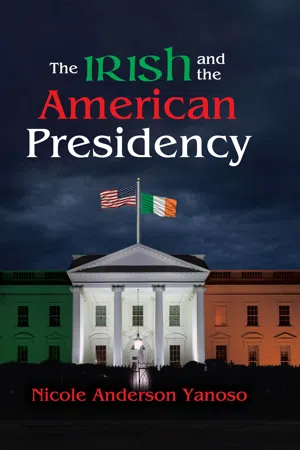
There is a widely held notion that, except for the elections of 1928 and 1960, the Irish have primarily influenced only state and local government. The Irish and the American Presidency reveals that the Irish have had a consistent and noteworthy impact on presidential careers, policies, and elections throughout American history. Using US party systems as an organizational framework, this book examines the various ways that Scots-Irish and Catholic Irish Americans, as well as the Irish who remained in eire, have shaped, altered, and sometimes driven such presidential political factors as party nominations, campaign strategies, elections, and White House policymaking.The Irish seem to be inextricably interwoven into important moments of presidential political history. Yanoso discusses the Scots-Irish participation in the American Revolution, the Whiskey Rebellion, and the War of 1812. She describes President Bill Clinton's successful Good Friday Agreement that brought peace and hope to Northern Ireland. And finally, she assesses the now-common presidential visits to Ireland as a strategy for garnering Irish-American support back home.No previous work has explored the impact of Irish and Irish-American affairs on US presidential politics throughout the entire scope of American history. Readers interested in presidential politics, American history, and/or Irish/Irish-American history are certain to find The Irish and the American Presidency enjoyable, informative, and impactful.
Trusted by 375,005 students
Access to over 1.5 million titles for a fair monthly price.
Study more efficiently using our study tools.
Information
1
Introduction
Irish and Irish-American affairs have significantly affected American presidential politics throughout US history, from the American Revolution to modern times. No other ethnic group, both in their country of origin and as immigrants, has influenced American presidential politics, in both domestic and foreign affairs, more than the Irish. Over the years, Irish and Irish-American events, issues, and personalities have meaningfully impacted political careers of presidents, party platforms and propaganda, electoral strategies and tactics, presidential nominations, and election results. Only by reviewing the full extent of this interaction between presidential-level politics and Irish and Irish-American affairs can the role of the Irish as a consistent force in US national politics be thoroughly understood and appreciated.
The vast, complex nature of this topic has perhaps discouraged historians from attempting a full-length study. Indeed, no work covering the entire scope of the Irish influence on presidential politics exists.1 To be sure, several works either directly or indirectly cover US–Ireland diplomatic relations, and there are studies that focus on either the Irish-American experience or various presidential administrations that include references to Irish influences on national politics. These sources, however, are generally very broad in scope and thus do not focus strictly on presidential politics. In another sense, these scholarly works are narrow in scope, in that typically they do not cover the entire span of US history.
Regardless of this limited coverage, Irish and Irish Americans consistently have shaped all aspects of presidential politics in some capacity throughout US history, consequently playing notable roles in each of America’s six party systems. These eras are separated and defined by significant shifts in presidential politics throughout the course of US history. Issues in Ireland as well as Scots-Irish (also known as Scotch-Irish) and Catholic Irish-American affairs affected these party systems and the presidencies involved.2
The Presbyterian Scots-Irish immigrants from northern Ireland helped develop the Young Republic and the Democratic-Republican Party that emerged during the nation’s First Party System.3 The Scots-Irish were also major players in the Jacksonian Democratic Party of the Second Party System and reacted to the Repeal Movement in Ireland which sought to dissolve the Act of Union of 1800 subjecting Ireland to British control. During the Second Party System, however, these Scots-Irish assimilated and were superseded in influence by the Catholic Irish who flooded into America from western and southwestern Ireland in the wake of the Great Famine of the 1840s.4
During the Third Party System, Irish Americans participated in America’s Civil War, the Fenian Movement for Irish independence, and the Gilded Age, particularly the 1884 and 1888 elections, both of which were probably decided by Irish-American voters. They also pressured presidents and presidential candidates to respond supportively to the Home Rule movement in Ireland which sought to restore self-government to Ireland on all domestic issues. During the Fourth Party System, the Irish opposed both the United States’ policy of expansion and the Treaty of Versailles, which ended the Great War but did not give Ireland self-determination as promised. During that same party system, the American Irish enthusiastically supported the 1928 nomination of the first Irish Catholic for president by a major political party.
In the Fifth Party System, Irish Americans for the first time became Washington insiders, serving in high places in Franklin Roosevelt’s administration and the Democratic Party. In 1960 Irish Americans helped elect the first and thus far only Irish-Catholic president, John F. Kennedy. Finally, during the Sixth Party System “The Troubles” in Northern Ireland affected American presidencies from Richard Nixon to Bill Clinton. Even after the Troubles ended, the Irish have continued to influence presidential elections into the twenty-first century.
Indeed, Irish and Irish Americans have carved a notable niche for themselves in American presidential political history and have made an indelible contribution to US presidential politics. This book chronicles that extraordinary story.
Notes
1. This conclusion is based on a thorough search of ProQuest and World Cat databases including a search of ProQuest Theses and Dissertations Database and the World Cat Dissertations Database.
2. The term “Scots-Irish” is a late nineteenth-century construct created by Protestant-Irish Americans who wished to differentiate themselves from the flood of poor, Catholic Irish who came to American shores during and after the 1840s. As described by Kerby Miller in Emigrants and Exiles: Ireland and the Irish Exodus to North America (1985), Protestant Americans of Ulster lineage created the “Scotch-Irish myth” to distinguish themselves as superior to the Catholic Irish. The “Scots” qualifier reckons back to the seventeenth and eighteenth centuries when many Scottish natives left their homeland for northern Ireland in order to escape the control of their English conquerors. America in the eighteenth century and early nineteenth century witnessed an influx of Scots—not Catholic Irish immigrants.
3. Even though the early American Irish and their descendants did not refer to themselves as Scots-Irish until the second half of the nineteenth century, for purposes of clarity, they shall be referred to as “Scots-Irish,” “Ulster Irish,” “Presbyterian Irish,” or “Protestant Irish” from this point forward.
4. When describing the American Catholic Irish, the terms “Catholic Irish” or simply “Irish” or “Irish American” will be used. Sometimes “Irish” will also refer to Protestant-Catholic Irish Americans together or all the Irish collectively—Protestant-Catholic Irish Americans and Irish in Ireland. Sometimes, “Irish American” will refer to Catholic-Protestant Irish Americans combined.
2
The Scots-Irish Role in the Colonial Period, American Revolution, and Early Republic (1656–1824)
The Presbyterian Irish, also known as Scots-Irish or Scotch-Irish, began arriving in the American colonies in significant numbers as early as May 1656. They came from Ulster, a northern province of Ireland, and their emigration to America continued for two centuries. The Scots-Irish would play an important role in America’s early history, by helping to settle the frontier, fighting in the revolution, and contributing to the development of America’s first political party system.
Protestant Irish emigrated from the northern part of Ireland to North America in the seventeenth, eighteenth, and nineteenth centuries primarily for political, religious, and economic reasons. The root causes of their departure extend back to the twelfth century, when England began to exert its political influence over Ireland and then steadily tightened its grip on the island over the next several centuries.1 Life got significantly worse for the Irish when King Henry VIII of England broke from Rome in 1534 and decreed that Anglicanism would be the realm’s official religion. In 1541 a pressured Irish Parliament subsequently made him King of Ireland. Henry used this authority to sharply reduce the political and civil liberties of both Protestant and Catholic Irish; Catholics were especially anathema to the English, while the Protestant Irish suffered because of their allegiance to the Presbyterian, not Anglican, branch of Protestantism. Comparatively, the Protestant Irish endured less oppression, and they tended to be better educated and more financially solvent than the Catholic Irish. This made the transatlantic voyage a more feasible option for the Protestant Irish, and by 1770 some 300,000 of them were living in America.2 “Both in size and in relative proportion,” Kerby Miller writes in Emigrants and Exiles: Ireland and the Irish Exodus to North America, “Ulster Presbyterian emigration far overshadowed all other population movement from Ireland to colonial America.”3 Because the more desirable coastal lands had already been claimed, many Scots-Irish settled in the backwoods of Pennsylvania, Virginia, the Carolinas, and other frontier areas.
Life was difficult for the Scots-Irish immigrants. For one thing, they encountered some resentment from colonists of Anglo-Saxon origin. Yet, “Ulster training had inured them to hostile surroundings,” the political scientist Henry Jones Ford notes, “and their arrival in the colonies marks the beginning of a period of vigorous expansion.”4 As Robert Leckie writes in George Washington’s War: The Saga of the American Revolution (1993), “No breed of frontiersman existed in America hardier than in these settlements of mostly Irish and Scots-Irish.”5 In his book The Winning of the West, the future President Theodore Roosevelt wrote admiringly of the Scots-Irish “backwoodsmen.” The “dominant strain in their blood,” Roosevelt observed, “was that of the Presbyterian Irish—The Scotch-Irish, as they were often called . . . . Mingled with the descendants of many other races, they nevertheless formed the kernel of the distinctively and intensely American stock . . . fitted to be Americans from the very start.”6 TR’s excessively florid rhetoric nonetheless expressed a basic truth. Along with other ethnic groups, Scots-Irish pioneers helped forge what would become the United States.
The Scots-Irish hatred for Britain did not dissipate upon their relocation across the Atlantic. In this they stood apart from most other colonists, who generally felt favorably inclined toward the Mother Country that intervened little in their affairs. England’s laissez-faire approach, however, changed soon after the French and Indian War ended in 1763. The British victory in that conflict had been costly, and so the King and Parliament decided that more money should be extracted from the American colonies through taxation. Beyond that the British government issued the Proclamation of 1763, which prohibited American colonists from settling in the frontier western lands formerly owned by France. The Proclamation’s intent was to forestall future conflicts between native-American tribes and colonists, who inevitably would seek expensive military protection from British troops.
As frontier folk, the Scots-Irish particularly resented this restriction on their movement, especially as it came as an edict from their old oppressor. Now, however, other American colonists were also roused to anger at the British. James Webb, author of Born Fighting: How the Scots-Irish Shaped America, writes “As the American colonies moved toward declaring independence from Great Britain, the Scots-Irish were all but unanimous in their desire to be free of the English Government.”7 Anti-British resisters in the Ulster settlements of the colonies rallied popular support against the British throne, acquiring the name...
Table of contents
- Cover Page
- Title Page
- Copyright Page
- Table of Contents
- Acknowledgments
- 1 Introduction
- 2 The Scots-Irish Role in the Colonial Period, American Revolution, and Early Republic (1656–1824)
- 3 Jacksonian Democracy, the Antebellum Period, and the Coming of the Catholic Irish to America (1824–59)
- 4 The Civil War Era, Fenian Movement, and Gilded Age (1860–96)
- 5 Imperialism, World War I, and the 1920s (1896–1928)
- 6 World War II, the Cold War, and Irish-American Camelot (1932–68)
- 7 The Late Twentieth Century to the Present (1968– )
- 8 Conclusion
- Index
Frequently asked questions
Yes, you can cancel anytime from the Subscription tab in your account settings on the Perlego website. Your subscription will stay active until the end of your current billing period. Learn how to cancel your subscription
No, books cannot be downloaded as external files, such as PDFs, for use outside of Perlego. However, you can download books within the Perlego app for offline reading on mobile or tablet. Learn how to download books offline
We are an online textbook subscription service, where you can get access to an entire online library for less than the price of a single book per month. With over 1.5 million books across 990+ topics, we’ve got you covered! Learn about our mission
Look out for the read-aloud symbol on your next book to see if you can listen to it. The read-aloud tool reads text aloud for you, highlighting the text as it is being read. You can pause it, speed it up and slow it down. Learn more about Read Aloud
Yes! You can use the Perlego app on both iOS and Android devices to read anytime, anywhere — even offline. Perfect for commutes or when you’re on the go.
Please note we cannot support devices running on iOS 13 and Android 7 or earlier. Learn more about using the app
Please note we cannot support devices running on iOS 13 and Android 7 or earlier. Learn more about using the app
Yes, you can access The Irish and the American Presidency by Nicole Anderson Yanoso in PDF and/or ePUB format, as well as other popular books in History & North American History. We have over 1.5 million books available in our catalogue for you to explore.