- 228 pages
- English
- ePUB (mobile friendly)
- Available on iOS & Android
eBook - ePub
About this book
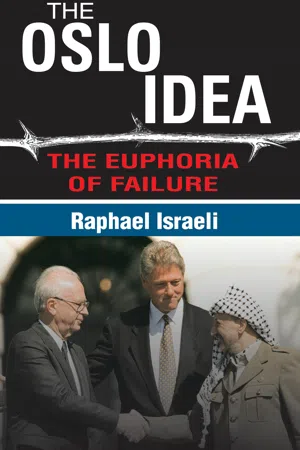
The idea of peace is always enchanting, for it encompasses the tranquility and serenity for which every human yearns. The nation of Israel has never known peace, but it dreams of peace. In practice Israel navigates between the poles of war and peace, with endless middle-of the-road situations like cease-fire, truce, armistice, and other temporary cessations of hostilities. The Oslo Idea traces the roots of the current campaign to delegitimize Israel. The campaign is not linked to Israeli resistance, to the absence of an acceptable settlement between Israel and the Palestinians, or to Israel's reluctance to abandon territory. It results from a change of tactics by the Palestinian leadership. Israeli argues that these tactics have been used to exhaust, reduce, and replace Israel rather than produce a compromise. Half the Palestinian people and other uncompromising Arabs and Muslims have stated that goal openly and act to achieve it. Raphael Israeli deconstructs the immense illusion of the Oslo peace accords, which initiated the so-called -peace process.- He shows how Oslo lured a naive Israeli leadership into a trap. He shows how outside factors, bent on finding and supporting an evasive peace, have helped perpetuate the fiasco Oslo represents. He shows how Oslo's supporters have advanced the -peace process- by coaxing and threatening Israel behind the scenes, and binding Israel alone with the Oslo commitments and their derivatives. More importantly, the author outlines and analyzes the basic and seemingly unbridgeable points of contention that remain: security, refugees, settlements, water, borders, and the status of Jerusalem itself.
Trusted by 375,005 students
Access to over 1.5 million titles for a fair monthly price.
Study more efficiently using our study tools.
Information
1
What Happened in Oslo? The Conspiracy
The Oslo process was launched in two stages: the first informally between Palestinians of authority and Israeli academics, not from the first ranks of Israel’s scholars, nor representing the top universities of the country, who generally believed in the Rabin–Peres leadership and in their capacity to produce a peaceful solution to the escalating Israeli–Palestinian dispute. Israel, having concluded a peace treaty with Egypt, which was regarded as the most dangerous of its enemies, was now ready to focus on the rest of its immediate rivals: the Syrians, the Jordanians, and the Palestinians, who came to be viewed as separate entities, unlike the position of Shamir who lumped together the latter two and tended to look and deal with the Palestinians only in the context of a settlement with Jordan. Only when those first exploratory contacts between the two parties of academics seemed to promise some advance, it became necessary to promote them into negotiations, which although still informal, involved participation of politicians of both sides, which if fruitful would have to become formal, public, and binding, and lead to some sort of agreement. It is, then, imperative to describe what happened in Oslo, on both the academic–personal and political–diplomatic levels.
According to the narrative of Yair Hirschfeld, one of the two Israeli academics, from Haifa University, who launched the initiative, the genesis of Oslo goes back to the year of 1990 when the young and hyperactive wunderkind of Israeli politics, Aryeh Der’i, the rising star and leader of the ultra religious Shas Party, who embraced a peace-orientation within the government coalition of Shamir, contrary to the traditional hawkish positions of religious parties, encouraged Peres to pursue his dovish program and cause the fall of the Shamir coalition government. Der’i prodded Peres at that point to withdraw from the unity government and lead a new coalition government with Shas’ participation. Indeed, in March of that year, the government fell, but contrary to the behind the scenes machinations by the “unrelenting subverter,” mainly due to Der’i’s last minute betrayal of the conspiracy, Shamir reconstituted the new narrow government with Der’i but without Peres, a scheme which won Rabin’s epithet of “the dirty trick,” and only deepened and dramatized the rift between Peres and Rabin, and pushed the latter to regain the helm of the Labor Party and become himself the new contender for the prime ministership instead of Peres his nemesis.
In those days, the Palestinian delegation, headed by Haidar abd-al-Shafi, one of the notables of Gaza, was subsumed by the Jordanian delegation to Washington, the venue where the Israeli–Arab negotiations were pursued, as the sequence to Madrid, which had been imposed on Israel and the Arabs following the Iraqi debacle in the Second Gulf War of 1990–1991 (the first had ravaged the Gulf during the Iran–Iraq War of 1980–1988). But, while Shamir and his government were not particularly disappointed with the impasse of those vain proximity talks, which they knew would involve vast Israeli concessions if they “succeeded,” the Israeli opposition “peaceniks” and their Palestinian counterparts sought ways to pull the talks from their grinding torpor. The Rabin government, which inherited that deadlock, and knew that the PLO did not back those negotiations which ignored it, was predisposed to examine new avenues, and to co-opt the preparatory and exploratory steps taken by Hirschfeld and his colleagues in concert with PLO officials, senior among whom were Abu Mazen, the second-in-command to Arafat, and Abu ‘Ala,’ the PLO economic expert and the head of the Palestinian delegation to Oslo.
From the outset, the differences between the two parallel tracks became evident and would guide the official one in Washington, whose minutes were recorded scrupulously, and only the Israeli team reported to its government and received instructions constantly, while the Palestinians were rather ignored by the PLO leadership, to inevitable deadlock; while in Oslo the reverse happened, with the Palestinians were approved by their leadership in Tunis and free to talk because no records were taken, while the Israelis were unofficial academics who could report to their contacts in the Israeli government (Peres and Beilin), but they were accountable to no one, and were free from the scruples of maintaining records or making any binding pledges. Moreover, while in Washington, Abd-al Shafi, lacking an authoritative overarching legitimacy, had a hard time reaching a consensus within his disparate delegation, which acted as part of the Jordanian program of settlement with Israel, the compact Palestinian delegation in Oslo represented the view of Arafat and was constantly speaking in one voice which reflected that of the leadership. Paradoxically, and understandably, the media constantly interfered with the deliberations in Washington, and with the need of the delegations to appear constructive, reasonable, and creative, but also principled and adamant, and forced the parties to prudence in their public statements and to diplomatic agility to make the positions of their authorities prevail. Conversely, Oslo was a free wheeling and open-agenda informal meeting, scrupulously kept under wraps, where all participants could raise the most outlandish ideas, which remained noncommittal because no records were taken and everything could be advanced or retracted at any time, without for it to become binding, unless a total agreement was crafted, adopted by the political leaderships, and then announced to the world.
Already in 1992, Hirschfeld met in Zurich with Sari Nuseibeh, a prominent Palestinian scholar, intellectual, and notable of the famous Nuseibeh clan in East Jerusalem, who counseled the Israeli scholar to try to draw into the informal talks the three essential Palestinian elements in order to secure their success: Yasser Arafat, whose presence and influence were needed politically and psychologically, though his tarnished figure after the Beirut debacle, and his exile in Tunis diminished him; Muhammed Abbas, alias Abu Mazen, his second-in-command, who controlled the machinery of the PLO and seemed amenable to negotiation and a settlement; and Faisal Husseini, the son of the legendary Palestinian commander of the Palestinian forces during the 1948 War, and a scion of one of the rival Jerusalemite rival clan of the Nuseibehs, who could rally the Palestinians in the West Bank (Gaza was Abd-al-Shafi territory), around any agreement reached. Hirschfeld was also encouraged by Hanan Ashrawi, the Christian star of PLO public relations and international media, whom he had met in conferences, to introduce himself to Ahmed Qurei, known as Abu ‘Ala,’ in order to advance his ideas, though both Ashrawi and Husseini, who were regarded as the local West Bank tier of PLO leadership and were weary of the seeming Washington impasse, were not fully aware of the impending Oslo alternative that was in the making.1
Against this background, Hirschfeld met with Abu ‘Ala’ in London on December 4, 1992, merely half a year into the Rabin government, where the prime minister conceded the post of foreign minister to his rival Peres, provided the latter did not interfere in the bilateral contacts with the Palestinians and other Arab parties, and his scope of authority was confined to the continuation of the multilateral contacts with all Arab parties in Washington, along the lines of the Madrid Conference. This meant that if there was to be any breakthrough on the bilateral level, it would have to be the result of circumventing Madrid and Washington, not of toeing their line. In that meeting, Abu ‘Ala’ seemed determined to effect a breakthrough and come to a positive result with Israel, evidently because the exiled leadership of the PLO in Tunis, who was under the threat to see its control of the Palestinians under Israeli rule dwindle, was desperately in need of a rescue buoy to remain afloat, and was ready, for the first time, to compromise on some of its previous rejectionist principles, as long as it could ensure a grip on the territories which were its turf and guaranteed the link and the control over its Palestinian constituency. This, of course, runs counter to the repeated argument of many leftists in Israel and the world, who erroneously claimed that since the 1970s and the 1980s the PLO was prepared for a practical settlement with Israel. What will unfold in the follow-up of Oslo provides more conclusive evidence for this thesis.
This newfound resolve of Arafat to come to terms kindled hopes among the Israelis, who though not so naïve as to the Palestinian schemes, were confident they could channel that Palestinian weakness in time of dire need, to their benefit in order to squeeze from them enough far-reaching concessions while standing fast with resilience on their basic demands for security and recognition by the PLO. But Arafat and his successors were to outsmart them on both scores, according them little and only retractable formulas which in fact meant nothing, while at the same time extracting from Israel recognition, territories, world legitimacy, and the acceptance of PLO armed forces, which would ultimately be turned against Israel, who armed them and let them in, assuming that they would keep internal order.
Hirschfeld’s blueprint for his well-calculated Oslo process started back in 1989, well before the elections of 1992 which brought Labor to power. In those years, he prepared himself and his group to the task of engaging the Palestinians in some sort of contact and informal talk, with a view of attaining a settlement with them. Those were the years of the first intifada, which had broken out in December 1987 and was triggered by a car accident along the Israel–Gaza border, where several Palestinians were killed and others wounded. Conspiracy theory which was rife, immediately imputed the accident to a purposeful Israeli plan to hurt Palestinians, and from an angry demonstration of protest, it erupted into a full-scale wave of civilian disobedience, which expanded into the West Bank and became a channel for the Palestinians to express their frustration from what they considered as Israel’s continued occupation and the lack of any solution in the horizon. Several years earlier, the poison hoax, under which Israel was accused of massive poisoning of school girls in the Jenin area on the eve on Jewish Passover in March 1983, in order to hurt their reproductive organs,2 left the Palestinians more suspicious than ever, and certainly did nothing to dissuade them from accepting that car accident as an unfortunate traffic mishap, the like of which happened every day.
The Palestinian uprising, which was spontaneous and grew out of that general atmosphere of fear and frustration, was soon embraced by the PLO leadership in Tunis as an opportunity to impose their leadership on the West Bank and Gaza, a process which generated the PLO gathering in Algeria in 1988, that declared the creation of the Palestinian state and created a sense of euphoria throughout the Palestinian territories, and a sense that independence was at hand. Hirschfeld and his group visited the West Bank and Gaza in those years, encouraging that trend of thought, if only Labor won the upcoming elections, and established contacts and caucuses for discussion with the local Palestinian leadership, chief among them were Husseini, Nusseibeh, Ashrawi, and several mayors, who swore allegiance to the PLO and its leadership. That was to be the first stage in this scheme, after which Yossi Beilin, who was in close association with that group, would from his opposition seat within Labor, channel those efforts into a practical political discourse. This activity had to remain discreet, because no politician of consequence would openly bear the responsibility of meeting up with PLO delegates, while the official state policy forbade such contacts, in view of its consideration of the PLO as a terror organization, with American backing. This policy was not only imposed by the Likkud-led government, but was also endorsed by Rabin, who was the defense minister until the “dirty trick” of 1990, and then elected as the new leader of the Labor Party, in replacement of Peres the “looser.” Peres, the sponsor of Beilin and his political associate, was to crystallize that policy in secret, true to his hard-won “relentless subverter” title, but when Rabin caught wind of those talks, he angrily forbade them and ordered them discontinued.
The collapse of that scheme, which Hirschfeld had so painstakingly and patiently labored to cultivate, with the latent support of Peres and Beilin, henceforth downgraded the talks he maintained with the local Palestinian leadership into “personal contacts,” when his political sponsors had to recede into the background. Despite this seeming freezing of the process, to which the PLO leadership attached much hope, the Palestinians were quite delighted to deal with the congenial and easy-going Hirschfeld, who made no harsh demands on them, though they knew that he also exercised no authority to concede anything to them. He was a welcome change for them compared to the tough, unyielding, and to their mind arrogant, Elyakim Rubinstein, a lawyer and diplomat, later to become the Israeli attorney general and then a Supreme Court Justice, who headed the Israeli delegation in Washington, and whose harsh reputation was spread all over the Palestinian press. Therefore, the PLO was deeply disappointed when Rabin did not replace him when he came to power in 1992, and as they learned that in the continued Washington negotiations, their allies Peres and Beilin, will have no say. That was a bad omen to them.
But since the “relentless subverters” were hard at work to find ways to circumvent Rabin’s directives and revive their frozen initiative, they took advantage of the full authority the prime minister left in their hands—Peres as the foreign minister and Beilin as his deputy, to deal with the multilateral aspects of the Washington process, and to let into the various working groups (on refugees, water, arms control, economic development, environment, etc.) handpicked Palestinian delegates to their liking, thus in fact breathing a new life into the deadlocked informal negotiations that Hirschfeld had begun, Peres and Beilin endorsed, and Rabin prohibited. Thus they set their sight on building confidence with PLO delegates without raising the wrath of their prime minister, who at that point still held to his preelection pledge of not recognizing the PLO nor negotiating with it. They developed a duplicitous approach to the negotiations: on the official level, pursuing the discussions in the working groups which they selected, using the Egyptian foreign minister, ‘Amr Musa, as a surrogate for contacts with Arafat himself; and resorting to the Hirschfeld group to renew the frozen informal talks with the local leadership of the PLO in the territories. Soon Rabin began to suspect that Peres was negotiating with the PLO behind his back, and in the fall of 1992, frustrated Hirschfeld, who had invested the better part of the previous decade building confidence with the Palestinians, seriously considered retreating from the whole affair and returning to his academic occupation.
According to Hirschfeld’s narrative,3 several developments suddenly injected an optimistic note into the prospects of reviving the talks and kindling his hopes. First, it was a public speech by Rabin, where he compared the PLO to the World Zionist Organization, which amounted to legitimizing Arafat, and that prompted Beilin, no doubt at Peres’ instigation, to table in the Knesset a law legitimizing meetings of individuals with PLO members, hitherto forbidden by law. Evidently, that was geared to lend legitimacy to the bilateral meetings with the PLO that he was scheming. Those demarches may have been considered at the time measured and well-reasoned toward normalizing the relationship with the Palestinians and pave the road to negotiations with them, had the Israeli politicians insisted that parallel changes should have occurred in the Palestinian positions. In fact, in pursuance of those unilateral steps initiated by Israel, the Palestinians were never asked to recognize Zionism as the movement of national liberation of the Jewish people, nor did they ever volunteer to do so, as Rabin and Beilin did vis-à-vis their PLO, with the end result that the Palestinian National Charter still treats Zionism as racism and vows to eliminate it.
At the same time that these momentous developments were taking place, though Rabin’s open-minded statement may have been done absentmindedly, Hirschfeld who had no official status in this process, received from an official European Union (EU) representative the copy of a document composed by Abu ‘Ala,’ who was then the chief spokesman of the PLO in the multilateral working groups, and evinced a penchant to discuss the economic issues involved. The document, though hostile to Israel in Hirschfeld’s judgment, seemed to him to follow Peres’ line of thinking about the future economic cooperation between the parties to the conflict. This is what triggered his interest in meeting Abu ‘Ala,’ who dwelt in those days with Arafat in Tunis, and this is also what inaugurated the furtive European contacts with leftist opposition groups in Israel (and began to finance them), who supported the Palestinians and negotiations with them, over the head of the government of Israel, with which the European community maintained official relations, both collectively as a EU and bilaterally with each European country separately.
Hirschfeld then introduced Terje Larsen, a Norwegian sociologist, who headed the applied social sciences institute in Oslo (FAFO), into those preparatory talks. Larsen became an enthusiast of such informal negotiations, recommended a meeting with Abu ‘Ala’ whom he knew, and offered to assist in pushing the idea forward. No one at that point asked Hirschfeld on what authority he was negotiating, whom he represented, or how far he could proceed with his projected Palestinian interlocutors. In those days the steering committee for the official multilateral talks was due to convene in London, with Beilin heading the Israeli delegation, as the deputy foreign minister, and Abu ‘Ala’ heading his team, though he was not to participate personally in the deliberations. Hirschfeld seized the occasion to connect with Abu ‘Ala,’ knowing that Beilin would be available in the neighborhood. But he also knew that the Israeli law banning such meetings was still in force, therefore even if he should come to an understanding with the Palestinians, that would be considered illegal and null and void, and he could even be prosecuted in consequence.
On November 30, 1992, Hirschfeld and his associate, Ron Pundak, also a like-minded academic of Haifa University, rendered a visit to Hanan Ashrawi in Ramallah, which was to launch them onto the new course. At that point both sides were still very pessimistic about any bright prospects for their ideas. According to Hirschfeld’s narrative, Ashrawi as a Christian was afraid of the mounting challenge to the PLO by the “extremist” Islamic movement of the Hamas. But as it turned out, the PLO was no less extremist, if one reads the annihilationist designs against Zionism that are still present in its national charter. Experience later showed that Arafat later collaborated with Hamas terrorists, and he turned against them only when they jeopardized his rule. Therefore, using this rhetoric of Islamic extremism as a scarecrow to press Israel and the West into more concessions, had an effect on Israeli negotiators on the left like Hirschfeld, and derailed the talks on more than one occasion as we shall see. On that occasion, Ashrawi prevailed on Hirschfeld to meet with Abu ‘Ala’ on his impending trip to London. The latter left in her hands the phone number of his cousin in London, where he was to stay, and so set in motion the entire PLO machinery which was alerted and challenged to respond. Indeed, Husseini was talked by Ashrawi into supporting that initiative, and they both contacted Akram Haniyeh, a PLO operative, their main liaison in the HQ in Tunis, to alert the top leadership of the impending demarche. Haniyeh, who had been a Jerusalemite and the editor of al-Sha’b daily, had been exiled by defense minister Rabin in 1986, and was put in charge of the liaison between the PLO leadership in Tunis, and the local one within the territories. Arafat gave his blessing and the process was launched.4
When Hirschfeld reached his cousin’s home in London, on December 3, a message was waiting for him from Afif Safieh, the PLO representative in London, to arrange for the meeting with Abu ‘Ala,’ and another from Terje Larsen, with whom he met the next morning. When he confided to his Norwegian friend the forthcoming meeting with Abu ‘Ala,’ Larsen enthusiastically supported the idea and promised that the Norwegian government would assume all the expenses to facilitate such meetings and would keep the entire affair secret, knowing that its progenitor was acting against Israeli law. Thus acted the friendly government of Norway in circumventing the government of Israel with whom it maintained cordial relations, while supporting and encouraging an Israeli citizen who acted against the law of his country, noble and worthy his intentions as they may be. Hirschfeld and Abu ‘Ala’ met in the restaurant of Larsen’s hotel in town, early morning on December 4. The former was deeply impressed with the personality of the latter, found him humorous, tactful, sensitive, and smart, but also a tough negotiator when he defended his positions. He immediately made it clear that he and Arafat were determined to come to terms with Rabin, a measure of their desperate situation to extricate their cause from the low ebb in which it found itself in remote and out of the way Tunis. However, Hirschfeld found Abu ‘Ala’’s ideas very detached from reality at first, something that necessitated more and more arduous meetings, all this still without the knowledge, much less the authorization, of the Rabin government.
At some point, Abu ‘Ala’ suggested that both parties should work out a paper that could be approved and backed by the outgoing Republican administration of Reagan, in which former Secretary of State Baker was now the White House Chief of Staff. Evidently, savvy and cunning Abu ‘Ala’ wished to use Israel’s auspices to seize upon the last days of the American administration which was traditionally inimical to the PLO, to legitimize it. Hirschfeld acted as if he were the Israeli emperor when he asked for “time to ponder t...
Table of contents
- Cover Page
- Half Title
- Title Page
- Copyright Page
- Dedication
- Apologia and Acknowledgments
- Introduction—The Oslo Idea
- 1. What Happened in Oslo? The Conspiracy
- 2. What Happened to Oslo? The Debacle
- 3. Palestinian Identity between Nationalism and Islam
- 4. Territories and Security
- 5. Palestinian Refugees and Israeli Settlers
- 6. United Jerusalem in a Jewish State
- 7. Foul Environment: Land Pollution and Ambience Poisoning
- 8. Options for Extra-Oslo Solutions
- Summary Reflections
- Bibliography
- Index
Frequently asked questions
Yes, you can cancel anytime from the Subscription tab in your account settings on the Perlego website. Your subscription will stay active until the end of your current billing period. Learn how to cancel your subscription
No, books cannot be downloaded as external files, such as PDFs, for use outside of Perlego. However, you can download books within the Perlego app for offline reading on mobile or tablet. Learn how to download books offline
Perlego offers two plans: Essential and Complete
- Essential is ideal for learners and professionals who enjoy exploring a wide range of subjects. Access the Essential Library with 800,000+ trusted titles and best-sellers across business, personal growth, and the humanities. Includes unlimited reading time and Standard Read Aloud voice.
- Complete: Perfect for advanced learners and researchers needing full, unrestricted access. Unlock 1.5M+ books across hundreds of subjects, including academic and specialized titles. The Complete Plan also includes advanced features like Premium Read Aloud and Research Assistant.
We are an online textbook subscription service, where you can get access to an entire online library for less than the price of a single book per month. With over 1.5 million books across 990+ topics, we’ve got you covered! Learn about our mission
Look out for the read-aloud symbol on your next book to see if you can listen to it. The read-aloud tool reads text aloud for you, highlighting the text as it is being read. You can pause it, speed it up and slow it down. Learn more about Read Aloud
Yes! You can use the Perlego app on both iOS and Android devices to read anytime, anywhere — even offline. Perfect for commutes or when you’re on the go.
Please note we cannot support devices running on iOS 13 and Android 7 or earlier. Learn more about using the app
Please note we cannot support devices running on iOS 13 and Android 7 or earlier. Learn more about using the app
Yes, you can access The Oslo Idea by Raphael Israeli in PDF and/or ePUB format, as well as other popular books in Politics & International Relations & Diplomacy & Treaties. We have over 1.5 million books available in our catalogue for you to explore.