- 450 pages
- English
- ePUB (mobile friendly)
- Available on iOS & Android
eBook - ePub
About this book
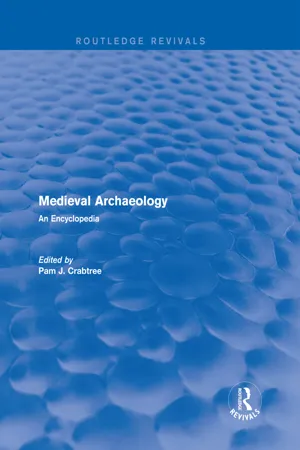
First published in 2001, this is the first reference work to cover the archaeology of medieval Europe. No other reference can claim such comprehensive coverage -- from Ireland to Russia and from Scandinavia to Italy, the archaeology of the entirety of medieval Europe is discussed.
With coverage ranging from the fall of the western Roman empire in the 5th century CE through the end of the high Middle Ages in 1500 CE, Medieval Archaeology: An Encyclopedia answers the needs of medieval scholars from a variety of backgrounds, including archaeologists, historians and classicists. Featuring over 150 entries by an international team of leading archaeologists, this unique reference is soundly based on the most important developments and scholarship in this rapidly growing field.
Trusted by 375,005 students
Access to over 1.5 million titles for a fair monthly price.
Study more efficiently using our study tools.
Information
A
Aggersborg
See Trelleborg Fortresses.
Alt Clut
See Scotland: Early Royal Sites.
Anglo-Saxons
See England.
Animal Husbandry
The period between A.D. 500 and 1500 encompasses many changes in animal husbandry in northwest Europe. The most important was probably the transition of agricultural produce from the context of a subsistence economy to that of a cash commodity, in which the production of a surplus and long-distance trade became its primary purpose. This change was not consistent either temporally or spatially, but it generally coincided with the advent of a widely based monetary economy in any given area.
Livestock husbandry during the Medieval period was characterized by underdevelopment and low productivity, with improvement, in most cases, beginning only during the postmedieval period. It has been estimated that, between the fourteenth and the nineteenth centuries, carcass weights of sheep and cattle trebled, fleece weights increased 2.5-fold, and milk yields increased fourfold. This increase was achieved by improved breeding and, more important, by improved feeding. It is estimated that the average live weight of medieval cattle was as low as c. 200 kg, of pigs 60 kg, and of sheep 30 kg. Medieval livestock were also slow growing and took much longer to develop to full size than their modern counterparts.
The principal limiting factor for the rearing of all livestock during the Medieval period was the availability of feed, especially during the winter. Strategies for feeding livestock were generally underdeveloped, and this is reflected in the fact that, in English estates, the stocking densities during the medieval period tend to be consistently lower than in the same areas during the early post-medieval period.
Two approaches were taken to manage the availability of winter fodder during the Medieval period. In areas in which the winters were particularly severe, such as continental Europe and Scandinavia, the snow cover was regularly so deep and long lasting that livestock could not exploit any winter grazing that might be present. The only option was to keep the animals indoors during the winter and bring the fodder to them. The archaeological evidence for this consists of long stall houses with part of the building given over to human habitation and the remainder divided into stalls for animals. Viking sagas often refer to the saving of hay, and evidence for the practice of hay saving is provided by the presence of scythes on archaeological sites. The importance of hay is reflected in Frankish laws that deal with the cutting and stealing of hay from the meadows of others. Organic material in prehistoric longhouses has shown that, instead of hay, the winter fodder consisted of gathered leaves, and it seems likely that this practice continued into the Medieval period.
In the more temperate west, it was possible to leave the livestock outdoors throughout the year. The Venerable Bede, living in northern England, noted of Ireland that snow rarely lay on the ground for more than three days and that, consequently, the Irish did not need to save hay or stall animals. This implies that winters were more severe in England and that hay saving and overwintering in stalls was necessary. In Ireland, and other temperate areas, the absence of the practice of saving hay meant that an alternative strategy had to be undertaken to ensure that livestock would survive the winter. The Irish laws make it clear that certain areas of “preserved grass” were cordoned off during the summer and reserved for winter grazing, and the dead winter grass in these reserved areas served the same purpose as hay. All methods of managing fodder depended on adequate fencing and supervision of the herds by shepherds, and much early law is concerned with livestock breaking into the fields of others. The documentary sources testify to the use of hobbles and bells, as well as the branding of livestock, in order to control and monitor the grazing of livestock.
In the more extreme areas, such as the islands of Scotland, it is clear that the reproduction rate of livestock clearly outstripped the ability of the land to produce adequate fodder. A nineteenth-century Scottish Hebridean saying stated that it was “better to have one calf than two skins,” and it was policy throughout much of post-medieval Scotland to kill every second calf. That this policy was also undertaken during the Medieval period is clearly evidenced by the presence of large quantities of very young calf bones on Scottish archaeological sites of the period.
One of the principal ways of preserving winter fodder, be it in situ preserved grass or utilizing grassland for the production of hay, was to move the livestock to temporary grazing grounds during the summer. The nature of these summer transhumance grounds depended on the topography of a given area. They were essentially marginal areas that were unsuitable for livestock during winter because they were too wet or too high and exposed. In general, they consisted of either mountain areas or bogs and marshlands into which the shepherds and their flocks would move during the summer months. In Ireland, evidence for these seasonal pastures can be found in the form of enclosures and small huts in upland areas in County Down that have been dated to the eighth century A.D. Documentary sources provide evidence for similar transhumance areas in northern England. The Venerable Bede, in his life of St. Cuthbert written c. A.D. 700, tells of the saint encountering some “shepherds huts, very makeshift constructions, built for the summer, and deserted.” Such exploitation of summer pastures was a continual feature of livestock rearing throughout the Medieval period. The summer pasturing of sheep in the French Alps is well documented during medieval times, and both the routes taken and the areas grazed were strictly regulated.
It must be stressed, however, that long-distance transhumance could be practiced only in areas where marginal land was readily available. The practice was alien to many farmers during the Medieval period. In the great expanses of rich arable land of southern England, the provision of fodder was firmly imbedded within the greater farming system of the production of cereals, and the grazing of livestock was undertaken over a much more limited geographical area. In seventh- and eighth-century Anglo-Saxon England, every village or group of two or three villages had an area of grazing commonage known as the feld. This was usually the poorest land in each particular area, and the herds were confined to this land while the hay and the grain were being grown in the better areas. After harvest, the livestock were moved onto the stubble to graze and, equally important, to fertilize the ground with their dung. Sheep provide the richest of all dungs, with higher levels of nitrogen, potassium, and phosphorus than that of cattle, for instance. Medieval farmers were acutely aware of this; during the period, there is a clear correlation between the importance of cereals in a given area and the number of sheep kept. Thus, large quantities of sheep are a feature of the great cereal areas of the south of England throughout the Medieval period. The importance of sheep dung is emphasized by continual litigation during the Norman period (eleventh-twelfth centuries) concerning the rights of having an estate’s sheep grazing on an individuals stubble. The lords of many manors often ordained that their tenants’ sheep had to graze on the stubble of the fields belonging to the lord, so leaving the tenants’ own arable land bereft of fertilizer.
The seasonal availability of fodder often dictated the time of year at which some animals were slaughtered. The dearth of winter fodder often led to the killing and curing of excess livestock in autumn. The traditional date for this was around Martinmas, which falls on November 11. The accounts of a certain Alice de Bryene of Acton in Suffolk in 1418–1419 indicate that, of seventeen cattle slaughtered by the household in that year, ten were killed in October and November. Of eighty-one sheep killed in the same year, thirty-one were killed before June, while fifty were killed after shearing in the late summer and autumn.
The management of pigs differed greatly from other livestock. They lived on roots and tubers rather than grass, and their favored grazing areas were not the open fields but the forest, where their diet during the autumn was augmented by beech and oak mast (i.e., the fallen nuts of those trees). Anglo-Saxon and Irish documentary sources consistently associate the rearing of pigs with forest. The seventh-century Saxon laws of Ine make it clear that forest-mast pasturage was regulated, and a tenth-century Irish text notes that eight sacks of mast were collected under each tree during a particularly good year of mast growth. This implies that mast was collected like hay and could be brought to the stalled animals. Indeed, during the following century Irish sources record the selling of mast at market, indicating that it had been elevated to the status of a cash crop. The pre-A.D. 1000 Irish sources are more specific than either Anglo-Saxon or Frankish texts in describing the range of food consumed by pigs. Along with mast, it included the roots of ferns, hazelnuts, and kitchen waste; pigs were fattened for slaughter on grain and milk. To rear pigs efficiently, access to forested lands was necessary. Where such resources were unavailable, the effect on pig production is reflected in the faunal remains from archaeological sites. The windswept islands of Scotland had virtually no forest during medieval times, and, consequently, only small quantities of pig remains are found on sites of the period.
Pigs were principally, if not exclusively, meat-producing animals. Their ability to thrive on the late autumn and winter mast crops meant that their meat-producing cycle differed from other livestock, ensuring a more even distribution of meat throughout the year. Unlike other animals, they could also be reared within towns, where domestic waste would have constituted much of their diet. They were especially popular during the Viking period (c. A.D. 800–1050); faunal remains from urban areas throughout western Europe at that time often demonstrate that pigs outnumbered other animals.
While the documentary sources provide much information concerning the management of different species, one must turn to the archaeological evidence to determine the relative importance of the different species at any given place or time. Such data are often at odds with the contemporary documentary evidence and also show great regional and temporal variation. Anglo-Saxon laws have led one leading livestock historian to conclude that “the pig was almost certainly the hallmark of Saxon pastoral husbandry, far more so than the ox or sheep.” Yet, this impression is not supported by the remains of animal bones from Anglo-Saxon settlements. Most have indicated that sheep were numerically the most important species present, with pigs usually in third place behind cattle. This literary bias toward pigs is also noted in contemporary Irish sources, with a noted historian concluding that “there are no beef-eating heroes in Irish literature, the doughtiest Irish warriors relied on pig-meat for their protein”—a sentiment belied by the zooarchaeological evidence, which generally shows cattle to be the dominant animal present. Frankish laws, too, emphasize the importance of pig, but again this is contradicted by faunal evidence. It seems likely that this overemphasis simply reflects the dietary preferences of the aristocratic class, whose members both compiled the laws and produced the non-legal literature that has survived to the present. Pork was the preferred food of the aristocratic feast, while the other animals tended to be regarded as inferior species. Tastes, however, change, and, in the later Middle Ages, beef was regarded among the affluent classes as a superior meat to either pork or mutton.
It is extremely difficult, on the basis of faunal remains from archaeological sites, to ascertain the specific way in which animals were used. The exception was pig, which was regarded exclusively as a meat-producing species. Cattle and sheep could be exploited for a range of purposes, including meat, milk, traction, wool, and hides, and the emphasis on these different products varied greatly. The Irish documentary evidence suggests that, during the early Medieval period, cattle were kept primarily for their milk, but elsewhere in Europe their value as plow animals was considered of primary importance. In both instances, it appears that meat was regarded as a secondary product. Cattle are not the only producers of milk, and late Anglo-Saxon sources, including the Domesday Book, make it clear that sheep were the principal suppliers of this produce. The Domesday Book implies that meat and wool were regarded as being of secondary importance as far as sheep were concerned.
The Domesday Book includes a census of livestock in England in 1086 and, in many ways, demarcates the passing of the old order as far as livestock husbandry was concerned. Until then, livestock rearing could be regarded as an aspect of an enclosed farming economy. Essentially, animal produce, be it meat, milk, hides, or wool, provided the necessities of life for the farmer and his family with any excess constituting renders and tribute to the local lord or chief. Trade of livestock produce would have been very limited. The introduction of a monetary economy transformed this system, with the production of a cash surplus becoming the primary motivation for all levels of farming society. The lord no longer wanted his rent in food tribute but instead demanded it in the form of cash. While livestock-rearing strategies had been organized in the past to service local needs, they were now generally dictated by regional and international markets. The more perishable goods, such as meat and dairy produce, were sold in local or regional markets, whereas wool and grain could be stored, transported, and traded i...
Table of contents
- Cover
- Title
- Copyright
- Original Title
- Original Copyright
- Dedication
- Contents
- Preface
- Acknowledgments
- Contributors
- Site Entries by Country
- Subject Guide
- Entries A to Z
- Index
Frequently asked questions
Yes, you can cancel anytime from the Subscription tab in your account settings on the Perlego website. Your subscription will stay active until the end of your current billing period. Learn how to cancel your subscription
No, books cannot be downloaded as external files, such as PDFs, for use outside of Perlego. However, you can download books within the Perlego app for offline reading on mobile or tablet. Learn how to download books offline
Perlego offers two plans: Essential and Complete
- Essential is ideal for learners and professionals who enjoy exploring a wide range of subjects. Access the Essential Library with 800,000+ trusted titles and best-sellers across business, personal growth, and the humanities. Includes unlimited reading time and Standard Read Aloud voice.
- Complete: Perfect for advanced learners and researchers needing full, unrestricted access. Unlock 1.5M+ books across hundreds of subjects, including academic and specialized titles. The Complete Plan also includes advanced features like Premium Read Aloud and Research Assistant.
We are an online textbook subscription service, where you can get access to an entire online library for less than the price of a single book per month. With over 1.5 million books across 990+ topics, we’ve got you covered! Learn about our mission
Look out for the read-aloud symbol on your next book to see if you can listen to it. The read-aloud tool reads text aloud for you, highlighting the text as it is being read. You can pause it, speed it up and slow it down. Learn more about Read Aloud
Yes! You can use the Perlego app on both iOS and Android devices to read anytime, anywhere — even offline. Perfect for commutes or when you’re on the go.
Please note we cannot support devices running on iOS 13 and Android 7 or earlier. Learn more about using the app
Please note we cannot support devices running on iOS 13 and Android 7 or earlier. Learn more about using the app
Yes, you can access Routledge Revivals: Medieval Archaeology (2001) by Pam J. Crabtree in PDF and/or ePUB format, as well as other popular books in History & European History. We have over 1.5 million books available in our catalogue for you to explore.