eBook - ePub
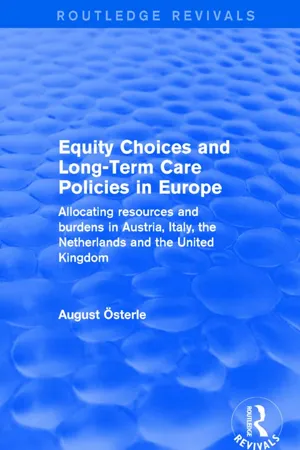
Equity Choices and Long-Term Care Policies in Europe
Allocating Resources and Burdens in Austria, Italy, the Netherlands and the United Kingdom
- 216 pages
- English
- ePUB (mobile friendly)
- Available on iOS & Android
eBook - ePub
Equity Choices and Long-Term Care Policies in Europe
Allocating Resources and Burdens in Austria, Italy, the Netherlands and the United Kingdom
About this book
This title was first published in 2001: Employing an interdisciplinary and comparative approach to equity in long-term care, this book addresses the fact that demographic changes leading to ageing populations, financial pressures and changes in traditional support systems have brought long-term care and the redesign of care systems to the top of the European social policy agenda. Despite the importance of this issue, however, the question of equity in long-term care has until now received relatively little attention in social policy research. Rather than focusing on theories of social justice or the analysis of specific interpretations of equity, this book develops key dimensions of equity choices in a framework for systematic comparative analysis. This tool is then used to investigate long-term care policies in Europe, exploring equity choices in both the provision and the finance of long-term care. These choices are discussed comparatively with regard to the implications for the various actors and are also contrasted with basic welfare state objectives. This book represents an important addition to comparative research into several key areas of welfare and welfare state design. It explores the division of responsibilities in long-term care systems between the public and private and formal and informal sectors, the relationships between different welfare state objectives, the different types of welfare state intervention, and the principles and choices surrounding the allocation of resources and burdens.
Trusted by 375,005 students
Access to over 1.5 million titles for a fair monthly price.
Study more efficiently using our study tools.
Information
1 Introduction
It is only recently that long-term care became a major social policy issue in all welfare states. The debate on how to redesign long-term care policies is shaped by an increasing demand for care, changes in formal as well as informal support systems, changing values and attitudes towards informal care-giving and the division between private and public responsibility, as well as incentives and challenges from the social, political and economic environment.
Parallel to the novelty on the top-agenda of social policy, long-term care is one of the less researched areas in social policy. Long-term care has often been equated with care in nursing homes, reflecting the fact that public expenditure primarily was directed at this type of care setting. In recent times, parallel to the emphasis on care in the community, long-term care is more often equated with social services for the elderly. Although important, both aspects only represent parts of the wider long-term care issue. Apart from the provision of in-kind services, some countries nowadays regard payments for care as the key to their long-term care systems. In most countries there is a slow growing awareness of the gendered issue of informal care-giving, regarding long-term care policies not just as an approach to support those in need of care but also those who informally provide an often enormously burdensome amount of care. Overall, considerably less emphasis in research has been put on the long-term care system as a whole, which is even more true for cross-country comparative research.
Only in the 1990s was there an increase in comparative research on long-term care. The OECD produced a series of publications on the topic (e.g. OECD 1998; 1996; 1994) and the EU addressed the issue in the European Observatory on Ageing and other research activities (e.g. Pacolet, Bouten, Lanoye, Versieck 2000; Bettio, Prechal 1998; Walker, Guillemard, Alber 1993). A number of comparative studies looked at long-term care systems (Martin 2001; Brodsky, Habib, Mizrahi 2000; Eisen, Mager 2000; Rostgaard, Fridberg 1998; Weekers, Pijl 1998; Tester 1996; Giarchi 1996; Hugman 1994; Jamieson, Illsley 1990). Other studies focused more specifically on payment for care programmes in long-term care (Weekers, Pijl 1998; Evers, Pijl, Ungerson 1994; Glendinning, McLaughlin 1993), on home and family care (Hutten, Kerkstra 1996; Baldock, Ely 1996; Leseman, Martin 1993; Jani Le-Bris 1993; Jamieson 1991), on gender issues in care (Ungerson 2000; Knijn, Kremer 1997; Ungerson 1995), on employment and care relationships (Naegele, Reichert 1999; Naegele, Reichert 1998; Phillips 1995) or a variety of specific economic questions (e.g. contributions in Eisen, Sloan 1996). Many of these studies include detailed descriptions of the respective elements in national long-term care systems, offering a valuable basis for any further research. The necessity of a multi-disciplinary and multi-dimensional approach in comparative work is widely accepted, but in the realisation only at the beginning. Efforts in cross-country comparative research have been hindered by considerable policy variations amongst and within countries, problems and constraints in data availability and comparability, as well as the lack of conceptual and analytical frameworks considering the specific characteristics of long-term care. The latter issue of missing analytical tools is one of the themes addressed in this book.
In this study the issue of long-term care is brought together with equity, which is at the core of welfare state and social policy definitions. Equity has been a central theme of the welfare state from the outset. And equity is an attractive label in social policy making. On the other hand, equity is still described as an ‘elusive’ issue. Approaches in analysing equity and even the definitions of equity vary considerably across and even within disciplines.
Searching for equity studies in long-term care is an almost fruitless task, although there are exceptions such as Evandrou, Falkingham, Le Grand, Winter (1992), Bebbington, Davies (1983) or most recently Davies, Fernandez, Nomer (2000) and Davies, Fernandez, Saunders (1999). However, most of the few existing studies address very specific interpretations of equity, other studies are locally restricted, or include only one type of service provision within the complex arena of long-term care. Although the concept of equity or equality is introduced in a number of studies, it is rarely based on an explicit specification of what is meant by equity or an equitable allocation. If there is such a specification, the choice of a specific interpretation often seems to be based on a mixture of what is supposed to be a widely accepted interpretation and what is going to be testable, given the data available.
Taking the broader perspective at equity studies in social policy one can identify three main streams of equity research: those studies analysing social policy issues in the light of theories of social justice, empirical studies investigating social justice perceptions and judgements, and those studies testing specific interpretations of equity (see part 3). The first line of normative research is very much theoretical with very little links to empirical studies. The second approach is focusing on justice beliefs and judgements with regard to allocation and distribution of resources and burdens on different levels of society. The third line of research has created a substantial amount of knowledge regarding the outcome of allocational procedures and the distribution of various resources with respect to specific interpretations of equity. What is widely ignored in research, is the way equity is translated into practice, the wide range of interpretations of equity that are used in practice. ‘& there have been virtually no attempts to study the whole range of questions of this kind, and to develop a conceptual and theoretical framework to describe and explain how institutions allocate goods and burdens.’ (Elster 1992: 2)
With the focus on concrete situations, the ‘empirical rules of equity’ in long-term care and the way resources and burdens are allocated, a number of questions arise that will be addressed in this study: What does equity in long-term care mean? What are the relevant dimensions in equity interpretations? What does equity look like in actual long-term care policies? How does the state intervene in the allocation of long-term care services? How are payments for care distributed? How does the state allocate the burdens of financing long-term care? What are appropriate approaches to address these questions in a comparative perspective? How do different equity interpretations fit with basic equity objectives of the welfare state? What are the consequences of different approaches on care receivers? What are the impacts of different equity rules for informal care givers?
Regarding the research topic of ‘Equity and Long-Term Care’, two major gaps in research have to be identified: First, there is a lack of conceptual and analytical frameworks for a comparative study of long-term care issues. Second, there is a lack of equity research focusing on the variety of equity approaches to be found in practice. This study attempts to reduce these gaps in social policy research and to contribute to a better understanding of long-term care and equity issues in a comparative perspective.
Research questions and methods
By bringing together the social policy issues of long-term care and equity, the objective of this study is to comparatively analyse long-term care policies in Europe with regard to equity choices and to contrast the respective choices in selected countries with basic equity objectives in the welfare state.
The theoretical objective of this study is to contribute to the understanding of the rules and interpretations of equity to be found in long-term care policies by developing and conceptualising an analytic framework for the comparative study of equity choices in long-term care policies. ‘Choices’ here terminologically point to the wide array of possibilities and potential decisions that can be made in the policy process to pursue the objective of equity. The focus here is not on the process but on the outcome of the process and herewith the design of long-term care policies with regard to equity. At the same time, choices that have been made are an important input for the actual provision, consumption and finance of long-term care. As suggested by the term long-term care policies’ rather than long-term care’, the focus is on the role of the welfare state in designing the long-term care system.
This concept requires a theoretical and conceptual consideration of long-term care as well as equity. As for long-term care, a clear definition of the concept and the content of long-term care is required to clarify the potential role and the objectives of the welfare state in long-term care. In order to systematically examine equity considerations in long-term care policies, the institutional and policy mix in long-term care has to be unpacked.
The equity focus of this study is on equity as a social policy objective, on how public policies interfere in long-term care systems by providing, financing, and regulating long-term care in terms of equity. It is not the objective of this study to analyse the normative question of how equity should be defined in long-term care or to analyse one specific interpretation of equity in long-term care, but to develop a framework covering the range of interpretations of equity.
Traditionally, categorisations according to welfare state principles such as universality vs. selectivity or social rights vs. social insurance vs. social assistance are used in this context. This is, for example, a convincing approach in searching for welfare state clusters or welfare state families, showing similar features across social policy areas. It does not, however, provide us with a clear picture of whether or not and to what extent equity objectives are promoted in single policy areas. Therefore, this study develops a different approach allowing a more thorough analysis of equity issues. The study will follow three basic characteristics according to which equity choices or interpretations of equity may differ: what is to be shared (that is the kind of goods to be shared, be it resources, benefits, burdens, costs, etc.), among whom (that is the subjects of the allocation procedure), and how (that is the principles according to which goods are allocated).
As mentioned before, equity research in social policy has been very much concentrated either on the analysis of social policy issues in the light of theories of social justice or the evaluation of outcomes with regard to very specific interpretations of equity. Both these approaches widely ignore the broad range of equity interpretations to be found in the design of welfare states. And this, in fact, is the focus of the study. It attempts to develop an analytical framework and to use that framework to investigate how public policies intervene in the allocation of resources and burdens in long-term care. Furthermore, the analytical framework offered here represents a helpful tool not just for the empirical study undertaken within this project but for future research on equity issues in long-term care as well as in other areas of social
The empirical objective of this study is to contrast equity choices in different European countries with basic equity objectives in the welfare state. It will be studied whether or not and to what extent actual allocation policies are promoting these equity objectives. The countries selected are Austria, Italy, the Netherlands and the United Kingdom. These countries are generally regarded as representatives of very different welfare state models with regard to objectives, design and outcome. At the same time they share a cultural and socio-economic context and major social and economic to the welfare state.
Explicitly or implicitly, welfare state definitions and social policy definitions include notions such as equity, justice or equality, they are even at the core of these definitions. Equity is widely accepted as an objective in social policy and is an attractive label in social policy making. However, apart from a basic agreement on equity as an objective of the welfare state, we are far from reaching an agreement on what constitutes equity. Precise specifications of equity are rare. There is no common clear-cut definition of equity as a welfare state objective. The study, therefore, will use a set of underlying the concept of modern welfare states.
Whether or not and to what extent these objectives are promoted in the countries selected will then be tested by investigating how public policies intervene in the regulation, provision and finance of long-term care. Here, the analysis follows the framework developed in the theoretical and conceptual part of the study. The empirical analysis of the actual choices made in the design of long-term care policies is divided according to the provision and the finance of long-term care. Considerable attention will be paid to the role of informal care givers and how they are addressed by long-term care policies as in-kind financiers of long-term care.
It will be shown that equity choices that are found in the design of long-term care policies in different countries are characterised by a complex mix of objects, subjects and principles of allocation. This complexity tends to be hidden by basic principles of welfare design, used, for example, in various attempts to categorise welfare states. In the final chapter, the potential and the comparative advantage of equity choices as a conceptual tool for studying welfare policies will be discussed.
Before proceeding, three methodological remarks seem necessary to place this study in research on welfare state and social policy issues.
The study is characterised by an interdisciplinary approach. Social policy, and given the institutional and policy mix, even more so health and long-term care issues, are prime examples for topics that are situated at the cross-roads of various policy areas. Long-term care policies are closely interrelated with health policy, demography, family policy, labour market policy, broader issues in social policy, economic policy, etc. And health and social policy are situated at the crossroads of the various streams in the social sciences. In the design and its basic idea, socio-economics can be seen as the background of this study. However, by choosing equity and equity choices as the object of the analysis it is focused on an issue whose coverage is rather limited in economics. This becomes obvious by looking at any textbook in economics or sub-field of economics, although there are prominent exceptions as theories of justice developed by the economic science or distributional issues in public finance.
It is regarded as an adequate approach to explicitly place this study at the crossroads of the social sciences. This has, as in all forms of research, both potential and problems. It does not restrict itself to a single methodological approach, but is characterised by incorporating elements from different disciplinary approaches. This cross-sectional pluralism is an appropriate approach to study pluralism in social policy in general, and in long-term care in particular.
Any interdisciplinary approach implies the question of what terminology to use. Equity and related issues are a prominent example that terminology differs quite considerably between disciplinary approaches, and – in that case – even within disciplines (see chapter 3.1). Using the term ‘equity’ in accordance with, for example, economics might well be in contrast to using that term in the context of political science, sociology, law or any other social science. This is true for many of the terms that have to be used in this study. It is hoped that with the study proceeding clarifications regarding terminology will help to overcome potential misunderstandings.
Finally, with regard to the comparative empirical study, there is the question of data and data quality for cross-country analysis. This will be discussed in more detail in chapter 4.1. As will be ...
Table of contents
- Cover
- Half Title
- Title Page
- Copyright Page
- Table of Contents
- List of Tables
- List of Figures
- Acknowledgements
- 1 Introduction
- 2 Long-Term Care and the Welfare State
- 3 Equity and Long-Term Care: A Framework for Analysis
- 4 Investigating Long-Term Care Policies in Europe
- 5 Equity Choices in Long-Term Care: A Comparative Perspective
- 6 Conclusions
- Glossary
- Bibliography
- Index
Frequently asked questions
Yes, you can cancel anytime from the Subscription tab in your account settings on the Perlego website. Your subscription will stay active until the end of your current billing period. Learn how to cancel your subscription
No, books cannot be downloaded as external files, such as PDFs, for use outside of Perlego. However, you can download books within the Perlego app for offline reading on mobile or tablet. Learn how to download books offline
Perlego offers two plans: Essential and Complete
- Essential is ideal for learners and professionals who enjoy exploring a wide range of subjects. Access the Essential Library with 800,000+ trusted titles and best-sellers across business, personal growth, and the humanities. Includes unlimited reading time and Standard Read Aloud voice.
- Complete: Perfect for advanced learners and researchers needing full, unrestricted access. Unlock 1.5M+ books across hundreds of subjects, including academic and specialized titles. The Complete Plan also includes advanced features like Premium Read Aloud and Research Assistant.
We are an online textbook subscription service, where you can get access to an entire online library for less than the price of a single book per month. With over 1.5 million books across 990+ topics, we’ve got you covered! Learn about our mission
Look out for the read-aloud symbol on your next book to see if you can listen to it. The read-aloud tool reads text aloud for you, highlighting the text as it is being read. You can pause it, speed it up and slow it down. Learn more about Read Aloud
Yes! You can use the Perlego app on both iOS and Android devices to read anytime, anywhere — even offline. Perfect for commutes or when you’re on the go.
Please note we cannot support devices running on iOS 13 and Android 7 or earlier. Learn more about using the app
Please note we cannot support devices running on iOS 13 and Android 7 or earlier. Learn more about using the app
Yes, you can access Equity Choices and Long-Term Care Policies in Europe by August Oesterle in PDF and/or ePUB format, as well as other popular books in Social Sciences & Social Work. We have over 1.5 million books available in our catalogue for you to explore.