- 240 pages
- English
- ePUB (mobile friendly)
- Available on iOS & Android
eBook - ePub
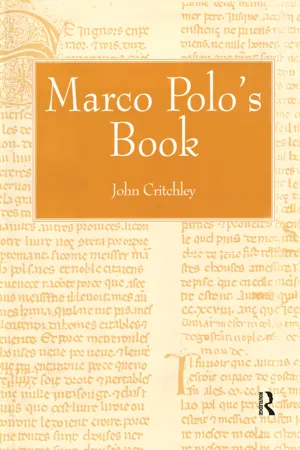
Marco Polo’s Book
About this book
Marco Polo and his book may seem to have been well served by scholars, yet the majority have been concerned to write about his travels in Asia, what he did or did not see, and how useful he is as a source on the East. John Critchley's subject, on the other hand, is the text of Polo's book itself and the political and ideological context - the crusades, the Mongol missions, the French presence in Italy - in which it was put together by its author(s), and read by its audience. The homogeneity of the 'original' Franco-Italian text and the accepted relationship between this text and the Latin recensions is tested by computer analysis. An examination of vocabulary and other textual features draws out the different attitudes and contributions of Polo himself and his various editors and translators. Critchley's book will be of interest not only to those concerned with the history of later medieval Europe but also to specialists in medieval Asia, who will find it useful to know about the background and composition of so famous and frequently cited a work. On pourrait penser que Marco Polo et son livre ont été amplement débattus par les spécialistes en la matière, cependant la majorité a surtout écrit à propos de ses voyages en Asie, ce qu'il avait ou n'avait pas vu et sur son utilité en tant que source de références sur l'Orient. Le sujet traité par John Critchley par contre, est le texte même du livre de Polo, ainsi que le contexte politique et ideologique - les croisades, les missions mongoles, la présence française en Italie - dans lequel il a été composé par son ou ses auteurs et dans lequel ses lecteurs ont pu le lire. L'homogeneïté du texte franco-italien d'origine et le rapport accepté entre celui-ci et les révisions latines ont été analysés par ordinateur. Un examen du vocabulaire et d'autres caractéristiques littéraires fait transparaître les différences d'attitudes et de contributions entre Polo
Trusted by 375,005 students
Access to over 1.5 million titles for a fair monthly price.
Study more efficiently using our study tools.
Information
Subtopic
World HistoryIndex
History1. The F Text and its Author
The earliest text of Marco Polo's book available to us today is a manuscript written in French in the early fourteenth century. It is now in Paris, where it is catalogued Bibliothèque Nationale MS.fr.1116. If this is the MS listed in an inventory of the royal library at Blois in 1518,1 then it was already in France by that date. But even though it is in French, it was probably written in Italy. Its French has a heavy Italian accent: place-names are transcribed with u rather than ou etc.;2 and at one point there is a marginal annotation in Italian, in a hand different from that used for the main text.3
This version of the book, once known as the 'Geographic Text' because it was printed by the Paris Société de Géographie in 1824, edited by J.B.G. Roux, is now universally referred to as 'F'. The standard edition of F is still the one by L.F. Benedetto, published in 1928, although it was printed again, with some amendments, in 1982.4 F is the source of most of what is said about Marco Polo's life, and over the past two centuries has formed the core of many editions of the book. Roux's 1824 printing of it as the Geographic text was the basis of H. Murray's English translation of 1844, of V. Lazari's Italian translation three years later and of E. Charton's modern French version of 1855.5 It is thought to be the closest we have to an 'original'. But it is certainly not the original, that is to say an autograph copy of Marco Polo or some scribe working at his dictation. It is a copy of something else and has the errors characteristic of a copyist, such as the confusion of c and t, t and r etc.6 And it is probably an abbreviated copy.1 What it misses out may or may not be provided from other recensions, notably a Latin text known as 'Z'.
The Paris MS is almost the only surviving representative of the version of the text it contains. There is a burned-out fragment in the British Museum which appears to be the remnant of another copy of the same recension, but it was written in the fifteenth century and is very corrupt.2 Most medieval copies of Marco Polo's book were of a Latin translation made by the Dominican, Francesco Pipino, sometime in the second decade of the fourteenth century. Pipino's text is a good deal shorter than F. Moreover he says he translated it from the 'vulgar' tongue, by which we know he meant not French but Lombard, or Venetian.3 This would have been Marco Polo's native language, and a case can be made that it was in this, not F's 'Italian—French', that the book was first written. The answer depends in part upon whether Polo alone wrote the book or, as F claims, he had a 'ghost'. A lot else about what we can legitimately use Marco Polo's book for rests upon this issue.
1.1
The man identified as Polo's co-author in the first chapter of the F text is Rusticiaus de Pise,4 a name usually expressed in an Italianate form as Rustichello (of Pisa). The different ways of spelling the name need not worry us: it crops up as 'Rusta', 'Rustaciaus', 'Rustapisan (de Pise)', 'Rustazo', 'Rusticiano' etc.5 He is not however to be confused with his near-contemporary, the Florentine poet Rustico di Filippo, or Rustico Filippi, called il Barbuto (c. 1230-c. 1300).6 Rather, Polo's Rustichello is linked by the 'Lords, emperor, kings ... ' declamation with which F and many other versions of Polo's book begin to a 'Rusticiaus de Pise' who had made a collection of Arthurian materials twenty-five or so years earlier.7 The F text has:
Seignors enperaor et rois, dux et marquois, cuens, chevaliers et borgiois, et tutes gens que voles savoir les deverses jenerasions des homes et les deversites des deverses region dou monde, si prennes cestui livre et le feites lire.1
This is very close to the opening address of the Arthurian collection of 'Rusticiens de Pise':
Seigneur, empereurs et rois et princes et dus et contes et barons et chevaliers et vavasseurs et bourgois et tous les prudhommes de cestui monde qui avez talent de vous deliter en rommans.2
There are insignificant variations in vocabulary and spelling in different MSS.3 However it would not be quite true to say that this formula appears nowhere else in the thirteenth century. In the 1260s the French poet Rutebuef opened his La complainte d'Outremer with the lines:
Empereour et roi et conte
Ε due et prince a cui hom conte
Romans divers ...4
Ε due et prince a cui hom conte
Romans divers ...4
Rutebuef's modern editors point to the parallel with papal letters urging (like the poem) support for the crusade.5 Keeping to the same language, we may cite Martin da Canale's account of the summons issued by Gregory X, the pope who appears in Polo's book, to the 1274 Council of Lyons:
Il mande par tote la Crestienté as patriarches, as evesques et as arc-evesques et a tos prelas de sainte iglise et a rois, a due et a marquis, a cuens et a poestes (podestà) que tuit fusent a Lion ...6
Another contemporary poet, Peire Cardenal, writing in Provençal, came up with something very like it:
Rey et emperador
Due, comte et comtor
Et cavallier ...7
Due, comte et comtor
Et cavallier ...7
And the heading to one of Dante's letters has a similar string:
Universis et singulis Italiae regibus et senatoribus almae urbis, nec non ducibus, marchionibus, comitibus atque populis.8
There is also a repeat of it later on in Polo's book, during the description of the Great K...
Table of contents
- Cover
- Half Title
- Title
- Copyright
- Contents
- List of Abbreviations
- Note on Romanization and Anglicization
- Introduction
- 1. The F text and its Author
- 2. The Author in His Time
- 3. The Book's Attitudes
- 4. The Book's Audience
- Epilogue
- Bibliography
- Index
Frequently asked questions
Yes, you can cancel anytime from the Subscription tab in your account settings on the Perlego website. Your subscription will stay active until the end of your current billing period. Learn how to cancel your subscription
No, books cannot be downloaded as external files, such as PDFs, for use outside of Perlego. However, you can download books within the Perlego app for offline reading on mobile or tablet. Learn how to download books offline
Perlego offers two plans: Essential and Complete
- Essential is ideal for learners and professionals who enjoy exploring a wide range of subjects. Access the Essential Library with 800,000+ trusted titles and best-sellers across business, personal growth, and the humanities. Includes unlimited reading time and Standard Read Aloud voice.
- Complete: Perfect for advanced learners and researchers needing full, unrestricted access. Unlock 1.5M+ books across hundreds of subjects, including academic and specialized titles. The Complete Plan also includes advanced features like Premium Read Aloud and Research Assistant.
We are an online textbook subscription service, where you can get access to an entire online library for less than the price of a single book per month. With over 1.5 million books across 990+ topics, we’ve got you covered! Learn about our mission
Look out for the read-aloud symbol on your next book to see if you can listen to it. The read-aloud tool reads text aloud for you, highlighting the text as it is being read. You can pause it, speed it up and slow it down. Learn more about Read Aloud
Yes! You can use the Perlego app on both iOS and Android devices to read anytime, anywhere — even offline. Perfect for commutes or when you’re on the go.
Please note we cannot support devices running on iOS 13 and Android 7 or earlier. Learn more about using the app
Please note we cannot support devices running on iOS 13 and Android 7 or earlier. Learn more about using the app
Yes, you can access Marco Polo’s Book by John Critchley in PDF and/or ePUB format, as well as other popular books in History & World History. We have over 1.5 million books available in our catalogue for you to explore.