eBook - ePub
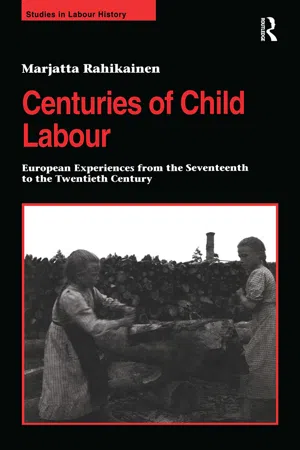
Centuries of Child Labour
European Experiences from the Seventeenth to the Twentieth Century
- 282 pages
- English
- ePUB (mobile friendly)
- Available on iOS & Android
eBook - ePub
Centuries of Child Labour
European Experiences from the Seventeenth to the Twentieth Century
About this book
Most historical studies of child labour have tended to confirm a narrative which witnesses the gradual disappearance of child labour in Western Europe as politicians and social reformers introduced successive legislation, gradually removing children from the workplace. This approach fails to explain the return or continuance of child labour in many affluent European societies. Centuries of Child Labour explains changes in past child labour and attitudes to working children in a way that helps explain the continued survival of the practice from the seventeenth through to the late twentieth centuries. Centuries of Child Labour conveys a richer sense of child labour by comparing the experiences of the Northern European periphery to the paradigmatic cases of Britain,and France. The northern cases, drawing heavily on empirical evidence from Sweden, Finland and Russia, test received ideas of child labour, through comparisons with Britain, France, Germany, Italy and Spain. Presenting the children themselves as the main protagonists, rather than the law makers, industrialists and social commentators of the time, Marjatta Rahikainen provides fresh information and perspectives, offering revelations to readers familiar only with the situation in France and Britain.
Trusted by 375,005 students
Access to over 1.5 million titles for a fair monthly price.
Study more efficiently using our study tools.
Information
Chapter 1
Children in Early Modern Manufacturing
Children and war
The endemic early modern warfare had many consequences for children and their work, while communities pressed or ruined by wars must have provided a barren soil for any new sensitivity to children. Neither did the obligation or compulsion of the children of the poor to work give proof of such sensitivity. From the perspective of child labour, these two phenomena, war and compulsion, were more typical of the early modern centuries than any signs of the discovery of childhood, as Ariès presented them. The question raised below concerns whether early modern warfare brought with it not only an increase in the amount of child labour, but also long-term implications for its practise.
War was present in children's lives in many ways in different parts of Europe. Peasant households in Castile had to bear the scourge of billeting the Spanish troops when they were stationed in the Iberian peninsula.1 Similarly, Russian peasants (serfs) had to billet soldiers in their homes.2 In France, many women followed their husbands to war and took their children with them, so among armies lived children 'who were thus prepared from childhood to the profession of arms' (S. Loriga). In Adam Smith's time, soldiers' children in Scotland appear to have lived in and around the soldiers' barracks.3 During the Thirty Years' War (1618-1648), civilian mortality was extremely high in the German regions where the troops moved, as refugees from the ravaged countryside crowded into the towns and cities, where they succumbed to epidemic diseases and hunger.4 Bologna, although far from the battlefields, nonetheless suffered from devastating epidemics and an economic crisis in the period 1619—1633. This was followed by tensions and conflicts in social relationships. Such hardships probably provoked the rough treatment of children and led to cases of children involved in theft and mendicancy or living the life of a vagabond outside their families. The family of Domenico di Vinceso Ferrarese, aged about twelve, succumbed during the epidemic. The lonely, orphaned boy lived as a vagabond until he managed to hire himself out as a cowherd to a widow, Caterina Pancalda, in San Gioseffe.5
The early series of larger battles in the Thirty Years' War took place in Bohemia. Did the movements of the armies drive the German countryside into confusion, so that a new labour market for migrant children emerged? Johan Conrad Kostner, the administrator (Pfleger) of the castle of Bludenz, reported to the government in Innsbruck in 1625 that, in spring, many children wandered from the poorest valleys of Vorarlberg to work in Ravensburg and Überlingen (north of Bodensee) and other places, returning home at Martinmas in November.6 These children anticipated eighteenth-and nineteenth-century seasonal labour migration by children from Voralberg (see Chapters 2 and 3).
Absolutist states 'were machines built overwhelmingly for the battlefield', as Perry Anderson puts it.7 The kingdom of Sweden was a prime example of this. Sweden was the first country in Europe with obligatory service in the armed forces. After 1620, when Sweden became involved in wars on the Continent, conscription was almost an annual event. To save their sons from being conscripted, people bribed the clergy who kept the population registers, and in order to confuse them, parents gave several sons the same name or lied about their birth years. Boys close to the minimum age for military conscription, fifteen years, did not turn up for their first communion, and youngsters who had passed the critical age were still insistently called boys. People also sometimes claimed that the boy or man concerned was dead. Schoolboys escaped conscription, and therefore many boys in towns clung to school, staying as many as eight years in the lowest form, for instance.8
Acquiring substitutes became a well-established practice in the kingdom of Sweden. In the Finnish part of the kingdom, in the province of Pohjanmaa (Osterbotten, or Ostrobothia), the price for a substituting man rose so high that it corresponded to the price of a holding or what a male farmhand could expect to earn in thirteen or fourteen years. Therefore peasants began to purchase sons of parish paupers to bring up as conscripts. The trade in substituting boys became extensive, and in the 1660s and 1680s small boys were even imported from Swedish parishes to Pohjanmaa. What the parents received varied according to the boy's age: the younger, the cheaper, thus even two-year-old boys were bought. The price may have been just half a barrel of rye, but if the boy had already turned fifteen, the purchaser typically gave his parents or parent a cow and a barrel of grain. It was even cheaper to take an orphaned or deprived boy in the neighbourhood as a foster child and a future conscript. Purchased boys were sometimes sold to other peasants, or even stolen from other peasants. A purchased boy or a foster child worked in his buyer's household as a shepherd or cowherd, and later as a farm hand, until he left for war.9
Russian peasants who could afford it bought themselves out of conscription, while serf owners sold substitutes from among their peasants for high prices. To save their sons from being conscripted, parents sometimes made them crippled while they were still infants. However, infirm serfs risked being exiled to Siberia by their lords who wanted to save good workers from being conscripted. Serf owners received quittances for men exiled to Siberia and used them at the next conscription to meet the recruitment obligation.10 In France, the pay for a substituting man was equivalent to ten years' pay of an agricultural worker, and the rich in particular resorted to replacements, although in the nineteenth century even peasant parents resorted to marchand d'hommes who provided substitutes.11
As men were sent to war, the workload of women and children grew. According to Jan Lindegren, who conducted a study on the parish of Bvgdeå in northern Sweden, the peasant community survived because 'the men who were left and the women, children and old people worked harder'. The archipelago had to supply men for the Swedish navy, so in Åland as many as half of the male farm servants were, quite exceptionally, young boys aged between twelve and fourteen.12 When manpower became scarce, noble masters in Sweden introduced the idea of bonded service by children. In 1651, the Estate of Nobility proposed that people in towns and cities who took a child as a servant or apprentice ought to have the right to be served by the child for as many years over the age of ten as the child had been under it when taken. The first proper Swedish Hired Labour Act (tjänstehjonsstadga) of 1664 then stipulated that if a master or mistress had at his or her own expense taught someone in crafts or book-keeping, that person was to serve the master until he was 'reasonably satisfied'. Correspondingly, the Hired Labour Act of 1723 stipulated that if a master had agreed to raise a poor man's child, and kept him as his servant or as a substitute for military conscription, then the boy had to serve his master 'until the troubles and costs he had caused to the master' had been met. A contemporary would even have given the master the right to sell his surplus young indentured servants.13
During the Great Northern War (1700-1721), the subordinated peasantry in Denmark were ordered to provide soldiers aged from fourteen years up.14 To meet the shortage of men, the Swedish authorities began to send deprived and orphaned boys to war. This happened to thirteen-year-old Hindrich in 1713, near Helsinki. The same year Russian troops occupied Sweden's Finnish provinces. They captured Jacob, a ten-year-old dragoon's son, in Helsinki and put him to serve a Russian Major. A much harsher fate awaited the Finnish boys and girls taken by the occupying forces to Russia, where they were set to work on the construction of the newly-founded St Petersburg, or put in the Russian army, and some ended in the slave market for Persia. Very few ever found their way back home.15 One man did manage to return in 1737, and even established himself as an heir to a farm owner under the false identity - like Martin Guerre in the French Pyrenees - of Jaakko Jouppila, a landed peasant's only son, abducted by the Russians at the age of thirteen in 1714.16
In Peter the Great's victorious Russia, the sons of the nobility owed the state universal service obligations from the age of fourteen to fifteen onwards, according to which two thirds of them had to enter the army, the rest civilian bureaucracy. All boys eligible for the military or civil service were expected to begin training for it in special schools at the age of ten, but this proved impossible to implement. During the Great Northern War the Russian countryside experienced a demographic catastrophe, corresponding to that which Sweden had been through. The forced recruitment of young men into the armed forces and state manufactories threatened to leave Russian villages with only old men, women and children to work the fields. According to David Ransel, this policy contributed to the social displacement of women, and evidently to the proliferation of illegitimate children and infanticide.17
During the large and protracted wars at the turn of the eighteenth century, teenage servants in England, including boys and girls aged under fifteen, became more common among emigrant servants in Liverpool.18 A century later, during the Napoleonic wars, workhouse boys aged thirteen who were tall enough passed for the navy, while others went into the cotton industry. 'For parish overseers, with children to apprentice, wars were blessings sent from heaven', according to L.D. Schwarz. When the war was over, the London workhouses were crowded with children, since there was now very little demand for them. As in other belligerent countries, there were communities in England in which the shortage of an able-bodied male labour force 'could only be met by the greater use of migrant workers and of women and children' (P. Horn).19
Military models and discipline found their way into schools and educational institutions in the eighteenth century, thus bellicose ideas even touched children who otherwise remained unaffected by warfare. The idea of military training for orphans, foundlings and soldiers' children spread in Europe.20 A military academy for noble youths aged between thirteen and eighteen was opened in St Petersburg in 1731. Sons of impoverished noble families were sent at the age of nine or ten to new military boarding schools in France. In 1790 in Prussia, Friedrich August Ludwig v. der Marwitz, a son of a noble estate owner, formally joined a regiment at the age of twelve in order to start accumulating years for his officer's career, and joined the army for real at the age of thirteen: he found it very heavy since for some years he remained physically weak and with a small stature of a child. While in 1810, under French rule, the life of a German orphan boy, Peter Bohlen, totally changed for the better when he was given the opportunity to join the army at the age of fourteen.21
What makes early modern warfare part of the history of child labour is the fact that countries engaged in the wars witnessed the substitution of women and children for men. The war-time increase in child labour was well in line with the labour policy supported by an establishment that strove to set or force children of the poor to work. How much did the war contribute to child labour in orphanages, workhouses, workshops and manufactories? Did the war-time use of child labour also promote a more general readiness to encumber children with work?
Orphanages and workhouses
In many parts of Europe the number of poor had increased since the sixteenth century, a process that has been connected with structural changes in the labour market, unemployment, a long-term decline in real wages, and population growth. A new doctrine spread in Europe of prohibiting begging and rescuing the poor from idleness by compelling them to work in charity and penal institutions.22 It does not seem to have made much difference whether the country was Protestant or Catholic. In fact, Natalie Zemon Davis asks 'whether businessmen and lawyers in European town councils did not, irrespective of their religious convictions, bring their vocational experiences to bear on difficulties of urban life'.23 The Great Confinement, as it has been called, was met with resistance from the common people, yet there were also parents who left their children in charity hospitals.24
This section describes how the new policy was implemented with regard to children. It starts with France, and proceeds roughly in the order in which the new doctrine spread in Europe, ending with the late ancien régime German and French charitable institutions, which were rather like manufactories. In the conclu...
Table of contents
- Cover
- Half Title
- Dedication
- Title
- Copyright
- Contents
- List of Tables
- General Editor's Preface
- Acknowledgements
- Introduction
- 1 Children in Early Modern Manufacturing
- 2 Peasant Children as Part of the Labour Force
- 3 Child Labour during the Agricultural Revolution
- 4 A Century of Factory Children
- 5 The Urban Labour Market for Children
- 6 Twentieth-Century Child Labour
- Conclusions
- Bibliography
- Index
Frequently asked questions
Yes, you can cancel anytime from the Subscription tab in your account settings on the Perlego website. Your subscription will stay active until the end of your current billing period. Learn how to cancel your subscription
No, books cannot be downloaded as external files, such as PDFs, for use outside of Perlego. However, you can download books within the Perlego app for offline reading on mobile or tablet. Learn how to download books offline
Perlego offers two plans: Essential and Complete
- Essential is ideal for learners and professionals who enjoy exploring a wide range of subjects. Access the Essential Library with 800,000+ trusted titles and best-sellers across business, personal growth, and the humanities. Includes unlimited reading time and Standard Read Aloud voice.
- Complete: Perfect for advanced learners and researchers needing full, unrestricted access. Unlock 1.5M+ books across hundreds of subjects, including academic and specialized titles. The Complete Plan also includes advanced features like Premium Read Aloud and Research Assistant.
We are an online textbook subscription service, where you can get access to an entire online library for less than the price of a single book per month. With over 1.5 million books across 990+ topics, we’ve got you covered! Learn about our mission
Look out for the read-aloud symbol on your next book to see if you can listen to it. The read-aloud tool reads text aloud for you, highlighting the text as it is being read. You can pause it, speed it up and slow it down. Learn more about Read Aloud
Yes! You can use the Perlego app on both iOS and Android devices to read anytime, anywhere — even offline. Perfect for commutes or when you’re on the go.
Please note we cannot support devices running on iOS 13 and Android 7 or earlier. Learn more about using the app
Please note we cannot support devices running on iOS 13 and Android 7 or earlier. Learn more about using the app
Yes, you can access Centuries of Child Labour by Marjatta Rahikainen in PDF and/or ePUB format, as well as other popular books in History & World History. We have over 1.5 million books available in our catalogue for you to explore.