eBook - ePub
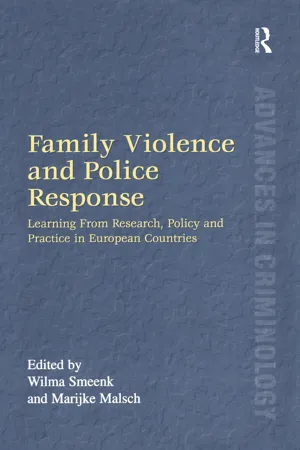
Family Violence and Police Response
Learning From Research, Policy and Practice in European Countries
- 276 pages
- English
- ePUB (mobile friendly)
- Available on iOS & Android
eBook - ePub
Family Violence and Police Response
Learning From Research, Policy and Practice in European Countries
About this book
Police response to incidents of intimate partner violence can be critical. This volume investigates the elements in the institutional, legal and organizational context that are relevant for police response to incidents in the realm of the private sphere and whether there exists a relation with the reporting of such incidents by victims. Addressing this complex question requires insights from research, policy and practice and, as such, any conclusions will have implications for each of these fields. This volume addresses issues that are key elements in the relationship between the (legal) response to family violence and the reporting by victims. These issues concern societal and legal definitions of family violence employed in research, policy making and legal practice; how the legislation of various countries covers violence in the private sphere; the way the police deal with reported incidents of intimate partner violence; and the role that other interventions play in the response to and combat of family violence and intimate partner violence.
Trusted by 375,005 students
Access to over 1.5 million titles for a fair monthly price.
Study more efficiently using our study tools.
Information
Chapter 1
Introduction
Wilma Smeenk and Marijke Malsch
Introduction
Researchers and policy makers across Europe are increasingly interested in studying family violence and the various interventions against this type of crime. Many recent publications demonstrate this increased level of interest. Research and its results have been fragmented, however, in the sense that European researchers have not brought together the results of their inquiries and examined them in light of the specific institutional context of their countries (Hagemann-White, 2001; Löbmann, Greve, Wetzels and Bosold, 2003). Intervention studies have been conducted but often cannot control for the specific nature of the institutional context reflected in penal code, police, prosecution, and judiciary (Kelly, Romkens and Stanko, 2001).
The relative lack of comparative cross-national research is all the more conspicuous as the degree to which family violence comes to the attention of the legal system, more specifically the police, may be influenced by a country's legal and institutional context. The so-called 'dark number' in family violence is an agreed-upon obstacle for researchers, policy makers and organisations working in the field. Being less visible than street crime, the degree to which family violence becomes known to the police is dependent on citizens' requests for police intervention. Victims' reporting behaviour is considered to be sensitive to the degree that society and police consider family violence as a crime, an assumption reflected in both general awareness-raising campaigns and police training programmes. Furthermore, organisational and institutional aspects, such as the police's task performance and attitudes, may facilitate or inhibit the entry of such cases into the legal system (Jordan, 2004).
The research literature on evaluation of police interventions and programmes mainly reflects American and British experiences, leaving room for ambiguity as to how interventions and programmes will work out in countries with different legal cultures and institutions (Kelly et al., 2001). Comparative research has focused not so much on the response to family violence but rather on the prevalence of family violence (Johnson, 2001; Ollus and Nevala – this volume). As a consequence, little investigation has taken a comparative stance to examine the interplay between the response to family violence and the local and national context. For example, the legal definition of family violence in a country conditions the response of the police to crime incidents and this, in turn, may affect the decision of victims to ask for police assistance. Studying and comparing experiences and approaches in various countries allows for a more comprehensive view of legal responses to family violence, and what may be intended or unintended consequences of a particular approach.
To undertake such comparison was the goal of a three-day workshop on the topic, held in October 2002 (Smeenk and Malsch, 2002, 2004). A generous subsidy by the European Science Foundation (ESF) enabled this workshop, titled Family Violence and Police Reaction in the EU. The workshop was organised by the Netherlands Institute for the Study of Crime and Law Enforcement (NSCR) in Leiden, the Netherlands. The combination of workshop participants from several European countries, with backgrounds in social science and legal studies, qualitative as well as quantitative in research orientation, ensured an interdisciplinary approach to this complex problem that is also reflected in this volume.
Police responses to family violence received special attention in the workshop, linking the criminal justice response with victim experiences of family violence. Nevertheless, the existence and importance of other intervention agencies was not neglected. Discussing police interventions in each country also disseminated valuable information about the law enforcement organisations involved, as well as institutions outside the legal system, thereby giving a more complete picture of how countries deal with the problem of family violence. Comparison at a European level also enabled the study of variations in legal definitions and penal codes, which influence the police response to reported incidents of family violence.
Flowing from the workshop, this volume investigates similarities and differences in the response to family violence in European countries. It also examines how the criminal justice systems of the various countries treat family violence cases. More specifically, we address interactions between general attitudes towards family violence, task performance by the police, and new developments in the applicable law. This brought together insights from research, policy and practice, and as such, the answers will have implications for each of these fields.
Key Elements in the Criminal Justice Response to Family Violence
The volume addresses issues that are considered key elements in the criminal justice response to family violence, from a comparative perspective. A first element concerns societal and legal definitions of family violence, employed in research, policy, and legal practice. In a society that defines family violence as a private rather than public problem, the police may be uninterested or unwilling to interfere, discouraging victims from reporting the violence. Also, applying a broad or narrow legal definition affects the way that family violence is registered and dealt with in the legal system. On the other hand, definitions that researchers use may affect public opinion and policy by shaping the public view of the nature and extent of this problem. In many European countries, surveys of the prevalence of family violence have contributed substantially to the public debate and awareness of this problem (Hagemann-White, 2001). Relevant questions are: What constitutes a case? Are we talking about incidents or patterns? A number of chapters in this volume demonstrate that definitional issues permeate the response to family violence in profound ways.
A second key element is how legislation covers family violence and how this affects the work of the police and the other law enforcement agencies. Do special provisions exist, or are general provisions supposed to apply to this type of family violence? Is the close relationship between offender and victim considered an aggravating condition, and do judges follow the legislator's intent in their judgments? Does the legal definition cover psychological violence and, if so, what evidence is presented to the court?
Third, specific attention is paid to how police (organisations) deal with reported incidents of family violence. Studies have documented the tendency of the police to belittle the problem of family violence. As first organisation in the law enforcement chain, the police perform a crucial role. As a consequence, policies to combat family violence have focused on the police adopting a more punitive attitude. Organisational challenges following on from these demands may include higher requests on registration, or the drafting of protocols that specify how to act when a case of family violence comes to the attention of the police. When police training is desired, a choice needs to be made between specialisation (appointing and training special persons or units), or a general approach (providing training for all police officers). In bringing about changes, the police organisational structure and culture may be a factor leading to the registration and prosecution of fewer cases than intended by legislators or policy makers. Here, the notion of police discretion deserves special attention.
Finally, the relative importance of the criminal justice response to family violence versus other interventions was considered a key element. This raises the point of what victims expect or want when they ask for third-party intervention, not only from the police but also from informal support networks or support organisations. It also raises issues of coordination and information exchange by the organisations involved in the response to family violence.
Research Definitions in the Study of Family Violence
One of the problematic aspects of research in the area of family violence is the lack of consensus on what encompasses family violence and how it should be measured. Different research traditions have developed different views on what behaviours should be studied, what the causes of family violence are, and what are the best ways to deal with it (Walby and Myhill, 2001). Such differences also pervade the policy and practice of those tasked with responding to family violence: the police, women's shelters, doctors, judges, social workers. As a result, readers on this topic may come across a number of definitions, for example: family violence, violence against women, intimate partner violence, domestic violence, domestic abuse (see chapter by Ollus and Nevala – this volume). Here, it is relevant to note that an emphasis on women as victims of violence draws attention to structural gender inequality and power imbalances in families and wider society as contributing factors to the origination and continuation of this type of violence.
As editors of this volume we abandoned the idea that all authors should use the same definition, as that would not do justice to the various approaches in the field. Instead, we have asked authors to make clear which definition they are using and, when applicable, what definitions are used in their country in policy documents, police practice and the legal domain. In the editorial chapters, we use 'family violence' as a general term that may include insights from different research traditions and disciplines. While 'domestic violence' is potentially equally broad in scope, we prefer family violence because it stresses the notion of family relationships and children as victims of violence, also in light of the transmission of violence between generations. We do so in the realisation that literature reviews have used the term in association with a particular research tradition ('family violence surveys' as distinct from 'violence against women surveys'; see chapter by Ollus and Nevala – this volume). As legal definitions often do not contain gender-specific formulations or do not specifically refer to certain groups of victims (women, children), however, and we explicitly meant to pay attention to all relevant legal definitions, we decided to continue to use the term 'family violence'.
Outline of this Volume
Various chapters in the volume address the key elements introduced above by either taking an explicitly comparative perspective, or by focusing on a specific country. Three comparative chapters address the definition and measurement of family violence in research, recent European developments in legislation, and a comparison of family violence legislation to legislation on a related phenomenon, stalking. Seven country chapters discuss research findings on family violence and/or the criminal justice response to it in Spain, France, Italy, Sweden, Greece, Switzerland and the United Kingdom.
The first chapter, by Ollus and Nevala (Finland), discusses problems in the assessment of the prevalence of (sexual) violence, and ways in which various survey traditions have tackled these difficulties. The chapter deals with issues of defining and measuring violence against women in a comparative perspective and discusses the development of a measurement tool for comparative research.
The following chapter, by Medina-Ariza and Fe-Rodriguez (Spain), argues that a more detailed picture of the magnitude of different forms of violence is needed, for theory and research as well as for public policy and practice purposes. An application of cluster analysis to Spanish data shows that a more differentiated view is preferable to the usual measures that dichotomise the population into violent and non-violent couples in rather simplistic ways.
A French contribution is written by Condon, who draws upon experience with the first French nation-wide survey, which asked about victim experiences of intimate partner violence. Information gathered in this survey enables levels of violence among migrant women to be examined. The chapter discusses the strengths and limitations of surveys as a way of investigating cultural differences in the prevalence of family violence.
The chapter by Kelly (United Kingdom) is explicitly comparative and focuses on recent developments in domestic violence legislation. It describes specific domestic violence legislation that was drafted in the 1990s in many countries, including legislation in other parts of the world. Special attention is given to innovative elements in some of these reforms, such as newly drafted powers to remove offenders from their homes, the inclusion of 'psychological abuse' in the legal definition of family violence, and laws that specify that criminal assault on a partner should be an aggravating factor in sentencing.
Moving on to a concrete example of innovative legislation, the chapter by Lindström (Sweden) reports on the implementation of the Swedish law called 'Gross violation of a woman's integrity'. This law makes punishable a repeated pattern of violation of a woman's integrity. The author discusses outcomes of evaluation research of this new offence as well as findings on the use of restraining orders as a response to family violence.
The chapter by Baldry (Italy) examines provisions in Italian law. The author demonstrates that all types of violence constituting what is called 'domestic violence' in Italy, including psychological, physical and sexual violence, are present in the Italian criminal code. Moreover, a specific reference to the wider notion of family violence exists within the code, in the article called 'Maltreatment within the family'. Also, a new law enabled protective and restraining orders to be issued especially in cases of domestic violence. The chapter discusses these legal provisions and elaborates on obstacles related to their application when domestic violence cases are reported and tried in court.
For Greece, Chatzifotiou provides a discussion of European research findings as a reference point for an exploration of the characteristics of the Greek setting that are relevant to the response to family violence. The chapter illustrates the barriers that victims encounter in getting help or having the offender prosecuted. A narrative case history of a victim of partner violence is included. Barriers lie in the police's unwillingness to record these incidents and a generally negative attitude to women reporting violence by their marital partners. The chapter addresses police officers' attitudes as well as that of the general public in Greece.
For Switzerland, Seith discusses the balance between legal and non-legal responses to family violence. The chapter reports an institutional analysis of domestic violence cases on the basis of case files of the police, social services and a shelter, as well as a number of interviews with professionals and women. Pros and cons of pro-active police intervention are discussed, with special attention paid to a victim's sense of autonomy, which may be seriously affected in situations of family violence.
The contribution by Dobash and Dobash (United Kingdom) addresses the balance between legal and non-legal approaches through a discussion of men's programmes. It considers the theoretical background related to these programmes and why criminal justice is important in this respect. The chapter locates these programmes in the context of criminal justice responses to violent men, such as, for example, arrest. The main body of the chapter is devoted to a discussion of an evaluation of two British programmes and the relationship between controlling and intimidating behaviours on the one hand, and violence on the other.
The comparative chapter by Malsch and Smeenk (The Netherlands) discusses legislation choices and outcomes that present themselves when societies takes family violence and violence against women more seriously. These choices are illustrated by comparing legislation on family violence, as discussed in the various chapters, to recent developments in legislation on stalking, where the repetitiveness of behaviours and the relationship between offender and victim pose comparable dilemmas to police, prosecution and the legislator.
The concluding chapter integrates the findings from research and signals trends in the criminal justice response to family violence in the various European countries. Special attention is given to the finding that family violence repeatedly occurs over an extended period of time, and what this entails for police and the prosecution, but also for research into this type of violence. As such, the chapter provides a look forward to future developments and issues in research, policy and practice in the legal response to family violence.
References
Hagemann-White, C. (2001). European Research on the Prevalence of Violence Against Women. Violence Against Women, 7 (Special issue: European perspectives on violence against women), 732-759.
Johnson, H. (2001). Enhancing knowledge on violence against women. In N. Ollus and S. Nevala (Eds.), Women in the Criminal Justice System: International Examples and National Responses (pp. 198-213): HEUNI.
Jordan, C. E. (2004). Intimate partner violence and the justice system. An examination of the interface. Journal of Interpersonal Violence, 19(12), 1412-1434.
Kelly, L. Romkens, R. and Stanko, B. (2001). Guest editors' introduction. Violence Against...
Table of contents
- Cover
- Half Title
- Title
- Copyright
- Contents
- List of Contributors
- Foreword
- 1 Introduction
- 2 Challenges of Surveying Violence Against Women: Development of Research Methods
- 3 Critical Issues Related to the Measurement of Intimate Partner Violence: A Clustering Analysis of Psychometric Scores
- 4 Violence Against Women in France and Issues of Ethnicity
- 5 Moving in the Same or Different Directions? Reflections on Recent Developments in Domestic Violence Legislation in Europe
- 6 Violence Against Women in the Swedish Context
- 7 Legal Processing of Domestic Violence Cases in the Italian Criminal Justice System
- 8 Family Violence Against Women in Greece
- 9 (Un)Organised Responses to Domestic Violence: Challenges and Changes in Switzerland
- 10 Abuser Programmes and Violence Against Women
- 11 Legislation on Family Violence and Stalking
- 12 Family Violence and Police Response: Learning from Research, Policy and Practice
- Index
Frequently asked questions
Yes, you can cancel anytime from the Subscription tab in your account settings on the Perlego website. Your subscription will stay active until the end of your current billing period. Learn how to cancel your subscription
No, books cannot be downloaded as external files, such as PDFs, for use outside of Perlego. However, you can download books within the Perlego app for offline reading on mobile or tablet. Learn how to download books offline
Perlego offers two plans: Essential and Complete
- Essential is ideal for learners and professionals who enjoy exploring a wide range of subjects. Access the Essential Library with 800,000+ trusted titles and best-sellers across business, personal growth, and the humanities. Includes unlimited reading time and Standard Read Aloud voice.
- Complete: Perfect for advanced learners and researchers needing full, unrestricted access. Unlock 1.5M+ books across hundreds of subjects, including academic and specialized titles. The Complete Plan also includes advanced features like Premium Read Aloud and Research Assistant.
We are an online textbook subscription service, where you can get access to an entire online library for less than the price of a single book per month. With over 1.5 million books across 990+ topics, we’ve got you covered! Learn about our mission
Look out for the read-aloud symbol on your next book to see if you can listen to it. The read-aloud tool reads text aloud for you, highlighting the text as it is being read. You can pause it, speed it up and slow it down. Learn more about Read Aloud
Yes! You can use the Perlego app on both iOS and Android devices to read anytime, anywhere — even offline. Perfect for commutes or when you’re on the go.
Please note we cannot support devices running on iOS 13 and Android 7 or earlier. Learn more about using the app
Please note we cannot support devices running on iOS 13 and Android 7 or earlier. Learn more about using the app
Yes, you can access Family Violence and Police Response by Marijke Malsch, Marijke Malsch,Wilma Smeenk in PDF and/or ePUB format, as well as other popular books in Law & Family Law. We have over 1.5 million books available in our catalogue for you to explore.